Is the Active Seat Belt System Market the Future of Automotive Safety in 2026?
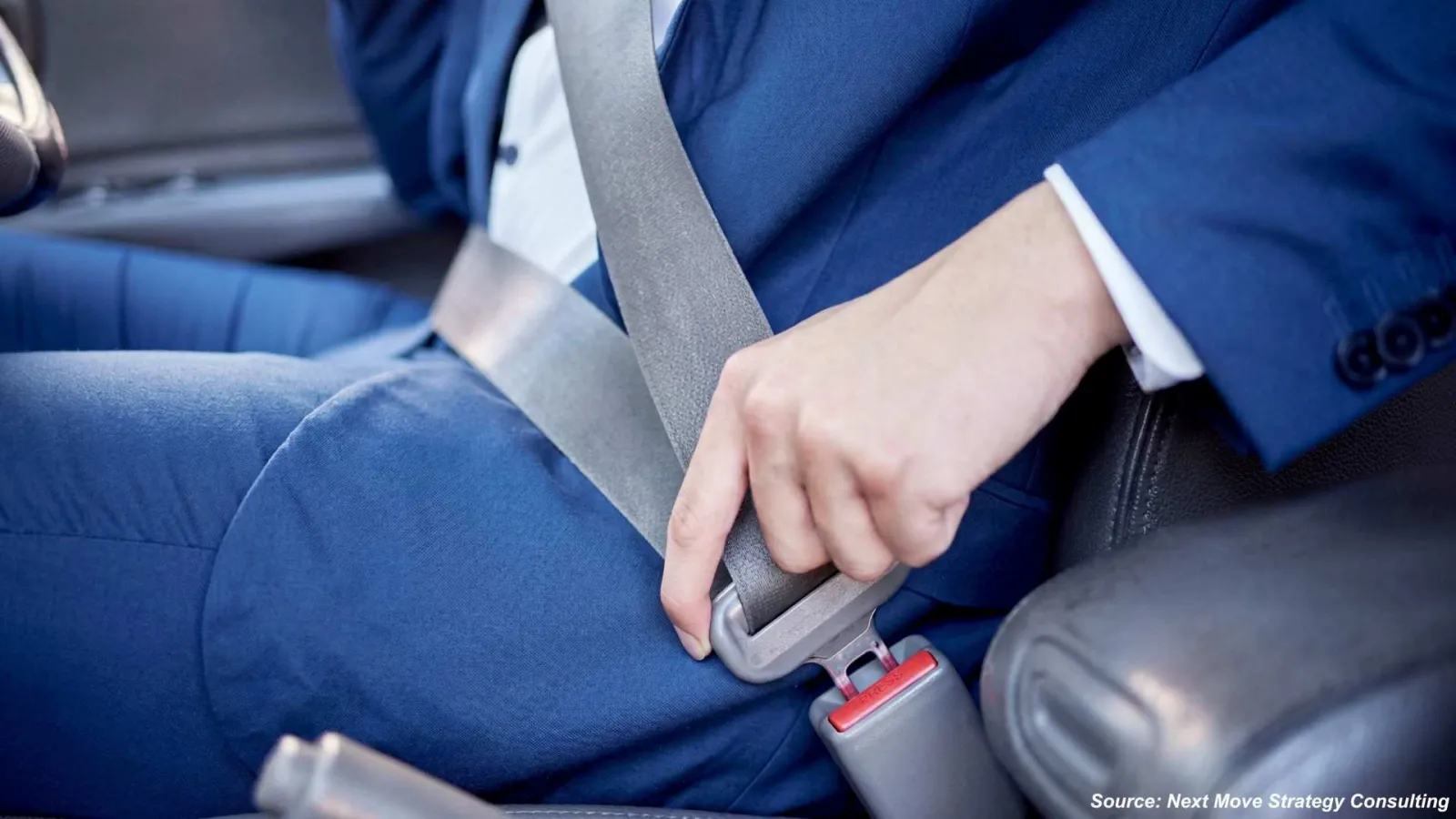
The Active Seat Belt System Market is becoming increasingly important as road traffic crashes continue to remain one of the most pressing global safety challenges. Every year, approximately 1.19 million lives are lost due to road traffic incidents, with the World Health Organization identifying road injuries as a leading cause of death among children and young adults globally. Despite decades of progress in vehicle safety engineering, a significant share of passenger vehicle fatalities continues to involve unrestrained occupants, highlighting the persistent gap between available safety technologies and their realworld adoption. This challenge is accelerating the need for advanced active seat belt systems that combine intelligent warning functions, real time sensing, and adaptive restraint technologies to improve occupant protection and strengthen vehicle safety outcomes.
How Regulation and Innovation Are Redefining the Active Seat Belt System Market in 2026
NHTSA's FMVSS 208 Reform Cycle: A Regulatory Catalyst With a Revised Timeline
The U.S. Department of Transportation’s National Highway Traffic Safety Administration finalized a major amendment to Federal Motor Vehicle Safety Standard No. 208, introducing mandatory seat belt use warning systems for rear seats and significantly strengthening warning requirements for driver and front passenger seats across passenger cars, trucks, buses, and multipurpose passenger vehicles within the applicable vehicle category. According to NHTSA, the updated rule is expected to reduce injuries and improve vehicle occupant safety outcomes through broader adoption of seat belt usage.
Following industry petitions for reconsideration, NHTSA later issued an interim final rule extending and aligning the compliance timeline for both front and rear seat belt warning requirements. The revised implementation schedule reflects the considerable hardware and software validation challenges faced by automotive manufacturers, including instrument panel redesign, software integration across vehicle portfolios, and the complexity of developing and validating occupant detection systems for rear seats.

Volvo and Adient-Autoliv: World-First Innovations Setting the New Industry Standard
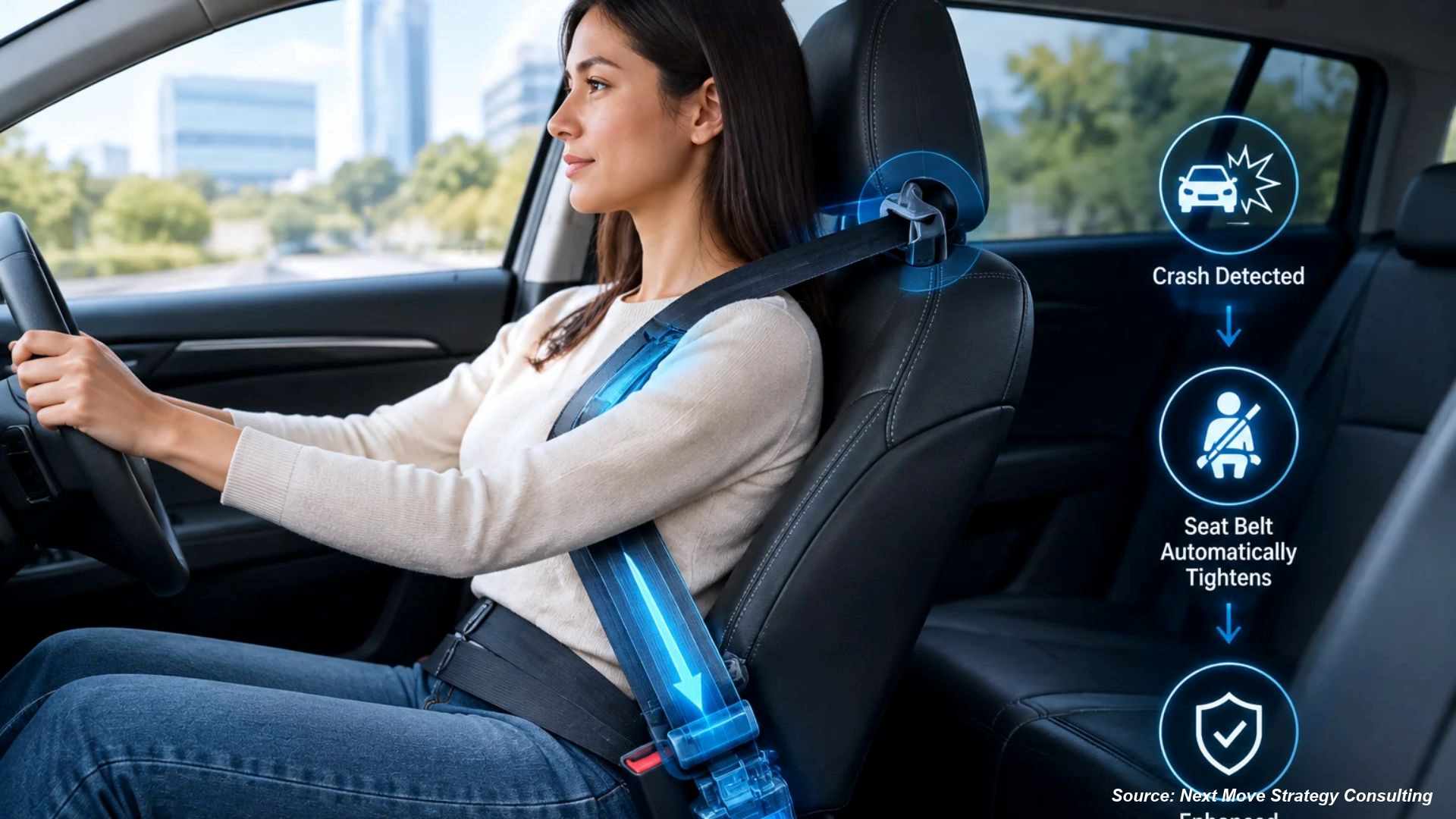
Volvo Cars announced that its world first multi adaptive safety belt was recognized as one of TIME Magazine’s Best Inventions, marking the second consecutive year that a Volvo safety innovation received this distinction. The technology is set to debut in the fully electric Volvo EX60 SUV and uses real time data from advanced interior and exterior sensors to customize occupant protection according to traffic conditions and individual occupant characteristics, including height, weight, body shape, and seating position.
According to Volvo Cars Safety Centre, the multi adaptive safety belt is designed to provide smarter and more personalized protection through real time adaptation, with capabilities that continue to improve through over the air software updates, further integrating active seat belt systems into the evolving software defined vehicle ecosystem.
At the same time, Adient and Autoliv introduced the Z Guard concept, an advanced dynamic seat safety solution developed to address occupant protection challenges associated with zero gravity seating positions that are becoming increasingly common in premium electric vehicles. The system combines technologies including an Active Cushion Collapse Mechanism, Adjustable Seat Belt Outlet, Dynamic Lumbar Retractor, Pelvic Cushion Airbag, and Head Side Airbag into a unified production ready safety architecture. The solution has been selected for deployment in a future high volume vehicle program, highlighting continued commercialization momentum for next generation active restraint technologies.

NMSC Strategic Perspective: Decoding the Active Seat Belt System Market Shift
According to Next Move Strategy Consulting's proprietary market intelligence, the global active seat belt system market was valued at USD 13.22 billion in 2024 and is projected to reach USD 20.98 billion by 2030, representing a CAGR of 8% over the 2025 to 2030 forecast period.
NMSC's analysis identifies the growing emphasis on vehicle safety standards by government bodies worldwide as the primary structural driver of market expansion. The increasing popularity of luxury vehicles which are disproportionately equipped with advanced active restraint technologies is a secondary but significant growth catalyst. Europe currently holds the predominant share of the active seat belt system market, supported by the presence of key players including Autoliv Inc., ZF Friedrichshafen AG, and Continental AG, as well as the Euro NCAP Vision 2030 framework, which emphasizes smarter, more adaptive safety systems. North America is projected to witness the most rapid growth during the forecast period, fueled by the FMVSS 208 reform cycle and the growing emphasis on seat belt reminder systems by government agencies across the region.
From a segmentation perspective, the market is structured across three component categories Retractors, Pretensioners, and Buckle Lifters and two primary application segments: Passenger Cars and Commercial Vehicles. NMSC's view is that the integration of AI-powered adaptive technologies, combined with mandatory regulatory compliance timelines, will sustain above-average growth across all segments through 2030.
Industry Impact Analysis
The Compliance Extension: Commercial Implications for OEMs and Tier 1 Suppliers
The interim final rule extending the FMVSS 208 compliance deadline carries important commercial implications for the Active Seat Belt System Market and the broader automotive safety supply chain. Industry stakeholders have highlighted that implementing the updated requirements involves extensive hardware and software modifications, including instrument panel redesigns, enhanced occupant detection capabilities, and comprehensive software validation across vehicle portfolios. The extended implementation timeline provides original equipment manufacturers with additional time to achieve compliance while maintaining production continuity and supporting sustained demand for active seat belt system components and related safety technologies.
The broader road safety challenge further reinforces the importance of this transition. Although traffic safety indicators have shown improvement in recent years, unrestrained occupants continue to account for a substantial share of passenger vehicle fatalities. The continued presence of these incidents despite long standing awareness efforts highlights the growing need for advanced warning architectures and intelligent restraint technologies, strengthening the longterm outlook for active seat belt systems across the automotive industry.
The Software-Defined Vehicle Paradigm and Its Impact on Active Seat Belt Systems
One of the most consequential structural shifts affecting the active seat belt system market is the transition to software-defined vehicles. Volvo's multi-adaptive safety belt with its over-the-air update capability exemplifies how active restraint systems are being integrated into the broader software architecture of modern vehicles. This integration transforms the active seat belt system from a one-time hardware purchase into a continuously evolving safety platform that can be updated, improved, and refined over the vehicle's operational lifetime a paradigm shift with significant implications for both product development cycles and long-term revenue models for Tier 1 suppliers.
The zero-gravity seating trend, driven by the rapid electrification of the vehicle fleet, is creating an entirely new category of active restraint engineering challenge. As Adient and Autoliv noted in their announcement, conventional safety systems are designed for standard upright seating positions and can be compromised by deeply reclined postures a risk that is growing as zero-gravity seating gains adoption in mid-to-high-end electric vehicle models. The Z-Guard concept's production readiness signals that the industry is actively commercializing solutions to this challenge expanding the addressable market for advanced active seat belt system technologies beyond traditional upright-seating applications.
OEM Behavioural Intervention: Expanding the Active Seat Belt System Value Proposition
Beyond crash performance, leading OEMs are increasingly deploying active seat belt systems to address pre-crash occupant compliance behaviour. As Jennifer Morrison, Director of Vehicle Safety Strategy at Mazda North American Operations, stated in December 2025: "Beyond the driver, seat belts are the most important safety system in the vehicle. It saves the most lives. It's the best thing anybody can do when they get in the car." This industry-wide recognition that active seat belt systems must address not only crash performance but also pre-crash occupant behaviour is expanding the functional scope and commercial value of the technology across all vehicle segments.
Pros and Cons of Recent Market Developments
|
Recent Development |
Pros |
Cons |
|
NHTSA FMVSS 208 Interim Final Rule (April 2026) — Compliance Extended to September 2028 |
Provides OEMs with adequate lead time for full software and hardware validation; reduces risk of production disruptions; sustains multi-year demand signal for Tier 1 suppliers |
Delays the life-saving benefits of mandatory rear seat warning systems; extends the period during which rear seat occupants remain without mandated active warning protection |
|
Volvo Multi-Adaptive Safety Belt (October 2025) |
Sets a new global benchmark for AI-assisted, personalized active restraint technology; OTA updatability extends product lifecycle and value; backed by 80,000-occupant real-world safety database |
High development cost may limit near-term adoption to premium vehicle segments; requires robust sensor infrastructure across the vehicle platform |
|
Adient and Autoliv Z-Guard Concept (October 2025) |
Production-ready solution for zero-gravity seating safety; addresses a growing EV-specific occupant protection gap; integrates multiple active restraint technologies into a unified system |
Complexity of multi-system integration increases per-unit cost; adoption dependent on OEM willingness to redesign seat and restraint architecture simultaneously |
Leading Companies in the Active Seat Belt System Market
The active seat belt system industry is characterized by strong competition and the presence of several established automotive safety and component manufacturers. Major market participants include Autoliv Inc., Continental AG, DENSO Corporation, Joyson Group, Tokairika Co., Ltd., ZF Friedrichshafen AG, Robert Bosch GmbH, Hyundai Mobis, Takata Corporation, Toyoda Gosei Co., Ltd., Far Europe Holding Ltd., Ningbo Joyson Electronics Corp., Ashimori Industry Co., Ltd., Kyang Yhe Delicate Machine Co., Ltd., and GWR Safety System, among others. To strengthen their market position and expand global reach, these companies are actively pursuing strategies such as new product launches, technology advancements, and regional expansion initiatives.

Future Outlook and Forecast for the Active Seat Belt System Market
Structural Tailwinds Supporting Long-Term Growth
Several structural forces are expected to sustain above-average growth in the active seat belt system market through the end of the decade. The FMVSS 208 unified compliance deadline of September 2028 creates a mandatory, time-bound demand signal that will drive procurement, engineering investment, and supply chain activity across the entire US automotive safety ecosystem for the next two years. In parallel, the Euro NCAP Vision 2030 framework which emphasizes smarter, more adaptive safety systems and is driving the development of Multi-Stage Load Limiters and other advanced active restraint technologies by European Tier 1 suppliers — is sustaining investment in the European market, which currently holds the dominant global market share.
The integration of AI and machine learning into active seat belt system platforms represents the next frontier of market evolution. Volvo's multi-adaptive safety belt demonstrates that AI-assisted, sensor-integrated, continuously learning restraint systems are commercially viable and market-recognized establishing a technology standard that will progressively diffuse across vehicle segments as development costs decline and OEM platform integration deepens. The rise in AI-powered features for vehicle safety systems including dashcam-based seat belt compliance monitoring and predictive restraint adjustment is creating additional commercial opportunities for active seat belt system providers across both the OEM and aftermarket channels.
Asia-Pacific: The High-Growth Frontier
Asia-Pacific is expected to register strong growth in the active seat belt system market through 2030, driven by rapid vehicle production expansion, increasingly stringent national safety regulations, and the accelerating adoption of advanced safety technologies across Chinese, Indian, Japanese, and South Korean automotive markets. China's C-NCAP and India's Bharat NCAP both of which incorporate seat belt reminder and restraint system performance criteria are creating regulatory demand signals that mirror the US and EU frameworks, establishing a globally convergent compliance environment for active seat belt system providers.
Next Steps for Stakeholders
For Automotive OEM Executives: Treat the FMVSS 208 unified compliance deadline of September 2028 as a strategic platform opportunity rather than a compliance obligation.
For Tier 1 Automotive Safety Suppliers: Invest in the development of modular, software-updatable active seat belt system architectures that can be integrated across multiple OEM platforms and vehicle segments.
For Institutional Investors and Private Equity: The active seat belt system market's 8.0% CAGR through 2030, combined with mandatory regulatory demand from both US and EU frameworks and a globally convergent compliance environment, presents a compelling risk-adjusted investment thesis.
For Regulatory and Policy Bodies: Accelerate the harmonization of active seat belt system requirements between the US FMVSS 208 framework and EU ECE Regulation 16 to reduce compliance complexity for global OEMs and accelerate the deployment of life-saving technologies.
Conclusion
The active seat belt system market is no longer defined by the passive restraint technologies of the twentieth century. It is being fundamentally redefined by a convergence of mandatory regulatory reform, world-first AI-assisted innovation, and the structural integration of active restraint systems into the software-defined vehicle architectures of the twenty-first century. The April 2026 NHTSA interim final rule unifying FMVSS 208 compliance deadlines to September 2028 has established a non-negotiable, time-bound compliance baseline that will drive procurement, engineering investment, and supply chain activity across the global automotive safety ecosystem for years to come.
About the Author
 Tania Dey
— Tania Dey is a content writer specializing in transformation-led, insight-driven storytelling. She develops research-backed, high-impact content aligned with evolving business priorities, digital behavior, and audience expectations. Her work helps organizations sharpen value propositions, strengthen visibility, and communicate strategic intent with clarity and precision. Grounded in data-informed storytelling, she brings a strong focus on relevance, consistency, and measurable digital impact across platforms.
Tania Dey
— Tania Dey is a content writer specializing in transformation-led, insight-driven storytelling. She develops research-backed, high-impact content aligned with evolving business priorities, digital behavior, and audience expectations. Her work helps organizations sharpen value propositions, strengthen visibility, and communicate strategic intent with clarity and precision. Grounded in data-informed storytelling, she brings a strong focus on relevance, consistency, and measurable digital impact across platforms.
About the Reviewer
 Sanyukta Deb
— Sanyukta Deb is Digital Marketing Team Lead at Next Move Strategy Consulting, where she has led content strategy and technical SEO for the firm's B2B market research publications for over 2 years. Her editorial process translates NextMSC's primary and secondary research — spanning technology, industrial, and consumer sectors — into commercial narratives, backed by search-intent, keyword, and competitive analysis. She brings 5 years of overall experience in digital marketing and content strategy.
Sanyukta Deb
— Sanyukta Deb is Digital Marketing Team Lead at Next Move Strategy Consulting, where she has led content strategy and technical SEO for the firm's B2B market research publications for over 2 years. Her editorial process translates NextMSC's primary and secondary research — spanning technology, industrial, and consumer sectors — into commercial narratives, backed by search-intent, keyword, and competitive analysis. She brings 5 years of overall experience in digital marketing and content strategy.















Add Comment