Is the Automotive Artificial Intelligence Market Entering a Commercialization Phase in 2026?
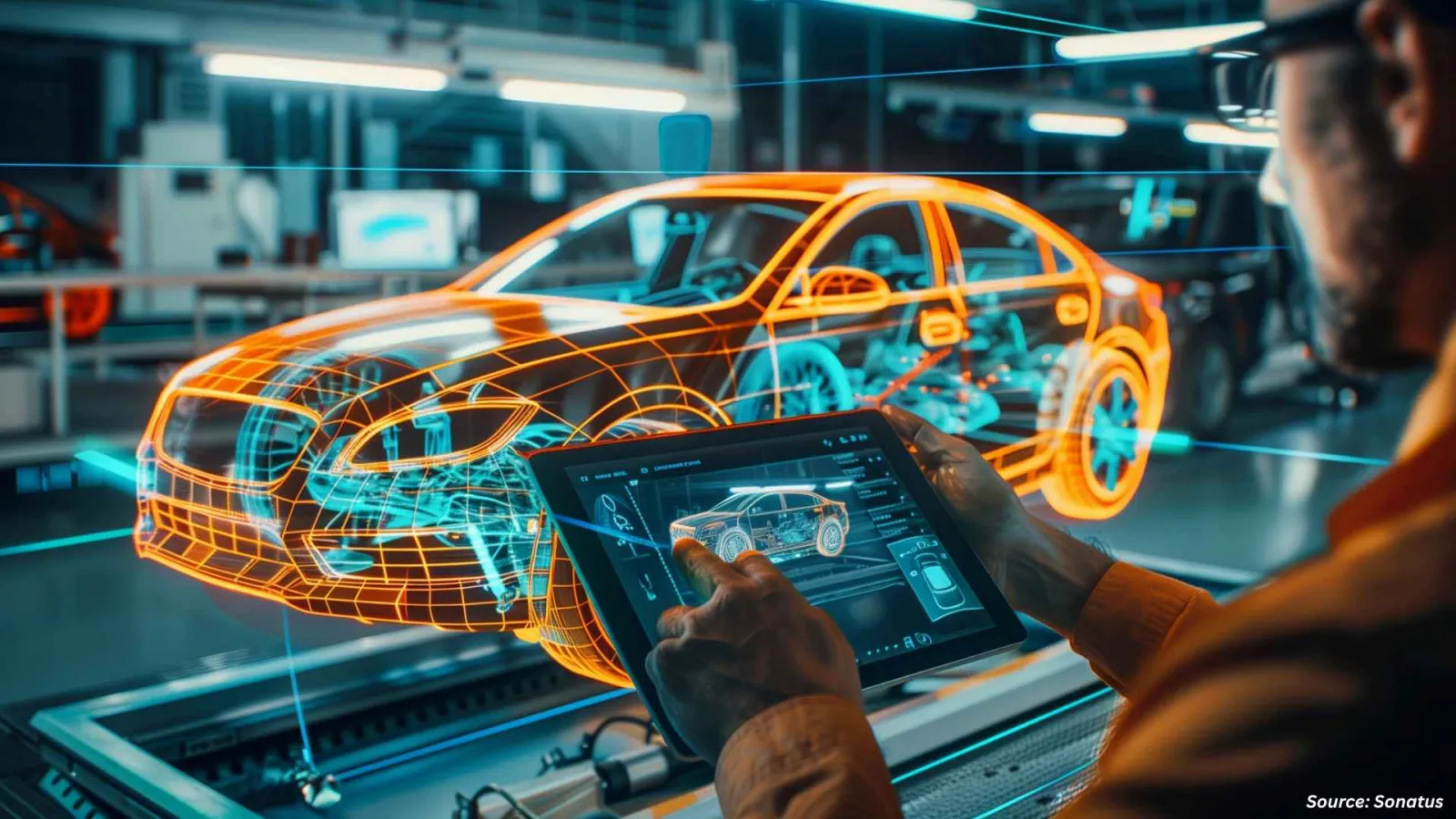
The Automotive Artificial Intelligence Market in 2026 reflects a decisive transition from experimental innovation to structured commercialization. Two major developments define this shift. Wayve has secured $1.2 billion in fresh capital to scale autonomous vehicle software, while Celonis is embedding artificial intelligence into automotive manufacturing workflows. Together, these developments indicate that artificial intelligence is becoming foundational infrastructure across both vehicles and enterprise operations.
How Is Wayve’s $1.2 Billion Funding Reshaping Autonomous AI?
Wayve announced that it raised $1.2 billion, with the total potentially increasing to $1.5 billion if performance targets are achieved. The funding round values the London-based company at $8.6 billion.
The investment was led by Eclipse and Balderton Capital and included participation from Microsoft, Nvidia, Uber, Mercedes-Benz, Nissan, Stellantis and SoftBank.
Unlike competitors that build both vehicles and autonomous systems, Wayve focuses exclusively on artificial intelligence software. Automakers license its technology, allowing them to concentrate on traditional vehicle design and manufacturing while integrating advanced driving intelligence through a software agreement.
Wayve’s system relies on data from cameras and sensors to make real-time driving decisions. The technology depends less on detailed maps and continuously feeds collected driving data into a centralized artificial intelligence system, enabling vehicles using the platform to improve collectively over time.
The company expects to launch driverless taxis this year through a commercial trial with Uber beginning in London. Consumer vehicles equipped with supervised autonomous capabilities are expected to be available by 2027.
Financially, Wayve raised $1 billion in 2024 and reported a loss of nearly $62 million in that same year. Meanwhile, European start-ups collectively raised approximately $69 billion last year compared with $320 billion in the United States, reflecting both momentum and competitive disparity in technology funding.
Can Process Intelligence Accelerate Automotive Manufacturing Efficiency?
Celonis is applying artificial intelligence to automotive business processes, and its clients include BMW, Ford, Mercedes-Benz and Toyota, as well as Tier 1 suppliers such as Mahle and Eissmann Automotive.
Mahle achieved a 20% reduction in inventory across its supply chain through Celonis tools, while Eissmann Automotive reports 30% faster throughput times.
Mercedes-Benz deployed the Celonis Process Intelligence Platform to connect production and logistics systems, enhancing its MO360 platform to gain visibility across orders, parts and processes.
Celonis supports Mercedes across order-to-delivery forecasting, aftersales bottleneck detection and quality management anomaly detection. The platform clusters and analyzes vehicle production data to detect failures early and alert teams.
BMW applies Celonis tools so extensively that nearly every vehicle it sells is touched by Celonis artificial intelligence in some capacity. BMW leadership has described process intelligence as a digital twin of enterprise processes that enables simulation, prediction and agent-driven execution.
Is the Automotive Artificial Intelligence Market Becoming Infrastructure-Level Technology?
The convergence of vehicle-level artificial intelligence and enterprise-level process intelligence suggests that artificial intelligence is becoming a core infrastructure layer in automotive ecosystems. Wayve’s licensing model allows manufacturers to integrate scalable autonomy without building proprietary systems. Celonis’ deployment of process intelligence demonstrates how artificial intelligence enhances internal efficiency and visibility. Together, these developments indicate that artificial intelligence is evolving from optional innovation to operational necessity.
How Are These Developments Influencing the Digital Twin for Construction Market?
The implications extend beyond automotive. Wayve’s centralized learning architecture demonstrates how distributed physical assets can feed continuous data into a shared artificial intelligence system, improving performance collectively over time.
Similarly, Celonis’ process intelligence model shows how enterprise data can be analyzed to optimize workflows and correct inefficiencies in real time.
For the Digital Twin for Construction Market, these approaches provide a framework for integrating real-time equipment data, predictive maintenance analytics and workflow simulation into unified digital environments. As automotive companies adopt centralized artificial intelligence feedback systems and process mining capabilities, construction digital twin platforms are likely to incorporate similar adaptive learning mechanisms and operational transparency tools.
How Do Vehicle AI and Process AI Compare in 2026?
|
Dimension |
Wayve |
Celonis |
|
AI Focus |
Autonomous driving software |
Process intelligence and workflow optimization |
|
Business Model |
Licensed AI to automakers |
Enterprise AI platform deployment |
|
Measurable Impact |
Driverless trials and supervised autonomy |
20% inventory reduction; 30% throughput improvement |
|
Strategic Value |
Scalable autonomy without OEM software buildout |
Operational transparency and automated process execution |
|
Data Architecture |
Centralized learning from vehicle data |
Digital twin of enterprise processes |
Key Companies shaping the industry
Several key players operating in the automotive artificial intelligence industry include NVIDIA Corporation, Mobileye Global Inc., Qualcomm Technologies, Inc., Robert Bosch GmbH, Continental AG, Aptiv PLC, Huawei Technologies Co., Ltd., DENSO Corporation, ZF Friedrichshafen AG, Valeo SA, Waymo LLC, Aurora Innovation, Inc., NXP Semiconductors N.V., Cerence Inc., and Cognata Ltd., among others. These companies are focusing on product launches, regional expansion, strategic partnerships, and continuous innovation to strengthen their competitive positions and sustain long-term market leadership.
In August 2023, Qualcomm Technologies announced a partnership to develop purpose-built vehicle systems leveraging its advanced technology portfolio. The collaboration is designed to enable next-generation in-car experiences, including enhanced infotainment systems, intelligent cockpit platforms, and advanced driver assistance capabilities, supporting the broader evolution of software-defined vehicles.
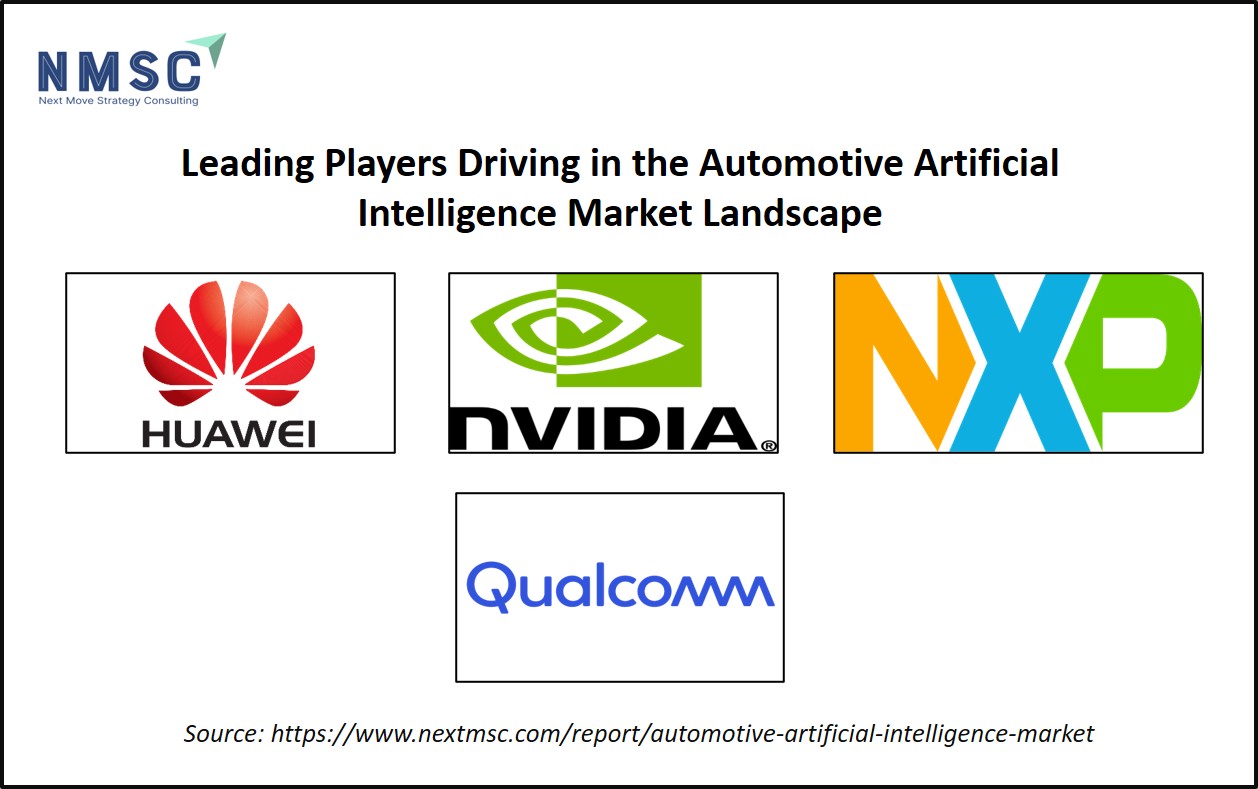
NMSC Viewpoint on the Automotive Artificial Intelligence Market in 2026
From a Next Move Strategy Consulting perspective, the 2026 developments surrounding Wayve and Celonis confirm that the Automotive Artificial Intelligence Market is entering a commercialization and execution phase.
Wayve’s $1.2 billion funding round and $8.6 billion valuation reflect strong investor confidence in scalable, licensing-based autonomous software models.
At the same time, Celonis’ reported 20% inventory reduction at Mahle and 30% faster throughput at Eissmann Automotive demonstrate measurable enterprise impact.
NMSC interprets these signals as evidence that artificial intelligence is shifting from pilot deployments to infrastructure-level integration across both vehicles and operations.
What Should Industry Stakeholders Do Next?
Next Steps
-
Evaluate artificial intelligence licensing partnerships to accelerate deployment
-
Integrate process mining into manufacturing and supply chain operations
-
Build centralized data architectures that support continuous learning
-
Monitor cross-sector artificial intelligence integration trends
About the Author
 Sanyukta Deb
— Sanyukta Deb is Digital Marketing Team Lead at Next Move Strategy Consulting, where she has led content strategy and technical SEO for the firm's B2B market research publications for over 2 years. Her editorial process translates NextMSC's primary and secondary research — spanning technology, industrial, and consumer sectors — into commercial narratives, backed by search-intent, keyword, and competitive analysis. She brings 5 years of overall experience in digital marketing and content strategy.
Sanyukta Deb
— Sanyukta Deb is Digital Marketing Team Lead at Next Move Strategy Consulting, where she has led content strategy and technical SEO for the firm's B2B market research publications for over 2 years. Her editorial process translates NextMSC's primary and secondary research — spanning technology, industrial, and consumer sectors — into commercial narratives, backed by search-intent, keyword, and competitive analysis. She brings 5 years of overall experience in digital marketing and content strategy.
About the Reviewer
 Debashree Dey
— Debashree Dey is Assistant Manager at Next Move Strategy Consulting, where she supports cross-vertical market content and communications across diverse industries for 6 years. Her professional background includes senior content writing, communications, and published manuscript authorship, with experience developing audience-focused business narratives and maintaining clear, consistent messaging. Her role supports research-led content development and editorial quality across NextMSC publications.
Debashree Dey
— Debashree Dey is Assistant Manager at Next Move Strategy Consulting, where she supports cross-vertical market content and communications across diverse industries for 6 years. Her professional background includes senior content writing, communications, and published manuscript authorship, with experience developing audience-focused business narratives and maintaining clear, consistent messaging. Her role supports research-led content development and editorial quality across NextMSC publications.
















Add Comment