Lung Cancer Surgery: Precision, Outcomes & Integrated Innovation

Lung cancer surgery is no longer a standalone intervention. It is becoming a highly integrated treatment strategy that combines minimally invasive techniques, real-time diagnostic precision, and systemic immune-based therapies.
Recent clinical developments from leading medical institutions show measurable improvement in survival outcomes and intraoperative decision-making. These advancements are strengthening the role of surgery within comprehensive cancer care.
Video-Assisted Thoracoscopic Surgery (VATS) Improves Survival Outcomes
Video-Assisted Thoracoscopic Surgery (VATS) represents a major shift from traditional open thoracotomy. Instead of large incisions and rib spreading, surgeons use small ports and a camera to remove cancerous lung tissue with reduced trauma.
According to Oncology Central, patients undergoing VATS for lung cancer demonstrate improved survival rates compared to conventional open surgery. The analysis also indicates reduced postoperative complications and shorter hospital stays.
The survival improvement is particularly significant because it suggests that surgical technique directly influences long-term prognosis. Minimally invasive access reduces systemic stress and enables faster recovery, which may contribute to stronger overall outcomes.
From an industry standpoint, according to Next Move Strategy Consulting, rising demand for minimally invasive lung cancer surgery is expected to drive investment in thoracoscopic instruments, imaging systems, and surgical training infrastructure globally.
Frozen Section Pathology Enhances Intraoperative Decision-Making
Precision during surgery determines long-term control of disease. Frozen section pathology allows surgeons to receive immediate microscopic evaluation of tissue margins while the patient remains in the operating room.
Mayo Clinic reports that frozen section pathology significantly enhances intraoperative decision-making in early-stage lung cancer surgery. Surgeons can confirm whether cancer margins are clear and determine the need for additional resection in real time.
This capability reduces uncertainty, limits repeat surgeries, and preserves healthy lung tissue whenever possible. Accurate margin assessment is critical because incomplete resection increases recurrence risk, while excessive removal can compromise respiratory function.
According to Next Move Strategy Consulting, expanded integration of intraoperative pathology is likely to increase demand for advanced diagnostic laboratories, rapid tissue processing technologies, and cross-disciplinary oncology infrastructure.
Immunotherapy Plus Chemotherapy Before Surgery Improves Long-Term Survival
Lung cancer surgery is increasingly combined with systemic treatment before tumor removal. This approach, known as neoadjuvant therapy, uses immunotherapy plus chemotherapy to shrink tumors and activate immune responses prior to surgery.
A five-year analysis from Johns Hopkins Medicine demonstrates that patients receiving immunotherapy combined with chemotherapy before lung cancer surgery experienced significantly improved long-term survival.
Long-term follow-up data is particularly meaningful. Sustained survival improvement over five years confirms that the benefit extends beyond immediate tumor shrinkage and supports durable disease control.
This evolution transforms surgery from a single intervention into a component of a coordinated therapeutic sequence, targeting both visible tumors and microscopic disease.
According to Next Move Strategy Consulting, the integration of immunotherapy and chemotherapy before surgery is expected to expand the immuno-oncology market while increasing collaboration between surgical and medical oncology segments. This convergence may reshape procurement strategies, clinical trial investments, and hospital oncology models globally.
Next Steps: Actionable Takeaways
-
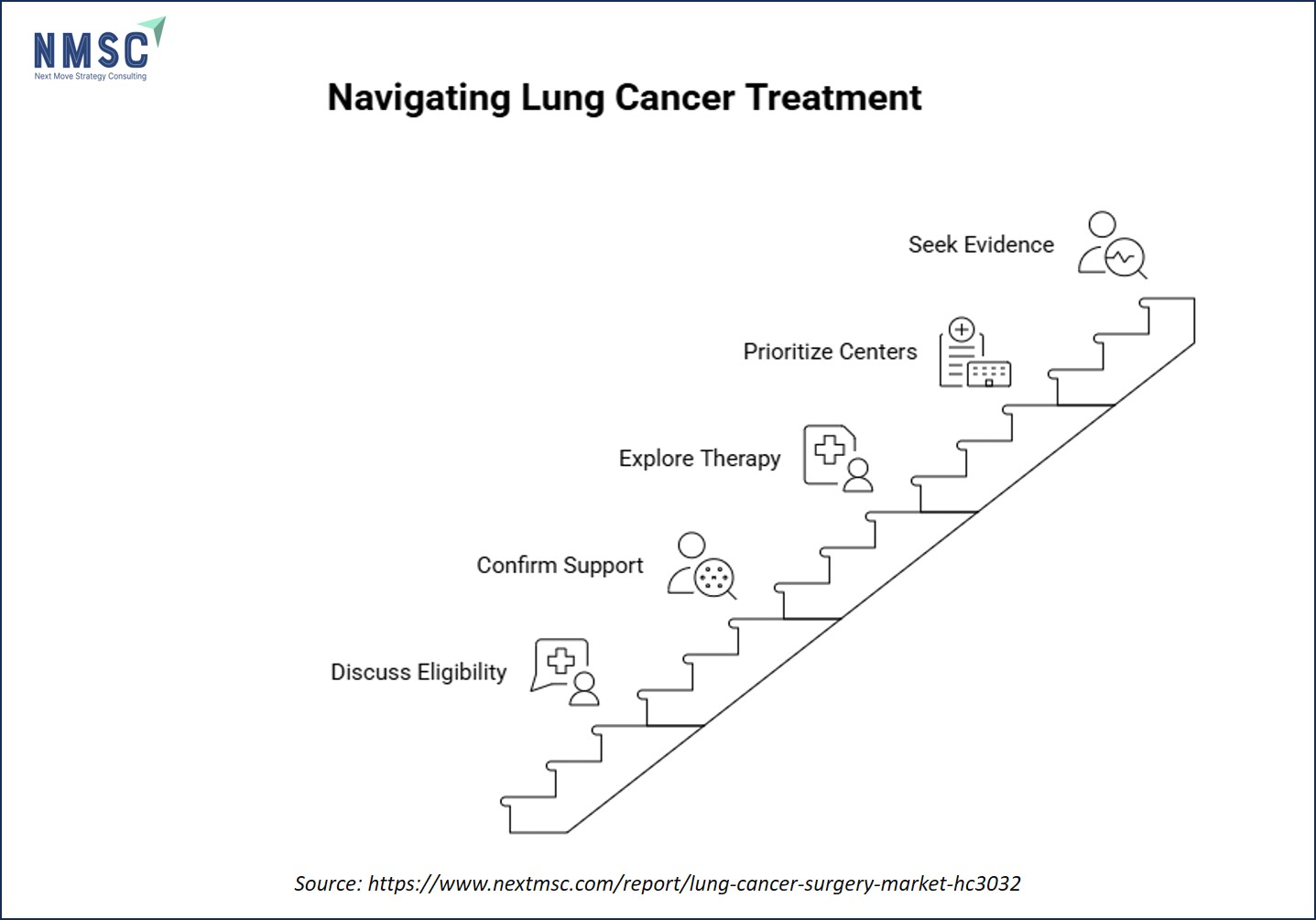
Discuss Minimally Invasive Eligibility Patients should consult thoracic surgeons regarding eligibility for Video-Assisted Thoracoscopic Surgery, especially in early-stage cases.
-
Confirm Intraoperative Diagnostic Support Choosing centers that offer frozen section pathology may improve surgical precision and reduce the likelihood of repeat procedures.
-
Explore Neoadjuvant Therapy Options Patients and providers should evaluate whether immunotherapy combined with chemotherapy before surgery is clinically appropriate.
-
Prioritize Multidisciplinary Cancer Centers Integrated oncology programs that coordinate surgery, pathology, and systemic therapy often provide stronger long-term outcome alignment.
-
Seek Evidence-Based Treatment Planning Treatment decisions should be guided by validated long-term survival data rather than short-term response metrics alone.
Conclusion
Lung cancer surgery is no longer defined by tumor removal alone. The integration of minimally invasive techniques such as Video-Assisted Thoracoscopic Surgery, real-time frozen section pathology, and immunotherapy combined with chemotherapy before surgery reflects a measurable shift toward precision-driven, outcome-focused care.
Clinical evidence now supports that surgical technique, intraoperative diagnostic accuracy, and pre-surgical systemic therapy directly influence long-term survival. This evolution demonstrates that the future of lung cancer treatment lies in coordinated, multidisciplinary strategy rather than isolated procedural intervention.
As hospitals adopt integrated surgical oncology frameworks, the emphasis is clearly moving toward improved survival, reduced recurrence risk, and higher treatment reliability.
About the Author
 Sanyukta Deb
— Sanyukta Deb is Digital Marketing Team Lead at Next Move Strategy Consulting, where she has led content strategy and technical SEO for the firm's B2B market research publications for over 2 years. Her editorial process translates NextMSC's primary and secondary research — spanning technology, industrial, and consumer sectors — into commercial narratives, backed by search-intent, keyword, and competitive analysis. She brings 5 years of overall experience in digital marketing and content strategy.
Sanyukta Deb
— Sanyukta Deb is Digital Marketing Team Lead at Next Move Strategy Consulting, where she has led content strategy and technical SEO for the firm's B2B market research publications for over 2 years. Her editorial process translates NextMSC's primary and secondary research — spanning technology, industrial, and consumer sectors — into commercial narratives, backed by search-intent, keyword, and competitive analysis. She brings 5 years of overall experience in digital marketing and content strategy.
About the Reviewer
 Debashree Dey
— Debashree Dey is Assistant Manager at Next Move Strategy Consulting, where she supports cross-vertical market content and communications across diverse industries for 6 years. Her professional background includes senior content writing, communications, and published manuscript authorship, with experience developing audience-focused business narratives and maintaining clear, consistent messaging. Her role supports research-led content development and editorial quality across NextMSC publications.
Debashree Dey
— Debashree Dey is Assistant Manager at Next Move Strategy Consulting, where she supports cross-vertical market content and communications across diverse industries for 6 years. Her professional background includes senior content writing, communications, and published manuscript authorship, with experience developing audience-focused business narratives and maintaining clear, consistent messaging. Her role supports research-led content development and editorial quality across NextMSC publications.


















Add Comment