Luxury Jewelry Market By Material Type (Gold Jewelry, Diamond Jewelry, Platinum Jewelry, Gemstone Jewelry, Pearl Jewelry, and Other Materials), By Product Type (Rings, Necklaces, Earrings, Bracelets and Others), By Distribution Channel {Offline (Brand Boutiques, Multi Brand Retail, and Others) and Online (Brand Websites and Luxury Marketplaces)}, By Application (Engagement, Fashion and Daily Wear, Gift and Occasion, and Investment and Collectible) – Global Analysis & Forecast, 2026–2035
Industry: Retail and Consumer | Publishing Date: December 18, 2025 | Last Updated: September 30, 2026 | No of Pages: N/A | No. of Tables: N/A | No. of Figures: N/A | Format: PDF | Report Code: RC3916
Industry Outlook
The global Luxury Jewelry Market size was valued at USD 70.24 billion in 2025 and is expected to reach USD 75.79 billion by 2026. Looking ahead, the industry is projected to expand significantly, reaching USD 150.25 billion by 2035, registering a CAGR of 7.9% from 2026 to 2035.
The industry today stands as one of the most enduring and culturally significant segments of the global luxury industry, rooted in craftsmanship, heritage, and emotional value. High-end brands continue to blend traditional artisanal techniques with modern aesthetics, catering to consumers who seek pieces that symbolize identity, milestones, and status. Applications span from bridal and ceremonial jewelry to high jewelry collectibles, with demand driven by personalization, rarity, and the appeal of long-term value. The industry also benefits from strong gifting culture, growing global travel retail, and a rising class of affluent young consumers who view jewelry not only as adornment but also as a lifestyle statement.
As the market evolves, high-end jewelry industry is increasingly intersecting with technology, sustainability, and new consumption models. Digital boutiques, virtual try-ons, and online high-jewelry showcases are reshaping how consumers discover and purchase pieces, expanding the reach of maisons beyond physical flagships. Ethical sourcing and traceable materials are becoming essential, while design innovation is leaning toward versatile, gender-fluid, and investment-oriented pieces. Looking ahead, the industry is set to benefit from expanding wealth in emerging markets, the rise of collectible fine jewelry, and the growing perception of high-value gold jewelry as both an emotional asset and a long-term store of value.
Additionally, the expanding urban population is boosting the luxury jewelry industry as city dwellers have higher exposure to premium brands, evolving fashion trends, and upscale retail environments. Urban consumers typically possess greater purchasing power and a preference for branded, high-quality products, driving stronger demand for luxury jewelry across both physical boutiques and online platforms.
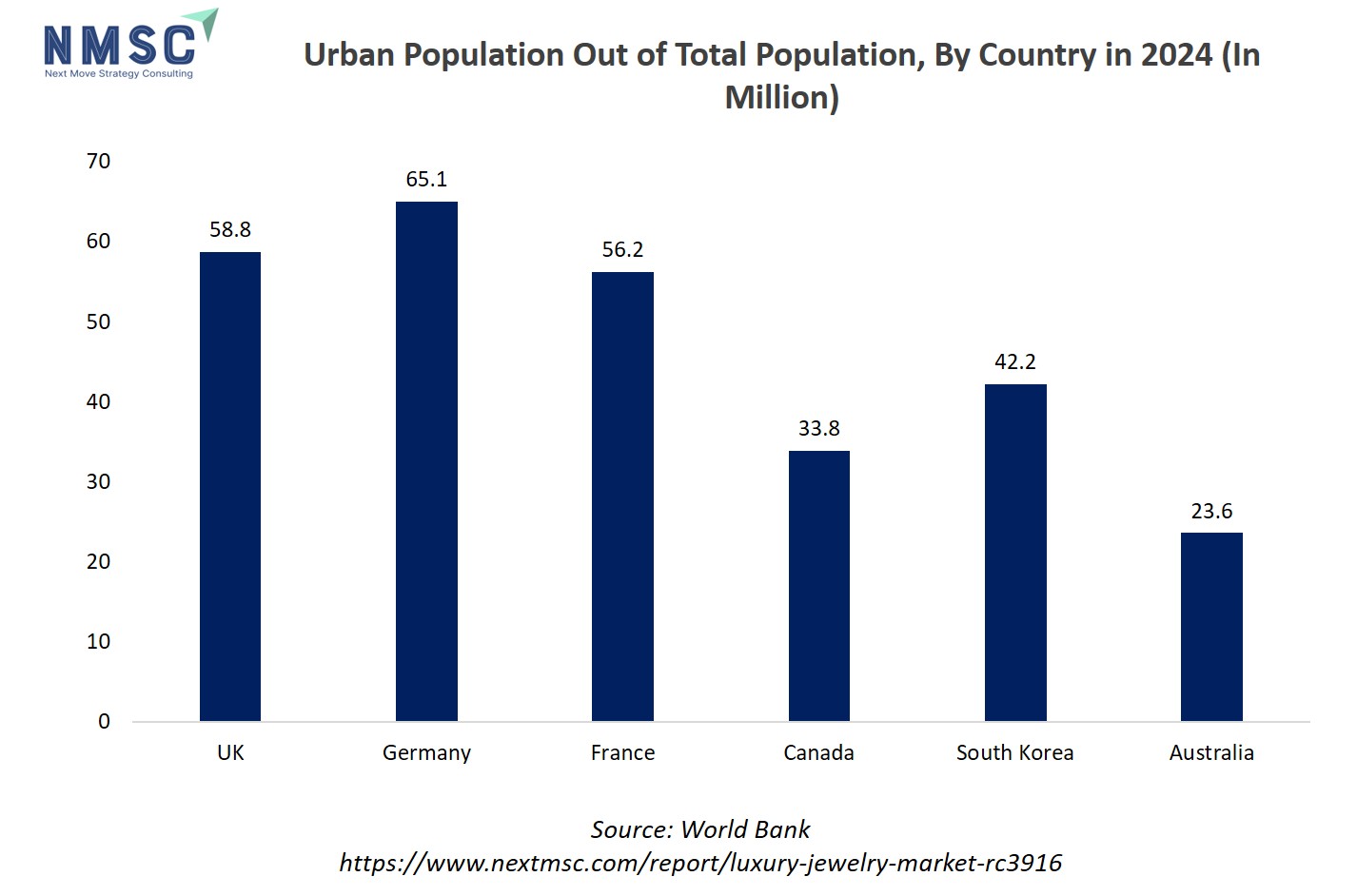
Thus, the above chart demonstrates that countries such as Germany, the UK, and France have significant urban populations in 2024, with over 50 million people each living in urban areas, while developed markets like South Korea, Canada, and Australia also show strong urbanization trends but with comparatively smaller urban populations. High urban concentration correlates with greater exposure to international trends, higher disposable incomes, and a dense retail footprint, all key drivers for the luxury jewelry industry.
What Are the Key Trends in the Luxury Jewelry Industry?
How Is the Luxury Jewelry Market Adapting to Economic Volatility & Discretionary Spending Risk?
The luxury jewelry industry is increasingly adopting strategies to navigate economic volatility and fluctuations in discretionary spending, ensuring resilience during uncertain financial periods. Brands are offering flexible payment options, limited-edition collections, and value-driven luxury items to maintain consumer engagement even when spending is cautious. For example, firms promote customizable jewelry bundles or smaller ticket luxury items that provide aspirational value without requiring substantial upfront investment. This trend reflects a shift towards more adaptable product strategies that cater to changing consumer budgets while preserving brand prestige. Companies capitalize on this by closely monitoring market sentiment, optimizing inventory, and introducing promotions that maintain sales momentum during economic slowdowns. These approaches not only sustain revenue streams but also reinforce customer loyalty and trust in unpredictable market conditions.
How Is Raw Material Price Volatility Influencing the Luxury Jewelry Market?
The luxury jewelry industry is increasingly impacted by raw material price volatility, as fluctuations in gold, platinum, diamonds, and gemstones directly affect production costs and profit margins. Sudden spikes in metal or gemstone prices lead to higher retail prices, affecting consumer demand, while declines pressure brands to manage inventory valuations and cost efficiency. This trend has prompted companies to adopt strategic sourcing, long-term supplier contracts, and hedging mechanisms to stabilize costs and maintain consistent product offerings. By leveraging these approaches, brands mitigate financial risks, optimize supply chain management, and sustain pricing strategies, ensuring operational stability while continuing to deliver high-quality heritage jewelry brands to discerning consumers.
How Are Counterfeiting & Brand Integrity Risks Impacting the Luxury Jewelry Market?
Counterfeiting remains a significant challenge for the luxury jewelry market, threatening brand reputation and undermining consumer trust. Fake diamonds, imitation gold, and unauthorized replicas not only reduce sales of authentic products but also dilute the perceived exclusivity and prestige associated with luxury brands. To address this, companies are increasingly investing in advanced authentication technologies, blockchain-enabled provenance tracking, and secure supply chain practices to verify product legitimacy. This trend reflects a strategic focus on protecting brand integrity while reassuring consumers of the authenticity and value of their purchases. By proactively combating counterfeiting, brands maintain consumer confidence, strengthen loyalty, and safeguard long-term market positioning in the highly competitive luxury jewelry sector.
What Are the Key Market Drivers, Breakthroughs, And Investment Opportunities That Will Shape the Luxury Jewelry Industry in the Next Decade?
The luxury jewelry sector now blends traditional craftsmanship with contemporary retail and experiential approaches. Brands highlight their heritage, bespoke offerings, and exclusive high-jewelry collections while expanding digital showrooms and omnichannel reach to engage younger UHNW and aspirational consumers. Key demand drivers include bridal purchases, gifting, collectible masterpieces, and investment-grade pieces valued for their rarity and provenance.
At the same time, the sector faces margin pressure from raw material volatility and rising ESG expectations; brands are responding with traceability programs, recycled metals, and transparency initiatives. Future prospects look positive but selective: growth favours maisons that blend provenance, circular practices, and digital intimacy while expanding selectively into emerging wealth centres.
Growth Drivers:
How Is Digitalisation & B2B E-Commerce Expansion Driving the Luxury Jewelry Market?
Digitalisation and the rapid expansion of B2B e-commerce are significantly propelling the luxury jewelry market growth by streamlining procurement, enhancing brand visibility, and enabling global scalability. As manufacturers, wholesalers, and retailers embrace digital platforms, they gain faster access to certified gemstones, metals, and finished jewelry through transparent online catalogues, automated order systems, and real-time inventory dashboards. This shift is evident across major jewelry hubs as brands adopt virtual showrooms, AI-based customization tools, and blockchain-enabled authentication to improve traceability and reduce reliance on traditional middlemen. Additionally, digital B2B marketplaces help smaller retailers source premium collections at competitive prices while simplifying cross-border trade. Companies leverage this momentum by integrating omnichannel wholesale strategies, strengthening digital supply chains, and offering value-added digital services, ultimately driving operational efficiency and accelerating market expansion in the luxury jewelry sector.
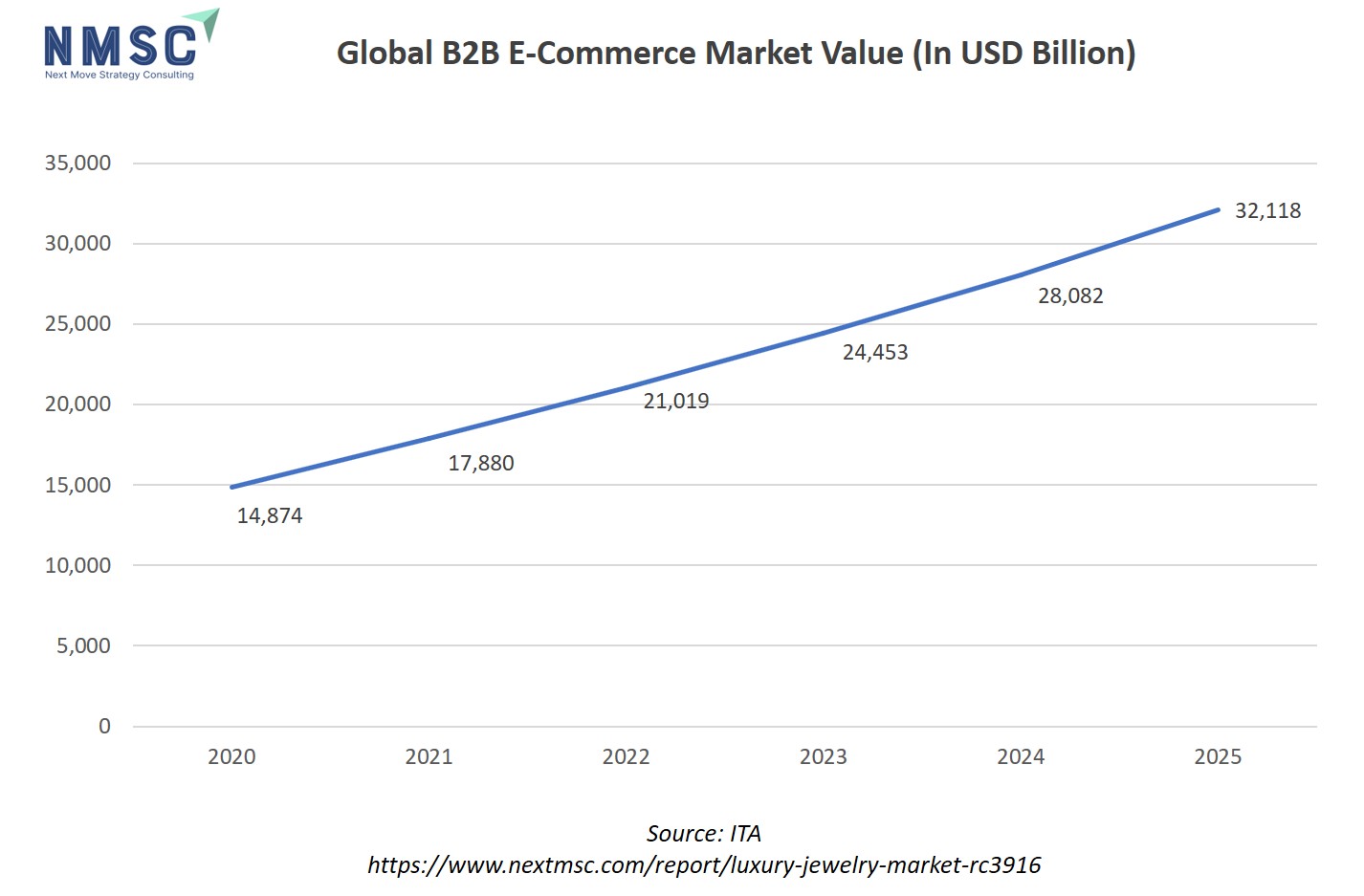
The chart above shows a robust and steady growth in the global B2B e-commerce market value, rising from approximately USD 14.9 trillion in 2020 to an estimated USD 32.1 trillion by 2025, which directly enhances growth prospects in the jewelry market by enabling stronger, more efficient global sourcing, distribution, and wholesale trade channels. As B2B e-commerce platforms scale, luxury jewelry manufacturers and retailers gain better access to international suppliers, rapid inventory procurement, and streamlined cross-border transactions, resulting in improved supply chain agility and reach. This e-commerce expansion allows luxury brands to enter new global markets and serve affluent B2B customers, such as premium boutiques and high-end department stores, faster and more effectively, thereby accelerating the market's growth trajectory and supporting the premium positioning essential for luxury jewelry.
How Are Rising Wealth & Disposable Incomes Driving Growth in the Luxury Jewelry Market?
Rising global wealth and increasing disposable incomes are significantly propelling the growth of the luxury jewelry market, as consumers with greater financial comfort are more willing to invest in high-value, premium jewelry pieces. This economic uplift is particularly visible among affluent millennials and emerging high-net-worth individuals across regions like Asia-Pacific, the Middle East, and North America, where luxury purchases are increasingly seen as symbols of status, personal expression, and long-term value. As households climb into higher income brackets, demand grows for certified diamonds, bespoke craftsmanship, and branded designer collections. This trend is also strengthened by evolving gifting cultures, milestone celebrations, and lifestyle upgrades driven by rising prosperity. Companies respond to this shift by expanding high-end product lines, enhancing exclusivity programs, and tailoring marketing strategies to wealth-driven consumer behaviour, ultimately accelerating premiumization and long-term market expansion in the luxury jewelry sector.
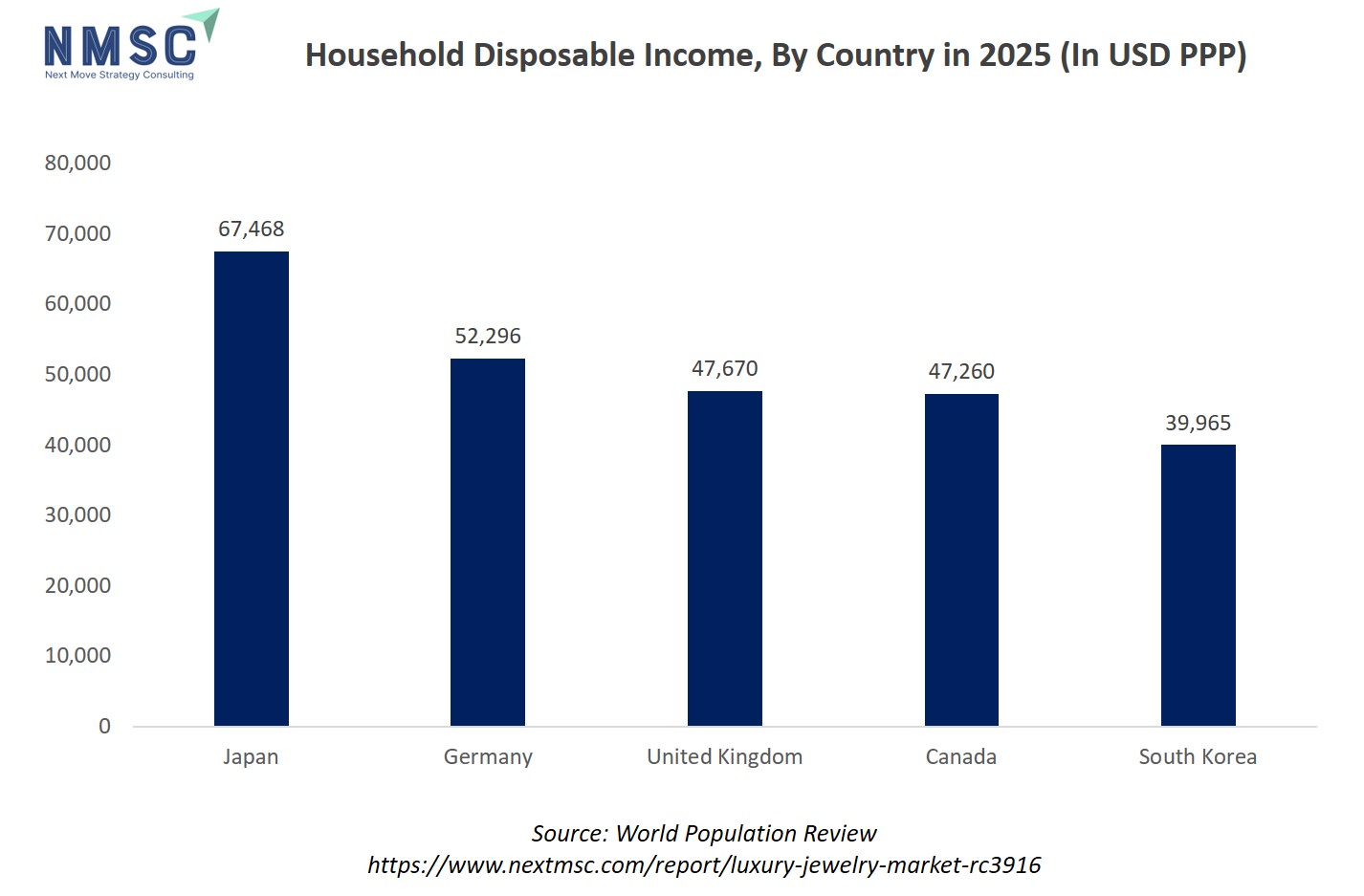
The chart reveals that in 2025, countries such as Japan, Germany, the United Kingdom, and Canada maintain notably high levels of household disposable income, with Japan leading the group at over USD 67,000 USD PPP, signalling robust consumer purchasing power vital for discretionary categories like luxury jewelry. The elevated disposable incomes in these advanced economies are likely to drive higher expenditure on premium goods, including luxury jewelry, as affluent households have greater financial flexibility to indulge in aspirational and high-value purchases. For luxury jewelry brands, this translates into favourable market conditions to intensify sales growth, introduce exclusive collections, and expand retail presence, all of which capitalize on the high spending propensities in these countries and further accelerate overall market growth.
Growth Inhibitors:
How Are Economic Volatility & Discretionary Spending Risks Restraining the Luxury Jewelry Market?
Economic uncertainty remains a significant restraint for the luxury jewelry market expansion, as fluctuations in global financial conditions directly impact consumers’ willingness to spend on high-value, non-essential products. During periods of inflation, currency instability, or reduced consumer confidence, discretionary purchases such as luxury jewelry are postponed or replaced with more practical spending priorities. This unpredictability slows retail momentum, affects inventory planning, and heightens revenue volatility for brands operating in premium segments. Companies, therefore mitigate these risks by diversifying geographically, strengthening liquidity buffers, and offering flexible pricing or promotional strategies that help maintain demand during economic downturns while safeguarding long-term brand value.
Growth Opportunities:
How Is the Growth of Lab-Grown & Ethical Gemstones Creating Opportunities in the Luxury Jewelry Market?
The rising popularity of lab-grown and ethically sourced gemstones is opening significant opportunities for the luxury jewelry market as consumers increasingly seek transparency, sustainability and responsible sourcing. With younger demographics prioritising environmental and social ethics, demand is shifting toward conflict-free diamonds, traceable gemstones, and eco-friendly production methods. This shift enables brands to diversify portfolios with high-quality lab-grown alternatives that offer comparable brilliance at accessible price points, attracting both value-driven and ethically conscious buyers. Luxury houses capitalize on this trend by investing in certified ethical supply chains, highlighting sustainability credentials, and creating dedicated eco-luxe collections. This not only strengthens brand differentiation but also expands the customer base, helping companies align with evolving consumer values while unlocking new revenue streams in a growing conscious-luxury segment.
How Luxury Jewelry Market segmented in this report, and what are the key insights from the segmentation analysis?
By Material Type Insights
Is Gold Jewelry Still the Dominating Segment of the Luxury Jewelry Material Mix?
Based on material type, the market is segmented into gold jewelry, diamond jewelry, platinum jewelry, gemstone jewelry, pearl jewelry, and other materials.
Gold jewelry remains dominant in volume, but its dominance is shifting in terms of value. While gold still plays a foundational role is especially in culturally significant markets, its high price is pushing some consumers toward platinum as a premium but relatively more affordable precious metal alternative, driving strong growth in that sub-segment. Diamond jewelry continues to command a major share of the luxury jewelry market in value terms, fueled by bridal, investment, and high jewelry demand. Gemstone and pearl jewelry, though smaller in scale, are gaining relevance through artisanal design, traceability, and sustainability narratives. Finally, other materials provide a playground for design innovation and help maisons reach a broader, younger audience. Together, these trends suggest a diversification of material mix in luxury jewelry, where value, rarity, and ethical sourcing increasingly matter as much as tradition.
Platinum is seeing renewed strength as a luxury jewelry material. According to the World Platinum Investment Council, global platinum jewelry demand rose by 8 % in 2024, reaching approximately 1,993 thousand troy ounces, and is forecast to climb further in 2025. This growth is driven in part by high gold prices platinum is being used more as an alternative. Given its rarity and industrial value, platinum also has a compelling investment and storytelling appeal. Luxury brands capitalize on this by highlighting platinum’s scarcity, sustainability, and relative price advantage vs gold in certain markets, especially in regions like China and India, where growth is projected.
Pearl jewelry is a niche but growing sub segment. Cultured pearls, Akoya, freshwater, South Sea dominate this space, and modern consumers are showing strong demand for sustainably farmed and traceable pearls. For luxury maisons, emphasizing responsible pearl farming, quality grading, and design innovation is key to capturing high-value and younger buyers.
By Product Type Insights
How Is Product Type Driving Growth in the Luxury Jewelry Market?
On the basis of product type, the market is segmented into rings, comprising bridal rings and fashion rings, necklaces, comprising pendants and chains and collars, earrings, comprising studs, hoops and drops, bracelets, comprising bangles, chain bracelets, and cuffs; and other jewelry.
Rings dominate in both value and cultural significance, driven largely by bridal and fashion rings. Necklaces and earrings capture the fashion and statement-driven luxury market, while bracelets serve as both gifting and collectable items with growing popularity among younger consumers. Other jewelry remains niche but essential for experimentation and high-jewelry exclusivity. Overall, the product landscape highlights a balance between tradition and modernity, with growth strongly influenced by personalisation, ethical sourcing, and innovative designs.
Necklaces are highly versatile, bridging everyday wear and statement pieces. Pendants serve as entry points for luxury buyers due to affordability and customization potential, while chains and collars cater to high-net-worth consumers seeking bold, collectable pieces. Ethical sourcing and traceable materials are increasingly emphasized for necklaces, given their visibility and symbolic value. Brands integrate storytelling, gemstone provenance, and layering options to enhance desirability and differentiate in a crowded marketplace.
Bracelets blend tradition and contemporary style, with bangles dominating Asian markets and cuffs trending in Western high-fashion. Chain bracelets and cuffs are increasingly popular among millennials and Gen Z for their personalisation and layering options. The global bracelet segment benefits from gifting occasions and social media-driven fashion trends. Brands leverage this by promoting modular, stackable, and convertible bracelets to appeal to fashion-conscious buyers while maintaining a luxury appeal
By Distribution Channel Insights
Is Omnichannel Presence Driving Luxury Jewelry Sales In 2025?
On the basis of distribution channel, the market is segmented into offline and online channels. Offline comprises brand boutiques, multi-brand retail, and department stores whereas online comprises of brand websites and luxury marketplaces.
Offline channels still dominate the luxury jewelry market, providing high-touch, experiential purchasing that builds brand loyalty and justifies premium pricing. However, the online channel is rapidly gaining share, especially among younger and international consumers who value convenience, curated experiences, and digital-first engagement. A balanced omnichannel strategy, combining exclusive in-store experiences with immersive online platforms, is essential for growth, brand visibility, and capturing both traditional and digitally native luxury buyers.
The online luxury jewelry segment is growing rapidly, fueled by digital adoption, social commerce, and younger high-net-worth consumers. Brand websites allow for curated storytelling, virtual try-ons, and direct engagement, while luxury marketplaces. Brands leverage this by offering seamless omnichannel experiences, integrating AR/VR try-on tools, and personalised e-commerce services to complement their offline presence.
By Application Insights
How Are Applications Shaping the Luxury Jewelry Market Trends in 2025?
On the basis of application, the market is segmented into engagement, fashion and daily wear, gift and occasion, investment and collectible.
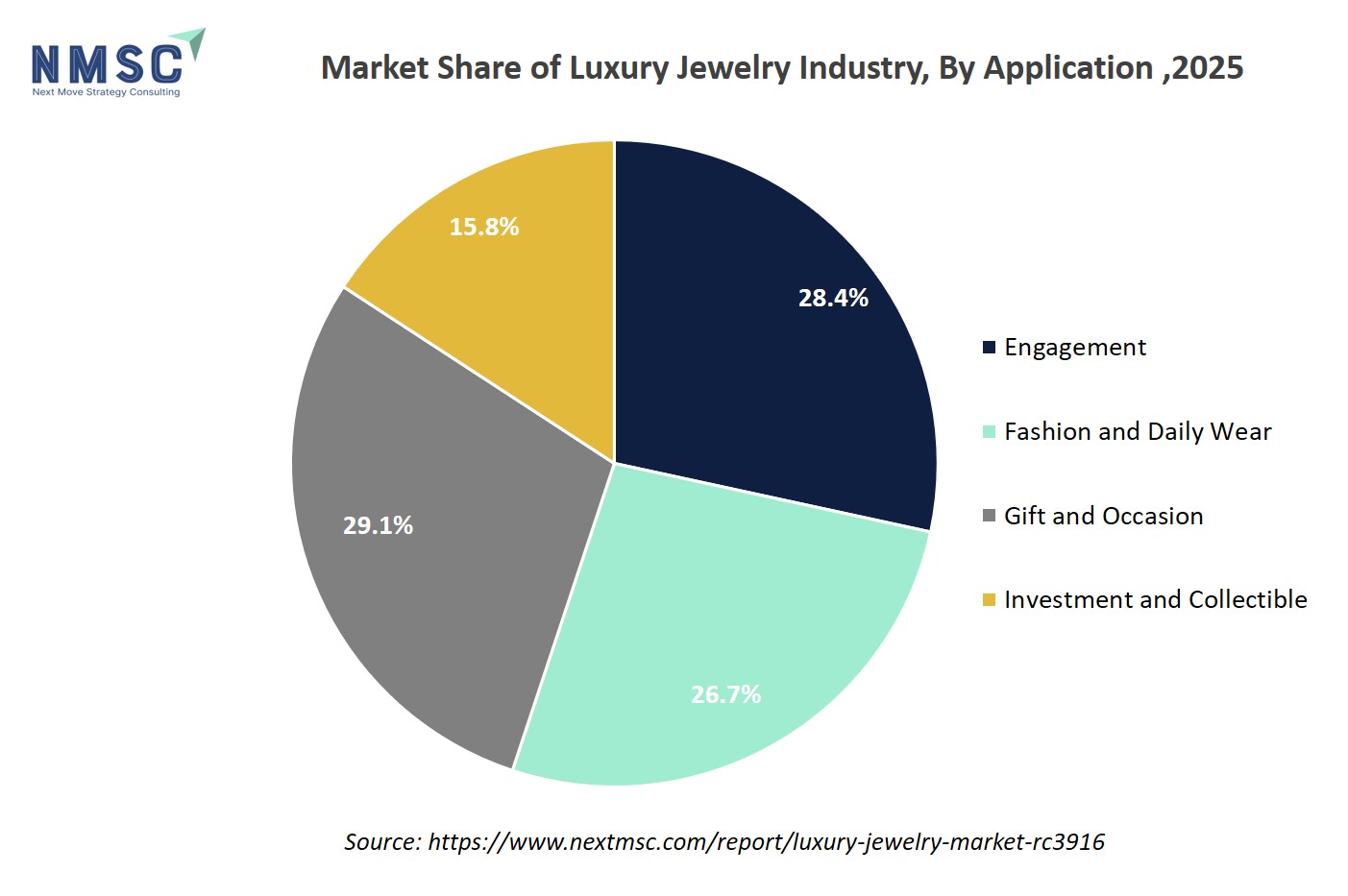
Engagement jewelry currently dominates due to its high value, emotional significance, and stable demand, especially in mature markets like the U.S. Fashion and daily wear follow, driven by aspirational consumers and younger demographics looking for stylish yet accessible luxury. Gift & occasion jewelry is also very prominent, buoyed by seasonal and milestone purchases. Meanwhile, the investment & collectable segment is smaller, but growing high-net-worth buyers are increasingly buying fine pieces as enduring assets, though its performance is more niche and dependent on brand, rarity, and craftsmanship.
Occasion-based jewelry such as anniversary gifts, holiday presents, and milestone celebrations, makes up a substantial share of luxury jewelry purchases. For example, weddings, birthdays, and holidays strongly influence buying behaviour. This segment thrives on emotional appeal, personalisation, and seasonal demand, making it a reliable growth pillar for luxury brands.
The investment and collectable segment include pieces bought for value retention, rarity, or craftsmanship. While reliable data on this sub-segment is more limited, luxury consumers and collectors do value such pieces for long-term holding. Rising disposable income and the cultural inclination toward tangible high-value assets are aiding growth in the luxury jewelry market. However, resale value varies widely, and many consumers still view jewelry more as a keepsake than a financial investment.
Regional Outlook
The luxury jewelry market share is geographically studied across North America, Europe, Asia Pacific, the Middle East & Africa, and Latin America and each region is further studied across countries.
Luxury Jewelry Market in North America
In North America, the luxury‑jewelry market is quite mature, underpinned by very high disposable incomes, well‑established luxury brand awareness, and a sophisticated retail ecosystem. Consumers in the U.S. and Canada place high value on customization, exclusive limited-edition pieces, and ethically sourced gemstones. The integration of digital channels with sizable growth in e commerce and virtual try-ons has accelerated access and engagement. This region’s stability, combined with a willingness to pay a premium for heritage and craftsmanship, fuels consistent demand.
Luxury Jewelry Market in the United States
The U.S. is the cornerstone of luxury jewelry in North America, accounting for a dominant share of the regional revenues. Digital innovation is particularly strong are virtual consultations, augmented reality, and direct-to-consumer models are helping brands deepen engagement with affluent buyers. The trend toward certification, traceability, and ethical sourcing also resonates strongly with American luxury shoppers, shaping brand strategies.
Luxury Jewelry Market in Canada
Canada’s jewelry market is propelled by rising consumer interest in personalized, sustainable, and ethically sourced pieces, supported by higher discretionary spending and strong gifting traditions across culturally diverse groups. Growing demand for custom designs, bridal jewelry, and fashion-forward collections is further amplified by the rapid expansion of online retail, where transparency, convenience, and broader design options attract younger shoppers. Together, these trends encourage brands to innovate in materials, craftsmanship, and omnichannel experiences, strengthening overall market growth.
Luxury Jewelry Market in Europe
Europe remains a very important market in luxury jewelry, rooted in centuries of craftsmanship, artisan heritage, and iconic maisons. Legacy brands from France, Italy, and Switzerland continue to drive demand, bolstered by strong tourist flows in major luxury hubs like Paris, Milan, and London. Many European consumers are also increasingly prioritizing sustainability, traceability, and ethical sourcing, which aligns with the heritage luxury houses leaning into more transparent supply chains. Europe’s strength lies in timeless design, deep brand trust, and prestige rooted in artisanal tradition.
Luxury Jewelry Market in the United Kingdom
In the UK, luxury jewelry consumption is boosted by its status as a global shopping destination and a strong tradition of bespoke jewelry. British consumers and tourists value heritage houses and personalized pieces. The presence of flagship boutiques in London adds to the region’s draw. Also, e-commerce and digital-first experiences are steadily growing, helping brands reach both domestic and international clients seeking exclusivity and craftsmanship.
Luxury Jewelry Market in Germany
Germany’s luxury jewelry market tends to emphasize discreet, high-quality luxury not always loud or flashy, but built on precision, technical skill, and fine materials. German consumers appreciate craftsmanship and long-term value, and there is a healthy appetite for both classic designs and investment-grade pieces. The country’s strong economy and affluent consumer base support continued premium growth, while sustainability concerns also influence purchase decisions.
Luxury Jewelry Market in France
France remains a global luxury epicentre, with its historic maisons continuing to set trends. French consumers, as well as international tourists, drive a significant portion of luxury jewelry purchases in the country. The heritage, exclusivity, and artistic legacy of French jewelry houses lend a prestige premium that sustains demand. Also, the broader European focus on sustainable sourcing and craftsmanship resonates strongly here.
Luxury Jewelry Market in Italy
Italy's luxury jewelry market is characterised by a growing consumer inclination towards natural and plant-derived products. This trend is evident in the increasing popularity of herbal supplements, functional foods, and natural skincare products. The Italian market benefits from a rich tradition of herbal medicine and a strong emphasis on quality and authenticity, fostering consumer trust. Additionally, the integration of luxury jewelry ingredients into traditional Italian cuisine and wellness practices further drives market growth, highlighting Italy's unique position in the European luxury jewelry landscape.
Luxury Jewelry Market in Spain
In Spain, luxury jewelry consumption is more niche but growing steadily, especially among affluent locals and tourists. The market benefits from tourism-driven luxury spending and a rising interest in bespoke and limited-edition designs. As sustainability and craftsmanship become more important to European consumers, Spanish luxury jewelry brands are carving out a space by combining artisanal traditions with modern design.
Luxury Jewelry Market in the Nordics
The Nordic countries are known for minimalistic aesthetics and sustainability consciousness, and these traits are influencing their luxury jewelry market. Here, consumers lean toward clean, contemporary designs, crafted from ethically sourced materials. Brands that emphasise recycled metals, traceable gemstones, and gender-neutral design resonate well. While the Nordic market does not match the volume of more traditional luxury hubs, its values align strongly with emerging global trends in transparency and responsible luxury.
Luxury Jewelry Market in the Asia-Pacific
Asia Pacific is currently the fastest-growing and most dominant region in the luxury jewelry market, driven by a rising middle and upper class, rapid urbanization, and strong cultural affinity for jewelry in weddings and special occasions. Younger consumers are adopting luxury jewelry not only for status but as a form of personal expression, and brands are responding with limited edition, heritage-infused, and culturally resonant collections. Online sales, digital-first engagement, customisation, and local partnerships are key forces driving this regional momentum.
Luxury Jewelry Market in China
China dominates the regional luxury jewelry market, accounting for a very large share of the Asia Pacific luxury jewelry revenue. The growth here is fueled by an expanding affluent class, rising brand penetration beyond Tier 1 cities, and a strong cultural resonance for gold and gemstone jewelry. Chinese consumers increasingly crave luxury pieces that reflect local aesthetics, which has prompted brands to collaborate with domestic designers. Additionally, the rise of homegrown players like Laopu Gold, which integrates cultural motifs and heritage design, shows that the luxury jewelry industry is localizing deeply.
Luxury Jewelry Market in Japan
In Japan, luxury jewelry growth is steadier but significant, anchored by a preference for refined materials such as platinum and pearls. According to reports, Japan contributes significantly to the Asia-Pacific’s share and is driven by design sophistication, craftsmanship excellence, and a mature collector base. Japanese consumers appreciate legacy luxury houses, but they also value innovation and limited editions, especially those that combine traditional styles with modern minimalism. The local market’s digital maturity and high per capita spending make it a strategic base for global luxury brands.
Luxury Jewelry Market in India
India is deeply culturally tied to jewelry, especially gold, and luxury jewelry plays a central role in weddings, festivals, and status expression. According to a report, India makes up a significant portion of the Asia-Pacific market, with strong growth projected. Rising wealth, a booming middle and upper class, and increasing exposure to global luxury brands are fueling demand for premium jewelry. Additionally, younger buyers are seeking bespoke, ethically sourced designs, pushing brands to offer customization, traceability, and modern, aspirational collections.
Luxury Jewelry Market in South Korea
Luxury jewelry in South Korea benefits from the country’s fashion-forward youth, K-pop influence, and a strong desire for status symbols. According to regional reports, South Korea represents a growing portion of Asia Pacific demand, with consumers drawn to celebrity-endorsed lines, gender neutral design, and limited edition drops. Digital engagement in Korea is very high, meaning brands that deploy influencer-led campaigns, virtual try-ons, and online exclusives find a receptive audience.
Luxury Jewelry Market in Taiwan
Taiwan follows trends similar to South Korea and Japan high digital maturity, design-conscious consumers, and a penchant for refined, well-crafted pieces. Affluent Taiwanese consumers balance heritage design with contemporary style, and boutique luxury brands thrive here through both physical stores and curated online presence.
Luxury Jewelry Market in Indonesia
In Indonesia, rising wealth, especially in urban centres like Jakarta and Bali, is fueling interest in luxury jewelry. Cultural traditions entail gifting, and affluent Indonesians are increasingly turning to premium brands. Although detailed luxury jewelry specific figures are sparse in some global reports, broader Asia-Pacific trends around digital adoption, brand aspiration, and personalization are very relevant. As international and regional brands deepen their retail presence, Indonesia is likely to contribute more meaningfully to luxury jewelry growth.
Luxury Jewelry Market in Australia
Australia’s luxury jewelry market is growing steadily, supported by a relatively high-income consumer base and a mature retail infrastructure. Australian buyers value craftsmanship, high-quality gemstones, and heritage brands. The digital shift is also prominent, with e-commerce and online customisation influencing purchase behaviour. Moreover, Australia’s proximity to Asia Pacific luxury hubs means that global brands leverage both local demand and regional cross-border strategies.
Luxury Jewelry Market in Latin America
Latin America represents a smaller but promising market for luxury jewelry. Countries such as Brazil and Mexico are leading the trend, fueled by a growing affluent class, urbanization, and increasing exposure to global luxury brands. Luxury jewelry in Latin America is linked to gifting, special occasions, and status. While economic volatility and political risk remain challenges, niche and bespoke luxury players are finding traction by offering culturally resonant collections and high-touch retail experiences.
Luxury Jewelry Market in the Middle East & Africa
In the Middle East & Africa, luxury jewelry is strongly driven by cultural traditions, ceremonies, and status display. The Gulf region is an especially significant consumer favoring gold and diamond jewelry, and there is a strong culture around gifting for weddings and festivals. High net-worth individuals, tourist inflows, and luxury tourism all support demand. However, some reports suggest moderating growth due to political risk or economic fluctuations, making brand strategies in MEA more sensitive to geopolitical dynamics.
Competitive Landscape
Which Companies Dominate the Luxury Jewelry Industry and How Do They Compete?
The luxury jewelry industry is dominated by heritage maisons such as Cartier, Chopard, Graff, and De Beers, alongside niche high jewelry names like Messika, Mikimoto, Damiani, Boucheron, Harry Winston, David Yurman, YOKO London, Garrard, and Pasquale Bruni. Cartier, under Richemont, is arguably the biggest, with deep brand prestige, a massive global footprint, and iconic collections. Tiffany, acquired by LVMH, brings American elegance and aggressive global retail expansion. Graff and Harry Winston focus on rare and large diamonds, while De Beers is unique in its mining-to-retail integration. Meanwhile, Messika pushes contemporary diamond design, and Mikimoto shines in the pearl segment. Each brand’s heritage, gem specialization, and design identity differentiate them, even as they vie for the same ultra-luxury clientele.
Market Dominated by Luxury Jewelry Giants and Specialists
In this luxury space, the competition is shaped by both giant maisons and specialist houses. Big players like Cartier and Tiffany benefit from scale, heritage, and deep pockets, enabling them to maintain flagship boutiques, invest heavily in high jewelry, and leverage global infrastructure. On the other hand, specialists such as Messika, Mikimoto, Pasquale Bruni, and YOKO London compete by focusing on very specific niches, fluid diamond designs, cultured pearls, or artisanal craftsmanship. This dual landscape means consumers choose between breadth and exclusivity; they pick a globally recognised heavyweight or a niche house that speaks to their personal aesthetic or investment goals.
Innovation and Adaptability Drive Market Success
Innovation is front and centre for leaders in the luxury jewelry world. For example, De Beers recently launched its Ombré Desert Diamonds line and a branded polished diamond platform called ORIGIN, which uses blockchain to trace provenance. Messika, celebrating its 20th anniversary, has rolled out a bold new Move campaign and introduced its textured Move Ciselé collection featuring chiselled gold. These innovations, whether in design, traceability, or materials, help these brands stay relevant to modern luxury consumers.
Market Players to Opt for Partnership and Collaboration Strategies to Expand Their Presence
Acquisition and merger move in this space are less frequent among those legacy maisons, but strategic expansion is very much underway. In India, De Beers plans to open 100 Forevermark stores by 2030, combining company owned and franchise outlets. On another front, Messika has partnered with Asia’s Bluebell Group to enter the South Korean market, strengthening its presence in Asia.
List of Key Luxury Jewelry Companies
-
Cartier
-
T&Co.
-
YOKO London
-
Chopard
-
De Beers
-
Boucheron
-
Pasquale Bruni
-
David Yurman
-
Mikimoto
-
Chow Tai Fook Jewelry Co., Ltd.
-
Garrard
-
Messika
What Are the Latest Key Industry Developments?
-
October 2025 - De Beers Group launched Desert Diamonds, a new consumer-facing beacon concept, backed by its biggest category marketing investment in over a decade, reaffirming its commitment to natural diamonds.
-
June 2025 - Chopard launched a summer accessories collection using ethical gold and Lucent Steel, highlighting its dual commitment to luxury and sustainability.
-
March 2025 - Graff celebrated the 50th anniversary of its iconic Butterfly motif, releasing a high jewelry line dedicated to it, a testament to enduring design legacy and creative reinvention
-
February 2025 - Mikimoto reopened a renovated boutique in Siam Paragon, Thailand, launching its The Bows collection alongside a design inspired by ribbon bows, underlining its expansion in Asia and commitment to craftsmanship.
What Are the Key Factors Influencing Investment Analysis & Opportunities in the Luxury Jewelry Market?
Investment analysis in the luxury jewelry market analysis is primarily shaped by brand equity, heritage, and the ability to innovate while maintaining exclusivity. Investors are increasingly drawn to companies that combine a strong legacy with modern digital engagement, as these brands are better positioned to capture both mature and emerging markets. The valuation of luxury jewelry companies reflects intangible assets such as brand reputation, craftsmanship, and unique design portfolios, alongside tangible elements like precious metals, gemstones, and retail footprint. Funding trends show a growing interest from private equity and strategic investors seeking long-term value in niche high-end brands, particularly those demonstrating adaptability to e-commerce, sustainability, and experiential retail.
Emerging investment hotspots include Asia-Pacific and the Middle East, where rising wealth and cultural affinity for luxury goods offer significant growth potential. Strategic partnerships, minority stake acquisitions, and targeted funding for innovation and geographic expansion are increasingly being used to strengthen market position. Investors tend to prioritise companies that balance heritage with modern consumer engagement, signalling robust opportunities for growth and sustainable returns in the global luxury jewelry landscape.
Key Benefits for Stakeholders:
Next Move Strategy Consulting (NMSC) presents a comprehensive analysis of the luxury jewelry market trends, covering historical trends from 2020 through 2025 and offering detailed forecasts through 2035. Our study examines the market at regional and country levels, providing quantitative projections and insights into key growth drivers, challenges, and investment opportunities across all major luxury jewelry segments.
The luxury jewelry industry creates value for a diverse set of stakeholders, each benefiting in distinct ways. Investors gain opportunities for high returns and portfolio diversification by backing brands with strong heritage, global recognition, and growth potential in emerging markets. Customers enjoy access to meticulously crafted, exclusive pieces that combine artistry, status, and personal expression, supported by customisation and ethical sourcing initiatives. Retailers and distributors benefit from high-margin products that drive footfall, brand loyalty, and repeat purchases, while designers and artisans find a platform to showcase innovation and craftsmanship. Even local economies and suppliers profit through employment, raw material demand, and tourism linked to luxury shopping hubs, creating a broad ecosystem where heritage, innovation, and prestige intersect.
Report Scope:
|
Parameters |
Details |
|
Market Size in 2026 |
USD 75.79 Billion |
|
Revenue Forecast in 2035 |
USD 150.25 Billion |
|
Growth Rate |
CAGR of 7.9% from 2026 to 2035 |
|
Analysis Period |
2025–2035 |
|
Base Year Considered |
2025 |
|
Forecast Period |
2026–2035 |
|
Market Size Estimation |
Billion (USD) |
|
Growth Factors |
|
|
Companies Profiled |
15 |
|
Countries Covered |
33 |
|
Market Share |
Available for 10 companies |
|
Customization Scope |
Free customization (equivalent to up to 80 analyst-working hours) after purchase. Addition or alteration to country, regional & segment scope. |
|
Pricing and Purchase Options |
Avail customized purchase options to meet your exact research needs. |
|
Approach |
In-depth primary and secondary research; proprietary databases; rigorous quality control and validation measures. |
|
Analytical Tools |
Porter's Five Forces, SWOT, value chain, and Harvey ball analysis to assess competitive intensity, stakeholder roles, and relative impact of key factors. |
Key Market Segments
By Material Type
-
Gold Jewelry
-
Diamond Jewelry
-
Platinum Jewelry
-
Gemstone Jewelry
-
Pearl Jewelry
-
Other Materials
By Product Type
-
Rings
-
Bridal Rings
-
Fashion Rings
-
-
Necklaces
-
Pendants
-
Chains and Collars
-
-
Earrings
-
Studs
-
Hoops
-
Drops
-
-
Bracelets
-
Bangles
-
Chain Bracelets
-
Cuffs
-
-
Other Jewelry
By Distribution Channel
-
Offline
-
Brand Boutiques
-
Multi Brand Retail
-
Department Stores
-
-
Online
-
Brand Websites
-
Luxury Marketplaces
-
By Application
-
Engagement
-
Fashion and Daily Wear
-
Gift and Occasion
-
Investment and Collectible
Geographical Breakdown
-
North America: U.S., Canada, and Mexico.
-
Europe: UK, Germany, France, Italy, Spain, Sweden, Denmark, Finland, the Netherlands, and rest of Europe.
-
Asia Pacific: China, India, Japan, South Korea, Taiwan, Indonesia, Vietnam, Australia, Philippines, Malaysia and rest of APAC.
-
Middle East & Africa (MEA): Saudi Arabia, UAE, Egypt, Israel, Turkey, Nigeria, South Africa, and rest of MEA.
-
Latin America: Brazil, Argentina, Chile, Colombia, and rest of LATAM.
Conclusion & Recommendations
The luxury jewelry market report is poised for sustained growth, driven by rising disposable incomes, digital adoption, and cultural affinity for high-end, personalized pieces. Strategic takeaways highlight the importance of balancing heritage and innovation, leveraging digital and e-commerce channels, and emphasizing sustainability and traceability to meet evolving consumer expectations. Regional trends show Asia-Pacific as the fastest-growing market, while North America and Europe remain strong in brand-driven, high-value segments. Niche players thrive alongside industry giants by targeting specialized designs, limited editions, and culturally resonant collections, underscoring the need for agility and market-specific strategies.
Executives and investors capitalize on these trends by pursuing selective geographic expansion, strategic partnerships, and technology-driven engagement. Investing in brands that demonstrate adaptability, strong digital presence, and sustainability credentials yields long-term value. Additionally, monitoring emerging markets and luxury consumption patterns allows for informed decisions regarding acquisitions, collaborations, and marketing strategies, ensuring a competitive advantage in a dynamic global landscape.


About the Author
 Mayurima Roy
— Mayurima Roy is Research Analyst at Next Move Strategy Consulting, where she has spent 4 years working across the firm's full industry coverage rather than a single fixed vertical. Her work centers on structured research, ongoing trend tracking, competitive assessment, and insight-led content development, translating complex market data into clear, decision-ready narratives that support informed client decision-making across diverse global industries, market sectors, and world regions every day.
Mayurima Roy
— Mayurima Roy is Research Analyst at Next Move Strategy Consulting, where she has spent 4 years working across the firm's full industry coverage rather than a single fixed vertical. Her work centers on structured research, ongoing trend tracking, competitive assessment, and insight-led content development, translating complex market data into clear, decision-ready narratives that support informed client decision-making across diverse global industries, market sectors, and world regions every day.
About the Reviewer
 Supradip Baul
— Supradip Baul is an accomplished business consultant and strategist with over a decade of rich experience in market intelligence, strategy, technology, and business transformation. His work has included rigorous qualitative and quantitative analysis across multiple industries, helping clients shape investment decisions and long-term roadmaps. Earlier in his career, he was associated with Gartner, where he contributed to industry-leading reports and market share analyses. He has worked with leading global companies and holds an MBA with a dual specialization in Marketing and Finance.
Supradip Baul
— Supradip Baul is an accomplished business consultant and strategist with over a decade of rich experience in market intelligence, strategy, technology, and business transformation. His work has included rigorous qualitative and quantitative analysis across multiple industries, helping clients shape investment decisions and long-term roadmaps. Earlier in his career, he was associated with Gartner, where he contributed to industry-leading reports and market share analyses. He has worked with leading global companies and holds an MBA with a dual specialization in Marketing and Finance.
At Next Move Strategy Consulting, we understand that insightful market research is the cornerstone of successful business decisions. That's why we employ a robust and multifaceted approach, combining various methodologies to deliver the most accurate and actionable data for our clients.

Research Landscape
We navigate the world of research with two primary approaches:
Qualitative Approach
Our qualitative research methodologies involve immersive techniques such as in-depth interviews, focus groups, and observational studies. By engaging directly with individuals and stakeholders, we uncover valuable insights that quantitative data alone may overlook.

Quantitative Research
In tandem with qualitative methodologies, NMSC leverages the power of Quantitative Research to provide a robust foundation of numerical insights. Through systematic data collection and analysis, we quantify patterns, preferences, and market trends, offering a comprehensive view of the business landscape.
Our quantitative research approach employs diverse tools, including surveys, experiments, and statistical modelling. These methodologies enable us to gather data from a large and representative sample, ensuring the statistical significance of our findings. By employing structured questionnaires and standardized data collection methods, we guarantee the reliability and validity of the information we present to our clients.
Quantitative research is particularly effective in measuring the prevalence of trends, assessing market size, and gauging the impact of various factors on consumer behavior. The numerical precision attained through this approach equips our clients with actionable insights, facilitating data-driven decision-making and strategy formulation.


Our Specialized Toolbox for Industry-Specific Market Research
We deploy a specialized arsenal of techniques tailored to meet your unique requirements. Here's a glimpse into our comprehensive toolbox:

Information Procurement
The stage entails acquiring market data or relevant information through various sources and methodologies.


Market Research Approach
We utilize both top-down and bottom-up approaches in market research analysis to achieve a comprehensive understanding of the market dynamics, leveraging the broad perspective of industry trends and macroeconomic factors alongside detailed insights from specific segments and individual companies.

Porters Five Forces Analysis
We conduct Porter's Five Forces analysis to evaluate the competitive landscape of an industry, providing us with insights into factors that affect profitability and strategic positioning.

SWOT Analysis

Forecasting
We utilize a forecasting model to predict future consumption by considering parameters like population, economics, regulations, market competition, drivers, constraints, technology, and pricing. We also employ statistical techniques such as multilinear regression, exponential smoothing, moving average, ARIMA, and Monte Carlo simulations for accurate predictions. In econometric forecasting, we analyzed short-term and long-term event impacts, attributing values based on regulatory frameworks, economic factors, and market events.





 Speak to Our Analyst