Medical Spa Market Statistics, Trends & Forecasts for 2026

Introduction
The global medical spa market is undergoing a structural transformation — one that extends well beyond treatment menus and client demographics. In 2026, the industry finds itself at a critical inflection point: accelerating consumer demand for non-invasive aesthetic procedures is colliding with an unprecedented wave of federal and state regulatory enforcement, while artificial intelligence and regenerative medicine are simultaneously redefining what a modern medical spa can deliver.
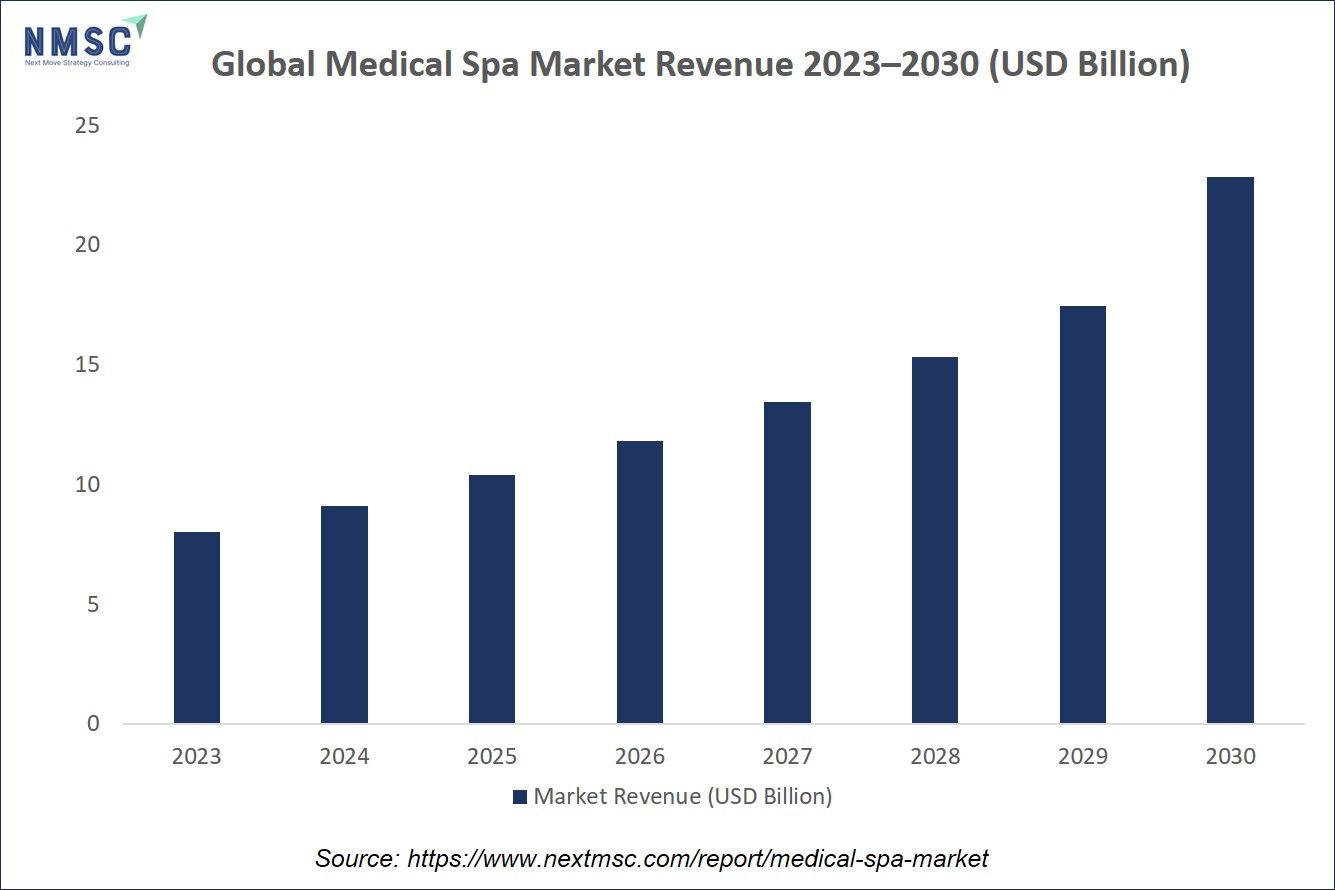
For C-level executives, institutional investors, and practice operators navigating this landscape, understanding the forces reshaping the medical spa market is no longer optional — it is a strategic imperative. According to Next Move Strategy Consulting (NMSC), the global medical spa market is projected to reach USD 22.85 billion by 2030, expanding at a compound annual growth rate (CAGR) of 13.9% from 2024 to 2030. This trajectory reflects not only robust consumer appetite for medically supervised aesthetic services but also the industry's growing sophistication in clinical delivery, technology adoption, and compliance infrastructure.
This report synthesizes the most consequential developments shaping the Medical Spa Market in 2026 — from landmark FDA enforcement actions and sweeping state legislation to the mainstreaming of AI-driven practice management — to equip decision-makers with the intelligence required to act with confidence.
For More Information: Download FREE Sample on Medical Spa Market Report
Regulatory Reckoning and Innovation: The Dual Forces Defining the Medical Spa Market in 2026
The FDA's Escalating Enforcement Posture
The single most consequential development in the medical spa market in 2026 has been the dramatic intensification of federal regulatory enforcement. On April 1, 2026, the U.S. Food and Drug Administration (FDA) issued its first-ever Drug Supply Chain Security Act (DSCSA) warning letter directly to a medical spa — a facility in Southlake, Texas — after inspectors found that the volume of Botox administered significantly exceeded the quantity purchased from authorized trading partners, raising serious concerns about unauthorized product sourcing. This action marked a pivotal shift: FDA enforcement under the DSCSA now extends beyond wholesale distributors and manufacturers to individual dispensing practices, including medical spas.
This enforcement action did not occur in isolation. The FDA had previously issued more than 55 warning letters to online sellers of compounded GLP-1 products in September 2025, followed by an additional 30 letters to telehealth companies in March 2026. On June 8, 2026, the FDA issued 25 further warning letters to telehealth companies for false and misleading marketing of compounded GLP-1 products, including semaglutide and tirzepatide, citing marketing claims that implied equivalence with FDA-approved drugs. These actions stem directly from the FDA's 2025 removal of semaglutide and tirzepatide from the federal drug shortage list, which eliminated the legal basis for mass-compounding these medications.
A study published in JAMA Health Forum by researchers at the University of Colorado Anschutz Medical Campus, using a "secret shopper" methodology, found that compounded GLP-1 medications remain widely available at many weight-loss clinics and medical spas despite the end of FDA shortages. Among the 23 compounding pharmacies supplying the 75 clinics and medical spas identified in the study, four lacked licenses required for sterile compounding, while several had recent disciplinary actions or FDA warning letters related to sterile compounding practices.
A Wave of State-Level Legislation
Concurrent with federal action, a wave of state-level legislation is fundamentally restructuring the legal framework governing medical spa operations across the United States. According to a legal alert published by Holland & Knight on August 5, 2026, the violations identified across federal and state enforcement efforts are strikingly consistent: unlicensed practice of medicine, absent or inadequate medical oversight, counterfeit and unlawfully compounded products, deceptive marketing, sanitation failures, and documentation deficiencies.
Indiana's Senate Enrolled Act 282, signed in March 2026 and effective July 1, 2026, represents the most comprehensive regulatory framework for medical spas enacted in the United States to date. It requires medical spas to register with the Indiana Medical Licensing Board beginning January 1, 2027, designate a responsible practitioner to oversee facility operations, report serious adverse events, and comply with healthcare provider advertising laws. The law imposes fines of up to USD 5,000 for operating an unregistered medical spa.
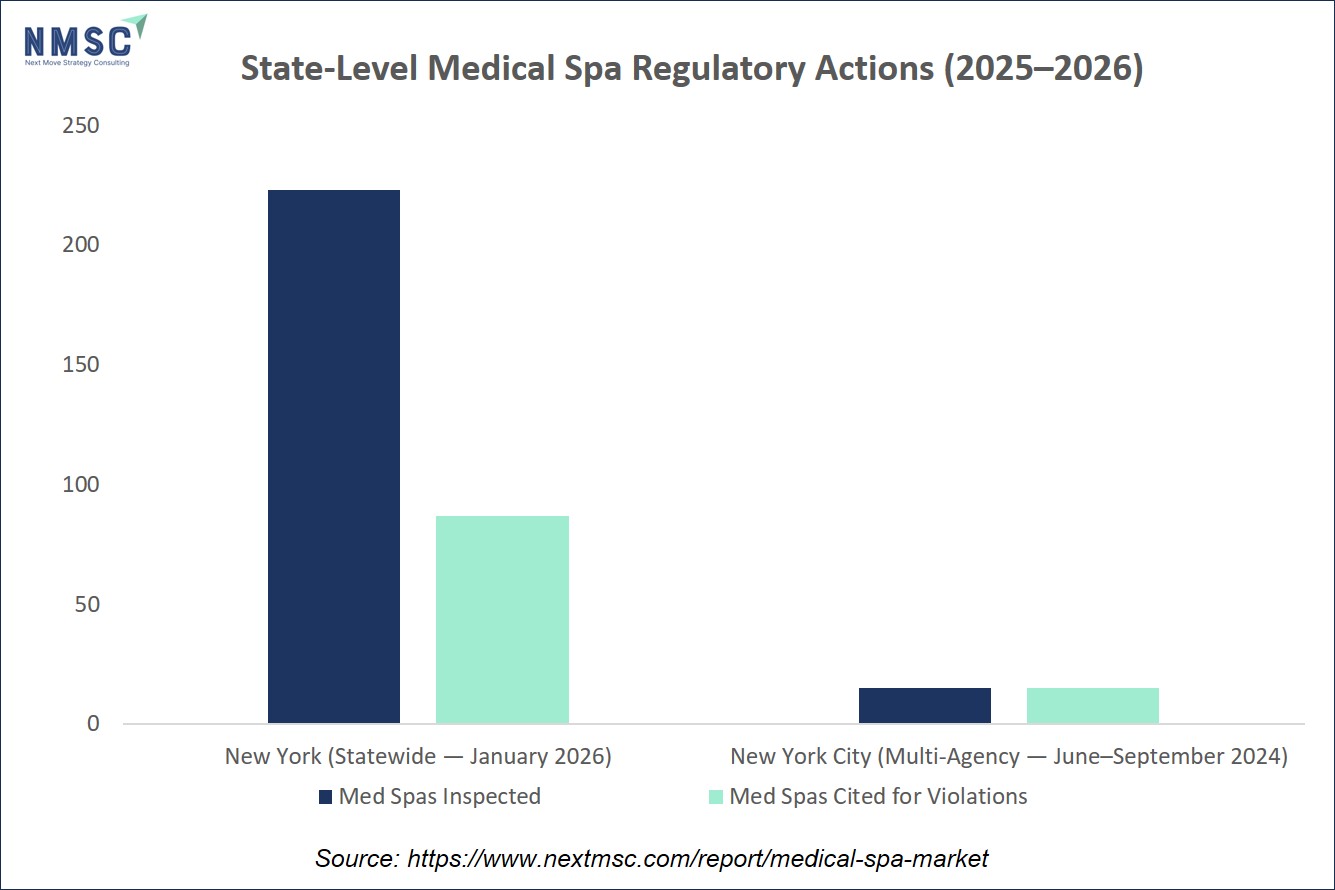
In New York, a statewide enforcement expansion led by the Department of State resulted in the inspection of more than 200 medical spas, with 87 cited for possible violations including the unlawful practice of medicine. Penalties have included monetary fines, license suspensions, license revocations, and in the most serious cases, criminal charges.
AI, Regenerative Medicine, and the New Practice Paradigm
Against this regulatory backdrop, the Medical Spa Show 2026 — held April 9–12 at the Wynn Las Vegas with more than 2,000 attendees — crystallized the industry's dual mandate: innovate responsibly while building compliance-first operations. The American Med Spa Association (AmSpa) introduced the Aesthetic Tech, Innovation & AI Summit as a dedicated full-day pre-conference event, reflecting the degree to which artificial intelligence and automation have entered the everyday reality of medical spa practice management.
Practical AI applications now in active deployment across high-performing medical spas include AI-powered lead management systems that capture and respond to patient inquiries across multiple channels, predictive scheduling tools that reduce provider downtime, automated patient communication workflows, and AI-assisted skin analysis platforms that enable more precise treatment planning.
Simultaneously, the continued expansion of regenerative medicine, longevity-focused therapies, and wellness-adjacent offerings emerged as a defining theme at Medical Spa Show 2026. Practice owners are actively exploring how evolving patient interest in cellular aging, metabolic support, hormone optimization, and regenerative aesthetics intersects with new clinical possibilities — while navigating the regulatory implications of these emerging treatment categories.
NMSC Strategic Perspective: Compliance as a Competitive Differentiator
From Next Move Strategy Consulting's analytical standpoint, the convergence of escalating enforcement and accelerating innovation represents a market maturation event rather than a headwind. The medical spa market is transitioning from a fragmented, lightly regulated cottage industry into a structured healthcare-adjacent sector with institutional-grade compliance expectations. Operators who invest proactively in compliance infrastructure — genuine medical director oversight, traceable product sourcing, documented delegation protocols, and robust staff training — are positioning themselves to capture disproportionate market share as under-compliant competitors face enforcement-driven attrition.
NMSC's analysis further indicates that the integration of AI-driven practice management tools is not merely an operational efficiency play; it is increasingly a patient retention and revenue optimization strategy. Practices that deploy AI for personalized patient communication, predictive treatment scheduling, and data-driven service mix optimization are demonstrating measurably higher patient lifetime value and lower administrative overhead — a combination that directly supports the sustained CAGR of 13.9% projected through 2030.
Section Summary: The medical spa market in 2026 is defined by the simultaneous intensification of regulatory enforcement and the mainstreaming of AI-driven innovation. Operators who treat compliance as a strategic asset — rather than a cost center — are best positioned to capitalize on the market's long-term growth trajectory.
Key Takeaways:
-
The FDA issued its first-ever DSCSA warning letter directly to a medical spa in April 2026, signaling that federal enforcement now reaches individual dispensing practices.
-
Indiana enacted the most comprehensive state-level medical spa regulatory framework in U.S. history, effective July 1, 2026.
-
New York inspected more than 200 medical spas and cited 87 for violations, with penalties including criminal charges.
-
AI and regenerative medicine are the two most consequential innovation vectors reshaping medical spa practice models in 2026.
Industry Impact Analysis
The Compliance Imperative: Operational and Financial Consequences
The regulatory tightening underway across the medical spa market carries direct and material operational consequences for practice owners, investors, and multi-site operators. The Holland & Knight legal alert of August 5, 2026, identifies three cross-state enforcement priorities that operators nationwide must address: unlicensed practice of medicine and inadequate physician oversight; product sourcing, labeling, and traceability; and sanitation, safety recordkeeping, and documentation gaps.
The financial exposure is significant. Indiana's new law imposes fines of up to USD 5,000 per violation for operating an unregistered medical spa, while New York's enforcement actions have resulted in license revocations and criminal charges. For multi-site operators and private equity-backed platforms, the reputational and operational risk of non-compliance now constitutes a material due diligence consideration.
The "matchmaker medical director" model — arrangements in which a physician signs a contract but provides no genuine clinical oversight — is now explicitly targeted by regulators in multiple jurisdictions. The Georgia Composite Medical Board issued a position statement on May 7, 2026, interpreting existing Georgia law to prohibit third-party physician-matching services that are paid for assigning or routing remuneration to a delegating physician.
The GLP-1 Disruption: Revenue Risk and Patient Safety
The FDA's enforcement actions against compounded GLP-1 products represent a specific and immediate revenue risk for medical spas that have built weight management service lines around compounded semaglutide and tirzepatide. The CU Anschutz study published in JAMA Health Forum found that many clinics and medical spas continue to offer these products despite the end of FDA shortages, with some sourcing from pharmacies that lacked sterile compounding licenses or had recent disciplinary actions.
Lead researcher Michael J. DiStefano, PhD, MBE, of the University of Colorado Anschutz Skaggs School of Pharmacy and Pharmaceutical Sciences, noted: "Our findings suggest this market didn't shrink after the shortages ended as many expected. Instead, it has remained remarkably robust, raising important questions about how these products are regulated and how patients can know whether they're receiving medications that meet appropriate quality standards."
Technology Adoption: Operational Efficiency and Patient Experience
The mainstreaming of AI and automation in medical spa operations is generating measurable improvements in practice efficiency and patient experience. At Medical Spa Show 2026, practice owners discussed real-world applications including faster lead response systems, scheduling support, patient communication workflows, and operational efficiencies that reduce administrative burden on clinical staff. The consensus among experienced operators was that the question is no longer whether to use technology, but how to use it without losing the personal connection patients expect in medical aesthetics.
Electronic medical record (EMR) systems, customer relationship management (CRM) platforms, lead management systems (LMS), and AI-powered marketing automation tools are now considered foundational infrastructure for high-performing aesthetic practices. The integration of these systems enables practices to segment patients by treatment interest, automate recall campaigns, and generate the revenue analytics required for data-driven decision-making.
Geographic Dynamics: North America and Europe Lead, Asia-Pacific Accelerates
According to NMSC's analysis, Europe holds a significant share of the global medical spa market, driven by the high prevalence of skin conditions such as acne, eczema, and rosacea, and by consistent growth in household disposable income. The Office for National Statistics (ONS) Household Finances Survey estimated the median household disposable income in the U.K. for the financial year ending 2022 at approximately USD 34,450, supporting sustained demand for premium aesthetic services.
North America is expected to show a steady rise in the medical spa market, driven by the growing importance placed on wellness and self-care. The International Spa Association reported that the spa industry in the U.S. generated approximately USD 18.1 billion in revenue in 2021, representing a 50% increase compared to the prior year's revenue of approximately USD 12.1 billion. This upward trajectory has continued, with the OECD Better Life Index noting that the average per capita net-adjusted household disposable income in Canada amounts to USD 34,421, further supporting discretionary spending on medical spa services.
Section Summary: The medical spa market's industry impact in 2026 is shaped by three converging forces: regulatory enforcement that is eliminating non-compliant operators, GLP-1 product disruption that is restructuring weight management service lines, and technology adoption that is separating high-performing practices from the rest. Geographic expansion into Asia-Pacific and continued strength in North America and Europe underpin the market's long-term growth thesis.
Key Takeaways:
-
The "matchmaker medical director" model is now explicitly prohibited in multiple U.S. jurisdictions, with enforcement actions carrying criminal liability.
-
Compounded GLP-1 products remain a significant compliance risk, with some medical spas sourcing from pharmacies lacking sterile compounding licenses.
-
AI-driven practice management tools — EMR, CRM, LMS, and automated marketing — are now foundational infrastructure for competitive medical spa operations.
-
North America and Europe lead global market share, while Asia-Pacific represents the highest-growth regional opportunity.
Future Outlook & Forecast
NMSC Market Forecast: A USD 22.85 Billion Opportunity by 2030
According to Next Move Strategy Consulting, the global medical spa market is projected to grow USD 22.85 billion by 2030, at a CAGR of 13.9%. This growth is underpinned by three primary drivers: the sustained increase in demand for non-invasive cosmetic procedures, the growing prioritization of wellness and self-care among individuals globally, and the rise in the incidence of skin-related conditions that drive patients toward medically supervised aesthetic treatments.
The NMSC report identifies technological advancements in skincare equipment as the most significant opportunity driver for the forecast period. The growing implementation of advanced technologies — including advanced serum infusion facials, radiofrequency micro-needling, and next-generation laser platforms — minimizes procedural pain and infection risk while delivering superior clinical outcomes, creating ample growth opportunities for key market players.
The primary restraint identified by NMSC is the high cost of spa equipment and the consequent surge in procedure costs. The acquisition of advanced laser and light therapy devices carries significant capital expenditure, with ongoing maintenance, calibration, and upgrade costs further compressing margins for smaller operators. This dynamic is expected to accelerate consolidation, with group ownership and multi-site platforms gaining market share at the expense of single-ownership practices.
Strategic Implications: Compliance-Driven Consolidation and Technology-Led Differentiation
The regulatory environment of 2026 is functioning as a market consolidation catalyst. As enforcement actions eliminate non-compliant operators and compliance costs rise, well-capitalized group ownership platforms and medical practice-associated spas are positioned to absorb market share from single-ownership practices that lack the resources to build institutional-grade compliance infrastructure. This dynamic is consistent with NMSC's segmentation analysis, which tracks group ownership and medical practices associate spa models as distinct and growing service provider categories within the global market.
The integration of AI and automation into practice operations will increasingly function as a revenue optimization lever rather than merely a cost reduction tool. Practices that deploy predictive analytics to forecast demand by season and service, AI-assisted consultation tools that improve treatment planning precision, and automated membership and loyalty programs that generate predictable recurring revenue will demonstrate superior financial performance metrics — making them more attractive acquisition targets for institutional investors and private equity platforms.
The regenerative medicine and longevity therapy segment represents the highest-potential growth vector for the medical spa market beyond 2026. As clinical evidence accumulates for treatments including peptide therapies, hormone optimization, and cellular aging interventions, and as regulatory frameworks mature to accommodate these modalities, medical spas that have built the clinical credibility and compliance infrastructure to deliver these services responsibly will command significant pricing power and patient loyalty.
Section Summary: The global medical spa market is on a clear trajectory toward USD 22.85 billion by 2030, driven by non-invasive procedure demand, wellness culture, and technological innovation. Regulatory consolidation, AI-driven practice management, and the emergence of regenerative medicine as a mainstream service category are the three strategic themes that will define competitive positioning through the end of the decade.
Key Takeaways:
NMSC projects the global medical spa market to reach USD 22.85 billion by 2030 at a CAGR of 13.9% from 2024 to 2030.
Regulatory enforcement is accelerating market consolidation, favoring well-capitalized group ownership and medical practice-associated spa models.
AI-driven practice management tools are transitioning from operational efficiency plays to revenue optimization and patient retention strategies.
Regenerative medicine and longevity therapies represent the highest-potential growth segment for the post-2026 medical spa market.
Next Steps for Stakeholders
For Medical Spa Owners and Operators:
Conduct an immediate compliance audit against the enforcement priorities identified by federal and state regulators in 2026: genuine medical director engagement, documented delegation protocols, traceable product sourcing from authorized distributors, and verified compounding pharmacy credentials. Practices that have relied on compounded GLP-1 products must assess their current sourcing arrangements against the FDA's updated enforcement posture and consult legal counsel experienced in medical spa regulatory matters. Invest in next-generation EMR, CRM, and AI-powered lead management systems as foundational infrastructure — not optional enhancements.
For Private Equity Investors and M&A Advisors:
Treat compliance infrastructure as a primary due diligence variable in medical spa acquisitions. The regulatory environment of 2026 has materially elevated the risk profile of non-compliant targets. Prioritize platforms with documented medical director oversight, institutional-grade product sourcing protocols, and technology stacks that generate auditable operational data. The consolidation dynamic underway in the market creates attractive acquisition opportunities among compliant single-ownership practices that lack the capital to scale independently.
For Technology and Equipment Vendors:
The Aesthetic Tech, Innovation & AI Summit at Medical Spa Show 2026 demonstrated that medical spa operators are actively seeking practical, compliance-aligned technology solutions — not theoretical AI capabilities. Vendors that can demonstrate clear ROI through improved lead conversion rates, reduced administrative overhead, and enhanced patient retention metrics will find a receptive and growing customer base. Prioritize integrations with existing EMR and compliance documentation systems to reduce implementation friction.
For Institutional Investors and Healthcare REITs:
The NMSC forecast of 13.9% CAGR through 2030 positions the medical spa market as one of the most compelling growth opportunities within the broader healthcare-adjacent services sector. Geographic diversification across North America, Europe, and Asia-Pacific provides natural risk mitigation. Monitor the regulatory consolidation dynamic closely — the elimination of non-compliant operators is a structural tailwind for well-positioned platforms, not a sector-wide headwind.
Conclusion
The medical spa market in 2026 is not simply growing — it is maturing. The convergence of landmark FDA enforcement actions, comprehensive state-level legislation, AI-driven practice transformation, and the emergence of regenerative medicine as a mainstream service category is reshaping the competitive landscape in ways that will determine which operators, investors, and technology providers capture the market's long-term value.
Next Move Strategy Consulting's projection of a USD 22.85 billion global medical spa market by 2030, expanding at a CAGR of 13.9%, reflects a sector with durable structural growth drivers. However, the path to capturing that growth runs directly through compliance excellence, technology adoption, and clinical credibility. The practices, platforms, and investors that internalize this reality today will be the ones defining the medical spa market of tomorrow.
About the Author
 Sanyukta Deb
— Sanyukta Deb is Digital Marketing Team Lead at Next Move Strategy Consulting, where she has led content strategy and technical SEO for the firm's B2B market research publications for over 2 years. Her editorial process translates NextMSC's primary and secondary research — spanning technology, industrial, and consumer sectors — into commercial narratives, backed by search-intent, keyword, and competitive analysis. She brings 5 years of overall experience in digital marketing and content strategy.
Sanyukta Deb
— Sanyukta Deb is Digital Marketing Team Lead at Next Move Strategy Consulting, where she has led content strategy and technical SEO for the firm's B2B market research publications for over 2 years. Her editorial process translates NextMSC's primary and secondary research — spanning technology, industrial, and consumer sectors — into commercial narratives, backed by search-intent, keyword, and competitive analysis. She brings 5 years of overall experience in digital marketing and content strategy.
About the Reviewer
 Debashree Dey
— Debashree Dey is Assistant Manager at Next Move Strategy Consulting, where she supports cross-vertical market content and communications across diverse industries for 6 years. Her professional background includes senior content writing, communications, and published manuscript authorship, with experience developing audience-focused business narratives and maintaining clear, consistent messaging. Her role supports research-led content development and editorial quality across NextMSC publications.
Debashree Dey
— Debashree Dey is Assistant Manager at Next Move Strategy Consulting, where she supports cross-vertical market content and communications across diverse industries for 6 years. Her professional background includes senior content writing, communications, and published manuscript authorship, with experience developing audience-focused business narratives and maintaining clear, consistent messaging. Her role supports research-led content development and editorial quality across NextMSC publications.

















Add Comment