Biometric Payment Cards: The Fingerprint Revolution Reshaping Banking
Introduction
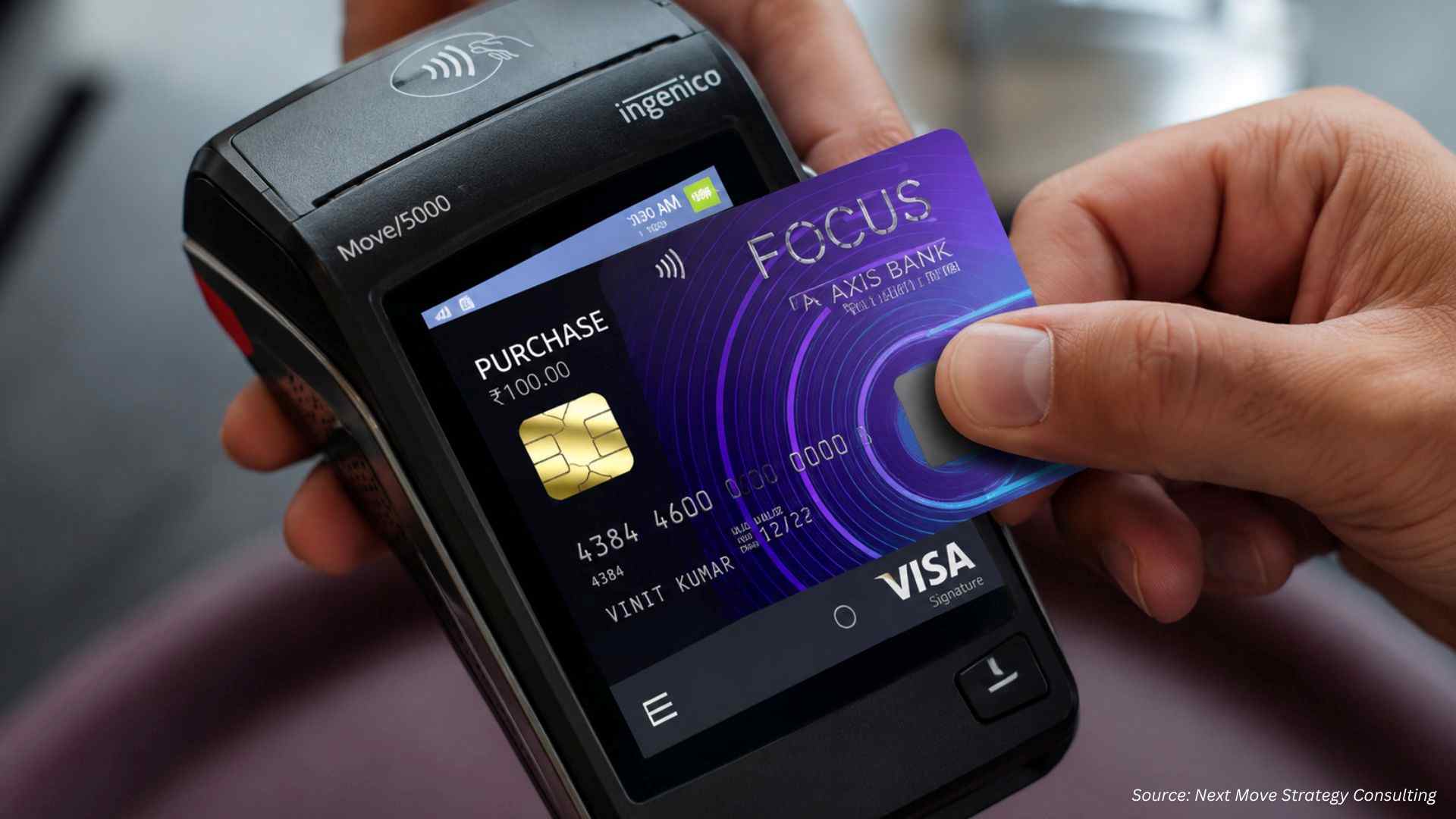
The plastic payment card—largely unchanged in form for half a century—is undergoing its most consequential reinvention yet. As card fraud losses continue to strain issuers and consumers demand both speed and security at the point of sale, the biometric payment cards market has moved decisively from pilot programs to commercial scale. These fingerprint-enabled smart cards combine the familiarity of a contactless card with on-card biometric authentication, eliminating PIN entry while keeping sensitive data stored locally on the card itself.
For More Information – Download FREE Sample on Biometric Payment Cards Market Report
For C-level executives at issuing banks, payment networks, and fintech challengers, the strategic question is no longer whether biometric authentication will define the next era of payments, but how quickly to position for it. With payment giants accelerating their transition away from manual card entry and passwords, and contactless transaction volumes setting new records across major economies, the future of contactless biometric payments is arriving faster than most balance sheets have planned for.
The Fingerprint Tipping Point: A Market Crossing into the Mainstream
In February 2026, Mastercard confirmed it was already halfway toward its stated goal of phasing out manual card entry online across Europe and moving fully to biometrics and tokenization by 2030. This milestone signals that the world's largest payment networks are not merely experimenting with biometric authentication but actively engineering passwords and plastic out of the checkout experience. In parallel, Visa entered into a definitive agreement to acquire Argentinian processors Prisma and Newpay, a deal explicitly structured to accelerate the deployment of tokenization, biometric authentication, and agentic commerce solutions across Latin America. The transaction is expected to close in Visa's fiscal second quarter of 2026.
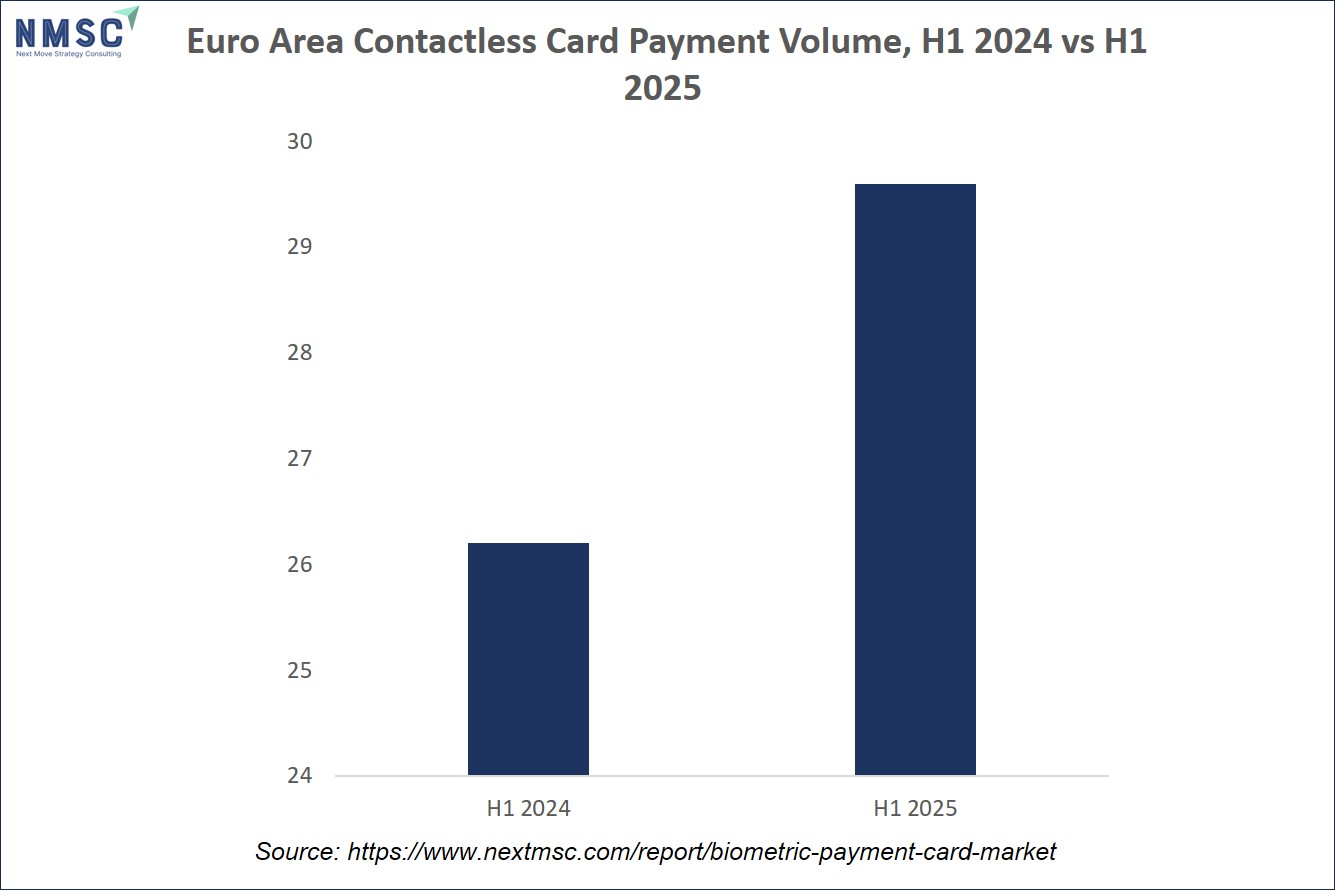
The infrastructure to support this shift is now substantially in place. According to the European Central Bank, the number of point-of-sale terminals in the euro area reached approximately 24.7 million by mid-2025, of which 93% accepted contactless transactions. Contactless card payments at physical terminals climbed to 29.6 billion in the first half of 2025, a 12.8% increase over the same period a year earlier, while the total value rose 13.9% to €0.8 trillion. Because biometric payment cards operate over the same contactless rails, this near-universal terminal readiness removes the single largest historical barrier to biometric smart card adoption.
NMSC Strategic Perspective
In the assessment of Next Move Strategy Consulting, the Mastercard 2030 transition is the most important demand catalyst the biometric card category has encountered. The strategic significance lies not in the technology itself, which has been viable for several years, but in the network-level mandate that aligns issuer economics, merchant infrastructure, and consumer expectation simultaneously. NMSC's analysis indicates that issuers who delay biometric card programs beyond the 2026–2027 window risk ceding the premium customer relationship to fintech challengers and digital wallets, which already leverage fingerprint and facial authentication natively. The competitive advantage of fingerprint cards is therefore time-sensitive: it accrues disproportionately to early movers who capture high-value cardholders before the feature becomes a baseline expectation rather than a differentiator.
Section Summary: The biometric payment cards market has reached an inflection point driven by network-level commitments and near-complete contactless terminal penetration. The convergence of Mastercard's 2030 roadmap, Visa's strategic acquisitions, and record contactless volumes confirms that the category is transitioning from pilot to scale.
-
Mastercard reported it is halfway to phasing out manual card entry in Europe by 2030.
-
Euro area contactless payments rose 12.8% year-on-year to 29.6 billion transactions in H1 2025.
-
93% of euro area POS terminals now accept contactless transactions, removing the primary adoption barrier.
-
NMSC views the 2026–2027 window as decisive for issuers seeking first-mover advantage.
Industry Impact Analysis
The business case for biometric payment cards is anchored most directly in fraud economics. The Nilson Report found that global payment card fraud losses reached $33.41 billion in 2024, tied to global card volume of $51.92 trillion. Critically, the report attributes the recent bending of the fraud curve to artificial intelligence and layered defenses including PINs, chips, tokenization, and encryption—precisely the security stack that on-card biometrics reinforce. The Nilson Report further projects that fraud losses will rise to $41.06 billion by 2030, indicating that the underlying threat continues to scale alongside transaction volume.
Biometric authentication directly addresses the most stubborn category of loss. The Nilson Report observed that social engineering scams now plague all world regions, with consumers having become the weakest link in the fight against fraud. Because a fingerprint cannot be socially engineered, phished, or shoulder-surfed in the way a PIN can, the biometric card shifts authentication from something the cardholder knows to something the cardholder is—structurally neutralizing a leading fraud vector.
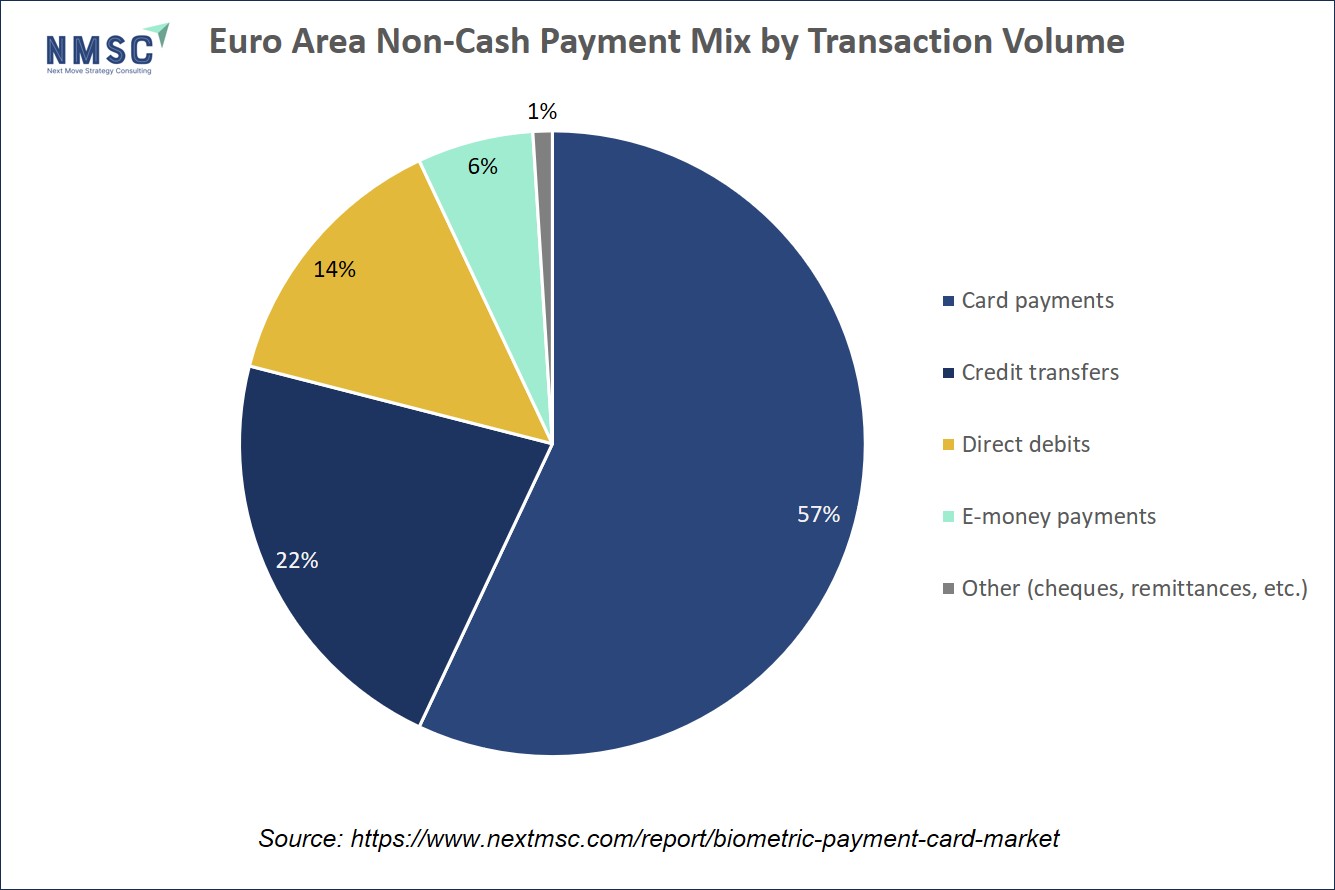
Adoption readiness is uneven across geographies, which shapes the rollout calculus for multinational issuers. The European Central Bank reported that the number of payment cards in circulation across the euro area reached 879.3 million by mid-2025, a 12.2% increase year-on-year, averaging 2.5 cards per inhabitant. Card payments accounted for 57% of all non-cash transactions in the euro area in the first half of 2025. This dense, card-centric, contactless-ready base positions Europe as a natural early market for biometric card issuance.
Section Summary: Persistent and rising fraud losses, combined with the migration of fraud toward social engineering, create a compelling structural rationale for biometric authentication. Mature card markets with high contactless penetration are best positioned for initial deployment.
-
Global card fraud losses stood at $33.41 billion in 2024 and are projected to reach $41.06 billion by 2030.
-
Social engineering has become the leading fraud vector, which on-card biometrics directly mitigate.
-
Euro area payment cards in circulation grew 12.2% year-on-year to 879.3 million by mid-2025.
-
Card payments represented 57% of euro area non-cash transactions, underscoring strong market readiness.
Pros and Cons of Recent Market Developments
|
Pros |
Cons |
|
On-card fingerprint storage neutralizes phishing and social engineering, the fastest-growing fraud vector |
Per-unit issuance cost remains materially higher than standard contactless cards |
|
Operates over existing contactless rails; 93% of euro area POS terminals are already compatible |
Consumer enrollment and education add friction to the activation journey |
|
Removes contactless transaction value limits, enabling higher-value tap purchases |
Sensor reliability and battery-free power harvesting require ongoing engineering refinement |
|
Strengthens premium customer relationships and brand differentiation for issuers |
Return on investment depends on achieving sufficient issuance scale to amortize costs |
|
Aligns directly with Mastercard's 2030 biometric and tokenization roadmap |
Regulatory and data-protection frameworks for biometric data vary across jurisdictions |
Key Data & Statistics
Euro Area Payment & Contactless Infrastructure Indicators, H1 2025 (Source: European Central Bank)
|
Indicator |
Value |
Year-on-Year Change |
|
Contactless card payments (volume) |
29.6 billion |
+12.8% |
|
Contactless card payments (value) |
€0.8 trillion |
+13.9% |
|
Payment cards in circulation |
879.3 million |
+12.2% |
|
POS terminals |
24.7 million |
+24.0% |
|
Share of POS terminals accepting contactless |
93% |
— |
|
Card payments as share of non-cash transactions |
57% |
— |
Global Card Fraud Loss Trajectory (Source: The Nilson Report)
|
Metric |
2024 (Actual) |
2030 (Projected) |
2034 (Projected) |
|
Global card fraud losses |
$33.41 billion |
$41.06 billion |
$48.50 billion |
|
Associated global card volume |
$51.92 trillion |
$70.73 trillion |
$84.76 trillion |
The fraud loss figures and forward projections are sourced from the Nilson Report's January 2026 release.
The payment mix shares—card payments at 57%, credit transfers at 22%, direct debits at 14%, e-money at 6%, and other instruments at 1%—are reported by the European Central Bank for the first half of 2025.
Future Outlook & Forecast
The trajectory for biometric payment cards is one of exceptionally steep growth from a small base. According to Next Move Strategy Consulting, the biometric payment card market is projected to reach USD 11,438.4 million by 2030, expanding at a compound annual growth rate of 99.8% from 2025 to 2030. This near-doubling annually reflects the category's transition from niche pilots to network-endorsed mainstream issuance. Within NMSC's segmentation, contactless and dual-interface technologies are positioned to lead deployment, the BFSI end-user segment anchors near-term demand, and Asia-Pacific represents the fastest-growing regional market.
Several converging forces underpin this outlook. The macro environment continues to favor digital, contactless, and tokenized payment rails, a direction reinforced by the network commitments observed in early 2026. The fraud economics remain compelling, as global losses are projected to climb even as a percentage of volume declines, ensuring sustained issuer investment in stronger authentication. The Nilson Report notes that fraud as a share of total card sales fell to 6.43 cents per $100 in 2024 and is projected to decline incrementally over the next decade, evidence that layered security investments are delivering measurable returns.
For issuers modeling the return on investment of biometric cards, the strategic equation balances elevated per-unit production costs against reduced fraud liability, premium cardholder retention, and the avoidance of competitive displacement. As issuance scales and component costs decline along a typical technology cost curve, NMSC anticipates the unit economics will move decisively in favor of broad deployment within the forecast horizon.
Section Summary: The biometric payment card market is forecast to grow at a triple-digit CAGR through 2030, propelled by network mandates, fraud economics, and improving unit costs. Contactless and dual-interface formats, BFSI demand, and Asia-Pacific expansion will shape the growth profile.
-
NMSC projects the market to grow from USD 173.6 million in 2024 to USD 11,438.4 million by 2030 at a 99.8% CAGR.
-
Contactless and dual-interface technologies and the BFSI segment lead near-term adoption.
-
Asia-Pacific is identified as the fastest-growing regional market.
-
Declining fraud-per-$100 metrics validate continued issuer investment in advanced authentication.
Next Steps for Stakeholders
For issuing banks and payment executives, the immediate priority is to launch or expand biometric card pilots targeting high-value and fraud-sensitive cardholder segments, where the return on investment materializes fastest. Decision-makers should negotiate supply agreements now to secure favorable unit economics ahead of the demand surge implied by the network roadmaps. Investors evaluating the category should concentrate on the enabling supply chain—biometric sensor manufacturers, secure element and chip providers, and card personalization specialists—which capture value irrespective of which issuer wins the consumer relationship. Across all stakeholders, early engagement with jurisdiction-specific biometric data-protection requirements will reduce compliance risk and accelerate time to market.
Conclusion
The biometric payment cards market has crossed from proof of concept into commercial momentum, propelled by network-level commitments to a passwordless, tokenized future and reinforced by the unrelenting economics of card fraud. With contactless infrastructure effectively ubiquitous in mature markets and a forecast trajectory measured in triple-digit annual growth, the strategic advantage now belongs to organizations that act within the current window. For issuers, networks, and investors alike, biometric payment cards represent not a speculative bet but a calculable response to verifiable shifts in fraud, infrastructure, and consumer expectation.
About the Author
 Sanyukta Deb
— Sanyukta Deb is Digital Marketing Team Lead at Next Move Strategy Consulting, where she has led content strategy and technical SEO for the firm's B2B market research publications for over 2 years. Her editorial process translates NextMSC's primary and secondary research — spanning technology, industrial, and consumer sectors — into commercial narratives, backed by search-intent, keyword, and competitive analysis. She brings 5 years of overall experience in digital marketing and content strategy.
Sanyukta Deb
— Sanyukta Deb is Digital Marketing Team Lead at Next Move Strategy Consulting, where she has led content strategy and technical SEO for the firm's B2B market research publications for over 2 years. Her editorial process translates NextMSC's primary and secondary research — spanning technology, industrial, and consumer sectors — into commercial narratives, backed by search-intent, keyword, and competitive analysis. She brings 5 years of overall experience in digital marketing and content strategy.
About the Reviewer
 Debashree Dey
— Debashree Dey is Assistant Manager at Next Move Strategy Consulting, where she supports cross-vertical market content and communications across diverse industries for 6 years. Her professional background includes senior content writing, communications, and published manuscript authorship, with experience developing audience-focused business narratives and maintaining clear, consistent messaging. Her role supports research-led content development and editorial quality across NextMSC publications.
Debashree Dey
— Debashree Dey is Assistant Manager at Next Move Strategy Consulting, where she supports cross-vertical market content and communications across diverse industries for 6 years. Her professional background includes senior content writing, communications, and published manuscript authorship, with experience developing audience-focused business narratives and maintaining clear, consistent messaging. Her role supports research-led content development and editorial quality across NextMSC publications.


















Add Comment