Semiconductor Material Market: Strategic Expansion in 2025–2026
Introduction
The global semiconductor material market stands at a pivotal inflection point — shaped simultaneously by an AI-driven demand surge, sweeping trade policy interventions, and a structural reorientation of supply chains that has no modern precedent. According to Next Move Strategy Consulting's Semiconductor Material Market report, the global semiconductor material market was valued at USD 64.26 billion in 2024 and is projected to reach USD 82.45 billion by 2030, growing at a CAGR of 4.2% from 2025 to 2030.
This trajectory is being shaped by three converging forces: the accelerating penetration of 5G infrastructure requiring high-performance compound semiconductor materials, rising global defense procurement mandating radiation-hardened and thermally stable substrates, and the AI data center buildout redirecting wafer and packaging capacity at a scale that is creating material shortages across the supply chain. The market's growth, while measured in CAGR terms, masks a far more turbulent structural transformation — one that C-level executives and institutional investors cannot afford to misread.
For More Information: Download FREE Sample on Semiconductor Material Market Report
Proclamation 11002 and the Redrawing of the Semiconductor Material Supply Map
A Presidential Proclamation That Changed the Rules of Engagement
On January 14, 2026, the U.S. Executive Office of the President issued Proclamation 11002, published in the Federal Register (91 FR 2443), invoking Section 232 of the Trade Expansion Act of 1962 to impose a 25% ad valorem tariff on advanced computing chips, semiconductor manufacturing equipment, and their derivative products. The proclamation's findings were unambiguous: the United States currently fully manufactures only approximately 10% of the chips it requires, creating a structural dependency on foreign supply chains that the Secretary of Commerce formally classified as a national security threat.
This proclamation is not merely a trade measure — it is a structural demand signal for domestic semiconductor materials. When a government formally declares that its chip manufacturing base is insufficient to meet defense and commercial needs, the downstream consequence is a mandated expansion of domestic wafer fabrication, which in turn requires silicon wafers, photoresists, specialty gases, SiC substrates, and advanced packaging materials to be sourced, qualified, and scaled domestically. The tariff's exemptions — covering chips imported for U.S. data centers, R&D, startups, and public sector applications — were deliberately designed to protect AI infrastructure buildout while incentivizing domestic manufacturing of the underlying materials.
The private sector response has been substantial. As of September 22, 2026, the Semiconductor Industry Association (SIA) reported that companies across the U.S. semiconductor ecosystem have announced over 160 projects across 30 states, totaling more than USD 827.8 billion in private investments since 2020, expected to create and support over 525,000 American jobs. These investments span the full materials stack: Hemlock Semiconductor received a USD 325 million CHIPS grant to produce hyper-pure semiconductor-grade polysilicon in Michigan; Coherent received a USD 79 million grant to expand 150mm and 200mm SiC substrate manufacturing in Pennsylvania; and Bosch received a USD 225 million CHIPS grant for its 200mm SiC device factory in Roseville, California — a facility expected to comprise more than 40% of all U.S.-based SiC device manufacturing capacity once operational.
NMSC Strategic Perspective: Why Material Sovereignty Is the New Competitive Moat
NextMSC primary research and analysis identifies a critical structural dynamic that the headline tariff narrative obscures: the bottleneck in semiconductor manufacturing is not chip design or fab capacity alone — it is the upstream material supply chain. Silicon carbide substrates, high-purity polysilicon, specialty photoresists, and ultra-pure process chemicals each require years of qualification cycles before they can be substituted or domestically sourced at scale. The Proclamation 11002 tariff regime, combined with the CHIPS Act's material-specific grant awards, is effectively forcing a parallel qualification race across the entire wafer fab materials segment.
NextMSC primary research and analysis further indicates that the Asia-Pacific region's dominance in semiconductor materials — driven by its concentration of silicon wafer production, specialty chemical manufacturing, and advanced packaging capacity — will face its most significant structural challenge over the 2025–2030 forecast period, not from demand weakness, but from deliberate policy-driven supply chain bifurcation across North America and Europe. This bifurcation will not eliminate Asia-Pacific's leadership position within the NMSC forecast horizon, but it will compress the region's market share advantage and create new addressable markets for domestic material suppliers in the U.S. and EU.
Section Summary & Key Takeaways:
The January 2026 proclamation and the substantial U.S. semiconductor investment pipeline represent important policy and supply-chain developments for semiconductor materials.
-
The U.S. currently manufactures only ~10% of its chip requirements domestically, creating a structural pull for domestic semiconductor material production across silicon, SiC, GaN, and specialty chemical segments.
-
CHIPS Act material-specific grants — including USD 325 million for polysilicon (Hemlock), USD 79 million for SiC substrates (Coherent), and USD 225 million for SiC devices (Bosch) — are directly expanding the addressable market for domestic wafer fab materials.
-
The tariff exemptions for data center and AI applications preserve demand for high-performance semiconductor materials while redirecting manufacturing incentives toward domestic supply chains.
-
NextMSC primary research and analysis identifies upstream material qualification cycles — not fab construction timelines — as the primary constraint on the pace of U.S. semiconductor supply chain reshoring.
Industry Impact Analysis
The AI Demand Surge and Its Material Consequences
The Deloitte Center for Technology, Media & Telecommunications' 2026 Global Semiconductor Industry Outlook, published February 5, 2026, projects global semiconductor industry revenues to reach US$975 billion in 2026 — a 26% growth rate — with generative AI chips approaching US$500 billion in revenue, or roughly half of global chip sales. This concentration of value in AI chips has created a zero-sum competition for wafer and packaging capacity that is directly disrupting the semiconductor material supply chain.
Specifically, the surge in demand for High Bandwidth Memory 3 (HBM3), HBM4, and DDR7 memory for AI inference and training has caused shortages of consumer memory such as DDR4 and DDR5, with prices rising approximately 4x between September and November 2025. For semiconductor material suppliers, this translates into a bifurcated demand environment: high-value advanced packaging substrates, specialty bonding wires, and encapsulants for AI chips command premium pricing and face capacity constraints, while commodity packaging materials for consumer electronics face margin compression.
Silicon wafer shipments — the foundational input for virtually all semiconductor manufacturing — increased by an estimated 5.4% in 2025, according to SEMI's October 2025 press release, with a new shipment record projected by 2028. This modest wafer volume growth relative to the 22% revenue growth in 2025 illustrates the value concentration dynamic: the semiconductor material market's revenue growth is increasingly driven by material quality and specification upgrades rather than volume expansion alone.
Silicon Carbide: From Automotive Enabler to Strategic Defense Material
Silicon carbide has emerged as the semiconductor material with the most acute strategic significance in 2026. Writing in National Defense Magazine on July 22, 2026, defense technology analysts identified silicon carbide as "rapidly emerging as a key strategic material for future weapons systems and critical infrastructure," noting that its thermal stability, radiation hardness, and high-voltage switching efficiency make it irreplaceable in radar systems, electronic warfare platforms, and power management for directed-energy weapons.
On the commercial side, Texas Instruments entered mass production for gallium nitride power semiconductors in October 2024, expanding internal capacity from its Dallas, Texas facility to Aizu, Japan — a move that directly increases demand for GaN epitaxial wafer materials and specialty process gases. GlobalFoundries' Vermont facility, supported by a USD 125 million CHIPS grant, is being revitalized to become the first U.S. facility capable of high-volume manufacturing of next-generation Gallium Nitride on Silicon — targeting electric vehicles, power grid, and 5G/6G smartphone applications.
5G Infrastructure and the Compound Semiconductor Material Pull
GSMA Intelligence's 2026 data confirms 1.6 billion 5G connections worldwide, with projections of 5.5 billion connections by 2030. Each 5G base station requires gallium arsenide and gallium nitride power amplifiers, indium phosphide-based optical transceivers, and silicon carbide power management components — material categories that are distinct from the silicon-dominant consumer electronics supply chain. The transition from 4G to 5G infrastructure therefore represents a structural shift in the semiconductor material mix, not merely a volume increase.
Defense Expenditure as a Sustained Material Demand Driver
According to the Stockholm International Peace Research Institute (SIPRI), total global military expenditure reached USD 2.44 trillion in 2023, up from USD 2.28 trillion in 2022 — a 6.8% increase in a single year. The U.S. Department of Defense's Five-Year Defense Plan (FYDP) projects the DoD budget to climb to USD 866 billion (inflation-adjusted) by 2029, a 1.9% increase from 2025. Defense procurement specifications for radar, electronic warfare, and missile guidance systems require semiconductor materials — particularly SiC, GaN, and indium phosphide — that meet military-grade reliability standards, creating a demand segment that is structurally insulated from consumer electronics cyclicality.
Section Summary & Key Takeaways:
The semiconductor material market is being reshaped by three simultaneous demand vectors — AI infrastructure, 5G rollout, and defense modernization — each requiring distinct material specifications that are driving a qualitative upgrade cycle across the wafer fab and packaging materials segments.
-
The AI chip revenue surge to ~US$500 billion in 2026 is creating a zero-sum competition for advanced packaging substrates, bonding wire, and encapsulants, compressing margins for commodity packaging material suppliers while expanding them for advanced material providers.
-
Silicon carbide has been formally identified as a strategic defense material in 2026, with CHIPS Act grants specifically targeting domestic SiC substrate and device manufacturing capacity.
-
GSMA's projection of 5.5 billion 5G connections by 2030 represents a structural shift in the compound semiconductor material mix, increasing demand for GaN, GaAs, and InP-based materials beyond what silicon-centric supply chains can address.
-
Global military expenditure at USD 2.44 trillion (SIPRI, 2023) and the DoD's projected USD 866 billion budget by 2029 create a defense-grade material demand segment that is structurally decoupled from consumer electronics cycles.
Key Industry Data Points — Semiconductor Material Market Drivers (2025–2026)
|
Indicator |
Value |
Source |
Relevance to Semiconductor Materials |
|
Global semiconductor industry revenue (2026 projection) |
US$975 billion |
Deloitte Center for Technology, Media & Telecommunications, February 2026 |
Validates sustained demand for wafer fab and packaging materials across all nodes |
|
AI chip revenue (2026 estimate) |
~US$500 billion |
Deloitte, February 2026 |
Drives premium demand for advanced packaging substrates, HBM-compatible bonding materials |
|
Global silicon wafer shipment growth (2025) |
+5.4% |
SEMI, October 2025 (via Deloitte) |
Confirms volume growth in the foundational wafer fab material segment |
|
U.S. semiconductor supply chain private investments (2020–2026) |
USD 827.8 billion+ |
Semiconductor Industry Association (SIA), September 22, 2026 |
Direct demand signal for domestic material suppliers across polysilicon, SiC, GaN, and specialty chemicals |
|
CHIPS Act grant awards disbursed |
USD 34.08 billion across 36 companies, 53 projects |
SIA, September 22, 2026 |
Material-specific grants (SiC, GaN, polysilicon) directly expand domestic material production capacity |
|
Global 5G connections (current) |
1.6 billion |
GSMA Intelligence, 2026 |
Sustains compound semiconductor material demand (GaN, GaAs, InP) for base station and device applications |
|
Global 5G connections (2030 projection) |
5.5 billion |
GSMA Intelligence, 2026 |
Long-term demand anchor for compound semiconductor materials through the NMSC forecast horizon |
|
Global military expenditure (2023) |
USD 2.44 trillion |
Stockholm International Peace Research Institute (SIPRI) |
Defense-grade SiC, GaN, and InP material demand structurally insulated from consumer electronics cycles |
|
U.S. DoD budget projection (2029) |
USD 866 billion (inflation-adjusted) |
U.S. DoD Five-Year Defense Plan (FYDP) |
Sustained procurement of defense-grade semiconductor materials through 2030 |
|
U.S. domestic chip manufacturing share |
~10% of domestic consumption |
U.S. Executive Office of the President, Proclamation 11002, January 2026 |
Quantifies the scale of domestic material production expansion required to achieve supply chain resilience |
Future Outlook & Forecast
The 2025–2030 Horizon: Material Complexity as the Defining Variable
NextMSC primary research and analysis projects the global semiconductor material market to grow from USD 64.26 billion in 2024 to USD 82.45 billion by 2030 at a CAGR of 4.2%. This growth rate, while moderate in absolute percentage terms, reflects a market undergoing significant compositional change: the share of advanced materials — silicon carbide, gallium nitride, indium phosphide, and specialty packaging substrates — within the total market is expanding at a rate that outpaces the overall CAGR, while commodity silicon wafer volumes grow more slowly.
The Deloitte 2026 Semiconductor Industry Outlook identifies AI data center workloads as forecast to triple or quadruple annually between 2026 and 2030, requiring chip- and system-level integration that will demand increasingly sophisticated packaging materials — including advanced substrates for chiplet architectures, co-packaged optics components, and high-bandwidth flash storage materials. For semiconductor material suppliers, this translates into a sustained demand pull for materials that enable heterogeneous integration — a segment where Asia-Pacific's advanced packaging expertise currently provides a structural advantage that North American and European suppliers are actively working to replicate through CHIPS Act-funded investments.
The adoption of 6G technology — currently in early standardization phases — represents the next material demand frontier beyond the NMSC forecast horizon. 6G's requirements for terahertz-frequency operation will necessitate semiconductor materials with electron mobility and thermal conductivity characteristics that silicon cannot provide, positioning gallium nitride, indium phosphide, and potentially diamond-based substrates as the materials of the 6G era. Akash Systems' CHIPS Act-funded facility in West Oakland, California — specifically targeting diamond cooling substrates for defense and communications applications — represents an early-stage investment in this material category.
Regional Dynamics Through 2030
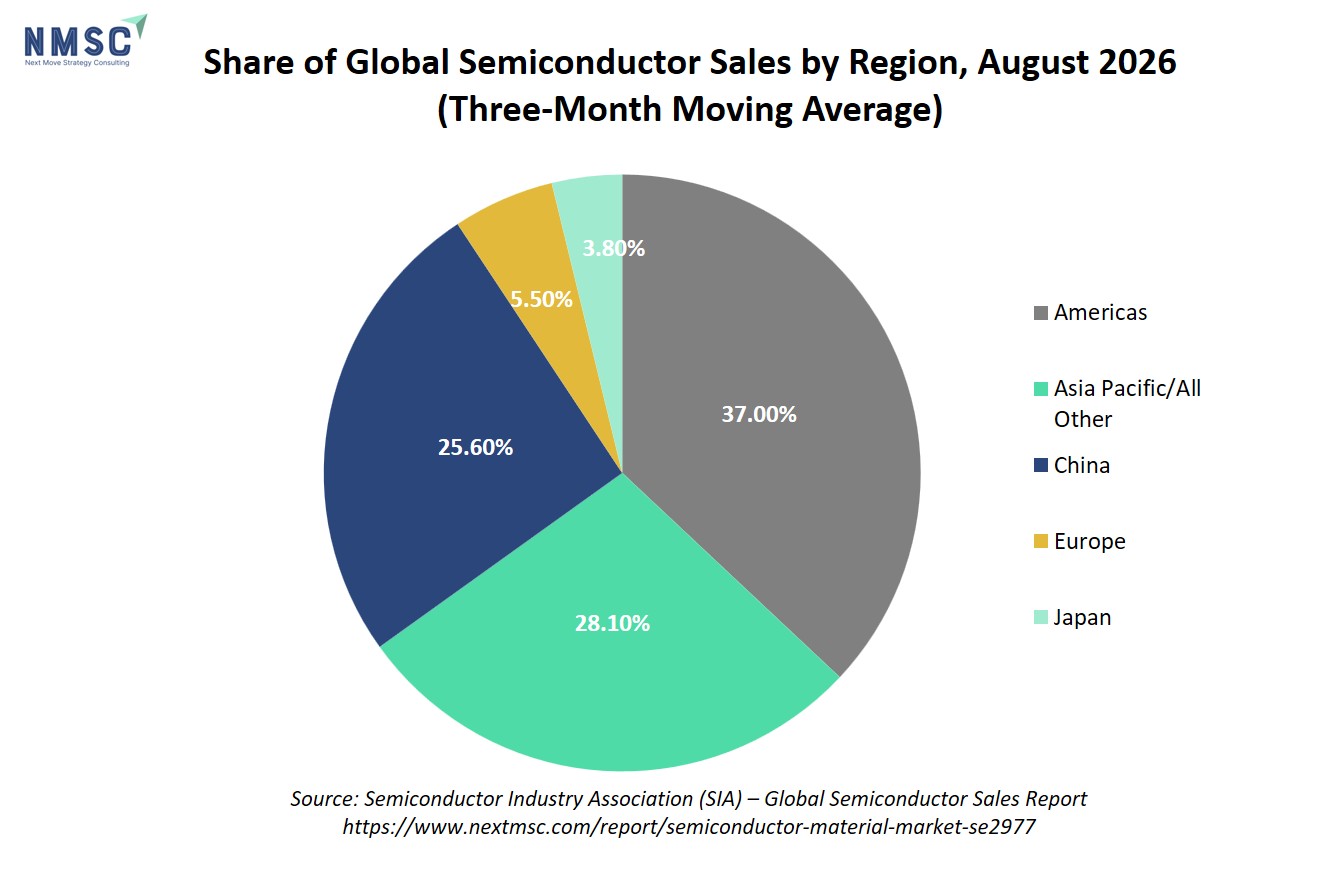
Asia-Pacific will retain its dominant position in the semiconductor material market through 2030, supported by GSMA's projection that smartphone connections in the region will reach 94% penetration by 2030, sustaining demand for silicon-based wafer fab materials and advanced packaging substrates. China's electric vehicle market — which recorded 8.1 million new EV registrations in 2023, a 35% increase over 2022, according to the International Energy Agency — will sustain demand for SiC power device materials within the region's automotive semiconductor supply chain.
North America's semiconductor material market share is projected to expand through 2030, driven by the CHIPS Act investment pipeline, the Section 232 tariff incentive structure, and the DoD's sustained procurement of defense-grade compound semiconductor materials. The 5G connection penetration rate in North America reached 55% of the total population in 2024, with growth projected to reach 90% by 2030 — a trajectory that will sustain demand for GaN and GaAs-based RF semiconductor materials throughout the forecast period.
Section Summary & Key Takeaways:
The semiconductor material market's 4.2% CAGR through 2030 understates the structural transformation occurring within the market's composition, as advanced materials displace commodity silicon in value share.
-
AI data center workloads forecast to triple or quadruple annually between 2026 and 2030 will sustain premium demand for advanced packaging substrates, chiplet integration materials, and co-packaged optics components.
-
6G technology standardization will create a new material demand frontier beyond 2030, positioning GaN, InP, and diamond-based substrates as the next-generation material categories requiring early investment and qualification.
-
Asia-Pacific will retain market dominance through 2030, but North America's CHIPS Act-funded material investment pipeline is creating a structural shift in the regional supply balance that will become measurable within the forecast horizon.
-
China's 8.1 million EV registrations in 2023 (IEA) and North America's 5G penetration trajectory to 90% by 2030 represent the two largest regional demand anchors for compound semiconductor materials through the NMSC forecast period.
Next Steps for Stakeholders
For C-Level Executives at Semiconductor Material Suppliers:
The Section 232 tariff structure and CHIPS Act grant pipeline have created a narrow but time-sensitive window to qualify domestic material production for U.S. fab customers. Suppliers with existing SiC substrate, GaN epitaxial wafer, or specialty chemical capabilities should prioritize CHIPS Act grant applications and accelerate customer qualification programs with U.S.-based fabs — particularly those receiving large CHIPS grants (Intel, TSMC Arizona, Samsung Taylor, Micron) — before the qualification windows close and incumbent suppliers lock in long-term supply agreements.
For Defense and Aerospace Procurement Officers:
The formal designation of silicon carbide as a strategic defense material in 2026 creates a procurement imperative to audit existing SiC supply chains for geographic concentration risk. Given China's significant position in SiC raw material supply, procurement officers should engage with CHIPS Act-funded domestic SiC suppliers — including Coherent (Easton, PA), Wolfspeed (Siler City, NC and Marcy, NY), and Bosch (Roseville, CA) — to establish dual-source supply agreements before defense program ramp-up creates capacity constraints.
For Institutional Investors:
The USD 827.8 billion in announced U.S. semiconductor supply chain investments (SIA, September 2026) represents a multi-decade capital deployment cycle. Investors should distinguish between near-term revenue beneficiaries — specialty chemical and process gas suppliers already qualified for existing U.S. fabs — and longer-term beneficiaries whose revenue ramp depends on new fab construction timelines extending to 2028–2032. Material qualification cycles of 18–36 months mean that revenue recognition for newly funded material suppliers will lag CHIPS grant announcements by a significant margin.
For Technology and Strategy Leaders:
The Deloitte 2026 Semiconductor Industry Outlook's identification of talent constraints in advanced packaging as a binding constraint on U.S. semiconductor autonomy applies equally to semiconductor material engineering. Organizations investing in domestic material production should treat workforce development — particularly in materials science, process chemistry, and metrology — as a parallel investment track to capital expenditure, not a downstream consideration.
Conclusion
The global semiconductor material market's trajectory to USD 82.45 billion by 2030, as projected by NextMSC primary research and analysis, is being shaped by forces that extend well beyond conventional demand cycles. Presidential Proclamation 11002's Section 232 tariff framework, the USD 827.8 billion U.S. semiconductor supply chain investment pipeline, the AI chip revenue surge approaching US$500 billion in 2026, and the formal designation of silicon carbide as a strategic defense material have collectively transformed the semiconductor material market from a component of the electronics supply chain into a domain of national security policy.
For executives and investors, the critical insight is this: the semiconductor material market's 4.2% CAGR is a market-level average that conceals a far more differentiated opportunity landscape. Advanced materials — SiC, GaN, InP, and specialty packaging substrates — are growing at rates that significantly exceed the market average, while commodity silicon wafer volumes grow more modestly. The organizations that will capture disproportionate value through 2030 are those that align their material portfolios, qualification programs, and capital allocation strategies with the specific material requirements of AI infrastructure, 5G/6G deployment, and defense modernization — the three demand vectors that are structurally reshaping this market.
About the Author
 Sanyukta Deb
— Sanyukta Deb is Digital Marketing Team Lead at Next Move Strategy Consulting, where she has led content strategy and technical SEO for the firm's B2B market research publications for over 2 years. Her editorial process translates NextMSC's primary and secondary research — spanning technology, industrial, and consumer sectors — into commercial narratives, backed by search-intent, keyword, and competitive analysis. She brings 5 years of overall experience in digital marketing and content strategy.
Sanyukta Deb
— Sanyukta Deb is Digital Marketing Team Lead at Next Move Strategy Consulting, where she has led content strategy and technical SEO for the firm's B2B market research publications for over 2 years. Her editorial process translates NextMSC's primary and secondary research — spanning technology, industrial, and consumer sectors — into commercial narratives, backed by search-intent, keyword, and competitive analysis. She brings 5 years of overall experience in digital marketing and content strategy.
About the Reviewer
 Debashree Dey
— Debashree Dey is Assistant Manager at Next Move Strategy Consulting, where she supports cross-vertical market content and communications across diverse industries for 6 years. Her professional background includes senior content writing, communications, and published manuscript authorship, with experience developing audience-focused business narratives and maintaining clear, consistent messaging. Her role supports research-led content development and editorial quality across NextMSC publications.
Debashree Dey
— Debashree Dey is Assistant Manager at Next Move Strategy Consulting, where she supports cross-vertical market content and communications across diverse industries for 6 years. Her professional background includes senior content writing, communications, and published manuscript authorship, with experience developing audience-focused business narratives and maintaining clear, consistent messaging. Her role supports research-led content development and editorial quality across NextMSC publications.


















Add Comment