Smart Home Security Market Trends, Stats & Forecasts 2026
Introduction
The global smart home security and surveillance market is undergoing a fundamental transformation. What was once a niche category reserved for high-value properties has evolved into a mainstream residential necessity, driven by the convergence of artificial intelligence, IoT connectivity, and an increasingly complex regulatory landscape. As of 2026, 61% of U.S. households have at least one security camera — a figure that has climbed 19 percentage points in just two years — underscoring the accelerating pace of adoption across demographics and income brackets.
The Smart Home Security and Surveillance Market now sits at a critical inflection point. Governments across the globe are enacting mandatory cybersecurity standards for connected devices, AI-powered surveillance capabilities are transitioning from premium features to baseline expectations, and the competitive landscape is being reshaped by the rise of DIY installation models and open interoperability protocols. For C-level executives, institutional investors, and strategic decision-makers, understanding the forces driving this market is no longer optional — it is a prerequisite for informed capital allocation and competitive positioning.
For More Information: Download FREE Sample on Smart Home Security and Surveillance Market Report
Regulatory Mandates and AI Integration: The Twin Forces Reshaping the Smart Home Security and Surveillance Market
A New Regulatory Era Begins
In one of the most consequential regulatory developments for the smart home security and surveillance market in recent memory, Australia's Cyber Security (Security Standards for Smart Devices) Rules 2025 formally commenced on 4 March 2026, following a 12-month transition period. The rules introduce mandatory cybersecurity standards for most smart devices acquired by consumers in Australia, including requirements for unique per-device passwords, transparent vulnerability reporting mechanisms, and published product support timelines. This initiative is a key action under Australia's 2023–2030 Cyber Security Strategy.
Simultaneously, in the United States, the Federal Communications Commission (FCC) has been advancing its U.S. Cyber Trust Mark program — a voluntary cybersecurity labeling initiative for wireless consumer IoT products. In April 2026, the ioXt Alliance was named as the program's Lead Administrator, and on August 11, 2026, the FCC opened a filing window for Cybersecurity Label Administrator applications. The program, grounded in criteria established by the National Institute of Standards and Technology (NIST), is designed to help consumers make informed purchasing decisions and create market incentives for manufacturers to meet higher cybersecurity standards. Eligible products include internet-connected home security cameras, video doorbells, smart locks, and baby monitors.
These regulatory developments are not isolated. The European Union's Data Act mandates open data ecosystems under Article 33, compelling manufacturers to abandon proprietary, closed-system architectures in favor of interoperable solutions. Together, these frameworks are fundamentally altering the cost structure, design requirements, and competitive dynamics of the smart home security and surveillance market.
AI-Driven Surveillance: From Feature to Foundation
Artificial intelligence has moved from a differentiating feature to a foundational capability within the smart home security and surveillance market. According to a nationally representative survey of 2,435 U.S. adults conducted by SafeHome.org between January and February 2026, 28% of home security device users already have AI-powered person and package detection, while 39% express interest in facial recognition capabilities — signaling that AI is on a rapid trajectory toward mainstream adoption.
The integration of edge AI is particularly significant. Rather than routing video data to the cloud for processing, edge AI enables smart home cameras to analyze footage locally on the device. This approach reduces latency to well below the 200-millisecond threshold that users perceive as seamless, enhances data privacy by keeping personally identifiable information on-device, and reduces manufacturers' compliance burden under frameworks such as the GDPR and the California Consumer Privacy Act (CCPA).
The Matter protocol has emerged as the universal interoperability standard for smart home devices, enabling a single device to function across Apple, Google, and Amazon ecosystems without complex re-pairing. For manufacturers, Matter compliance reduces SKU proliferation and lowers return rates caused by ecosystem incompatibility — a meaningful operational benefit in a market where hardware margins are under sustained pressure. However, Matter requires Thread, Wi-Fi, and Bluetooth LE to operate simultaneously, introducing significant RF complexity that demands advanced silicon architectures.
NMSC Strategic Perspective
According to Next Move Strategy Consulting (NMSC), the global smart home security and surveillance system market is projected to reach a valuation of USD 82.07 billion by 2030, with the forecast period spanning 2025 to 2030. NMSC identifies the growing acceptance of smart home technologies, heightened security concerns among residential consumers, and continuous technological advancements — particularly AI and machine learning integration — as the primary growth catalysts. The firm also highlights advanced real-time monitoring solutions as a compelling opportunity for market participants capable of delivering AI-driven, proactive surveillance capabilities tailored to evolving consumer needs.
NMSC's analysis underscores that while cybersecurity vulnerabilities and data privacy concerns remain meaningful restraints on adoption, the development of hardware-level security architectures and transparent regulatory frameworks is progressively addressing these barriers. The firm's segmentation covers components (hardware, software, and services), product types (smart cameras, smart door locks, smart alarms, and sensors), connectivity types (wired and wireless), communication modules (professionally monitored and self-monitored), installation methods (DIY and professional), and sales channels (online and offline).
Section Summary
The smart home security and surveillance market is being reshaped by two concurrent forces: mandatory regulatory frameworks that raise the cybersecurity baseline for connected devices, and the rapid integration of AI capabilities that are elevating consumer expectations. These forces are creating both compliance obligations and commercial opportunities for market participants.
Key Takeaways:
-
Australia's mandatory Cyber Security (Security Standards for Smart Devices) Rules 2025 commenced on 4 March 2026, setting a new global precedent for IoT device security requirements.
-
The FCC's U.S. Cyber Trust Mark program appointed ioXt Alliance as Lead Administrator in April 2026 and opened a Cybersecurity Label Administrator filing window on August 11, 2026.
-
28% of U.S. home security users already have AI person and package detection; 39% want facial recognition — signaling rapid AI mainstreaming.
-
NMSC projects the global smart home security and surveillance system market to reach USD 82.07 billion by 2030.
Industry Impact Analysis
The DIY Revolution and Its Market Implications
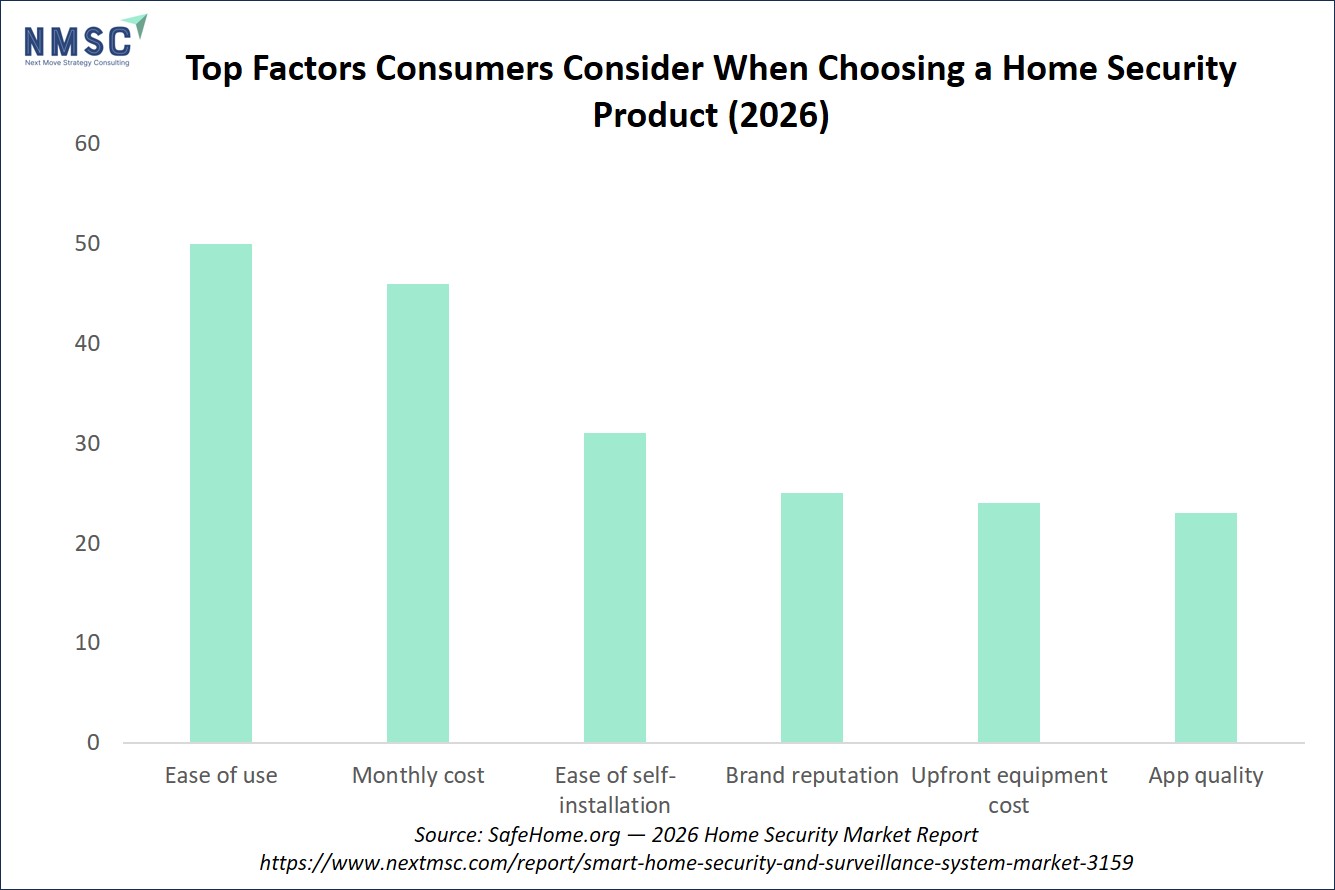
For the first time in recorded industry data, DIY installation has overtaken professional installation in the U.S. home security market. According to SafeHome.org's 2026 Home Security Market Report, 49% of alarm system users installed their own systems, compared to 42% who hired a professional. This structural shift carries significant implications for the competitive landscape of the smart home security and surveillance market.
The rise of DIY adoption is most pronounced among younger demographics: 54% of users aged 18–29 and 55% of those aged 30–44 installed their own systems, compared to 38% of users aged 60 and older. This generational divide reflects a broader consumer preference for app-managed, contract-free security solutions — a preference that has propelled brands such as Ring to commanding market positions. Ring is now identified as the primary home security brand by 43% of U.S. security camera and system users, nearly as often as all other brands combined.
The DIY trend is also reshaping the renter segment, which represents one of the fastest-growing opportunities in the market. Security camera adoption among renters jumped 12 percentage points in a single year — from 42% to 54% — the sharpest single-year gain in SafeHome.org's dataset. Products designed for renters — cable-free installation, portable hardware, no-contract plans — are well-positioned to capture this demand.
Privacy Concerns as a Market Constraint
Despite robust adoption growth, privacy concerns represent a meaningful and growing constraint on the smart home security and surveillance market. SafeHome.org's 2026 survey found that 37% of home security device users worry about who might have access to their footage, and 23% feel uneasy about the extent to which technology monitors their home. These are not marginal positions — they represent a substantial share of an already large user base.
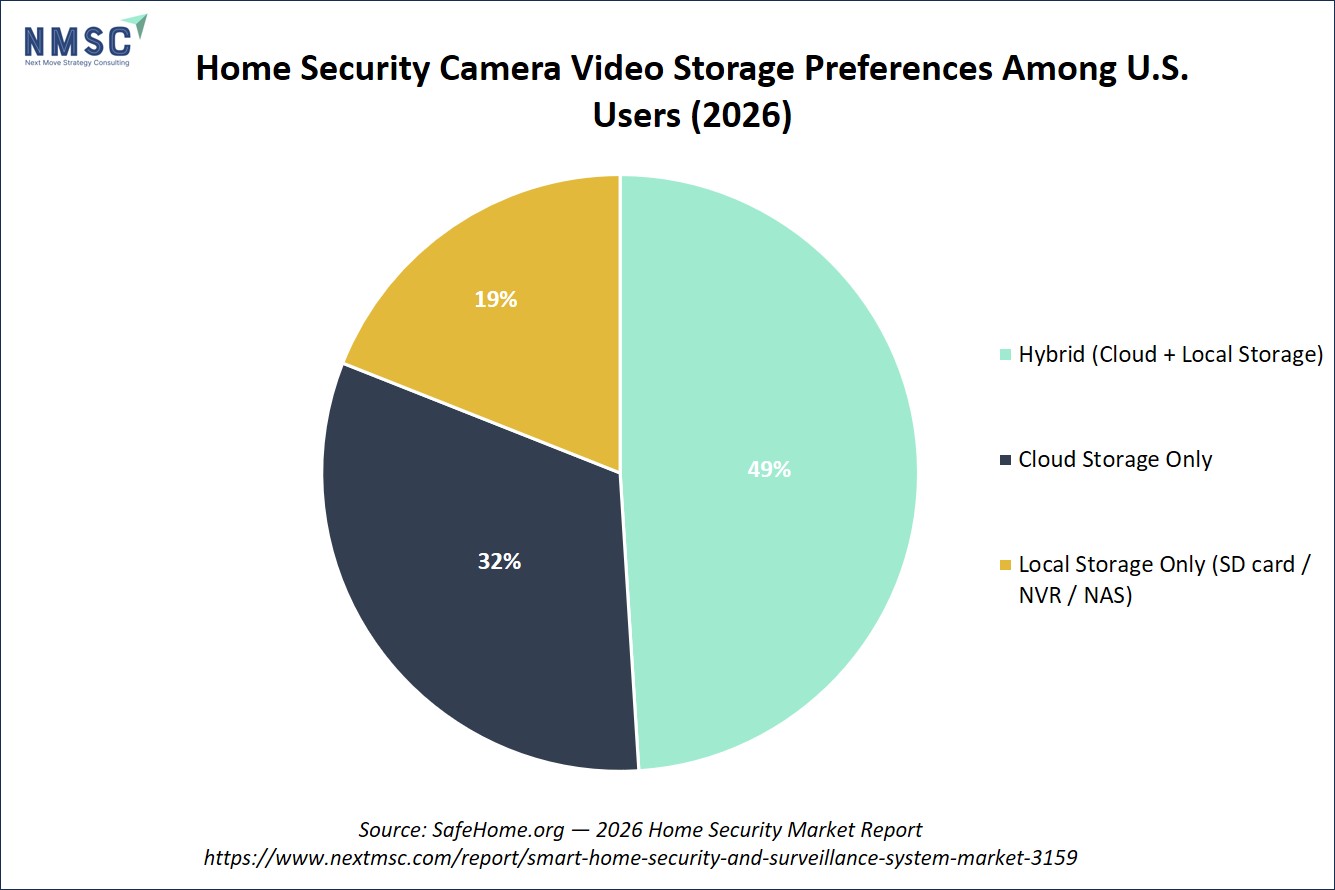
The tension between surveillance utility and data privacy was brought into sharp relief in early 2026 by a high-profile missing-person case in Arizona, in which a doorbell camera detected motion the night of the incident but had no active subscription to preserve the footage. The case highlighted the vulnerability of the 32% of users who rely solely on cloud storage for their security camera footage — a segment that may be operating under a false sense of security.
Ring's AI-powered "Search Party" feature, launched in late 2025 and prominently featured in a February 2026 advertising campaign, generated significant backlash from privacy advocates who raised concerns about opt-out defaults and the potential for broader surveillance use. Such incidents are likely to intensify regulatory scrutiny and consumer demand for transparent data governance frameworks.
Cybersecurity Vulnerabilities and Hardware-Level Risk
The proliferation of connected smart home devices has expanded the attack surface available to malicious actors. Hackers are exploiting insecure IoT devices — including smart plugs and cameras — as entry points into home networks, using compromised devices to launch distributed denial-of-service (DDoS) attacks via botnets. NIST IR 8425A guidelines, which form the basis for the U.S. Cyber Trust Mark, emphasize hardware roots of trust and secure enclaves as essential protections — security measures that cannot be addressed through software patches alone and require changes to the underlying hardware architecture.
Major retailers including Amazon and Best Buy are moving toward preferential stocking of smart home devices bearing the Cyber Trust Mark, driven by pressure from liability insurance providers to stop selling insecure devices. This retail shift creates a meaningful distribution risk for manufacturers that have not invested in hardware-level security architecture.
Inflation and Cost Sensitivity
Macroeconomic pressures are creating friction at the cost-sensitive edges of the smart home security and surveillance market. SafeHome.org's 2026 survey found that 12% of users delayed upgrades in the past year due to rising costs, and 6% canceled or downgraded paid subscriptions. Renters are disproportionately affected: 16% delayed upgrades, 11% reduced paid features, and 8% canceled or downgraded subscriptions entirely.
The subscription model — which underpins the recurring revenue strategies of leading platforms including Ring, Blink, and Nest — faces particular pressure from cost-conscious consumers. As awareness grows of the limitations of subscription-free camera ownership (live feed only, no recorded footage), manufacturers offering local storage alternatives are gaining competitive ground.
Section Summary
The smart home security and surveillance market is experiencing structural shifts driven by the DIY revolution, growing privacy concerns, hardware-level cybersecurity imperatives, and macroeconomic cost pressures. These forces are simultaneously expanding the addressable market and creating new competitive fault lines.
Key Takeaways:
-
DIY installation has overtaken professional installation for the first time, with 49% of U.S. alarm system users self-installing — a structural shift that favors app-managed, contract-free brands.
-
Renter adoption of security cameras surged 12 percentage points in a single year, representing a high-growth segment for manufacturers offering portable, no-contract solutions.
-
37% of home security users express concern about footage access; high-profile privacy incidents in 2025–2026 are intensifying regulatory and consumer scrutiny.
-
Major retailers are moving toward preferential stocking of Cyber Trust Mark-certified devices, creating a meaningful distribution risk for non-compliant manufacturers.
U.S. Home Security Device Adoption Trends (2023–2026)
|
Device Type |
2023 |
2024 |
2026 |
2-Year Change |
|
Home Security Cameras |
42% |
52% |
61% |
+19 percentage points |
|
Video Doorbells |
37% |
45% |
48% |
+11 percentage points |
|
Home Alarm Systems |
32% |
28% |
30% |
−2 percentage points |
U.S. Home Security Brand Market Share (2026)
|
Brand |
Market Share (% of camera/security system users) |
|
Ring |
43% |
|
ADT |
10% |
|
Google Nest |
7% |
|
Wyze |
6% |
|
Xfinity |
5% |
|
SimpliSafe |
5% |
|
Eufy |
4% |
|
Honeywell |
3% |
|
Vivint |
3% |
|
Others |
14% |
Key Regulatory Milestones Impacting the Smart Home Security and Surveillance Market (2025–2026)
|
Regulation / Initiative |
Jurisdiction |
Status (as of August 2026) |
Key Requirements |
|
Cyber Security (Security Standards for Smart Devices) Rules 2025 |
Australia |
In force (commenced 4 March 2026) |
Unique per-device passwords; vulnerability reporting; published support timelines |
|
U.S. Cyber Trust Mark (FCC) |
United States |
Active; Cybersecurity Label Administrator filing window opened August 11, 2026 |
Voluntary cybersecurity labeling for wireless consumer IoT products; NIST-based standards |
|
EU Data Act (Article 33) |
European Union |
In force |
Mandatory open data ecosystems; prohibition of proprietary data lock-in |
|
NIST IR 8425A Guidelines |
United States |
Published and referenced as basis for U.S. Cyber Trust Mark |
Hardware roots of trust; secure enclaves; strong device authentication |
|
Regulation / Initiative |
Jurisdiction |
Status (as of August 2026) |
Key Requirements |
|
Cyber Security (Security Standards for Smart Devices) Rules 2025 |
Australia |
In force (commenced 4 March 2026) |
Unique per-device passwords; vulnerability reporting; published support timelines |
|
U.S. Cyber Trust Mark (FCC) |
United States |
Active; Cybersecurity Label Administrator filing window opened August 11, 2026 |
Voluntary cybersecurity labeling for wireless consumer IoT products; NIST-based standards |
|
EU Data Act (Article 33) |
European Union |
In force |
Mandatory open data ecosystems; prohibition of proprietary data lock-in |
|
NIST IR 8425A Guidelines |
United States |
Published and referenced as basis for U.S. Cyber Trust Mark |
Hardware roots of trust; secure enclaves; strong device authentication |
Future Outlook & Forecast
Smart Home Security and Surveillance Market Trajectory Through 2030
According to Next Move Strategy Consulting (NMSC), the global smart home security and surveillance system market is projected to reach USD 82.07 billion by 2030, with the forecast period spanning 2025 to 2030. This trajectory reflects the compounding effect of rising consumer adoption, accelerating AI integration, expanding regulatory frameworks, and the proliferation of connected devices across both developed and emerging markets.
North America is expected to maintain its position as the dominant regional market, supported by high consumer awareness, a well-established technological infrastructure, and the presence of leading market players including Honeywell International, Ring LLC, Google LLC, Apple Inc., Vivint, and ADT. The region benefits from early product launches and sustained investment in home automation and security.
Europe represents the second-largest regional market, with growth driven by heightened public concern around privacy and personal security, increasing internet penetration, and regulatory initiatives aimed at enhancing consumer data protection. The United Kingdom leads the region in video surveillance growth, reflecting strong market engagement and a proactive approach to residential security technology.
Asia-Pacific is emerging as the fastest-growing regional market, fueled by accelerating urbanization, rising household incomes, and substantial government investment in smart city infrastructure. Countries including China, India, and South Korea are leading in both consumption and production of smart home security products. Regional partnerships and public-private collaborations are supporting innovation and market penetration at scale.
The Rest of the World — including South America, the Middle East, and Africa — presents long-term growth potential as affordability improves, digital infrastructure expands, and consumer awareness of smart home security solutions increases. While currently in an early stage of adoption, these regions hold meaningful long-term upside as barriers continue to diminish.
Technology Vectors Shaping the Next Phase of Growth
Several technology vectors are expected to define the next phase of growth in the smart home security and surveillance market:
Edge AI and Local Processing: As regulatory pressure mounts to keep personally identifiable information on-device, edge AI will become a standard architectural requirement rather than a premium feature. Manufacturers that invest in neural processing unit (NPU) integration will be better positioned to meet both consumer expectations and regulatory compliance requirements simultaneously.
Matter Protocol Maturation: The widespread adoption of the Matter protocol is expected to accelerate interoperability across the smart home ecosystem, reducing fragmentation and enabling consumers to build comprehensive, multi-brand security setups. This will intensify competition on features and price rather than ecosystem lock-in, benefiting consumers while compressing margins for manufacturers reliant on proprietary architectures.
Subscription Model Evolution: As cost-sensitive consumers increasingly scrutinize recurring charges, manufacturers will face pressure to offer compelling subscription-free alternatives — including local storage options — while maintaining the recurring revenue streams that underpin their business models. The 32% of users currently relying on cloud-only storage represent a segment at risk of disillusionment as awareness of subscription limitations grows.
Multimodal Sensing Integration: The convergence of voice, vision, and touch sensing — enabled by heterogeneous compute architectures — is enabling smart home security devices to deliver personalized, context-aware responses. Smart cameras that combine radar-based presence detection, facial recognition, and voice command processing represent the next generation of residential surveillance capability.
Section Summary
The smart home security and surveillance market is on a sustained growth trajectory toward USD 82.07 billion by 2030, driven by AI integration, regulatory tailwinds, and expanding global adoption. Regional dynamics, technology evolution, and business model innovation will determine which market participants capture disproportionate value.
Key Takeaways:
-
NMSC projects the global smart home security and surveillance system market to reach USD 82.07 billion by 2030 (forecast period: 2025–2030).
-
North America leads in market share; Asia-Pacific is the fastest-growing region, driven by urbanization and smart city investment.
-
Edge AI, Matter protocol adoption, and subscription model evolution are the three primary technology vectors shaping the market's next growth phase.
-
Multimodal sensing — combining voice, vision, and radar — represents the next frontier of residential surveillance capability.
Next Steps for Stakeholders
For C-Level Executives and Product Leaders:
-
Prioritize regulatory compliance as a competitive advantage. With Australia's mandatory smart device security rules now in force and the FCC's U.S. Cyber Trust Mark program actively enrolling administrators, manufacturers that achieve early compliance will benefit from enhanced retailer relationships, reduced liability exposure, and stronger consumer trust. Major retailers are already moving toward preferential stocking of Cyber Trust Mark-certified devices — a distribution dynamic that will intensify as the program matures.
-
Invest in edge AI and hardware-level security architecture. The integration of neural processing units (NPUs) and hardware secure enclaves is transitioning from a differentiating feature to a market entry requirement. Manufacturers that rely on software-only security solutions face growing risk of retailer delisting and regulatory non-compliance.
-
Design for the DIY and renter segments. With DIY installation now the dominant installation modality and renter adoption growing at its fastest recorded pace, product roadmaps that prioritize ease of self-installation, portable hardware, and no-contract service models will capture the highest-growth consumer segments.
-
Adopt Matter-native architecture from the outset. Building Matter compliance into silicon from the design stage — rather than retrofitting it — reduces SKU proliferation, lowers return rates, and future-proofs product lines against evolving interoperability mandates, particularly in the European Union.
-
Develop transparent data governance frameworks. As privacy concerns grow among 37% of existing users and high-profile incidents continue to generate regulatory and media scrutiny, manufacturers that proactively publish clear, consumer-friendly data governance policies will differentiate themselves in an increasingly trust-sensitive market.
For Institutional Investors:
-
Monitor the subscription model transition. The growing tension between cloud-only storage models and consumer demand for subscription-free local storage alternatives represents a meaningful business model risk for platforms heavily dependent on recurring monitoring revenue. Evaluate portfolio companies' exposure to subscription churn, particularly among cost-sensitive renter and younger-demographic cohorts.
-
Assess Asia-Pacific exposure. With Asia-Pacific emerging as the fastest-growing regional market — led by China, India, and South Korea — investment theses that underweight this region may be missing the most dynamic growth opportunity in the global smart home security and surveillance market.
Conclusion
The smart home security and surveillance market is at a defining moment. The convergence of mandatory cybersecurity regulations, AI-driven surveillance capabilities, and shifting consumer installation preferences is fundamentally restructuring the competitive landscape. With 61% of U.S. households now equipped with at least one security camera and the global market projected to reach USD 82.07 billion by 2030 per NMSC's analysis, the scale of the opportunity is substantial — but so are the strategic demands it places on market participants.
Manufacturers, investors, and policymakers who recognize the dual imperatives of security and privacy — and who invest accordingly in compliant, AI-native, interoperable architectures — will be best positioned to lead in the next phase of the smart home security and surveillance market's evolution. Those who treat regulatory compliance as a cost center rather than a competitive asset, or who underestimate the speed of AI mainstreaming, risk being displaced by more agile and forward-looking competitors. The market's trajectory is clear; the question is which organizations will have the strategic foresight to capitalize on it.
About the Author
 Sanyukta Deb
— Sanyukta Deb is Digital Marketing Team Lead at Next Move Strategy Consulting, where she has led content strategy and technical SEO for the firm's B2B market research publications for over 2 years. Her editorial process translates NextMSC's primary and secondary research — spanning technology, industrial, and consumer sectors — into commercial narratives, backed by search-intent, keyword, and competitive analysis. She brings 5 years of overall experience in digital marketing and content strategy.
Sanyukta Deb
— Sanyukta Deb is Digital Marketing Team Lead at Next Move Strategy Consulting, where she has led content strategy and technical SEO for the firm's B2B market research publications for over 2 years. Her editorial process translates NextMSC's primary and secondary research — spanning technology, industrial, and consumer sectors — into commercial narratives, backed by search-intent, keyword, and competitive analysis. She brings 5 years of overall experience in digital marketing and content strategy.
About the Reviewer
 Debashree Dey
— Debashree Dey is Assistant Manager at Next Move Strategy Consulting, where she supports cross-vertical market content and communications across diverse industries for 6 years. Her professional background includes senior content writing, communications, and published manuscript authorship, with experience developing audience-focused business narratives and maintaining clear, consistent messaging. Her role supports research-led content development and editorial quality across NextMSC publications.
Debashree Dey
— Debashree Dey is Assistant Manager at Next Move Strategy Consulting, where she supports cross-vertical market content and communications across diverse industries for 6 years. Her professional background includes senior content writing, communications, and published manuscript authorship, with experience developing audience-focused business narratives and maintaining clear, consistent messaging. Her role supports research-led content development and editorial quality across NextMSC publications.

















Add Comment