
Customer Relationship Management (CRM) Market, By Component (Software, Services), By Enterprise Size (Large Enterprise, SMEs), By Application (Sales Force Automation, Marketing Automation, Customer Service & Support, Lead Generation & Retention, CRM Analytics, Customer Experience Management, Social Media Monitoring), By Industry Vertical (BFSI, Retail & E-commerce, IT & Telecom, Manufacturing, Healthcare & Life Sciences, & Others) – Global Analysis & Forecast, 2025–2035
Industry: ICT & Media | Publishing Date: February 4, 2026 | Last Updated: September 16, 2026 | No of Pages: N/A | No. of Tables: N/A | No. of Figures: N/A | Format: PDF | Report Code: IC4039
Industry Outlook
The Customer Relationship Management (CRM) Market size was valued at USD 104.20 billion in 2025 and is expected to reach USD 116.14 billion by 2026. Looking ahead, the industry is projected to expand significantly, reaching USD 308.35 billion by 2035, registering a CAGR of 11.46% from 2026 to 2035.
The global (CRM) market is experiencing robust growth as organisations worldwide prioritise customer-centric strategies to drive revenue growth and operational efficiency. Enterprises across industries are increasing investments in CRM platforms to unify customer data, streamline sales and marketing workflows, and enhance service responsiveness across digital channels. Cloud-based deployment, mobile accessibility, and subscription pricing models are reshaping adoption patterns, particularly among small and medium enterprises. Rapid integration of artificial intelligence, advanced analytics, and automation is expanding CRM functionality into predictive insights, personalised engagement, and intelligent decision support. At the same time, rising data volumes, omnichannel customer interactions, and remote work models are increasing demand for scalable and interoperable solutions. As data privacy regulations and cybersecurity requirements intensify, vendors offering secure, flexible, and ecosystem-integrated CRM platforms are positioned to lead long-term customer relationship management (CRM) market growth.
What Are the Key Trends in the Customer Relationship Management (CRM) Industry?
How will Composable Architectures and CDPs Change CRM Implementation Velocity and Total Cost of Ownership?
The shift toward composable CRM architectures built on CDPs, API-first microservices, event streaming, and low-code orchestration materially improves implementation velocity by decoupling data, engagement, and execution layers. Enterprises deploy targeted use cases faster, avoid monolithic rollouts, and replace components without full-platform migrations. However, while upfront software TCO declines, ongoing integration, data governance, and operational complexity increase. Value capture shifts from perpetual licenses toward recurring integration, data operations, and managed services. Over time, total cost of ownership becomes more predictable but service-heavy. To protect margins, CRM vendors must certify enterprise-grade connectors, provide managed integration runtimes, and package composable blueprints for priority verticals, thereby reducing buyer friction and preventing functional commoditization.
How is Regulatory and Privacy Evolution Reshaping CRM Architectures and Vendor Selection?
Evolving data protection, AI governance, and privacy regulations are directly influencing CRM architecture decisions and vendor shortlists. Enterprises are increasingly requiring region-specific data residency, built-in consent management, auditable data lineage, and explainable AI workflows as standard procurement criteria, rather than optional add-ons. CRM consent management systems now serve as systems of record for consent, identity resolution, and automated decisioning, raising compliance risk if architectures are opaque or poorly governed. Vendors lacking certified regional hosting or transparent AI governance face disqualification in regulated and multinational deals. As a result, compliance capabilities are becoming competitive differentiators. Vendors and integrators must embed privacy-by-design, DPIA workflows, and model-governance tooling directly into core CRM stacks.
Why is Verticalization and Embedded Commerce Creating New CRM Buying Centers?
Verticalized CRM offerings and embedded commerce capabilities are reshaping who buys CRM and how decisions are made. Industry-specific clouds that integrate CRM with payments, regulatory workflows, and operational systems reduce implementation risk and accelerate time-to-value. This shifts ownership from central IT toward business leaders in revenue operations, marketing, and line-of-business functions who control P&L outcomes. Embedded commerce further blurs boundaries between CRM monetization platform, payments, and service delivery, expanding budgets beyond traditional software lines. As procurement cycles shorten, vendors that deliver certified vertical accelerators gain a structural advantage. To capture these buying centres, CRM providers should develop preconfigured industry stacks and pursue joint go-to-market strategies with leading vertical ISVs and payment partners.
What Are the Key Market Drivers, Breakthroughs, And Investment Opportunities That Will Shape the Customer Relationship Management (CRM) Industry in The Next Decade?
The (CRM) market most powerful growth engines are the AI & cloud platform transition and the deepening integration of commerce and payments into customer-engagement workflows. Vendor filings for 2024–2025 show strong subscription growth and elevated investment in AI and data services, reflecting enterprise willingness to pay for measurable outcomes rather than basic feature sets.
Breakthroughs in continuous-intelligence architectures and CDP convergence enable real-time personalisation at scale. Challenges include regulatory fragmentation, integration overhead for composable stacks and the need for model governance. Opportunities are concentrated in CDP and data-infrastructure providers, managed-services firms for mid-market implementation, and verticalized advanced CRM analytics bundles that embed payments and compliance workflows.
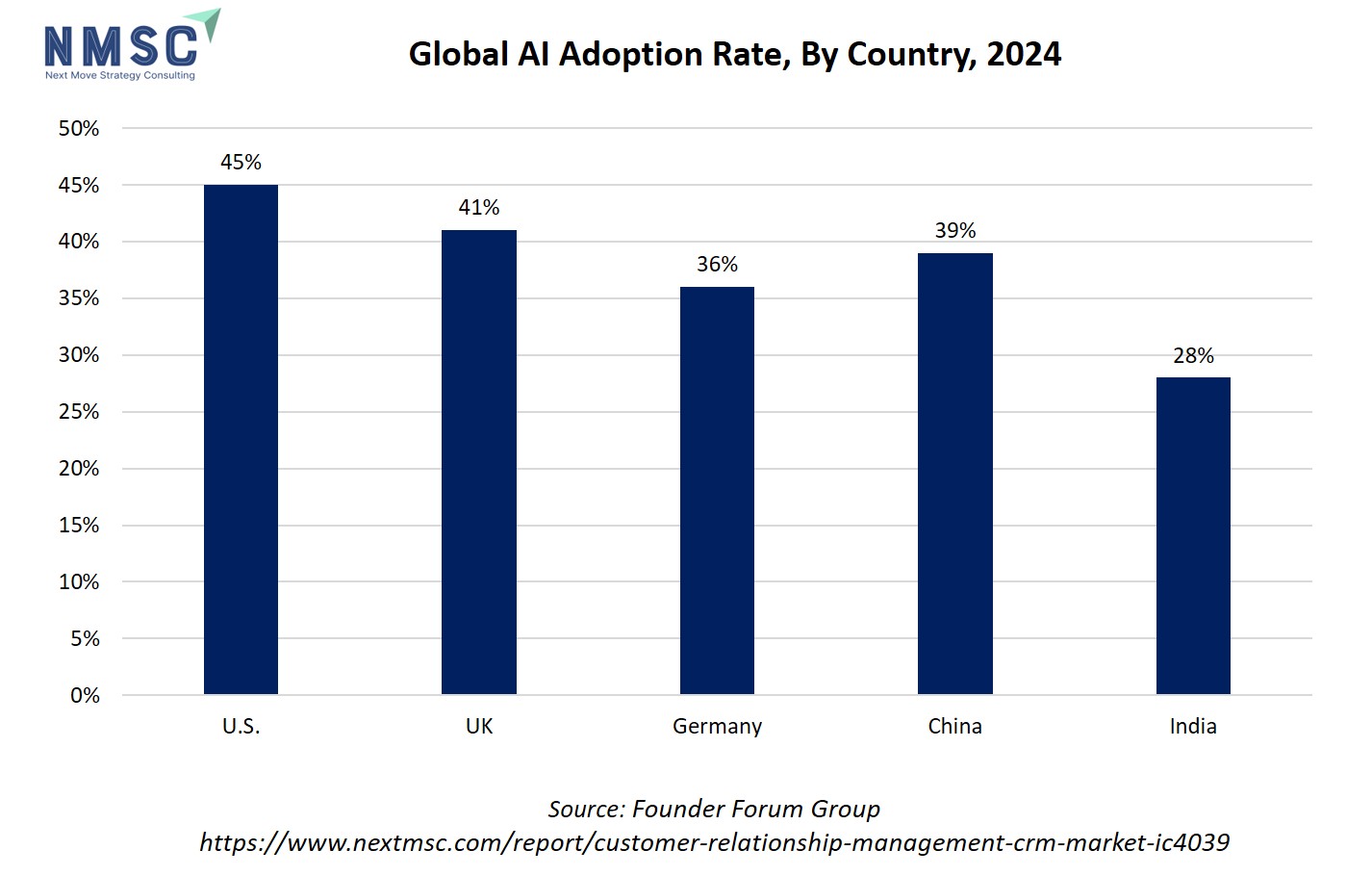
The chart shows AI adoption in 2024 for the global customer relationship management (CRM) market. This pattern underscores a rapid pivot toward AI-augmented customer engagement in mature economies, where vendors are embedding predictive analytics, next best action engines, and conversational AI directly into CRM workflows. As adoption spreads, competitive differentiation in CRM is shifting from basic contact management to the depth of AI-driven personalisation, automation, and insight generation that providers offer across sales, marketing, and service functions.
Growth Drivers:
How will the AI and Cloud Platform Transition Accelerate CRM Value Capture?
The 2024–2025 CRM roadmap positions AI tightly integrated with hyperscale cloud platforms as the primary value multiplier rather than a standalone feature. Embedded AI agents automate high-volume service tasks, improve sales prioritisation through predictive scoring, and personalise engagement at scale across channels. This transition shifts CRM economics from efficiency-driven cost savings to measurable revenue uplift and margin. As AI models are trained on unified customer data hosted in scalable cloud environments, CRM becomes a continuous optimisation engine. The commercial impact is faster ROI realisation and stronger executive sponsorship. To maximise value capture, vendors must package AI as outcome-led propositions, supported by governance, auditability, and KPI-linked pricing that shortens buying cycles.
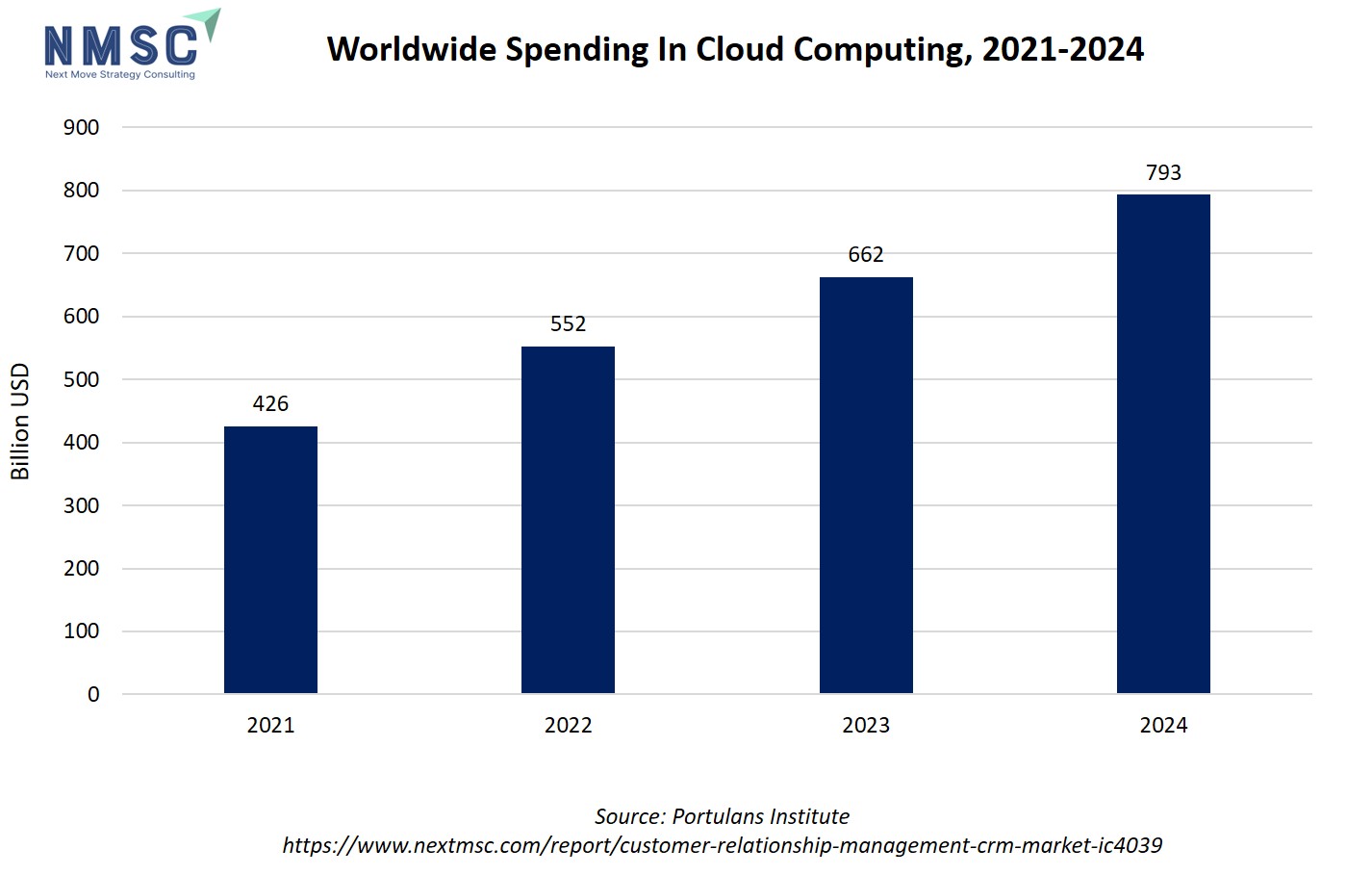
The chart highlights that worldwide cloud computing spending, underscoring a strong multi year shift of enterprise workloads to the cloud. For the global customer relationship management (CRM) market, this acceleration in cloud investment reinforces the dominance of SaaS delivery models, as organisations standardise on cloud-based CRM platforms to unify customer data, support distributed sales and service teams, and integrate with adjacent martech and CX stacks. As cloud spending scales, CRM vendors increasingly compete on ecosystem depth, APIs, and marketplace integrations, enabling enterprises to orchestrate end to end customer journeys across multiple cloud services rather than relying on isolated, on premise CRM deployments.
How will Integrated Commerce and Payments Embed CRM into Revenue Operations?
The convergence of CRM, commerce, and payments is repositioning CRM as a core revenue-operations platform rather than a front-office tool. When order management, loyalty accrual, payment reconciliation, and customer engagement are unified, CRM directly influences cash flow visibility and revenue predictability. This integration elevates CRM purchasing decisions to revenue operations leaders and C-suite executives, accelerating deal sizes and strategic urgency. Experience-led vendors increasingly bundle commerce and payments into CRM workflows to capture this shift. The result is deeper system lock-in and higher lifetime value. Vendors that deliver certified payment connectors, real-time revenue dashboards, and loyalty monetisation analytics will expand addressable budgets and gain access to new buying centres.
Growth Inhibitors:
How will Regulatory Fragmentation and Data-Sovereignty Requirements Slow Global Rollouts?
Regulatory fragmentation across regions, combined with evolving data protection and AI governance requirements, materially increases complexity in global CRM deployments. Consent management, DPIA workflows, model explainability, and data-residency constraints add legal, architectural, and operational overhead. For multinational enterprises, this slows rollout velocity and raises integration costs, particularly where centralised CRM architectures conflict with local hosting mandates. As a result, procurement increasingly favours vendors with regionally certified infrastructure and built-in compliance automation. Vendors lacking these capabilities risk extended sales cycles or outright exclusion from regulated deals. To mitigate this inhibitor, CRM providers must offer region-specific deployments, automated compliance tooling, and transparent model-governance features as standard, not premium, capabilities.
Where Should Investors Allocate to Capture CRM Platform Evolution?
The most attractive investment opportunities sit adjacent to core CRM platforms rather than within commoditising license businesses. High-potential targets include CDP and privacy-preserving data infrastructure firms enabling real-time, compliant analytics, managed-services providers that industrialise composable CRM deployments for mid-market enterprises, and vertical ISVs embedding CRM with commerce, payments, and regulatory workflows. These segments benefit from recurring revenue, high switching costs, and structural demand driven by AI adoption and regulatory complexity. Investor attention should focus on firms with repeatable delivery models, strong enterprise references, and expanding ARR. Growth equity and minority stakes aligned with hyperscale ecosystems offer scalable exposure with reduced platform risk.
How Customer Relationship Management (CRM) Market Segmented in this Report, and What are the Key Insights from the Segmentation Analysis?
By Component Insights
Is Software Still the Principal Growth Engine While Services Capture Long-Run Margins?
Based on component, the customer relationship management (CRM) market is segmented into software and services.
Software platforms, including core CRM, CDPs, and analytics layers, remain the primary growth engine by scaling recurring ARR and expanding the installed base. However, services increasingly capture a disproportionate share of lifetime value, particularly in complex, composable deployments. Vendor disclosures indicate that while subscription revenues grow steadily, implementation, integration, and managed services are critical to customer success and retention. Software drives rapid CRM market penetration, but services underpin stickiness, upsell, and renewal economics. The strategic implication is clear, long-term value capture depends less on licenses alone and more on a robust services ecosystem supported by certified partners and productized managed offerings.
By Software Deployment Insights
Is Cloud (SaaS) the Dominant Model with Hybrid for Regulated Sectors?
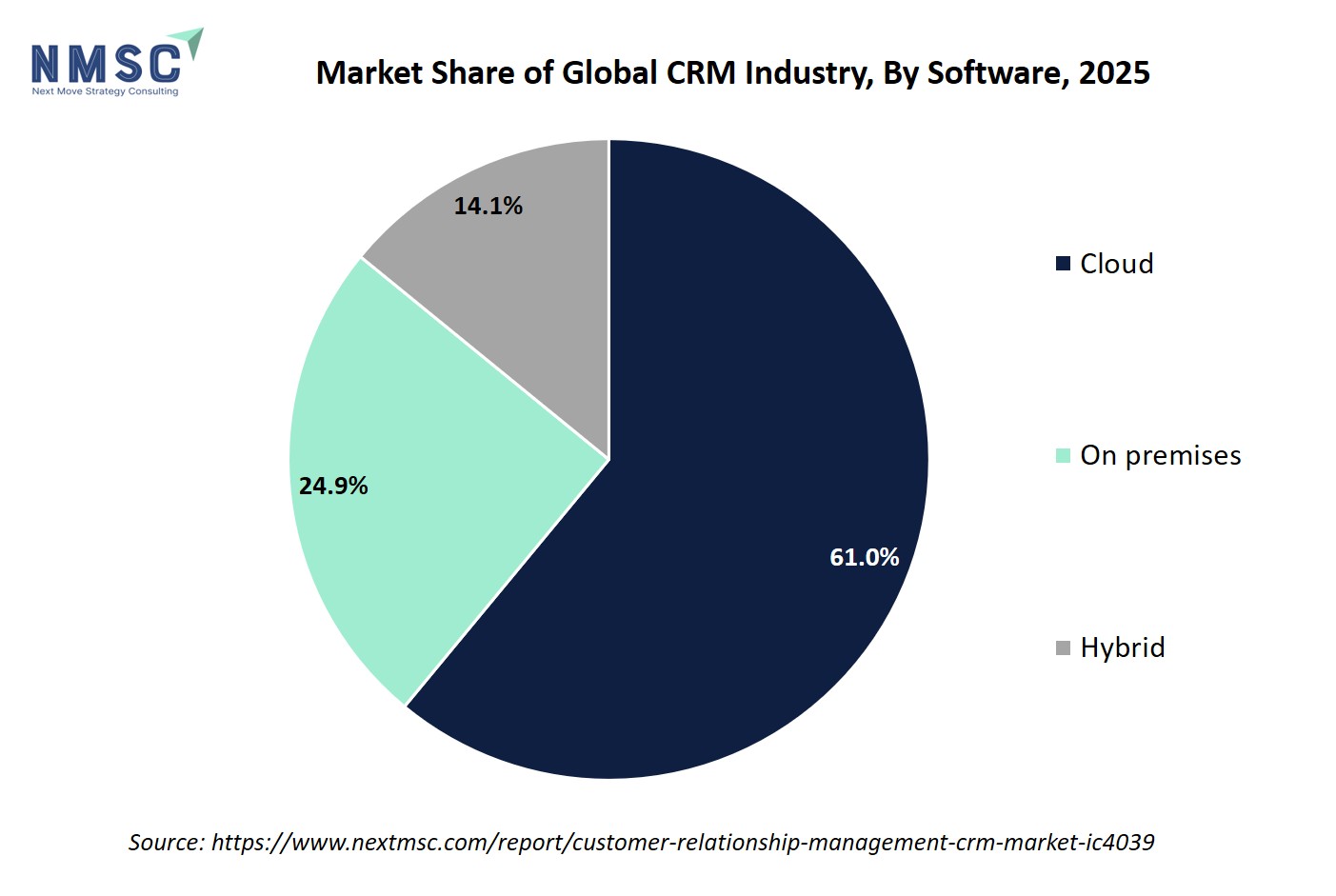
Based on software deployment, the customer relationship management (CRM) market is segmented into cloud, on premises, and hybrid.
Cloud-based CRM is the dominant deployment model for new projects, driven by faster implementation cycles, continuous feature updates, and predictable operating costs. Vendor roadmaps consistently prioritise SaaS-first delivery, reinforcing cloud as the default choice for most enterprises. Nevertheless, hybrid and selective on-premises deployments retain relevance in regulated sectors such as financial services and government, as well as in organisations with extensive legacy estates. As a result, vendors must balance cloud-native innovation with flexible architectures that support regional hosting, data residency, and hybrid integration. Those able to combine cloud scale with regulatory adaptability will capture the broadest enterprise demand.
By Services Insights
Are Managed Services and Analytics the Highest Growth Service Lines?
Based on services, the customer relationship management (CRM) market is segmented into implementation and integration, consulting and training, support and maintenance, and managed services.
Managed services, analytics operations, and training are emerging as the fastest-growing service lines as enterprises seek continuous value rather than one-time implementations. Increasing reliance on AI, data governance, and real-time campaign optimisation is driving demand for outsourced expertise and always-on support models. Vendor commentary highlights rising customer preference for subscription-based managed services that deliver predictable outcomes and reduce internal skill gaps. These services generate recurring, high-margin revenue while materially lowering customer churn. Providers that standardise service tiers, align SLAs to measurable KPIs, and bundle analytics operations with CRM platforms are best positioned to build durable ARR and long-term client dependency.
By Application Insights
Are Marketing Automation, Service, Sales Automation, and Analytics Equally Strategic?
Based on application, the customer relationship management (CRM) market is segmented into sales force automation, marketing automation, customer service and support, lead generation and customer retention, CRM analytics, customer experience management, and social media monitoring.
Marketing automation, customer service, sales force automation, and analytics remain equally strategic pillars, but their relative importance varies by industry context. Retail and e-commerce prioritise marketing orchestration and commerce-linked analytics, BFSI emphasises onboarding, compliance, and service workflows, telecommunications focus on churn prediction and lifecycle management. This diversity elevates the importance of unified data models and cross-functional orchestration within CRM platforms. Vendors must therefore deliver tightly integrated application suites supported by industry-specific templates and analytics. The ability to deploy coordinated use cases across marketing, sales, and service materially reduces implementation timelines and improves cross-sell effectiveness.
By Industry Vertical Insights
Which Verticals Present the Largest CRM Demand Pools?
Based on industry vertical, the customer relationship management (CRM) market is segmented into BFSI, retail and e-commerce, IT and telecommunications, manufacturing, healthcare and life sciences, professional services, public administration, transportation and logistics, and others.
Retail and e-commerce, BFSI, telecommunications, travel and hospitality, and healthcare represent the largest CRM demand pools due to high transaction intensity, regulatory complexity, and service-driven business models. These sectors benefit most from CRM systems that integrate engagement, compliance, and operational workflows. Industry cloud strategies from major vendors reflect this demand by embedding vertical-specific processes such as payments, KYC, claims, or reservations directly into CRM platforms. Verticalization shortens procurement cycles, reduces customisation risk, and supports premium pricing. Vendors that invest in deep vertical IP achieve stronger differentiation, higher ASPs, and greater long-term customer stickiness.
Regional Outlook
The customer relationship management (CRM) market is geographically studied across North America, Europe, Asia Pacific, Middle East & Africa, and Latin America and each region is further studied across countries.
Customer Relationship Management (CRM) Market in North America
North America leads global CRM innovation through platform scale, AI commercialization, and outcome-driven enterprise procurement. Buyers prioritize revenue operations, customer experience automation, and analytics-led decisioning, resulting in large, multi-year ARR contracts. Enterprise sophistication and mature partner ecosystems accelerate adoption of embedded AI, composable architectures, and governance tooling. Procurement standards set in North America strongly influence global CRM roadmaps, particularly around model explainability, integration depth, and data operations. As both the largest revenue contributor and primary innovation hub, the region anchors vendor financial performance while shaping global best practices in enterprise CRM deployment.
Customer Relationship Management (CRM) Market in the United States
The United States is the primary growth engine of the global customer relationship management (CRM) market and home to most tier-one vendors. U.S.-based enterprises are early adopters of AI-driven CRM, advanced analytics, and composable architectures, funding innovations that later scale globally. Multinational corporations headquartered in the U.S. standardize CRM platforms across regions, accelerating worldwide rollouts and vendor roadmap alignment. Procurement decisions emphasize scalability, security, and measurable revenue impact, reinforcing the U.S. role as the global benchmark market for enterprise CRM capabilities and commercial models.
Customer Relationship Management (CRM) Market in Canada
Canada’s customer relationship management (CRM) market is shaped by strong expectations around privacy, responsible AI, and data governance. Enterprises prioritize consent management, auditability, and model transparency, influencing platform selection and deployment design. These requirements exceed minimum regulatory standards and act as early indicators of future global compliance norms. Canadian buyers therefore play an outsized role in shaping privacy-first CRM architectures for cross-border deployments. Vendors that embed explainability, governance-by-design, and robust consent tooling gain competitive advantage both domestically and in other regulated markets.
Customer Relationship Management (CRM) Market in Europe
Europe balances advanced CRM adoption with stringent regulatory oversight under GDPR and evolving AI governance frameworks. Enterprises require data residency, traceability, and auditable automation, making compliance a core procurement criterion rather than a secondary feature. This creates a premium CRM market for vendors with region-certified hosting, transparent data lineage, and embedded governance workflows. While regulatory complexity lengthens sales cycles, it also increases switching costs and favors established platforms with strong compliance credentials and experienced regional partners.
Customer Relationship Management (CRM) Market in the United Kingdom
The U.K. customer relationship management (CRM) market emphasizes governance, analytics rigor, and financial-services-grade controls. British enterprises and consultancies strongly influence CRM implementation standards across Europe and other regions where U.K. systems integrators operate. CRM investments are closely tied to risk management, data quality, and regulatory alignment alongside commercial performance. As a result, the U.K. functions as a methodology and delivery hub, shaping how complex CRM programs are architected, governed, and scaled in multinational environments.
Customer Relationship Management (CRM) Market in Germany
Germany’s CRM demand is driven by its industrial and manufacturing base, where B2B relationship management, dealer networks, and after-sales service are central. CRM systems are tightly integrated with ERP platforms and asset lifecycle management, prioritizing reliability and integration depth over rapid feature expansion. Procurement decisions emphasize engineering rigor, long-term support, and operational continuity. Vendors must demonstrate strong systems integration capabilities and support for complex partner ecosystems to compete effectively in the German market.
Customer Relationship Management (CRM) Market in France
France shapes CRM demand through luxury retail, hospitality, and tourism-led use cases. Enterprises prioritize omnichannel loyalty, multilingual engagement, and seamless service orchestration for international customers. CRM platforms must support premium digital experiences while coordinating marketing, commerce, and service touchpoints. This focus on brand experience and service quality makes France a key market for experience-led CRM capabilities, particularly for vendors serving global luxury and travel brands.
Customer Relationship Management (CRM) Market in Italy
Italy’s CRM adoption is driven by a large SME and mid-market base that values affordability, modularity, and rapid deployment. Export-oriented manufacturers and service firms favor CRM solutions that deliver fast time-to-value with minimal implementation complexity. Localized user experiences, flexible pricing, and partner-led delivery models are critical success factors. Vendors that combine cloud-native simplicity with scalable functionality perform better than enterprise-heavy platforms in this CRM market.
Customer Relationship Management (CRM) Market in Spain
Spain’s CRM demand is shaped by tourism, hospitality, and logistics sectors with pronounced seasonal variability. Enterprises require scalable CRM architectures, multilingual support, and resilient contact-centre operations to manage fluctuating demand. CRM platforms that flex capacity and analytics around tourism cycles gain a competitive advantage. As service quality and responsiveness are critical, CRM investments focus on operational reliability and real-time customer engagement rather than deep customisation.
Customer Relationship Management (CRM) Market in the Nordic Countries
Nordic customer relationship management (CRM) market emphasizes digital maturity, cloud-first adoption, privacy, and sustainability. Enterprises favour API-driven, efficient CRM platforms that integrate cleanly into broader digital ecosystems. Buyers expect transparent data practices, strong security, and operational efficiency as baseline requirements. Nordic procurement behaviour sets regional benchmarks for privacy-centric and automation-driven CRM adoption, influencing wider European expectations around responsible technology use.
Customer Relationship Management (CRM) Market in Asia-Pacific
Asia-Pacific is a high-growth CRM region driven by e-commerce expansion, mobile engagement, and hyperscaler investment in local cloud regions. Reduced latency and improved data residency accelerate cloud CRM adoption across Southeast Asia, India, and developed APAC markets. Growth is heterogeneous, requiring vendors to tailor pricing, deployment, and partner strategies by country maturity. APAC represents the fastest-expanding incremental CRM demand globally.
Customer Relationship Management (CRM) Market in China
China’s CRM landscape is shaped by super-app ecosystems and high-frequency digital commerce. CRM implementations are deeply localised, requiring domestic integrations, regulatory alignment, and partnerships with local providers. Global vendors typically operate through joint ventures or alliances to access the market. CRM functions are tightly linked to commerce, messaging, and payments, creating a structurally distinct model compared with Western enterprise CRM architectures.
Customer Relationship Management (CRM) Market in Japan
Japan emphasises service excellence, after-sales support, and long-term customer relationships, particularly in the automotive and manufacturing sectors. CRM platforms must support complex dealer networks, service workflows, and lifecycle-based customer engagement. Reliability, precision, and operational depth are prioritised over rapid feature iteration. As a result, CRM adoption is steady but conservative, with strong emphasis on integration quality and long-term vendor stability.
Customer Relationship Management (CRM) Market in India
India is a large, price-sensitive customer relationship management (CRM) market with strong systems integrator capacity. SMB adoption is driven by low-cost cloud CRM and managed services, while large enterprises selectively invest in AI, analytics, and platform consolidation. Scale, affordability, and partner-led delivery models are critical. India also serves as a global delivery hub, influencing CRM implementation economics and service models worldwide.
Customer Relationship Management (CRM) Market in South Korea
South Korea sets high expectations for mobile-first CRM, real-time personalization, and loyalty integration. Retail and consumer technology sectors drive demand for fast data processing and omnichannel orchestration. CRM platforms must support high engagement frequency and mobile-native experiences. This pushes vendors to optimize performance, analytics speed, and integration with digital ecosystems.
Customer Relationship Management (CRM) Market in Taiwan
Taiwan’s CRM demand is concentrated in B2B manufacturing and electronics supply chains. CRM functions focus on account management, distributor coordination, and service reliability rather than consumer marketing. Integration with ERP and partner systems is critical. CRM acts as an operational coordination layer supporting long-term commercial relationships and supply-chain visibility.
Customer Relationship Management (CRM) Market in Indonesia
Indonesia’s mobile commerce growth and vast SMB base drive demand for scalable, low-cost CRM platforms integrated with payments. High transaction volumes favour cloud-native, lightweight CRM solutions that support rapid onboarding and mobile-first usage. Vendors that combine affordability with embedded financial workflows are best positioned to capture scale.
Customer Relationship Management (CRM) Market in Australia
Australia is a mature customer relationship management (CRM) market with strong enterprise SaaS adoption and emphasis on governance, analytics, and compliance. Public sector and regulated industries require robust data controls and professional services support. Vendors with deep local partner ecosystems and strong compliance credentials perform well in both public and private sector deployments.
Customer Relationship Management (CRM) Market in Latin America
Latin America shows accelerating CRM adoption in banking, telecommunications, and digital commerce. Growth is driven by mobile engagement and customer experience digitisation, but regulatory fragmentation increases deployment complexity. Vendors must localise compliance, integrate with regional payment rails, and support diverse operating models to scale effectively.
Customer Relationship Management (CRM) Market in the Middle East & Africa
The Middle East, particularly GCC countries, drives high-value CRM deployments across retail, financial services, and public-sector digital initiatives. Africa remains at an earlier adoption stage, with demand focused on mobile-first CRM linked to payments and agent-based service models. Vendors must tailor delivery, pricing, and platform sophistication to wide disparities in digital maturity across the region.
Competitive Landscape
Which Companies Dominate the Customer Relationship Management (CRM) Industry and How do they Compete?
The global CRM market is anchored by platform leaders such as Salesforce, Microsoft, Adobe, SAP, and Oracle, which combine broad product portfolios, extensive partner ecosystems, and global scale. These vendors dominate large-enterprise ARR and shape market direction on AI enablement, governance frameworks, and integration standards. Alongside them, a dynamic layer of CDPs, vertical specialists, and regional SaaS providers, including HubSpot, Zendesk, Freshworks, and Zoho, competes on affordability, industry focus, and speed to value. This structure creates high barriers to achieving global scale, yet leaves meaningful whitespace for niche software providers and managed-services firms that address specific industries, regions, or operational pain points.
Market Dominated by Customer Relationship Management (CRM) Giants and Specialists
Platform giants retain structural advantages through extensibility, worldwide support coverage, and sustained investment in AI and data platforms. In contrast, specialists gain traction in mid-market and SMB segments by localising user experience, integrating payments and messaging, and bundling low-cost managed services. The prevailing competitive pattern is consolidation, with large platforms acquiring CDPs, analytics tools, and vertical ISVs to expand total addressable market and accelerate go-to-market execution. Vendors that pair strong partner programs with repeatable vertical playbooks are best positioned to compete across enterprise and mid-market segments simultaneously.
Innovation and Adaptability Drive Market Success
Market leaders are distinguished by their ability to integrate AI responsibly, support composable architectures, and deliver outcome-based services rather than standalone software. Pre-trained, locale-aware models combined with automated compliance, consent management, and region-certified hosting are increasingly decisive in regulated industries. Equally critical are partner ecosystems that scale implementation, integration, and ongoing data operations. Vendors that align product innovation with delivery capability and measurable business outcomes achieve higher retention, stronger margins, and sustained competitive advantage in an increasingly complex CRM landscape.
Market Players to Opt for Merger & Acquisition Strategies to Expand their Presence
M&A activity accelerated during 2024–2025 as CRM platform vendors and specialists moved to acquire adjacent capabilities, data assets, and channel reach to compress innovation cycles and strengthen competitive positioning. Recent transactions illustrate this pattern, HubSpot’s acquisition of Frame AI in December 2024 added conversational-AI intelligence, complementing its earlier 2024 expansion into commerce and CPQ through Cacheflow, Freshworks’ June 2024 acquisition of Device42 enhanced IT asset and service-management integration, and Zendesk’s completion of the Local Measure deal in May 2025 strengthened experience and location-based data capabilities. Collectively, these deals reflect a clear playbook, using targeted tuck-in acquisitions to accelerate AI, CDP, and service-automation roadmaps, enable faster vertical bundling, and unlock cross-sell across installed bases.
List of Key Customer Relationship Management (CRM) Companies
-
Salesforce, Inc.
-
Microsoft
-
Freshworks Inc.
-
Oracle
-
Adobe
-
Zendesk
-
Pipedrive
-
Brevo
-
SugarCRM Inc
-
Comarch SA.
-
Zoho Corporation Pvt. Ltd.
-
Infor
-
Agile CRM.com
What Are the Latest Key Industry Developments?
-
July 2025- Salesforce completed the acquisition of Convergence.AI in June 2025 to strengthen its CRM’s AI automation capabilities, particularly for navigating complex enterprise workflows across systems.
-
May 2025- SAP extends collaborations with Accenture, Cohere, Google Cloud and others at Sapphire/Connect to co develop CX, AI, and data driven engagement solutions.
-
July 2025- Zendesk acquires HyperArc, an AI native analytics company, to build next generation gen AI analytics into the Zendesk platform.
-
April 2025- Freshworks launches new partner program with expanded reseller and services offerings.
What Are the Key Factors Influencing Both Investment Analysis & Customer Relationship Management (CRM) Market Opportunities?
Investment evaluation in the CRM market should prioritize a combination of growth quality and defensibility rather than topline scale alone. Core metrics include ARR growth, net revenue retention, and gross-margin mix between software subscriptions and services, alongside the depth of partner ecosystems and ownership of vertical-specific IP. The most attractive opportunities sit with enterprise-grade CDPs, managed-services firms with repeatable and scalable delivery models, and vertical ISVs embedding payments, compliance, or regulatory workflows into CRM managed services. While secondary research indicates a rapidly expanding addressable market, primary diligence must test client concentration risk, contract duration, renewal behavior, and outcome-linked KPIs. Regulatory exposure is a critical variable, companies with region-certified hosting and privacy-by-design architectures are structurally advantaged. Strategic M&A or minority investments that unlock channels or platform partnerships materially reduce go-to-market risk.
Key Benefits for Stakeholders:
Next Move Strategy Consulting (NMSC) presents a comprehensive analysis of the customer relationship management (CRM) market, covering historical trends from 2020 through 2025 and offering detailed forecasts through 2035. Our study examines the market at regional and country levels, providing quantitative projections and insights into key growth drivers, challenges, and investment opportunities across all major customer relationship management (CRM) segments.
Enterprises benefit from CRM platforms that deliver measurable outcomes, including higher conversion rates, improved customer retention, and lower service and operating costs through AI-driven automation and integrated commerce. Vendors gain durable recurring ARR, expansion revenue from adjacent modules such as CDPs and analytics, and higher lifetime value through managed services and ecosystem lock-in. Investors access predictable subscription economics and upside from platform and ecosystem expansion by backing CDPs, vertical accelerators, and service-led models. End customers receive more timely, personalized, and relevant interactions, provided privacy and fairness controls are enforced. Regulators and policymakers benefit from embedded compliance, auditability, and traceability, improving transparency and reducing fraud risks across digital customer engagement systems.
Report Scope
|
Parameters |
Details |
|
Market Size in 2026 |
USD 116.14 Billion |
|
Revenue Forecast in 2035 |
USD 308.35 Billion |
|
Growth Rate |
CAGR of 11.46% from 2026 to 2035 |
|
Analysis Period |
2025–2035 |
|
Base Year Considered |
2025 |
|
Forecast Period |
2026–2035 |
|
Market Size Estimation |
Billion (USD) |
|
Growth Factors |
|
|
Companies Profiled |
15 |
|
Countries Covered |
33 |
|
Market Share |
Available for 10 companies |
|
Customization Scope |
Free customization (equivalent to up to 80 analyst-working hours) after purchase. Addition or alteration to country, regional & segment scope. |
|
Pricing and Purchase Options |
Avail customized purchase options to meet your exact research needs. |
|
Approach |
In-depth primary and secondary research; proprietary databases; rigorous quality control and validation measures. |
|
Analytical Tools |
Porter's Five Forces, SWOT, value chain, and Harvey ball analysis to assess competitive intensity, stakeholder roles, and relative impact of key factors. |
Customer Relationship Management (CRM) Market Key Segments
By Component
-
Software
-
Cloud
-
On premises
-
Hybrid
-
-
Services
-
Implementation and integration
-
Consulting and training
-
Support and maintenance
-
Managed services
-
By Enterprise Size
-
Large enterprises
-
Small and medium enterprises SMEs
By Application
-
Sales force automation
-
Marketing automation
-
Customer service and support
-
Lead generation and customer retention
-
CRM analytics
-
Customer experience management
-
Social media monitoring
By Industry Vertical
-
BFSI
-
Retail and e-commerce
-
IT and telecommunications
-
Manufacturing
-
Healthcare and life sciences
-
Professional services
-
Public administration
-
Transportation and logistics
-
Others
Geographical Breakdown
-
North America: U.S., Canada, and Mexico.
-
Europe: U.K., Germany, France, Italy, Spain, Sweden, Denmark, Finland, Netherlands, and rest of Europe.
-
Asia Pacific: China, India, Japan, South Korea, Taiwan, Indonesia, Vietnam, Australia, Philippines, Malaysia and rest of APAC.
-
Middle East & Africa (MEA): Saudi Arabia, UAE, Egypt, Israel, Turkey, Nigeria, South Africa, and rest of MEA.
-
Latin America: Brazil, Argentina, Chile, Colombia, and rest of LATAM
Conclusion & Recommendations
Our report equips stakeholders, industry participants, investors, and consultants with actionable intelligence to capitalize on customer relationship management (CRM)’s transformative potential. By combining robust data-driven analysis with strategic frameworks, NMSC’s customer relationship management (CRM) market Report serves as an indispensable resource for navigating the evolving landscape. The global CRM market is transitioning from discrete campaign tooling to continuous, AI-enabled revenue platforms embedded with CDPs and commerce. Regulatory complexity and integration overhead are primary adoption frictions, but composable architectures and vertical accelerators reduce time-to-value. Vendors should productize privacy-first AI modules, certify regional hosting and scale managed-services playbooks to capture recurring value. Enterprises must prioritize composable data fabrics and outcome-based procurements to accelerate ROI. Investors should favour CDPs, vertical ISVs and managed-services firms with repeatable delivery models.
For executives and investors, the key to capitalising on these trends lies in identifying high-potential segments, investing in R&D for innovative customer relationship management (CRM) solutions, and fostering strategic partnerships to expand market reach. Productizing region-certified AI modules and consent management. Building certified vertical accelerators with payments and compliance.
About the Author
 Ridip Gogoi
— Ridip Gogoi is a Research Associate at Next Move Strategy Consulting, where he supports cross-vertical market research and analysis across multiple industry sectors, with four years of experience. His work includes market analysis, data validation, secondary research, and insight development, helping structure evidence into clear findings for business and strategy decisions. He contributes to research quality checks and reporting, with a focus on consistency, source review, and clarity accuracy.
Ridip Gogoi
— Ridip Gogoi is a Research Associate at Next Move Strategy Consulting, where he supports cross-vertical market research and analysis across multiple industry sectors, with four years of experience. His work includes market analysis, data validation, secondary research, and insight development, helping structure evidence into clear findings for business and strategy decisions. He contributes to research quality checks and reporting, with a focus on consistency, source review, and clarity accuracy.
About the Reviewer
 Supradip Baul
— Supradip Baul is an accomplished business consultant and strategist with over a decade of rich experience in market intelligence, strategy, technology, and business transformation. His work has included rigorous qualitative and quantitative analysis across multiple industries, helping clients shape investment decisions and long-term roadmaps. Earlier in his career, he was associated with Gartner, where he contributed to industry-leading reports and market share analyses. He has worked with leading global companies and holds an MBA with a dual specialization in Marketing and Finance.
Supradip Baul
— Supradip Baul is an accomplished business consultant and strategist with over a decade of rich experience in market intelligence, strategy, technology, and business transformation. His work has included rigorous qualitative and quantitative analysis across multiple industries, helping clients shape investment decisions and long-term roadmaps. Earlier in his career, he was associated with Gartner, where he contributed to industry-leading reports and market share analyses. He has worked with leading global companies and holds an MBA with a dual specialization in Marketing and Finance.
At Next Move Strategy Consulting, we understand that insightful market research is the cornerstone of successful business decisions. That's why we employ a robust and multifaceted approach, combining various methodologies to deliver the most accurate and actionable data for our clients.

Research Landscape
We navigate the world of research with two primary approaches:
Qualitative Approach
Our qualitative research methodologies involve immersive techniques such as in-depth interviews, focus groups, and observational studies. By engaging directly with individuals and stakeholders, we uncover valuable insights that quantitative data alone may overlook.

Quantitative Research
In tandem with qualitative methodologies, NMSC leverages the power of Quantitative Research to provide a robust foundation of numerical insights. Through systematic data collection and analysis, we quantify patterns, preferences, and market trends, offering a comprehensive view of the business landscape.
Our quantitative research approach employs diverse tools, including surveys, experiments, and statistical modelling. These methodologies enable us to gather data from a large and representative sample, ensuring the statistical significance of our findings. By employing structured questionnaires and standardized data collection methods, we guarantee the reliability and validity of the information we present to our clients.
Quantitative research is particularly effective in measuring the prevalence of trends, assessing market size, and gauging the impact of various factors on consumer behavior. The numerical precision attained through this approach equips our clients with actionable insights, facilitating data-driven decision-making and strategy formulation.


Our Specialized Toolbox for Industry-Specific Market Research
We deploy a specialized arsenal of techniques tailored to meet your unique requirements. Here's a glimpse into our comprehensive toolbox:

Information Procurement
The stage entails acquiring market data or relevant information through various sources and methodologies.


Market Research Approach
We utilize both top-down and bottom-up approaches in market research analysis to achieve a comprehensive understanding of the market dynamics, leveraging the broad perspective of industry trends and macroeconomic factors alongside detailed insights from specific segments and individual companies.

Porters Five Forces Analysis
We conduct Porter's Five Forces analysis to evaluate the competitive landscape of an industry, providing us with insights into factors that affect profitability and strategic positioning.

SWOT Analysis

Forecasting
We utilize a forecasting model to predict future consumption by considering parameters like population, economics, regulations, market competition, drivers, constraints, technology, and pricing. We also employ statistical techniques such as multilinear regression, exponential smoothing, moving average, ARIMA, and Monte Carlo simulations for accurate predictions. In econometric forecasting, we analyzed short-term and long-term event impacts, attributing values based on regulatory frameworks, economic factors, and market events.





 Speak to Our Analyst