Vending Machine Market Trends & Forecasts for 2026
Introduction
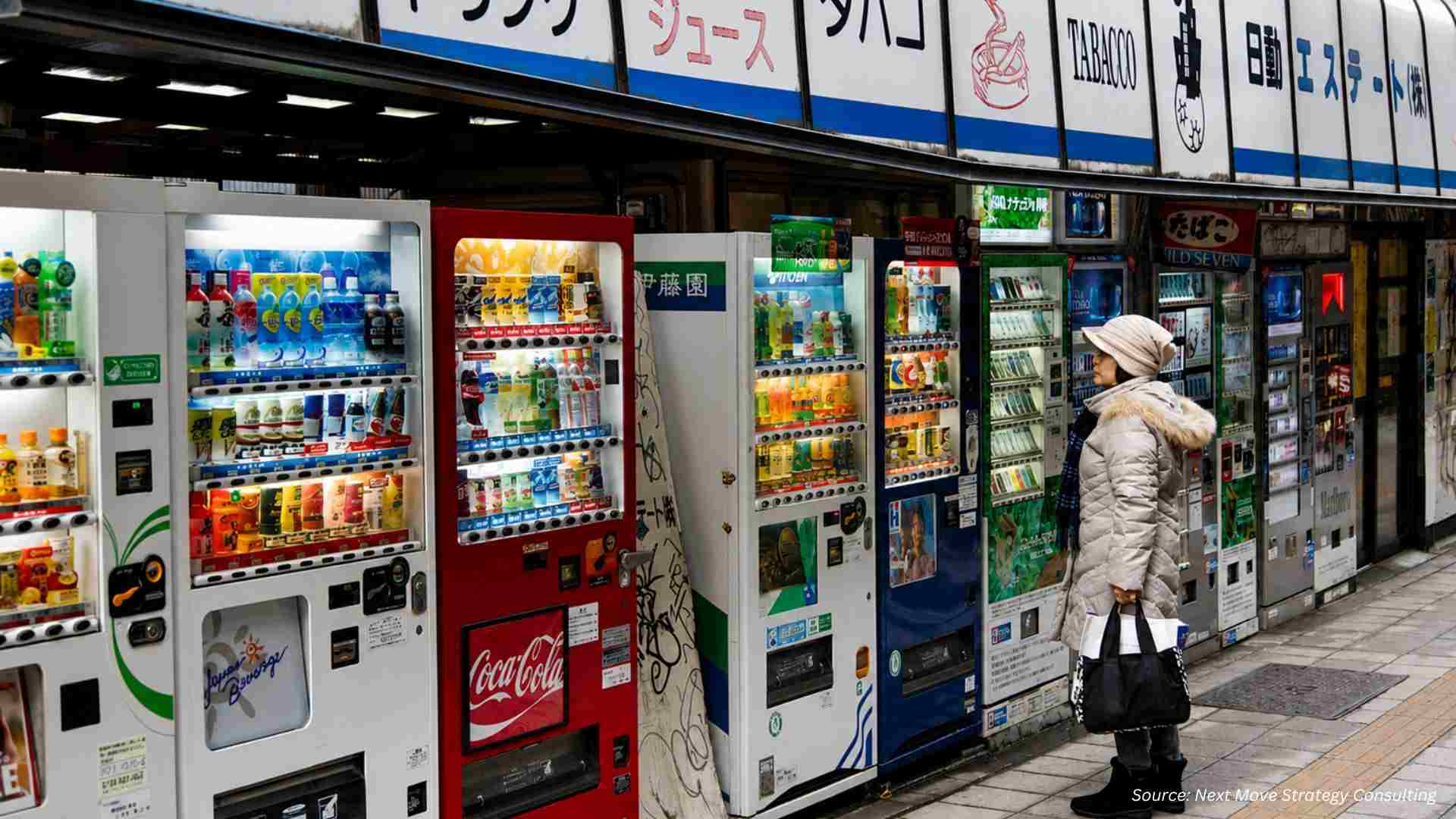
The vending machine market is no longer a story about coins and candy bars. It has become a proving ground for artificial intelligence, IoT connectivity, cashless payments, and even alternative energy, as operators race to convert static dispensers into responsive, data-driven retail nodes. For C-level executives and institutional investors tracking automated retail, the vending machine market represents a rare convergence of hardware engineering, fintech, and sustainability innovation operating at global scale.
What was once a low-margin, mechanically simple category is now attracting serious capital because of measurable technological inflection points: connected device penetration is climbing toward saturation, cashless payment rails are displacing coin mechanisms, and manufacturers are experimenting with hydrogen and solar power to remove machines from grid dependence entirely. This article examines the vending machine market through the lens of a real, recent industry milestone, unpacks the regulatory and labor-market forces reshaping deployment strategies, and translates NMSC's proprietary forecast data into actionable guidance for stakeholders evaluating this space through 2030.
Hydrogen, Connectivity, and the New Vending Machine Market Playbook
A defining industry event anchors the current narrative: in October 2024, Coca-Cola Bottlers Japan Inc. and Fuji Electric Co., Ltd. announced the joint development of the world's first vending machine powered by replaceable hydrogen cartridges, which was subsequently installed and unveiled at Expo 2025 Osaka, Kansai, Japan, when the exposition opened in March 2025. The machine operates through a generator unit in which a hydrogen cartridge produces electricity via a chemical reaction with ambient oxygen, storing the output in a battery that powers the vending unit without any fixed electrical connection, effectively removing weather and location constraints that have historically limited placement options.
This milestone did not occur in isolation. It arrived alongside a broader connectivity shift documented by IoT analyst firm Berg Insight, which estimates that the global installed base of connected vending machines reached 8.1 million units in 2025, with a projected climb to nearly 11.7 million units by 2030, representing a 7.6% CAGR and a jump in connectivity penetration to roughly 77.5% of the installed base by the end of the forecast period. Berg Insight identifies cashless payment adoption, rather than operational telemetry alone, as the primary driver pulling connectivity into the mainstream, since contactless and smartphone-based payment acceptance now arrives pre-integrated with telemetry hardware in most new machine deployments.
NMSC's Strategic Perspective: Reading the Hydrogen and Connectivity Signal
From NMSC's analytical standpoint, these two developments jointly signal a maturation phase in the vending machine market. The hydrogen-cartridge breakthrough demonstrates that hardware manufacturers are no longer treating vending machines as static appliances but as engineerable platforms capable of energy independence, an innovation with material implications for placement economics in remote, disaster-prone, or infrastructure-constrained regions. Simultaneously, the Berg Insight connectivity data confirms that payment modernization is now the primary catalyst for the smart vending upgrade cycle, not a secondary feature. NMSC assesses that operators who fail to bundle cashless acceptance with telemetry and predictive maintenance capabilities risk falling behind on unit economics, since connected machines materially reduce stockouts and route servicing costs. For institutional investors, the strategic takeaway is that capital deployed into vending infrastructure should prioritize platforms engineered for modular upgrades across payment, connectivity, and power systems simultaneously, rather than single-feature retrofits.
For More Information – Download FREE Sample on Vending Machines Market Report
Section Summary: The vending machine market's most consequential recent development combines a sustainability breakthrough (hydrogen-powered vending at Expo 2025 Osaka) with an accelerating connectivity curve (Berg Insight's 8.1 million connected units in 2025). Together, they demonstrate that innovation in this sector is now occurring simultaneously across energy, payments, and data infrastructure.
-
Fuji Electric and Coca-Cola Bottlers Japan unveiled the world's first hydrogen-cartridge-powered vending machine at Expo 2025 Osaka, eliminating fixed grid dependence.
-
Berg Insight estimates 8.1 million connected vending machines globally in 2025, projected to reach 11.7 million by 2030 at a 7.6% CAGR.
-
Cashless payment integration is now the primary driver of connectivity adoption, not a standalone feature.
-
NMSC recommends prioritizing platforms with modular, multi-system upgrade capability over single-feature retrofits.
Industry Impact Analysis
The convergence of connectivity, cashless payments, and energy innovation is reshaping vending machine deployment economics across every major region. On the payments side, the World Bank's Global Findex Database 2025 reports that 79% of adults globally now hold a financial account, while 84% of adults in low- and middle-income countries own a mobile phone and 3 billion of them have smartphones, a digital infrastructure base that directly underpins the viability of cashless vending expansion in previously underserved markets. Separately, Visa's analysis of the same Findex 2025 dataset notes that 42% of adults worldwide made a digital payment directly to a merchant, a figure that speaks directly to the addressable base for cashless vending transactions.
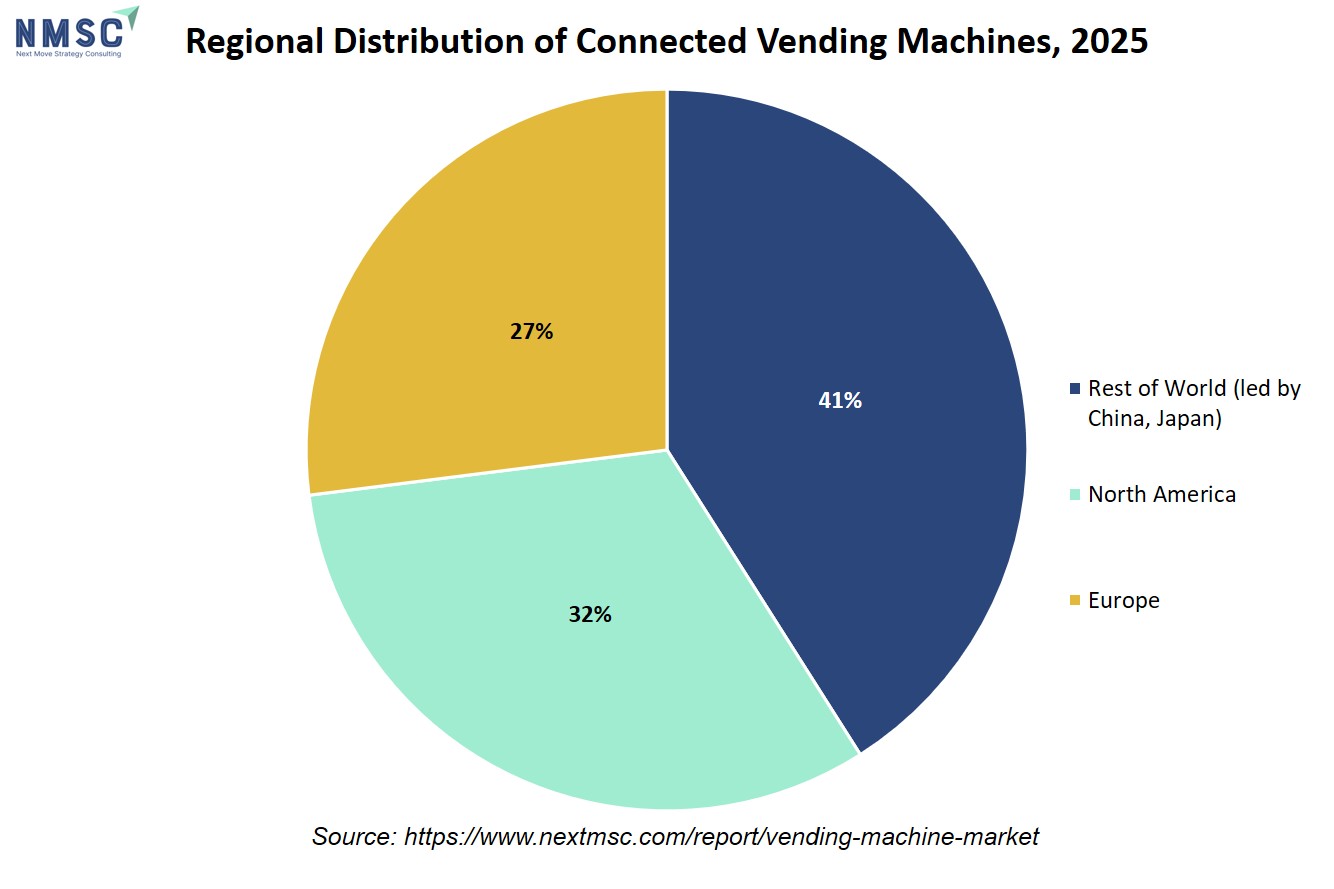
On the labor side, persistent workforce shortages are accelerating automation investment across retail broadly, with Bloomberg documenting Japan's expanded rollout of service robots specifically to address labor market gaps. This labor dynamic reinforces the commercial logic for unattended retail formats, including vending machines, since they require no on-site staffing to operate around the clock. Regionally, Berg Insight's connectivity breakdown shows "Rest of the World" (led by China and Japan) holding the largest connected installed base at approximately 3.3 million units, followed by North America at 2.6 million and Europe at 2.2 million, underscoring that Asia-Pacific's technology readiness continues to outpace other regions in absolute connected unit volume.
Section Summary: Macro-level financial inclusion data and labor-market pressures are reinforcing, rather than merely coinciding with, the vending machine market's technology shift. Digital payment infrastructure is now sufficiently mature globally to support widespread cashless vending, while labor shortages are pushing retailers toward unattended formats as a structural necessity rather than a discretionary upgrade.
-
79% global account ownership and 3 billion LMIC smartphone users provide the digital foundation for cashless vending expansion.
-
42% of adults worldwide already make digital merchant payments, directly benefiting vending transaction volumes.
-
Labor shortages are accelerating automation and unattended retail investment, as demonstrated by Japan's service robot rollout.
-
Asia-Pacific (China, Japan) leads in absolute connected vending unit volume among all regions.
Key Data & Statistics
Global Connected Vending and Digital Payment Indicators (2024–2030)
|
Metric |
Value |
|
Global connected vending machines, 2025 |
8.1 million units |
|
Projected connected vending machines, 2030 |
11.7 million units |
|
Connectivity CAGR, 2025-2030 |
7.6% |
|
Projected connectivity penetration by 2030 |
77.5% |
|
Global adults with a financial account, 2024 |
79% |
|
Adults in LMICs owning a mobile phone |
84% |
|
Adults worldwide making digital merchant payments |
42% |
Future Outlook & Forecast
According to Next Move Strategy Consulting's proprietary analysis, the global Vending Machines Market reached USD 25.88 billion in 2025 and is projected to expand to USD 34.96 billion by 2030, registering a CAGR of 6.20% across the forecast period. In terms of volume, the market is expected to grow from 15 million units in 2025 to 23 million units by 2030, reflecting a CAGR of 9.30% over the same period. Asia-Pacific is projected to reach USD 13.53 billion by 2030, growing at a CAGR of 7.17% from 2025 to 2030, while Europe is projected to expand at a CAGR of 6.09% over the same period, positioning both regions as critical growth engines within the broader forecast.
These NMSC projections align directly with the external connectivity and payments data discussed earlier: as connected device penetration approaches 77.5% by 2030 and global digital payment adoption continues its post-Findex 2025 trajectory, the structural conditions for sustained vending machine market expansion are firmly in place. Operators and investors should expect smart, cashless, AI-enabled machines to command a growing share of incremental revenue, while traditional cash-only and fully mechanical units gradually recede into niche, low-connectivity markets.
Section Summary: NMSC's forecast of USD 34.96 billion by 2030 at a 6.20% CAGR is reinforced by independent connectivity and digital payment trends, suggesting the market's technology-driven growth trajectory is durable rather than speculative.
-
NMSC projects the vending machine market to grow from USD 25.88 billion (2025) to USD 34.96 billion (2030) at a 6.20% CAGR.
-
Unit volume is forecast to expand from 15 million (2025) to 23 million (2030) at a 9.30% CAGR.
-
Asia-Pacific and Europe are positioned as the fastest-growing regional segments through 2030.
-
External connectivity and digital payment data corroborate the durability of NMSC's growth forecast.
Next Steps for Stakeholders
C-level executives and institutional investors evaluating the vending machine market should prioritize three actions. First, allocate capital toward operators and manufacturers demonstrating modular hardware architecture that can absorb cashless payment, telemetry, and alternative energy upgrades without full machine replacement. Second, evaluate regional entry strategy through the lens of digital payment infrastructure maturity, using Global Findex data as a proxy for cashless vending readiness in emerging markets. Third, monitor sustainability-linked procurement criteria, as energy-independent vending formats such as hydrogen and solar units are increasingly favored in public tenders and ESG-conscious site placements.
Conclusion
The vending machine market has moved decisively beyond its legacy image as a low-tech convenience channel. The combination of hydrogen-powered innovation showcased at Expo 2025 Osaka, an accelerating global connectivity curve approaching 77.5% penetration by 2030, and digital payment infrastructure now reaching the majority of adults worldwide has repositioned this sector as a genuine automated retail growth story. With NMSC forecasting the market to reach USD 34.96 billion by 2030, stakeholders who align investment strategy with these converging technology and infrastructure trends stand to capture disproportionate value in the vending machine market's next growth phase.
About the Author
 Sanyukta Deb
— Sanyukta Deb is Digital Marketing Team Lead at Next Move Strategy Consulting, where she has led content strategy and technical SEO for the firm's B2B market research publications for over 2 years. Her editorial process translates NextMSC's primary and secondary research — spanning technology, industrial, and consumer sectors — into commercial narratives, backed by search-intent, keyword, and competitive analysis. She brings 5 years of overall experience in digital marketing and content strategy.
Sanyukta Deb
— Sanyukta Deb is Digital Marketing Team Lead at Next Move Strategy Consulting, where she has led content strategy and technical SEO for the firm's B2B market research publications for over 2 years. Her editorial process translates NextMSC's primary and secondary research — spanning technology, industrial, and consumer sectors — into commercial narratives, backed by search-intent, keyword, and competitive analysis. She brings 5 years of overall experience in digital marketing and content strategy.
About the Reviewer
 Debashree Dey
— Debashree Dey is Assistant Manager at Next Move Strategy Consulting, where she supports cross-vertical market content and communications across diverse industries for 6 years. Her professional background includes senior content writing, communications, and published manuscript authorship, with experience developing audience-focused business narratives and maintaining clear, consistent messaging. Her role supports research-led content development and editorial quality across NextMSC publications.
Debashree Dey
— Debashree Dey is Assistant Manager at Next Move Strategy Consulting, where she supports cross-vertical market content and communications across diverse industries for 6 years. Her professional background includes senior content writing, communications, and published manuscript authorship, with experience developing audience-focused business narratives and maintaining clear, consistent messaging. Her role supports research-led content development and editorial quality across NextMSC publications.
















Add Comment