Why Is AI Edge Intelligence Becoming the Backbone of Enterprise Infrastructure?
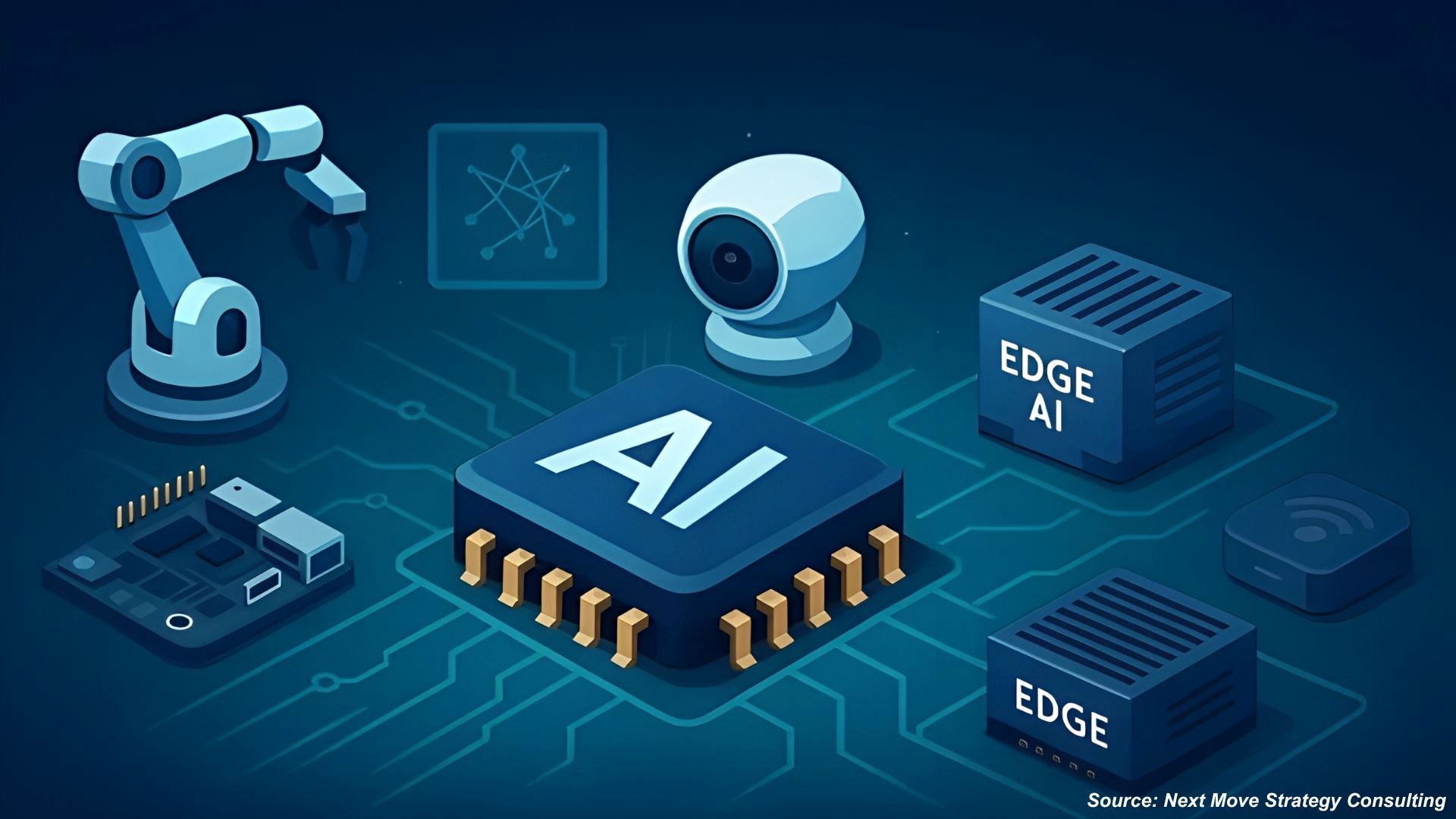
Artificial intelligence is undergoing a major architectural shift. Instead of relying entirely on centralized cloud environments, enterprises are increasingly deploying intelligence directly on connected devices operating closer to the source of data generation. This transition is redefining how businesses manage automation, operational efficiency, and real-time decision-making across industrial ecosystems.
The AI Edge Device Market is rapidly gaining strategic importance because enterprises now require faster processing speeds, lower latency, and scalable infrastructure capable of supporting massive volumes of connected devices. Industries such as manufacturing, transportation, logistics, robotics, and healthcare are generating continuous streams of operational data that cannot always be processed efficiently through centralized systems alone.
Recent developments from Allied Market Research and Accenture’s investment in CLIKA highlight how edge AI is moving from an emerging technology category into a foundational enterprise infrastructure layer. Businesses are increasingly recognizing that intelligent edge deployment can improve responsiveness, reduce infrastructure strain, and support next-generation automation capabilities.
How Is Edge AI Reshaping Enterprise Operations?
Traditional cloud computing models often introduce operational delays because information must travel to remote servers before processing can occur. For industries operating in real time, these delays can affect productivity, automation accuracy, and decision-making efficiency.
Edge AI addresses this issue by processing information directly on connected devices such as industrial machines, autonomous systems, smart sensors, and IoT endpoints. This localized processing model allows enterprises to analyze and respond to operational data almost instantly.
According to Allied Market Research, the global AI edge computing market was valued at $9.1 billion in 2020 and is projected to reach $59.6 billion by 2030, registering a CAGR of 21.2%. The expansion reflects growing enterprise demand for intelligent infrastructure capable of supporting real-time analytics and decentralized computing environments.
Industrial Internet of Things applications currently represent the largest market segment because industrial environments generate large amounts of operational data that require immediate analysis. Manufacturers are increasingly using edge AI to optimize predictive maintenance, monitor equipment performance, and reduce production downtime.
The shift toward localized processing also supports better bandwidth optimization and improved data privacy, particularly for enterprises managing sensitive operational information.

Major Trends Defining the AI Edge Device Market
The market is increasingly evolving toward scalable intelligent edge ecosystems designed for enterprise-level deployment. Organizations are prioritizing infrastructure models capable of supporting connected devices across diverse operational environments.
One of the most important developments in 2025 was Accenture’s investment in CLIKA, a company specializing in AI compression and optimization technologies for edge devices. The partnership reflects rising enterprise demand for simplified AI deployment across fragmented hardware environments that include industrial robotics, autonomous vehicles, smartphones, and IoT infrastructure.
A major challenge within edge AI deployment involves running advanced AI models on low-power hardware systems. CLIKA’s platform addresses this issue by compressing and optimizing AI models for different hardware environments without requiring extensive customization. This approach allows enterprises to deploy compact, high-performance models more efficiently across operational environments.
Regional expansion is also shaping the market landscape. Allied Market Research identified Asia-Pacific as the fastest-growing region due to the expansion of connected infrastructure projects, digital transformation initiatives, and rising adoption of smart technologies across countries including India, China, Japan, and Australia.
The continued rollout of 5G infrastructure is further supporting market growth by enabling faster communication between edge devices and enterprise systems.
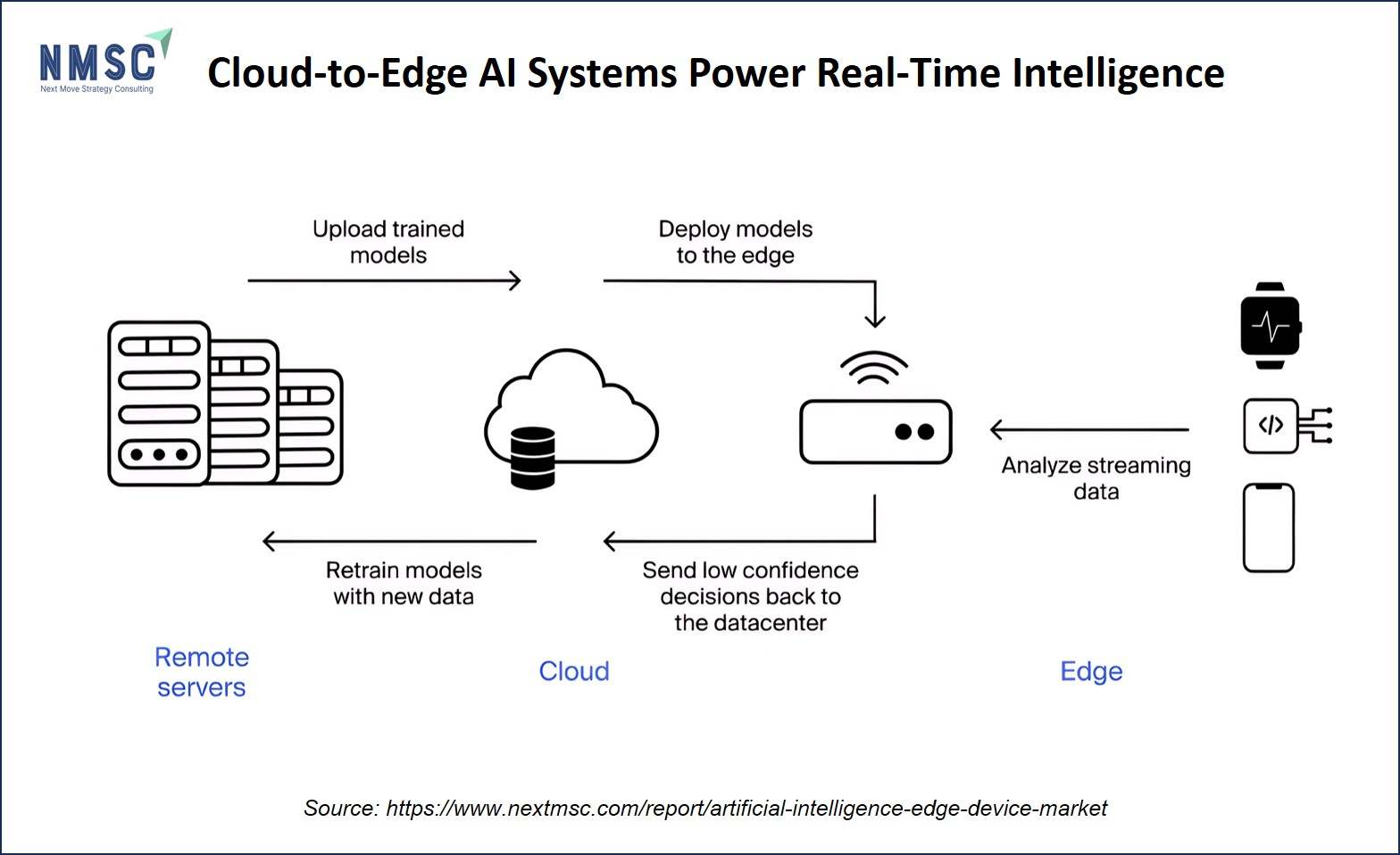
How AI Edge Computing Enables Real-Time AI Deployment
This diagram explains the workflow of AI edge computing and how artificial intelligence models move between remote servers, cloud infrastructure, and edge devices to enable real-time analytics.
The process begins in remote servers and cloud environments, where AI models are trained using large datasets and powerful computing infrastructure. Once the models are fully trained, they are uploaded and deployed to edge devices located closer to where data is generated.
At the edge layer, connected devices such as smartwatches, smartphones, sensors, and IoT systems continuously generate streaming data. Edge devices analyze this information locally in real time, which reduces latency and allows faster decision-making without depending entirely on centralized cloud servers.
The diagram also shows a feedback loop where low-confidence decisions or new operational data are sent back to cloud or remote servers. These systems retrain and improve AI models using updated data before redeploying optimized models back to edge devices.
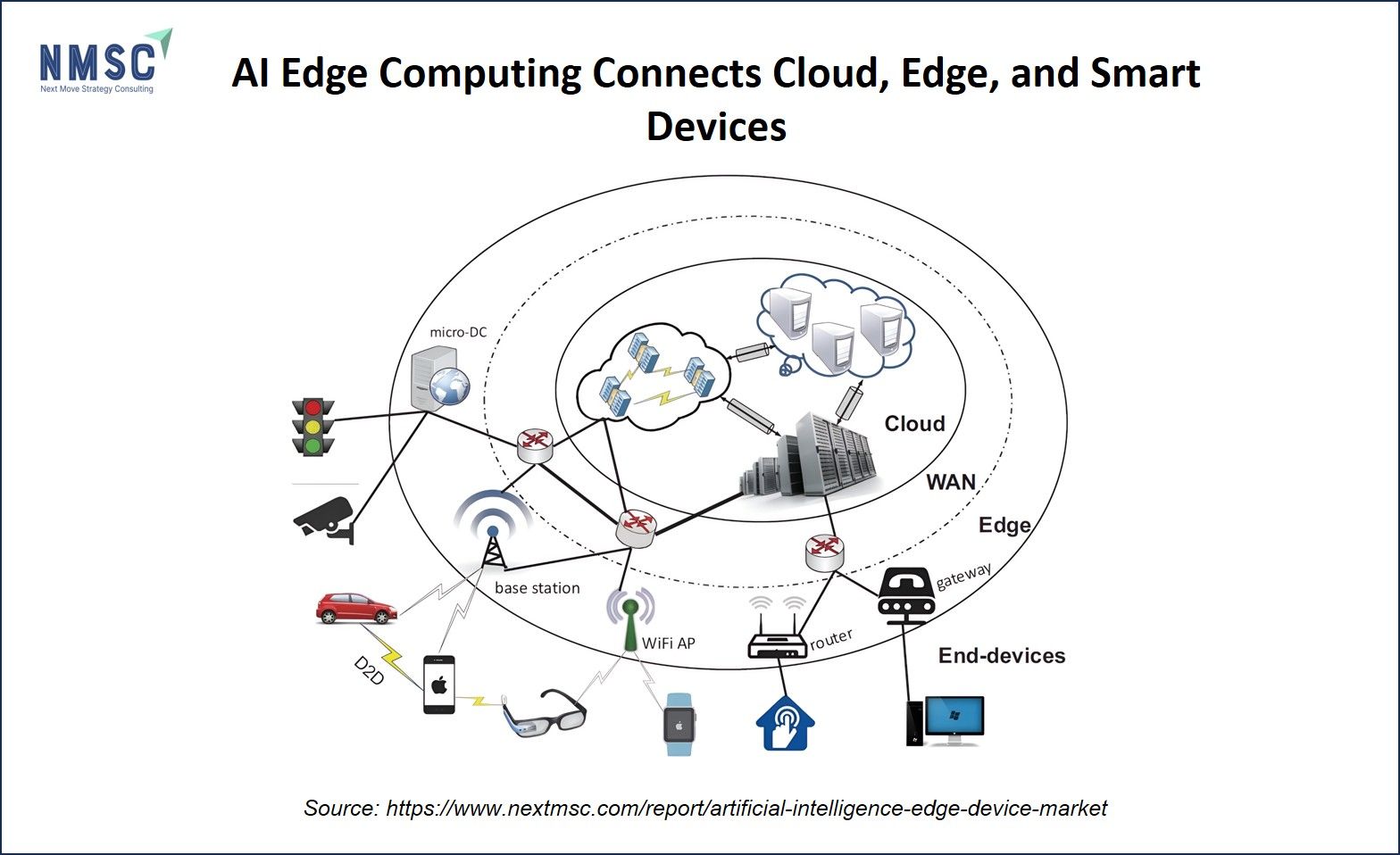
AI Edge Computing Architecture Overview
The diagram illustrates how AI edge computing enables real-time data processing by distributing intelligence across cloud systems, edge infrastructure, and connected end devices. Instead of sending all data to centralized cloud servers, edge computing processes information closer to where it is generated, reducing latency and improving operational efficiency.
At the center of the architecture is the cloud layer, which manages large-scale storage, advanced analytics, and centralized computing resources. Surrounding the cloud is the Wide Area Network (WAN) and edge layer, where localized processing takes place through routers, gateways, micro data centers, and base stations. These edge systems help filter and analyze data before transmitting only essential information to the cloud.
The outer layer consists of end devices, including smartphones, smart wearables, autonomous vehicles, surveillance cameras, industrial sensors, and connected home systems. These devices continuously generate operational data that is processed in real time through nearby edge infrastructure.
The diagram also highlights how technologies such as WiFi access points, device-to-device communication, and 5G-enabled base stations support seamless connectivity between devices and edge systems. This decentralized structure allows enterprises to improve automation, reduce network congestion, enhance response times, and support intelligent real-time applications across industries.
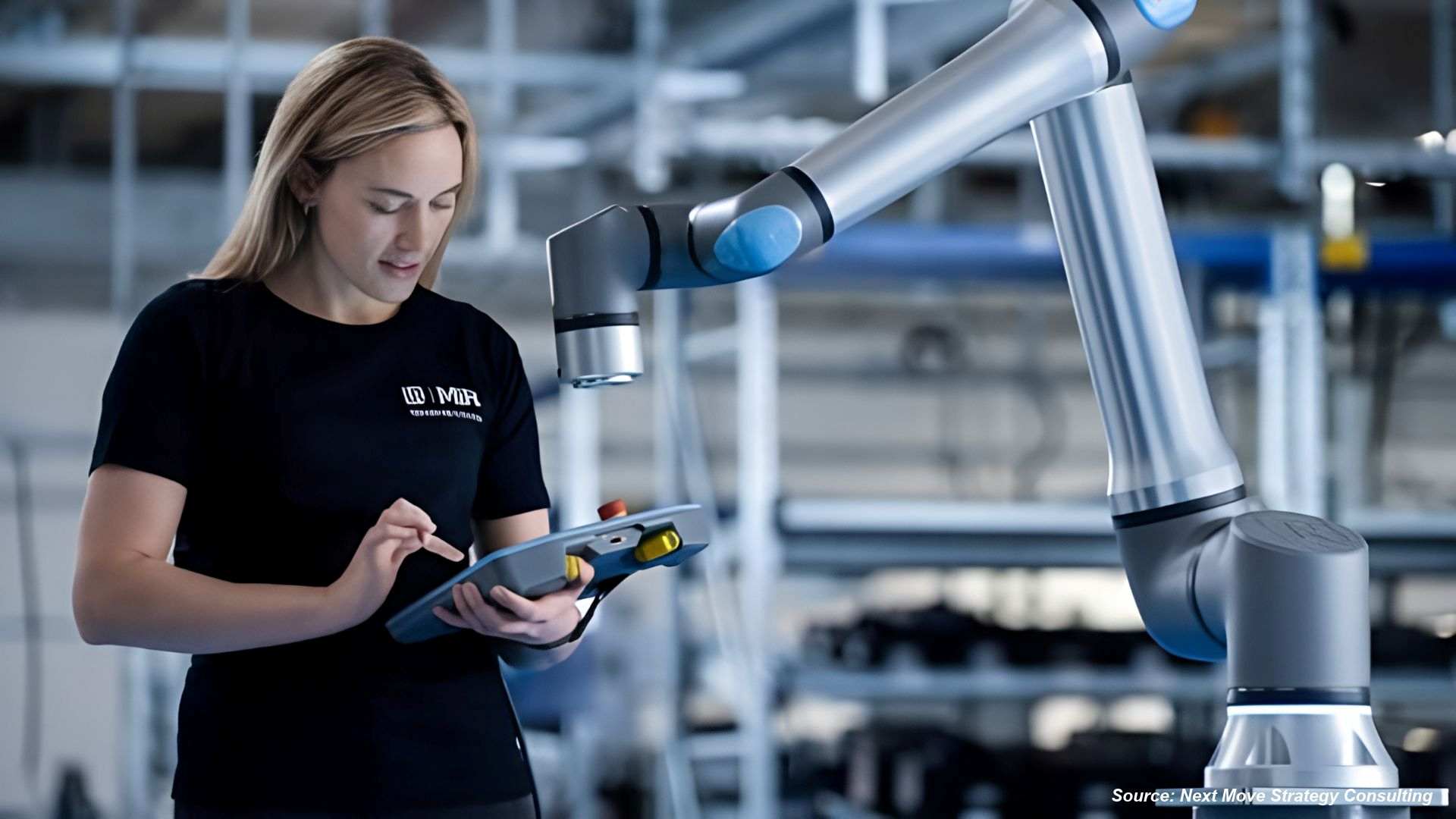
Leading Companies Driving Innovation in AI Edge Devices
The artificial intelligence edge device industry includes major technology companies such as Intel Corporation, Huawei Technologies Co. Ltd., Microsoft Corporation, MediaTek Inc., NVIDIA Corporation, International Business Machines Corporation (IBM), Mythic, Inc., Alphabet Inc., Amazon Web Services, Inc., and Imagination Technologies Limited. These companies are continuously investing in innovation, advanced AI infrastructure, and intelligent edge computing technologies across global markets to strengthen their competitive position in the artificial intelligence edge device industry.

AI Edge Computing Adoption Across Enterprise Industries
The pie chart highlights how different industries are adopting AI edge computing technologies to improve real-time decision-making, automation, and operational efficiency. The largest share belongs to IIoT & Manufacturing (32%), reflecting the growing use of edge AI for predictive maintenance, machine monitoring, and smart factory operations.
The Transportation & Logistics sector accounts for 24%, driven by increasing deployment of autonomous systems, fleet intelligence, and real-time tracking solutions. Healthcare represents 16% of adoption, as connected medical devices and edge-based patient monitoring systems become more important for faster data processing and localized analytics.
Meanwhile, Smart Infrastructure and Robotics & Automation each contribute 14%. These segments are expanding due to rising investments in smart cities, intelligent surveillance systems, industrial robotics, and automated operational environments.
Overall, the chart demonstrates that enterprises are increasingly integrating edge AI into industries that require low-latency processing, decentralized intelligence, and continuous real-time analytics.

Industry Impact Analysis
The impact of edge AI extends across multiple industrial sectors because organizations increasingly require real-time operational intelligence.
Manufacturing companies are using intelligent edge systems to improve predictive maintenance, automate workflows, and enhance machine monitoring capabilities. Transportation and logistics providers are deploying edge AI within fleet operations and autonomous systems that require immediate data processing capabilities. Healthcare organizations are integrating edge-based applications to support connected medical technologies and faster patient data analysis.
Public infrastructure projects are also adopting edge AI within surveillance systems, smart city frameworks, and intelligent transportation networks. Robotics applications are becoming increasingly advanced because localized intelligence enables machines to process operational data independently without depending entirely on centralized cloud connectivity.
Despite these advantages, adoption challenges remain. Infrastructure investment requirements continue to affect deployment decisions, particularly for enterprises operating legacy systems. Hardware fragmentation and shortages of skilled AI professionals also create operational complexity for organizations attempting to scale deployment environments.
At the same time, continued investments in AI optimization technologies and connected infrastructure are expected to create long-term modernization opportunities for enterprises worldwide.
Future Outlook
The future of the AI Edge Device Market points toward wider enterprise adoption of decentralized intelligence systems capable of supporting automation at scale. Businesses are increasingly recognizing that centralized cloud infrastructure alone cannot support the operational demands of connected industrial ecosystems.
Future development is expected to focus on lightweight AI models, scalable deployment frameworks, AI optimization platforms, and intelligent automation technologies. The collaboration between Accenture and CLIKA demonstrates how enterprises are prioritizing infrastructure solutions capable of delivering efficient AI deployment across diverse hardware environments.
As industrial ecosystems continue generating larger volumes of operational data, edge AI is expected to become a foundational component of enterprise infrastructure modernization strategies.
Next Steps
Organizations evaluating intelligent edge strategies should assess operational areas requiring real-time analytics while strengthening infrastructure readiness and cybersecurity planning. Enterprises should also evaluate deployment optimization strategies capable of supporting scalable AI implementation across fragmented hardware environments.
Strategic partnerships with intelligent infrastructure providers may become increasingly important as enterprise adoption accelerates across industrial sectors.
-
Assess infrastructure readiness for edge AI deployment across operational environments
-
Identify business functions that require real-time data processing and low-latency decision-making
-
Evaluate AI model optimization platforms for deployment across fragmented hardware ecosystems
Conclusion
The AI Edge Device Market is redefining enterprise infrastructure by enabling decentralized intelligence, faster analytics, and scalable automation capabilities. Industries managing large volumes of operational data are increasingly adopting edge AI solutions to improve efficiency, reduce latency, and strengthen infrastructure responsiveness.
As digital transformation initiatives continue expanding globally, intelligent edge deployment is becoming a strategic operational requirement rather than a niche technology investment. The continued growth of connected infrastructure, AI optimization technologies, and industrial automation is expected to reinforce the long-term importance of edge AI across enterprise ecosystems.
About the Author
 Sanyukta Deb
— Sanyukta Deb is Digital Marketing Team Lead at Next Move Strategy Consulting, where she has led content strategy and technical SEO for the firm's B2B market research publications for over 2 years. Her editorial process translates NextMSC's primary and secondary research — spanning technology, industrial, and consumer sectors — into commercial narratives, backed by search-intent, keyword, and competitive analysis. She brings 5 years of overall experience in digital marketing and content strategy.
Sanyukta Deb
— Sanyukta Deb is Digital Marketing Team Lead at Next Move Strategy Consulting, where she has led content strategy and technical SEO for the firm's B2B market research publications for over 2 years. Her editorial process translates NextMSC's primary and secondary research — spanning technology, industrial, and consumer sectors — into commercial narratives, backed by search-intent, keyword, and competitive analysis. She brings 5 years of overall experience in digital marketing and content strategy.
About the Reviewer
 Debashree Dey
— Debashree Dey is Assistant Manager at Next Move Strategy Consulting, where she supports cross-vertical market content and communications across diverse industries for 6 years. Her professional background includes senior content writing, communications, and published manuscript authorship, with experience developing audience-focused business narratives and maintaining clear, consistent messaging. Her role supports research-led content development and editorial quality across NextMSC publications.
Debashree Dey
— Debashree Dey is Assistant Manager at Next Move Strategy Consulting, where she supports cross-vertical market content and communications across diverse industries for 6 years. Her professional background includes senior content writing, communications, and published manuscript authorship, with experience developing audience-focused business narratives and maintaining clear, consistent messaging. Her role supports research-led content development and editorial quality across NextMSC publications.

















Add Comment