Why Texas Is One of the Fastest-Growing Markets for New Businesses

Co-working hubs in Austin, Dallas, and Houston keep filling with founders testing new ideas, but the story underneath that scene has changed. What used to be framed as a general “why start a business in Texas” pitch is really a story about one specific, fast-moving corner of commercial real estate: the co-working space market, where flexible, membership-based offices are replacing long-term leases for freelancers, startups, and increasingly, large enterprises.
This piece looks at where that market actually stands: the segments and growth drivers behind it, why Texas has become one of its most closely watched regional test cases, which of the industry's named operators and enterprise tenants have made the most consequential moves over the past year, and where the model is starting to strain under its own growth.
The Co-Working Space Market, By the Numbers
Next Move Strategy Consulting values the global co-working space market at USD 15.39 billion in 2026, up from USD 12.93 billion in 2025, and projects it will reach USD 74.28 billion by 2035 a compound annual growth rate of 19.1% across the 2026–2035 forecast window. The market spans six ways of segmenting flexible office demand, summarized below.
Co-Working Space Market Segmentation by Category
|
Segment category |
Key sub-segments |
|
Space Type |
Shared Open Spaces · Enclosed Private Suites · Virtual Office Solutions · Event/Meeting Facilities |
|
Membership Type |
Hot Desks · Dedicated Desks · Private Office Leases · Hybrid Flex Passes |
|
Industry Vertical |
Technology & IT Services · Financial & Professional · Healthcare & Life Sciences · Manufacturing & Logistics · Public Sector & Education |
|
End User |
Freelancers/Remote Workers · Startups (<10 employees) · SMEs (10–250 employees) · Large Enterprises (>250) |
Three forces are doing most of the work behind that growth, per NMSC's analysis: rising freelance and remote work driving demand for professional, on-demand environments; networking and collaboration needs that a home office simply can't replicate; and a broader corporate shift toward asset-light, short-term leasing over traditional five-to-ten-year commercial commitments. Working against that growth, per the same analysis, are high operational costs rent, maintenance, and technology integration that squeeze margins for small and mid-sized operators in particular.
Section summary: co-working has moved from a freelancer amenity to a mainstream corporate real estate strategy.
-
NMSC forecasts the market growing from $15.39B (2026) to $74.28B (2035) at a 19.1% CAGR.
-
Hybrid work, freelance growth, and asset-light leasing are the three structural drivers cited across the segment.
-
High operational costs remain the clearest brake on smaller operators' expansion.
Texas: A Population Story with a Twist
Texas is still the single biggest source of new co-working demand of any U.S. state, but the story is more nuanced than “endless boom.” According to newly released U.S. Census Bureau data reported by the Texas Tribune, Texas added 391,243 residents in 2025 more than any other state bringing its population to roughly 31.7 million. But the state's growth rate slowed to 1.2%, its weakest pace since 2021, as net international migration into Texas fell 48% year-over-year amid a broader national immigration slowdown. The takeaway for co-working operators isn't that Texas has stopped growing; it's that the easy, high-velocity growth of the pandemic years has cooled into something steadier.
That steadier growth is still translating directly into flexible-office demand. Austin's tech-driven startup ecosystem, incubators, and accelerator networks continue to feed a pipeline of small teams that need professional space without a multi-year lease, while Dallas and Houston's logistics, energy, and corporate-services sectors are increasingly using flexible offices as satellite hubs rather than headquarters replacements. Texas's lack of a state income tax and comparatively simple business-formation process remain structural advantages for new companies choosing where to set up, independent of any single service provider.
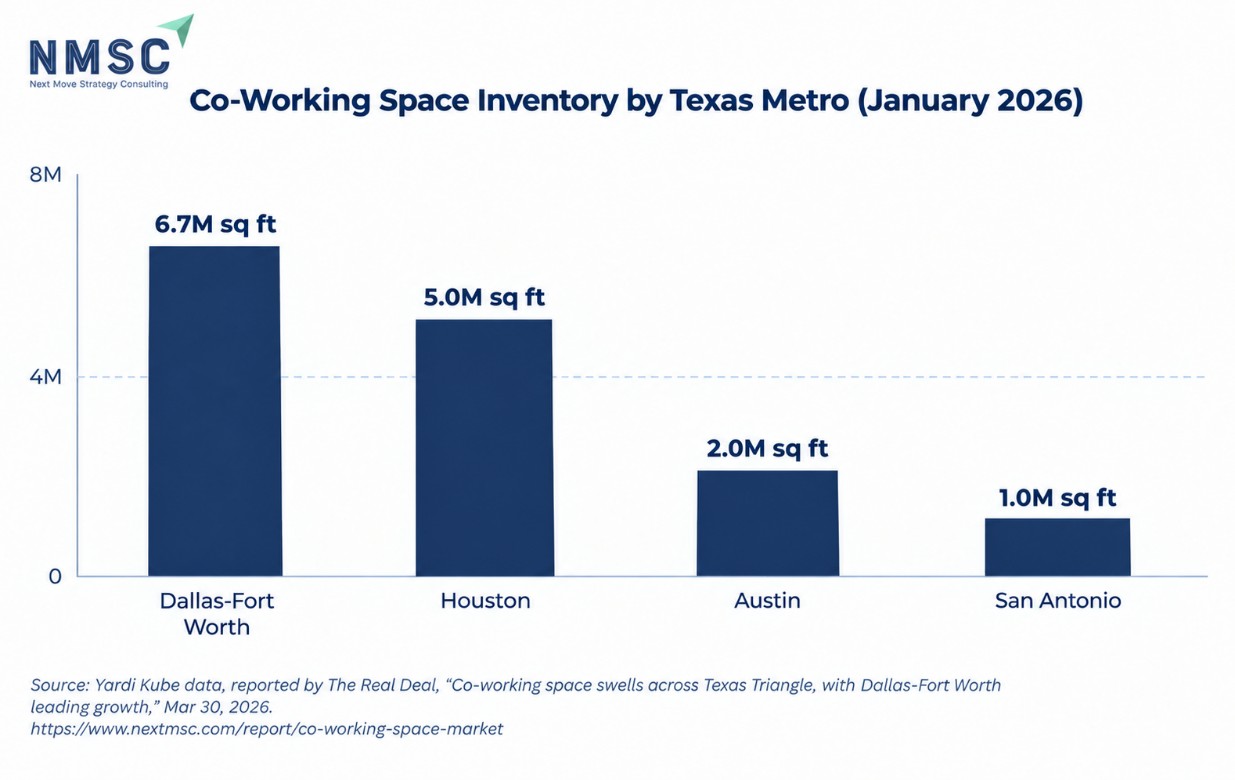
Dallas-Fort Worth is now Texas's largest co-working market at 6.7 million square feet fifth-largest nationally behind Manhattan, Chicago, Los Angeles, and Washington, D.C. after growing 29% in a single year. Houston follows at 5 million square feet, with Austin at 2 million and San Antonio, the fastest-growing of the four by percentage, at 1 million. Nearly 80% of co-working locations nationwide are run by independent operators rather than the largest branded chains, and DFW reflects that pattern closely: of the roughly 301 locations tracked in the metro, International Workplace Group operates 59 and WeWork 12, leaving about three-quarters run by smaller or regional operators.
Industry Leader Moves: Who's Actually Shaping the Co-Working Space Market
A handful of the 20 companies named as key players in this space have made verifiable, globally relevant moves over the past year; several of the smaller, more regional operators on the list had no material development that met that bar, and that gap is reflected honestly below rather than papered over.
The two biggest branded operators are growing in opposite directions
International Workplace Group the owner of Regus and Spaces, and the market's largest branded operator posted an 11% jump in system-wide revenue to $2.4 billion in the first half of 2026, signing 728 new centers and opening 425, while reiterating full-year adjusted EBITDA guidance of $585–625 million. Management has leaned into a capital-light, franchised and managed-location model rather than owning real estate outright. WeWork, by contrast, is rebuilding more selectively after its 2023 bankruptcy restructuring: in May 2026 it signed its first new Dallas-area lease since 2019, expanding to nearly 54,000 square feet in Plano after seeing membership across its Dallas-Fort Worth locations climb almost 25% since the start of the year driven, the company said, by demand from financial-services and technology tenants.
The demand side is now setting the pace, not just the operators
Perhaps the clearest sign of where this market is headed comes from the tenant side rather than the operators. Fortune reported in January 2026 that Amazon and JPMorgan two of the earliest and strictest companies to mandate five-day office returns are now among the biggest users of coworking space themselves, alongside firms like Lyft and Pfizer, using flexible offices to add capacity without long-term commitments. JPMorganChase's own announcement of a new 41,000-square-foot flexible workspace in Frisco, Texas in August 2026, built to serve its fast-growing Dallas-Fort Worth client base, reflects the same logic. Cushman & Wakefield's occupier research puts numbers behind the trend: 55% of global occupiers now use flexible office space in some form, with meeting-room bookings up 24.5% in Asia-Pacific and 22% in the Americas year-over-year, evidence that flex space is becoming a collaboration hub rather than a stopgap.
Smaller and regional operators make up most of the market quietly
Hub Australia, a premium Australian operator, saw founder Brad Krauskopf step down as CEO in December 2025 after 16 years to become Board Chair, part of a broader leadership transition as the company opens its next site in Perth's Brookfield Place tower. LiquidSpace expanded its enterprise booking integration with Industrious in January 2026, and Crown Workspace continues to support office relocations and fit-outs as companies move in and out of flexible space. For the remaining names on the list including V74 CoWorking Space, The Commons, Spacent, Baseworx, Amalie6, Office Hub, SOHO, ZOKU, Workspace365, Easy Offices, CreativeCubes.Co, and Ostow Limited no globally reported, independently verifiable development from the past six months met this article's evidentiary bar; that reflects the market's structure as much as anything else, since independent and regional brands make up the large majority of locations worldwide but rarely generate international press coverage individually.
Recent Strategic Moves by Key Co-Working Space Market Players
|
Company |
Recent move |
Date |
Scale / value |
|
International Workplace Group (Regus, Spaces) |
H1 2026 system-wide revenue up 11% to $2.4B; signed 728 new centers, opened 425 |
Aug 2026 |
Adjusted EBITDA $265M; FY26 guidance $585–625M |
|
WeWork Inc. |
First new Dallas-area lease since 2019 expanded to 53,776 sq ft in Plano, TX |
May 2026 |
DFW membership up ~25% since start of year |
|
Cushman & Wakefield |
Published occupier survey: 55% of global occupiers now use flexible offices |
2026 |
Meeting-room bookings up 24.5% APAC, 22% Americas YoY |
|
JPMorgan Chase & Co. |
Announced a lease for a new 41,000-square-foot office at The Tower at HALL Park (6605 Warren Parkway) in Frisco, Texas. |
Aug 2026 |
41,000 sq ft; 100+ new employees |
|
Hub Australia |
Founder Brad Krauskopf stepped down as CEO after 16 years to become Chair |
Dec 2025 |
16 locations; 3 more in development |
|
LiquidSpace, Inc. |
Expanded Instant Book integration with Industrious for enterprise clients |
Jan 2026 |
Not disclosed |
|
Crown Workspace |
Continued office relocation/fit-out services supporting flex-office transitions |
Ongoing, 2026 |
Not disclosed |
|
V74 CoWorking Space |
No globally-reported material development identified in the period |
|
Not disclosed |
|
The Commons |
No globally-reported material development identified in the period |
|
Not disclosed |
|
Spacent |
No globally-reported material development identified in the period |
|
Not disclosed |
|
Baseworx |
No globally-reported material development identified in the period |
|
Not disclosed |
|
Amalie6 |
No globally-reported material development identified in the period |
|
Not disclosed |
|
Office Hub |
No globally-reported material development identified in the period |
|
Not disclosed |
|
SOHO |
No globally-reported material development identified in the period |
|
Not disclosed |
|
ZOKU |
Continued operation of hybrid aparthotel/coworking concept (Amsterdam, Copenhagen, Paris, Vienna) |
Ongoing, 2026 |
Not disclosed |
|
Workspace365 Pty Ltd |
No globally-reported material development identified in the period |
|
Not disclosed |
|
Easy Offices |
No globally-reported material development identified in the period |
|
Not disclosed |
|
CreativeCubes.Co Pty Ltd |
No globally-reported material development identified in the period |
|
Not disclosed |
|
Ostow Limited |
No globally-reported material development identified in the period |
|
Not disclosed |
|
Crown Workspace (Philippines) |
Managed relocation for a global financial-services client in Taguig City |
2026 |
Not disclosed |
Industry impact: growth is coming from both sides of the lease now.
-
Branded operators (IWG, WeWork) are growing through different models asset-light franchising versus selective, demand-led expansion.
-
Large enterprises (Amazon, JPMorgan) are now demand drivers in their own right, not just occupiers of last resort.
-
The market's long tail of independent and regional operators still represents the majority of physical locations worldwide.
Where the Co-Working Space Market Sits Globally
Texas's growth is a North American story, but it's playing out inside a market where Europe currently holds the largest share.
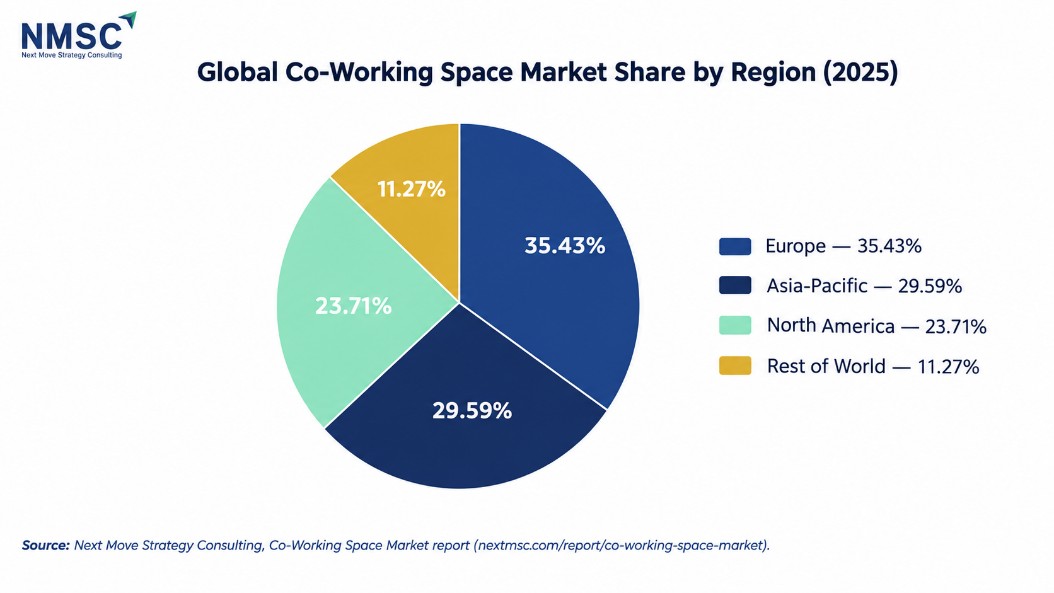
Europe holds 35.43% of the global market, supported by strong government backing for SME incubation and commercial-leasing rules that favor flexible arrangements, particularly in financial hubs like London and Frankfurt. Asia-Pacific follows at 29.59%, driven by rapid urbanization and startup formation in China, India, and Singapore. North America Texas’s home region holds 23.71%, with growth concentrated in hybrid-work adoption and enterprise satellite hubs. The remaining 11.27% spans the Middle East, Africa, and Latin America, where foreign direct investment and the expansion of global operators are introducing flexible workspace to markets that have historically leaned on traditional leasing.
Market Challenges: Costs and Uneven Absorption
The same forces driving growth are creating real strain in specific metros. NMSC's own analysis flags high operational costs rent, maintenance, and technology integration as the clearest brake on smaller operators, particularly where occupancy fluctuates with the broader economic cycle. That tension is visible on the ground in Texas: Commercial Property Executive reported in early 2026 that Austin's office market opened the year with elevated vacancy even after a year-over-year decline, transaction activity that remained muted through February, and a construction pipeline that kept adding supply regardless a combination that puts pressure on lease rates even as coworking's share of total office inventory keeps expanding.
Market Opportunities and Future Outlook
NMSC's analysis points to sustainability and green building practices as the clearest emerging differentiator: operators investing in energy-efficient systems, eco-friendly materials, and green certifications are positioned to command premium memberships from environmentally conscious enterprise clients, on top of the long-term operating-cost savings those investments bring. Specialization is following a similar path industry-specific environments for tech, life sciences, and regulated sectors are gaining ground on generic, one-size-fits-all coworking floors, since they cut onboarding time and give tenants infrastructure that's already tailored to their compliance and workflow needs.
Future outlook: the market's next phase rewards specialization and balance-sheet discipline over square footage alone.
-
Green building and sustainability credentials are shifting from marketing differentiator to a genuine driver of premium pricing.
-
Industry-specific and enterprise-managed spaces are gaining share faster than generic, freelancer-first coworking floors.
-
Markets with strong absolute demand growth but easing population tailwinds, like Texas, will likely see consolidation among operators rather than pure expansion.
Conclusion
Texas's role in the co-working space market was never really about population growth alone it’s about what steady, still-substantial growth does to the calculus for founders, enterprises, and workspace operators deciding where to place their next square foot. With Dallas-Fort Worth now the fifth-largest coworking market in the country and companies as different as WeWork and JPMorgan Chase expanding flexible footprints in the same metro for very different reasons, Texas looks less like a temporary boomtown and more like a durable proving ground for how the broader market matures.
|
Get the full market picture Full market sizing, forecast data, and segment-level detail for the co-working space market are available in NMSC's complete syndicated report. |
About the Author
 Sanyukta Deb
— Sanyukta Deb is Digital Marketing Team Lead at Next Move Strategy Consulting, where she has led content strategy and technical SEO for the firm's B2B market research publications for over 2 years. Her editorial process translates NextMSC's primary and secondary research — spanning technology, industrial, and consumer sectors — into commercial narratives, backed by search-intent, keyword, and competitive analysis. She brings 5 years of overall experience in digital marketing and content strategy.
Sanyukta Deb
— Sanyukta Deb is Digital Marketing Team Lead at Next Move Strategy Consulting, where she has led content strategy and technical SEO for the firm's B2B market research publications for over 2 years. Her editorial process translates NextMSC's primary and secondary research — spanning technology, industrial, and consumer sectors — into commercial narratives, backed by search-intent, keyword, and competitive analysis. She brings 5 years of overall experience in digital marketing and content strategy.
About the Reviewer
 Debashree Dey
— Debashree Dey is Assistant Manager at Next Move Strategy Consulting, where she supports cross-vertical market content and communications across diverse industries for 6 years. Her professional background includes senior content writing, communications, and published manuscript authorship, with experience developing audience-focused business narratives and maintaining clear, consistent messaging. Her role supports research-led content development and editorial quality across NextMSC publications.
Debashree Dey
— Debashree Dey is Assistant Manager at Next Move Strategy Consulting, where she supports cross-vertical market content and communications across diverse industries for 6 years. Her professional background includes senior content writing, communications, and published manuscript authorship, with experience developing audience-focused business narratives and maintaining clear, consistent messaging. Her role supports research-led content development and editorial quality across NextMSC publications.


















Add Comment