What Are the Financial Perks of Expanding Your Business to the Caribbean?

Where capital gets structured, and by whom, has always mattered more than where a business happens to be located. That is as true for sustainable capital as for any other kind. According to Next Move Strategy Consulting's Green Finance Market analysis, the global green finance market was valued at USD 4.43 trillion in 2025 and is expected to reach USD 10.46 trillion by 2035, growing at a CAGR of 8.96% from 2026 to 2035.
Two forces are behind that growth. The first is regulatory: mandatory climate disclosure regimes across Europe and Asia-Pacific are standardizing what counts as a credible green instrument, which is steering capital toward taxonomy-aligned assets rather than looser ESG labels. The second is structural: sustainability-linked bonds and loans, which tie financing terms to measurable performance targets rather than funding a specific project, are broadening which companies can participate at all. Both trends are reshaping which institutions win the underwriting, advisory, and asset-management mandates that come with that capital and the last year has brought the clearest consolidation move the market has seen in some time.
Why Green Finance Is Entering a New Growth Phase
The shift from volume-driven green bond issuance toward platform depth is visible in how institutions are competing. Rather than simply expanding balance sheets, banks and asset managers are acquiring ESG data platforms, carbon-accounting tools, and climate-analytics capability investments aimed at underwriting precision and advisory credibility rather than issuance volume alone. At the same time, blended finance structures, which combine concessional public capital with private investment to de-risk projects in emerging markets, are becoming more sophisticated as grant funding narrows, incorporating partial guarantees and first-loss capital rather than relying on concessional volume alone.
Retail access is expanding alongside institutional capital, too: reduced minimum investment thresholds and fintech distribution channels are drawing younger, long-horizon investors into sustainability-linked ETFs and impact oriented savings products.
For high-net-worth investors and family offices managing cross-border assets, wealth-preservation structures such as a Nevis Trust can also form part of broader long-term financial planning.
The account-connectivity and data-sharing infrastructure behind that shift overlaps with NMSC's own Open Banking Market research, since open banking APIs are increasingly what let retail platforms plug climate-aligned investment products into a customer's existing bank accounts.
Content key takeaways
In short: green finance is maturing from a labeling exercise into a platform business, where regulatory credibility and data infrastructure increasingly decide who wins mandates.
-
The market is projected to roughly double from USD 4.43 trillion (2025) to USD 10.46 trillion by 2035
-
Mandatory climate disclosure is standardizing what counts as a credible green instrument, favoring taxonomy-aligned assets
-
Sustainability-linked bonds and loans are broadening corporate participation beyond traditional use-of-proceeds green bonds
-
Institutions are competing on ESG data and analytics capability, not just balance-sheet scale
Industry Leader Moves: Consolidation and Transition Finance
Next Move Strategy Consulting's Green Finance Market report tracks twenty key players, and the past year's clearest signal is consolidation in sustainable asset management alongside new transition-finance frameworks at several major banks.
BNP Paribas, through its insurance arm BNP Paribas Cardif, completed a €5.1 billion acquisition of AXA Investment Managers on July 1, 2025, creating a combined asset-management platform with more than €1.5 trillion in assets under management. The two businesses' legal entities were fully merged by December 31, 2025 under the BNP Paribas Asset Management brand, positioning the combined platform, with AXA IM's specific expertise in private assets and responsible investment, as one of the largest sustainability-oriented asset managers in Europe.
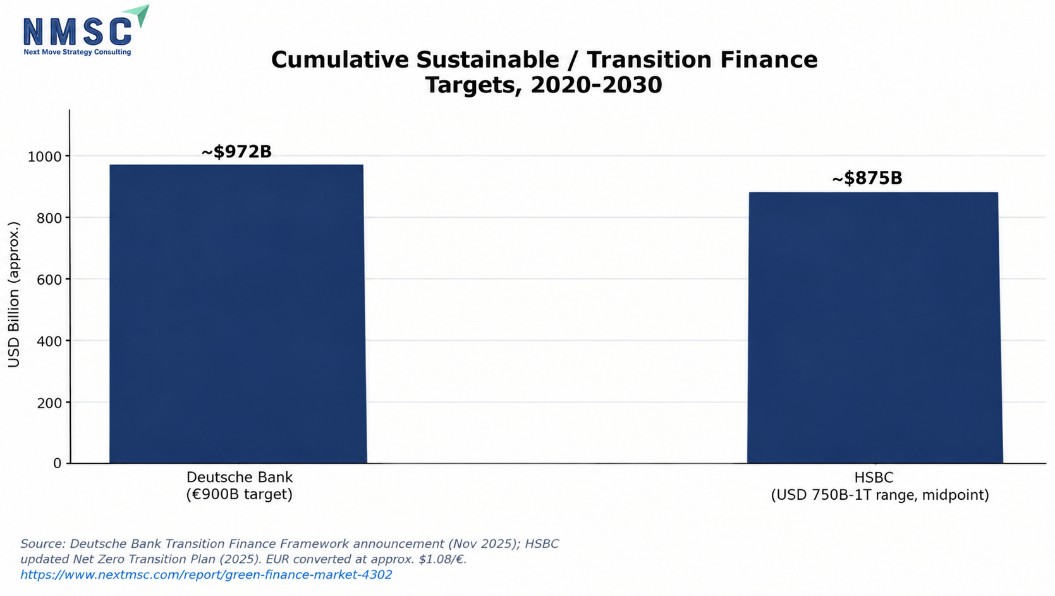
Deutsche Bank announced a new cumulative sustainable and transition finance target of €900 billion through 2030 at COP30 in November 2025, alongside its first Transition Finance Framework (TFF), effective January 1, 2026. The framework defines clear rules for financing net-zero transitions in hard-to-abate sectors and has received a positive second-party opinion from ISS-Corporate a governance step aimed at avoiding the kind of vague “transition” claims that have drawn regulatory scrutiny elsewhere in the market.
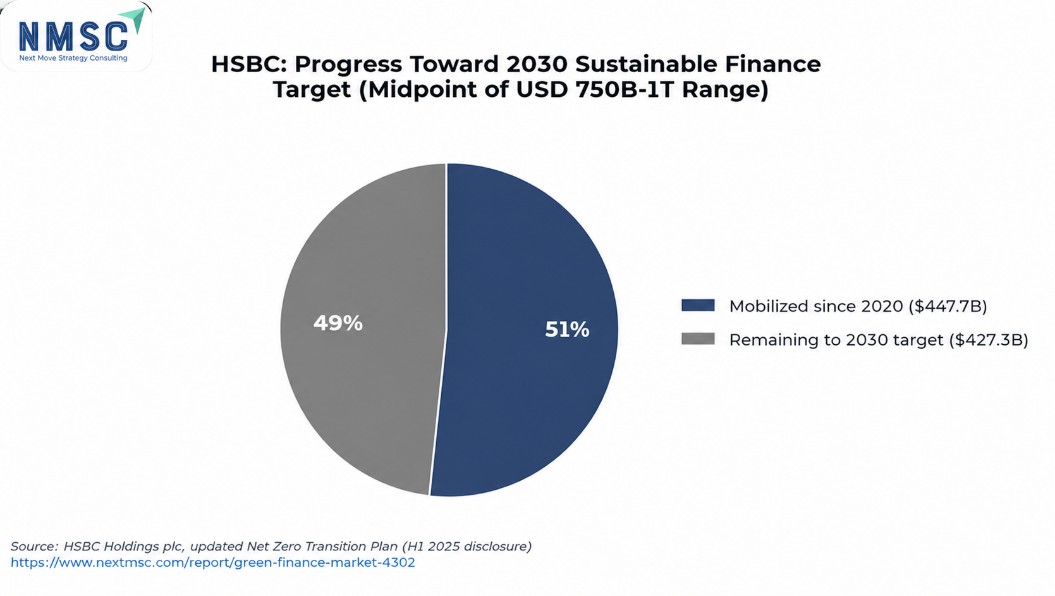
HSBC updated its Net Zero Transition Plan, reporting USD 54.1 billion in sustainable finance and investment in the first half of 2025 alone, a 19% increase year-on-year, bringing total mobilization since 2020 to USD 447.7 billion against a 2030 goal of USD 750 billion to USD 1 trillion. Notably, the bank also replaced several fixed 2030 sectoral financed-emissions targets with target ranges, citing real-economy decarbonization constraints a move that drew criticism from climate campaigners even as HSBC maintained its overall 2050 net-zero ambition.
JPMorgan Chase played a lead role in a $5 billion financing package for VoltaGrid, a natural-gas microgrid company supplying behind-the-meter power to AI data centers, completed in February 2026 as part of the bank's $1.5 trillion, ten-year Security and Resiliency Initiative. The bank's own research projects USD 5.8 trillion in global grid-upgrade spending between 2026 and 2035 a reminder that not all of the capital flowing into energy transition and grid resilience is structured as a pure green instrument; some of it, like this deal, finances lower-carbon but not zero-carbon infrastructure built to meet surging AI-driven power demand.
Mizuho Financial Group had its green deposit framework, dated February 2026, assigned a “very good” Sustainability Quality Score by Moody's, covering nine eligible green project categories aligned with ICMA's Green Bond Principles a comparatively modest but concrete step for a bank whose 2025 acquisition of advisory firm Augusta & Co, per NMSC's competitive analysis, was aimed at building out renewable-energy and transition-finance advisory capacity.
IFC (World Bank Group) signed a collaboration agreement in November 2025 with Malaysia's Permodalan Darul Ta'zim and Ditrolic Energy to develop the Southern Johor Renewable Energy Corridor, a USD 6 billion, 2,000-square-kilometer solar-and-storage hub designed to deliver up to 4 gigawatts of solar capacity and 5.12 gigawatt-hours of storage, supporting the ASEAN Power Grid initiative. This is a correction to NMSC's own report, which cites the project's value as “USD 6 trillion”; independent verification against IFC's own press release and multiple financial-news outlets confirms the figure is USD 6 billion.
BlackRock has continued to frame the energy transition around technology adoption rather than policy support, with a senior executive telling a March 2026 industry conference that low-carbon technology adoption not policy has been the bigger determinant of transition progress, even as policy setbacks have delayed net-zero timelines in some markets.
The remaining profiled institutions Triodos, CECEPEC, ING, Standard Chartered, Raiffeisen Bank International, CaixaBank, Societe Generale, Goldman Sachs, Morgan Stanley, UBS, The Vanguard Group, the Eurasian Development Bank, and Bank of America continue to anchor the market from different positions along the same value chain: universal banks structure and distribute green and sustainability-linked debt, asset managers such as Vanguard and UBS direct ESG-integrated portfolio flows, and development institutions such as the Eurasian Development Bank play a catalytic role in emerging markets. Standard Chartered specifically has continued issuing green-labeled bonds including a recent €1 billion issuance backed by a $17.4 billion green-asset pool spanning renewable power, efficient buildings, and water management as part of its broader emerging-markets sustainable finance program.
Industry Impact key takeaways
In short: the past year's defining move is consolidation in sustainable asset management (BNP Paribas/AXA IM), while several major banks are formalizing transition-finance frameworks that go beyond simple green-bond labeling.
-
BNP Paribas' €5.1 billion acquisition of AXA Investment Managers is the largest disclosed consolidation move among the profiled institutions
-
Deutsche Bank and HSBC have both set or updated long-term sustainable/transition finance targets, though HSBC's move to target ranges shows real-economy constraints are shaping ambition
-
Not all climate-adjacent bank financing is a pure green instrument, as JPMorgan's natural-gas microgrid financing for AI data centers illustrates
-
Development institutions like IFC remain essential for large, capital-intensive emerging-market projects that private capital alone would not de-risk
Green Finance Market: Report Scope and Segmentation
|
Parameter |
Detail |
|
Market Size in 2025 |
USD 4.43 Trillion |
|
Market Size in 2026 |
USD 4.83 Trillion |
|
Revenue Forecast in 2035 |
USD 10.46 Trillion |
|
Growth Rate |
CAGR of 8.96% from 2026 to 2035 |
|
Analysis Period |
2025–2035 |
|
Base Year Considered |
2025 |
|
Countries Covered |
33 |
|
Companies Profiled |
20 |
|
Growth Factors |
Tightening climate disclosure mandates; expanding sustainability-linked bond and loan issuance; blended finance mobilizing private capital |
Industry Leader Moves at a Glance
|
Company |
Recent Move |
When |
Source |
|
BNP Paribas |
Completed €5.1B acquisition of AXA Investment Managers; full legal merger Dec 2025 |
Jul & Dec 2025 |
BNP Paribas press releases |
|
Deutsche Bank AG |
New €900B cumulative sustainable/transition finance target; first Transition Finance Framework |
Nov 2025 / Jan 2026 |
Deutsche Bank Newsroom |
|
HSBC Group |
Updated Net Zero Transition Plan; $447.7B mobilized since 2020 vs. $750B–$1T 2030 goal |
2025 disclosure |
HSBC Holdings plc |
|
JPMorgan Chase & Co. |
$5B financing package for VoltaGrid AI-data-center microgrids under Security and Resiliency Initiative |
Feb 2026 |
J.P. Morgan Newsroom |
|
Mizuho Financial Group |
Green deposit framework rated “very good” by Moody's |
Feb 2026 |
Moody's / Mizuho disclosure |
|
IFC (World Bank Group) |
$6B Southern Johor Renewable Energy Corridor agreement (4GW solar / 5.12GWh storage) |
Nov 2025 |
IFC Press Room |
|
BlackRock, Inc. |
Public commentary framing technology, not policy, as the primary transition driver |
Mar 2026 |
Industry conference remarks |
|
Standard Chartered |
€1B green bond issuance backed by $17.4B green-asset pool |
2025–2026 |
Company disclosures |
Future Outlook
Three trends look likely to continue. First, expect further consolidation in ESG-focused asset management, following the logic of BNP Paribas' AXA IM deal, as scale and data infrastructure become bigger differentiators than balance-sheet size alone. Second, transition finance frameworks like Deutsche Bank's will keep proliferating as banks seek credible, third-party-reviewed ways to finance hard-to-abate sectors without inviting greenwashing criticism. Third, expect continued tension between climate ambition and real-economy constraints, as HSBC's shift to target ranges illustrates banks are likely to keep their overall net-zero commitments while building more flexibility into near-term sectoral targets.
Future Outlook key takeaways
In short: scale, credible transition-finance governance, and realistic near-term targets are becoming the market's main competitive differentiators.
-
Expect continued consolidation in ESG-focused asset management following BNP Paribas' AXA IM playbook
-
Expect more banks to publish formal transition finance frameworks with third-party review
-
Expect banks to keep long-term net-zero commitments while building flexibility into near-term sectoral targets
-
Expect blended finance structures to keep growing more sophisticated as concessional public funding remains constrained
Conclusion
The green finance market's path to a projected USD 10.46 trillion by 2035 is increasingly a story about which institutions can combine balance-sheet scale, credible transition-finance governance, and ESG data infrastructure into a single platform. BNP Paribas' acquisition of AXA Investment Managers is the clearest example so far of what that combination looks like in practice, but Deutsche Bank's and HSBC's moves show that credibility and realism, not just ambition, are what the next phase of growth will reward.
Curious how these figures break down by investor type, financing type, and region? Download Free Sample of NMSC's full Green Finance Market report.
About the Author
 Sanyukta Deb
— Sanyukta Deb is Digital Marketing Team Lead at Next Move Strategy Consulting, where she has led content strategy and technical SEO for the firm's B2B market research publications for over 2 years. Her editorial process translates NextMSC's primary and secondary research — spanning technology, industrial, and consumer sectors — into commercial narratives, backed by search-intent, keyword, and competitive analysis. She brings 5 years of overall experience in digital marketing and content strategy.
Sanyukta Deb
— Sanyukta Deb is Digital Marketing Team Lead at Next Move Strategy Consulting, where she has led content strategy and technical SEO for the firm's B2B market research publications for over 2 years. Her editorial process translates NextMSC's primary and secondary research — spanning technology, industrial, and consumer sectors — into commercial narratives, backed by search-intent, keyword, and competitive analysis. She brings 5 years of overall experience in digital marketing and content strategy.
About the Reviewer
 Debashree Dey
— Debashree Dey is Assistant Manager at Next Move Strategy Consulting, where she supports cross-vertical market content and communications across diverse industries for 6 years. Her professional background includes senior content writing, communications, and published manuscript authorship, with experience developing audience-focused business narratives and maintaining clear, consistent messaging. Her role supports research-led content development and editorial quality across NextMSC publications.
Debashree Dey
— Debashree Dey is Assistant Manager at Next Move Strategy Consulting, where she supports cross-vertical market content and communications across diverse industries for 6 years. Her professional background includes senior content writing, communications, and published manuscript authorship, with experience developing audience-focused business narratives and maintaining clear, consistent messaging. Her role supports research-led content development and editorial quality across NextMSC publications.


















Add Comment