Renewable Energy Market Statistics, Trends & Forecasts for 2026

The global power system has crossed a structural threshold. By the end of 2025, renewables accounted for 49.4% of total installed power capacity worldwide, edging ever closer to majority status, as global renewable power capacity reached 5,149 GW following a record single-year addition of 692 GW. For utility-scale solar developers, wind farm developers, renewable energy EPC contractors, and institutional investors, this is no longer a transition narrative—it is the defining commercial reality of the decade.
The renewable energy market now sits at the intersection of unprecedented demand growth and intensifying capital discipline. Electricity demand is rising almost everywhere, propelled by data centers, electrification, and industrial load, while solar photovoltaic alone met more than 25% of the increase in global energy demand in 2025—the first time on record that a modern renewable source contributed the largest share. This article examines the breaking developments, regulatory shifts, and forward forecasts that stakeholders must internalize to capture value through 2030.
For More Information – Download FREE Sample on Renewable Energy Market Report
The Record-Breaking Surge Redefining the Renewable Energy Market
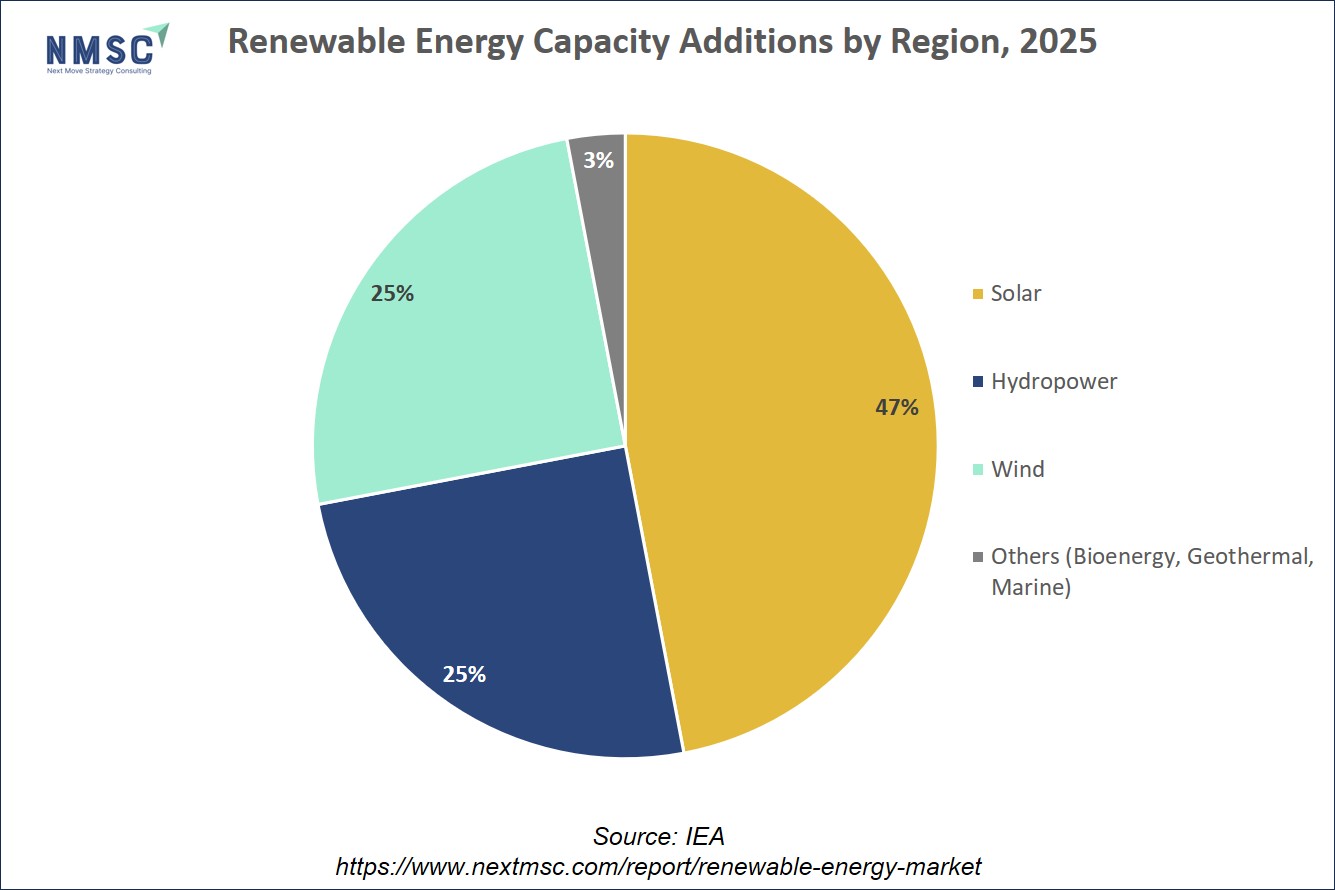
The single most consequential industry event of the past six months was the confirmation, published by the IEA in its Global Energy Review 2026, that annual global renewable capacity additions rose to a record 800 GW in 2025—a 16% increase—of which solar contributed 75%. Equally striking, the 2025 increase in solar PV generation of 600 terawatt-hours was the largest-ever annual electricity generation increase by any source, outside of post-crisis recovery periods, and renewables combined now virtually match total global generation from coal.
This momentum is corroborated by IRENA, which reported that solar capacity increased by 511 GW (+27.2%) in 2025, while wind energy additions reached a record high of 158.7 GW (+14.0%)—together accounting for 96.8% of all net renewable additions. On the capital side, BloombergNEF confirmed that global energy transition investment reached a record $2.3 trillion in 2025, underscoring the depth of financial commitment now anchoring the sector.
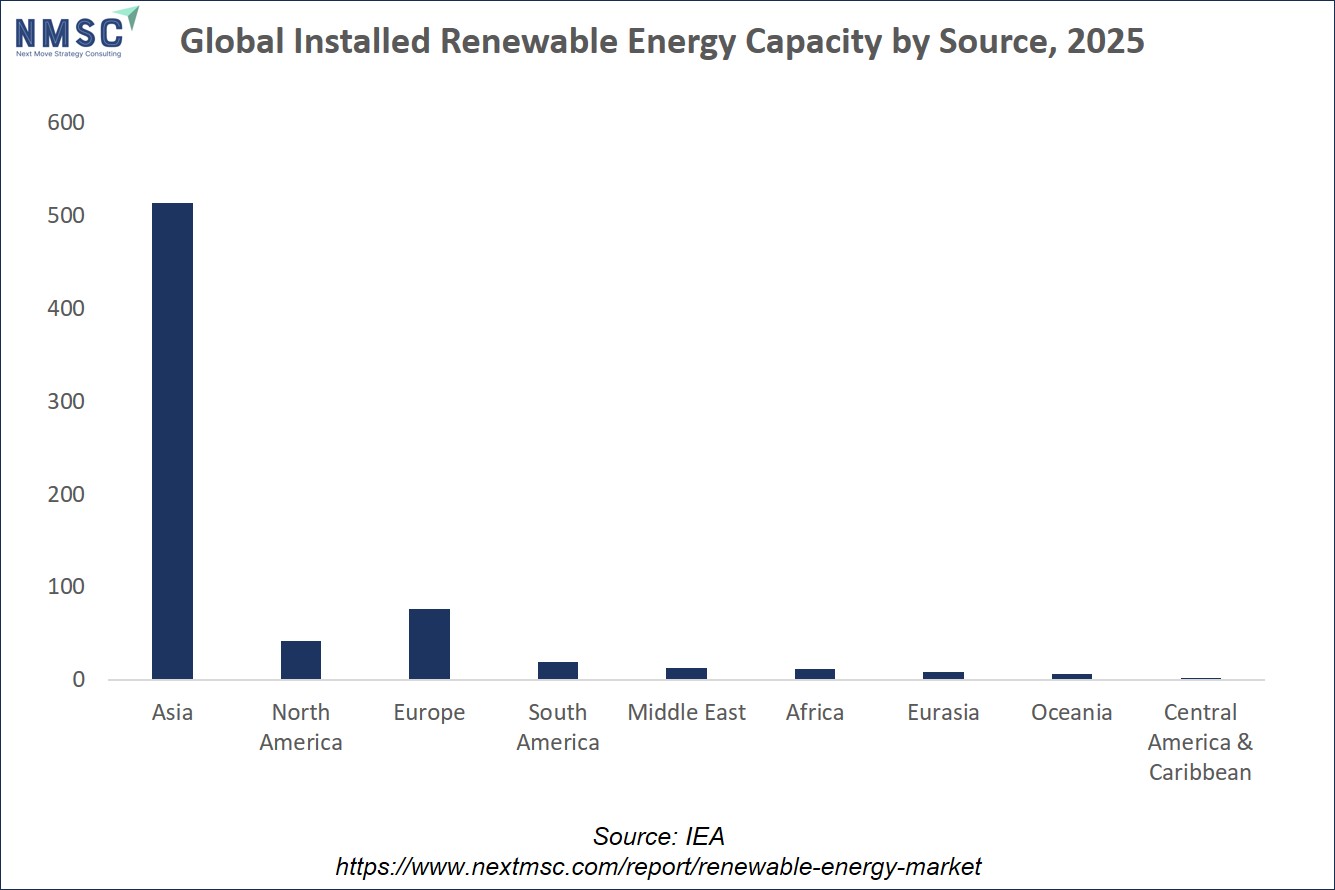
Below is a verified snapshot of 2025 renewable capacity by source, suitable for visual rendering.
NMSC Strategic Perspective
The convergence of record physical deployment and record investment validates the long-term trajectory captured in Next Move Strategy Consulting's market sizing, which values the global renewable energy market at USD 856.08 billion in 2021 and projects it to reach USD 2,025.94 billion by 2030 at a CAGR of 9.6%. In NMSC's assessment, the critical strategic signal for 2026 is the decoupling of capacity growth from cost relief: developers and EPC contractors should not interpret record volumes as a margin tailwind, but rather position for a market where scale is abundant yet execution discipline—permitting, grid interconnection, and supply-chain resilience—will separate value-accretive portfolios from stranded pipelines.
Section Summary: Renewable deployment reached historic highs in 2025 across capacity, generation, and investment, with solar and wind dominating net additions. The data confirms a maturing, capital-deep market in which execution capability—not demand—is the binding constraint.
-
Global renewable capacity additions hit a record 800 GW in 2025 (+16%), solar contributing 75%.
-
Solar and wind jointly accounted for 96.8% of net renewable additions.
-
Global energy transition investment reached a record $2.3 trillion in 2025.
Industry Impact Analysis
The most immediate market-shaping force in 2026 is the collision between surging electricity demand and constrained project delivery. Demand for electricity grew at well over twice the rate of overall energy demand in 2025, and in the United States, data centers made up half of all growth in electricity use. This demand intensity is now feeding directly into procurement economics: the average North American solar power purchase agreement price rose 4.7% during the first quarter of 2026, while wind prices rose nearly 8%, with solar and wind PPA costs up 13% and 24% respectively year-on-year.
These are the highest PPA rates reported since LevelTen Energy began indexing the data in 2018, driven not by commodity inflation but by the sheer intensity of demand for electric generation, compounded by permitting delays, labor shortages, tariffs, and rising insurance premiums. For corporate offtakers and clean energy technology suppliers, the implication is a fundamental repricing of renewable procurement risk.
Battery storage has emerged as the connective tissue of this new system. It was the fastest-growing power technology in 2025, with capacity additions rising around 40% to reach almost 110 GW—more than the highest-ever annual additions from natural gas. BloombergNEF projects storage to jump 17-fold from 223 GW in 2025 to 3.8 TW by 2035, signaling enormous opportunity for energy storage system integration and grid modernization projects.
Section Summary: Record demand—particularly from data centers—is pushing PPA prices to multi-year highs while project delivery faces structural friction. Storage is rapidly becoming the decisive enabler of renewable integration and a primary growth vector for integrators and EPC contractors.
-
North American solar and wind PPA prices reached the highest levels since 2018.
-
Battery storage additions rose ~40% to nearly 110 GW in 2025, the fastest-growing power technology.
-
In the EU, solar PV and wind reached a 30% generation share in 2025, surpassing fossil fuels for the first time.
Pros and Cons of Recent Market Developments
|
Pros |
Cons |
|
Record 800 GW of capacity added in 2025, validating long-term demand for developers and EPC contractors. |
Rising PPA prices (solar +13%, wind +24% YoY) are pushing smaller buyers out of the market. |
|
Record $2.3 trillion in energy transition investment strengthens project bankability. |
Permitting delays, labor shortages, tariffs, and insurance costs are escalating development risk. |
|
Storage projected to scale 17-fold to 3.8 TW by 2035, opening major integration revenue. |
Non-renewable additions nearly doubled in 2025, led by over 100 GW of new capacity in China (~81% coal). |
|
New U.S. utility-scale solar additions are surging, supporting EPC and equipment demand. |
A significant gap remains versus the COP28 goal to triple capacity to over 11 TW by 2030. |
Key Data & Statistics
The following tables consolidate externally verified figures from primary institutions and financial outlets. None of this data is drawn from the NMSC report.
Table 1: Global Renewable Energy Snapshot, End-2025 (Primary Institutional Data)
|
Metric |
Value (2025) |
|
Total installed renewable capacity |
5,149 GW |
|
Net capacity added in 2025 |
+692 GW (+15.5%) |
|
Renewables' share of total power capacity |
49.4% |
|
Record annual capacity additions (all sources) |
800 GW (+16%) |
|
Battery storage additions |
~110 GW (+40%) |
|
Global energy transition investment |
$2.3 trillion |
Table 2: North American PPA Pricing & U.S. Solar Pipeline (Financial & Trade Data)
|
Metric |
Value |
|
Average solar PPA price (Q1 2026) |
$64.49/MWh |
|
Average wind PPA price (Q1 2026) |
$79.40/MWh |
|
Solar PPA price increase (YoY) |
+13% |
|
Wind PPA price increase (YoY) |
+24% |
|
Planned U.S. utility-scale solar additions (2026) |
43.4 GW (+60% YoY) |
Future Outlook & Forecast
The forward trajectory of the renewable energy market is anchored by both structural demand and a widening ambition gap. The IEA projects that more than 400 GW of net renewable capacity will be added between 2026 and 2030, with 70% coming from solar PV, while globally renewable power capacity is projected to increase almost 4,600 GW between 2025 and 2030—double the deployment of the prior five years. Yet IRENA cautions that significant acceleration will be required to meet the COP28 goal of tripling installed capacity to more than 11 TW by 2030, against the 5.15 TW recorded at end-2025.
BloombergNEF reinforces the long-horizon case, projecting that solar will become the world's single largest source of electricity by 2032, driven by supply glut, technology advances, and falling prices. Within this external context, Next Move Strategy Consulting forecasts the global renewable energy market to expand from USD 856.08 billion in 2021 to USD 2,025.94 billion by 2030, advancing at a 9.6% CAGR—with Asia-Pacific maintaining its position as the dominant regional market and Commercial & Industrial (C&I) demand serving as a core growth engine.
Section Summary: The renewable energy market is set for accelerated, solar-led expansion through 2030, with strong institutional forecasts and NMSC's USD 2.03 trillion market projection. The principal risk is execution velocity, not demand, as the world remains materially short of its 11 TW tripling target.
-
Renewable capacity is projected to grow nearly 4,600 GW between 2025 and 2030.
-
Solar is forecast to become the world's largest electricity source by 2032.
-
NMSC projects the market to reach USD 2,025.94 billion by 2030 at a 9.6% CAGR.
Next Steps for Stakeholders
For C-level executives and institutional investors positioning within the renewable energy market, four priorities warrant immediate attention. First, lock in long-tenor offtake early, as the LevelTen data indicates PPA prices are likely to keep rising for the next year or two amid sustained demand intensity. Second, allocate decisively toward energy storage system integration, given the projected 17-fold scaling of storage capacity through 2035.
Third, de-risk project pipelines by prioritizing assets with secured interconnection and permitting, the binding constraints now driving cost escalation. Fourth, evaluate geographic exposure with precision: Asia commanded 74.2% of new capacity in 2025, yet markets such as the Middle East (+26.9% growth) and Africa (+15.9%) represent the highest-growth frontiers for diversified developers.
Conclusion
The renewable energy market enters 2026 with undeniable momentum—record capacity, record generation, and record investment—yet the competitive advantage has shifted decisively toward those who can execute at speed within a constrained delivery environment. With solar approaching dominance, storage scaling exponentially, and NMSC projecting a USD 2.03 trillion market by 2030, the strategic mandate for developers, EPC contractors, and investors is clear: secure offtake, integrate storage, and de-risk delivery. The institutions that master execution—not merely ambition—will define the next phase of the global energy transition.
About the Author
 Sanyukta Deb
— Sanyukta Deb is Digital Marketing Team Lead at Next Move Strategy Consulting, where she has led content strategy and technical SEO for the firm's B2B market research publications for over 2 years. Her editorial process translates NextMSC's primary and secondary research — spanning technology, industrial, and consumer sectors — into commercial narratives, backed by search-intent, keyword, and competitive analysis. She brings 5 years of overall experience in digital marketing and content strategy.
Sanyukta Deb
— Sanyukta Deb is Digital Marketing Team Lead at Next Move Strategy Consulting, where she has led content strategy and technical SEO for the firm's B2B market research publications for over 2 years. Her editorial process translates NextMSC's primary and secondary research — spanning technology, industrial, and consumer sectors — into commercial narratives, backed by search-intent, keyword, and competitive analysis. She brings 5 years of overall experience in digital marketing and content strategy.
About the Reviewer
 Debashree Dey
— Debashree Dey is Assistant Manager at Next Move Strategy Consulting, where she supports cross-vertical market content and communications across diverse industries for 6 years. Her professional background includes senior content writing, communications, and published manuscript authorship, with experience developing audience-focused business narratives and maintaining clear, consistent messaging. Her role supports research-led content development and editorial quality across NextMSC publications.
Debashree Dey
— Debashree Dey is Assistant Manager at Next Move Strategy Consulting, where she supports cross-vertical market content and communications across diverse industries for 6 years. Her professional background includes senior content writing, communications, and published manuscript authorship, with experience developing audience-focused business narratives and maintaining clear, consistent messaging. Her role supports research-led content development and editorial quality across NextMSC publications.

















Add Comment