Wood Coating Market Statistics, Trends & Forecasts for 2026

Introduction
The global wood coating market stands at a pivotal inflection point in 2026. As construction pipelines expand across emerging economies, renovation cycles accelerate in mature markets, and environmental regulations tighten across Europe and beyond, the industry is navigating a complex but opportunity-rich landscape. Wood coatings — encompassing protective and decorative finishes applied to furniture, flooring, cabinetry, joinery, and exterior surfaces — are no longer a commodity product. They have evolved into high-performance, compliance-driven solutions that sit at the intersection of design, chemistry, and sustainability.
According to Next Move Strategy Consulting (NMSC), the Wood Coating Market is projected to reach USD 14.89 billion by 2030, expanding at a compound annual growth rate (CAGR) of 5.5% during the forecast period of 2022–2030. This trajectory reflects a structural shift in how manufacturers, architects, and end-users perceive wood coatings — not merely as a finishing step, but as a critical value-add in product longevity, indoor air quality, and aesthetic differentiation.
For More Information: Download FREE Sample on Wood Coating Market Report
Regulatory Disruption and Technological Reinvention: The Forces Redefining the Wood Coating Market in 2026
EU Formaldehyde Emission Restrictions and the Accelerating Shift to Sustainable Formulations
One of the most consequential regulatory developments affecting wood-related products in the European Union in 2026 is the implementation of new formaldehyde emission restrictions under the EU REACH framework. From August 6, 2026, furniture and wood-based articles placed on the EU market must comply with a formaldehyde emission limit of 0.062 mg/m³ under specified test conditions.
While the regulation does not constitute a blanket ban on formaldehyde-containing wood coatings, it increases the importance of low-emission materials, compliant formulations, and emissions control across wood-product supply chains.
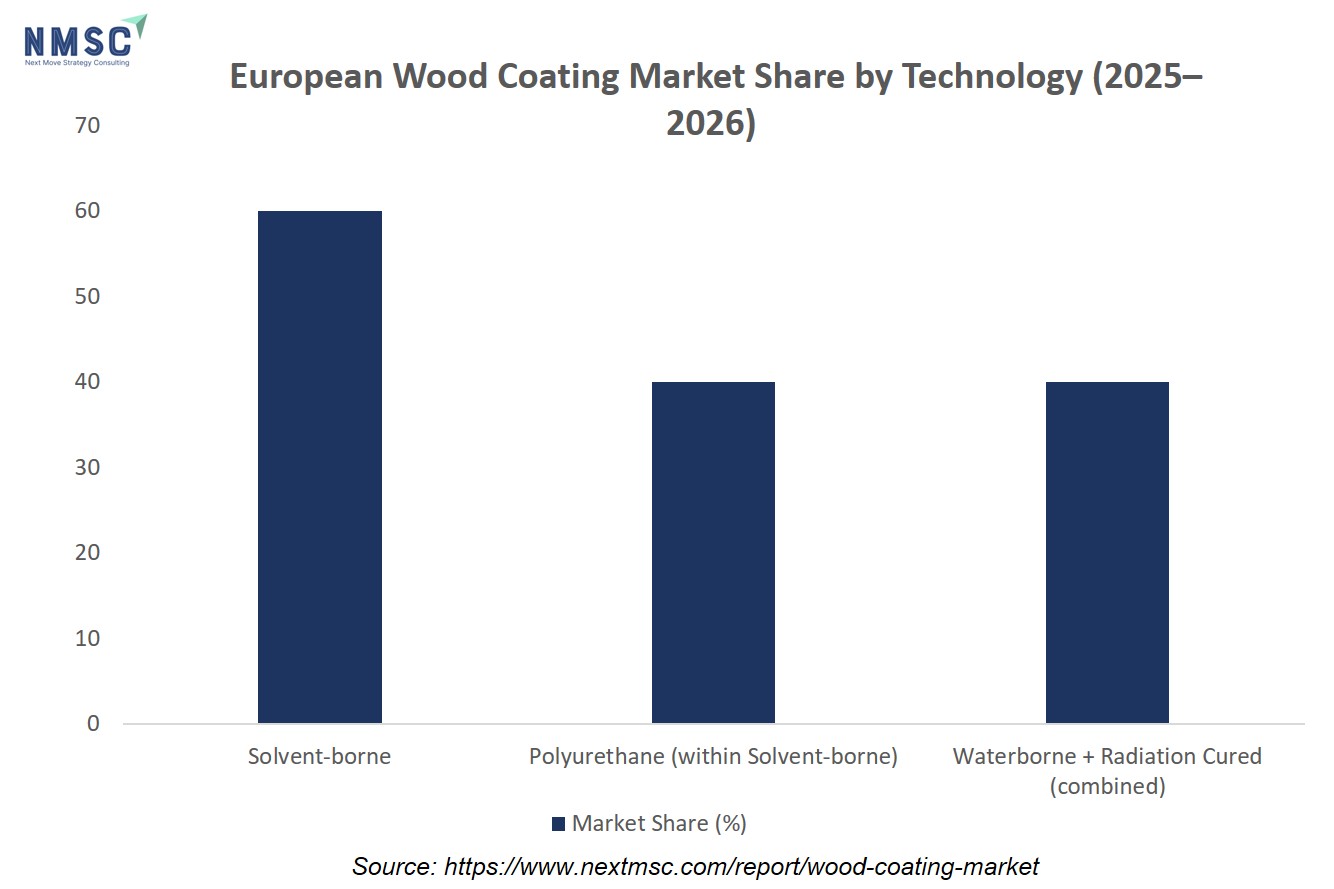
hese regulatory shifts are not incremental adjustments — they represent a structural transformation of the European wood coatings supply chain. The solvent-based segment, which currently accounts for approximately 60% of the European market with polyurethane resins dominating at around 40%, is under direct pressure to transition toward safer, lower-emission alternatives. Manufacturers that fail to adapt risk losing market access in one of the world's most stringent regulatory environments.
In response, leading coatings companies are accelerating the development of polyurethane-acrylic free isocyanate substitutes — formulations free of aromatic solvents, formaldehyde, and polyisocyanates — alongside high-performance single-component (1K) waterborne coatings designed for premium furniture applications. LED-compatible UV coating systems are also gaining traction as a reliable, lower-cost, and environmentally superior alternative to traditional UV mercury lamp technology.
Beyond Europe, the global momentum toward low-VOC (volatile organic compound) and waterborne systems is unmistakable. AkzoNobel's Wood Finishes division confirmed that waterborne systems and advanced curing technologies — particularly UV and UV LED — continued to gain momentum in 2025, as manufacturers sought to increase throughput while reducing energy use, emissions, and operational risk. Minwax similarly reported strong demand for low-VOC, low-odor, and fast-drying formulas that enable users to complete projects more efficiently, with water-based technologies continuing to narrow the performance gap with traditional oil-based products.
NMSC Strategic Perspective: Compliance as a Competitive Differentiator
From Next Move Strategy Consulting's analytical standpoint, the regulatory wave sweeping through Europe and progressively influencing global standards is not merely a compliance burden — it is a strategic differentiator. Companies that proactively invest in low-VOC, waterborne, and LED-curable formulations are positioning themselves to capture premium market segments, secure long-term supply agreements with sustainability-conscious OEMs, and future-proof their product portfolios against tightening global standards.
NMSC's research identifies the transition from conventional solvent-borne systems to waterborne and radiation-cured technologies as one of the most significant structural shifts within the wood coating market during the 2022–2030 forecast window. The market's projected CAGR of 5.5% is underpinned not only by volume growth in construction and furniture manufacturing, but by the value uplift associated with premium, compliant, and high-performance coating systems. Stakeholders who align their R&D and commercialization strategies with this transition stand to capture disproportionate value as the market scales toward USD 14.89 billion by 2030.
Section Summary: The wood coating market in 2026 is being fundamentally reshaped by regulatory mandates and technological innovation, particularly in Europe. The EU formaldehyde ban, diisocyanate restrictions, and the LED transition are compelling manufacturers to reformulate products and invest in sustainable alternatives.
Key Takeaways:
-
The EU formaldehyde ban expected in 2026 and the UV mercury lamp phase-out by 2027 are forcing rapid reformulation across the European wood coatings supply chain.
-
Waterborne and UV/UV LED curing technologies are the primary beneficiaries of the regulatory transition, gaining market share from conventional solvent-borne systems.
-
Low-VOC and fast-drying formulations are now a baseline consumer expectation, not a premium feature.
-
NMSC identifies compliance-driven innovation as a key value driver within the market's projected 5.5% CAGR through 2030.
Industry Impact Analysis
Construction Booms, Renovation Cycles, and the Demand Multiplier Effect
The demand dynamics driving the wood coating market extend well beyond regulatory compliance. Global construction activity — particularly in Asia-Pacific and the Middle East — is generating sustained, high-volume demand for wood coatings across residential, commercial, and hospitality applications.
In the UAE, the scale of construction activity is particularly illustrative. In 2024, the country recorded over 1,000 active building projects, with approximately 25% involving residential and hospitality segments. Wood is used in over 80% of indoor fit-outs, including flooring, doors, and paneling, while approximately 70% of luxury apartments feature premium wood finishes requiring high-performance coatings. Dubai alone has more than 100 hotels under active development, each demanding coated wooden elements across lobbies, suites, and dining spaces. Wood use in UAE interior design segments is growing at 12–15% annually, creating a compounding demand curve for protective and aesthetic coatings.
In Asia-Pacific — the largest regional market for wood coatings globally — NMSC's analysis highlights increasing investment in residential and commercial construction in China and India as primary growth catalysts. China remains the world's largest furniture manufacturing hub, driving both domestic consumption and export-linked demand for wood coatings. Government-backed affordable housing initiatives in India, including the Pradhan Mantri Awas Yojana (PMAY), have further amplified demand for wood finishing products across the residential segment.
In North America and Europe, the growth narrative is driven by renovation and remodeling rather than new construction. AkzoNobel's Wood Finishes division noted that the global wood coatings market demonstrated steady recovery in 2025, particularly where wood substrates are tied to renovation, remodeling, and value-add interior applications such as cabinetry, furniture, and flooring. The aging housing stock in North America and Europe, combined with consumers' preference for refreshing rather than replacing, is sustaining demand for high-performance stains, sealers, and topcoats.
The Antimicrobial and Clean-Air Coating Trend
A notable post-pandemic demand driver that continues to gain commercial traction in 2026 is the integration of antimicrobial and clean-air properties into wood coating formulations. Antimicrobial additives — including silver-ion compounds and titanium dioxide photocatalysts — are now being incorporated into coatings for high-touch surfaces such as cabinet handles, handrails, and door frames, with performance claims of up to 99.9% bacterial reduction within 24 hours of exposure. These features are increasingly mandated in schools, clinics, childcare centers, and fitness studios, expanding the addressable market for wood coatings beyond traditional residential and commercial applications.
Raw Material Volatility: The Persistent Headwind
Despite robust demand fundamentals, the wood coating market faces a structural challenge in raw material cost volatility. Resins, solvents, pigments, and additives — the core inputs for wood coating formulations — are subject to significant price fluctuations driven by crude oil price movements and feedstock availability. A 20% surge in resin pricing can inflate end-product costs by 8–12%, pressuring buyers and creating demand elasticity risks, particularly in price-sensitive commercial fit-out and mass-residential segments. This dynamic discourages investment in premium or eco-focused coatings and slows the adoption of advanced technologies among smaller applicators and fabricators.
Section Summary: The wood coating market is experiencing demand acceleration from multiple vectors — construction booms in the Middle East and Asia-Pacific, renovation cycles in mature markets, and emerging applications in antimicrobial and clean-air coatings. However, raw material cost volatility remains a persistent constraint on margin expansion and technology adoption.
Key Takeaways:
-
Asia-Pacific leads global wood coating demand, driven by China's furniture manufacturing dominance and India's government-backed housing programs.
-
The UAE's construction pipeline — with 1,000+ active projects and 100+ hotels under development in Dubai — is generating accelerating demand for high-performance wood coatings.
-
Antimicrobial coating technologies represent an emerging opportunity in selected healthcare, hospitality, institutional, and other applications where specific performance requirements and applicable regulations support their use.
-
Raw material cost volatility, particularly in polyurethane and acrylic resins, remains the primary margin risk for manufacturers and applicators.
Pros and Cons of Recent Market Developments
|
Recent Development |
Pros |
Cons |
|
EU Formaldehyde Ban (2026) |
Drives innovation in safer, high-performance formulations; opens premium market segments for compliant products |
Significant reformulation costs for manufacturers; potential supply disruption during transition period |
|
Shift to Waterborne & UV LED Technologies |
Reduces VOC emissions; improves energy efficiency; aligns with global sustainability mandates |
Higher upfront capital investment in new curing equipment; performance parity with solvent-borne systems still being established in some applications |
|
Construction Boom in Asia-Pacific & Middle East |
Substantial volume growth in demand; new market entry opportunities for global coating suppliers |
Intensified price competition; risk of commoditization in high-volume, lower-margin segments |
|
Antimicrobial Coating Integration |
Expands addressable market into healthcare, education, and hospitality; supports premium pricing |
Regulatory certification requirements add complexity; consumer awareness and willingness to pay remain variable |
|
Renovation & Remodeling Demand in Mature Markets |
Sustains demand in low-growth construction environments; supports premium product positioning |
Dependent on consumer confidence and housing market liquidity; vulnerable to macroeconomic headwinds |
|
Raw Material Cost Volatility |
Incentivizes supply chain diversification and bio-based resin development |
Erodes manufacturer margins; creates pricing instability; slows adoption of advanced eco-friendly formulations |
Key Data & Statistics
Table 1: Global Wood Coating Market — NMSC Forecast Overview (2021–2030)
|
Parameter |
Details |
|
Base Year Market Value (2021) |
USD 9.2 Billion |
|
Forecast Market Value (2030) |
USD 14.89 Billion |
|
CAGR (2022–2030) |
5.5% |
|
Largest Regional Market |
Asia-Pacific |
|
Leading Resin Type |
Polyurethane |
|
Leading Technology Segment |
Waterborne |
|
Key End-Use Segments |
Furniture, Flooring, Cabinets, Joinery, Siding |
|
Forecast Period |
2022–2030 |
|
Report Source |
Next Move Strategy Consulting |
Table 2: Wood Coating Market — Key Industry Developments & Regulatory Milestones (2022–2027)
|
Year |
Development |
Impact on Wood Coating Market |
|
2022 |
EU Diisocyanate Restrictions Implemented |
Accelerated shift away from conventional PU systems; drove demand for isocyanate-free alternatives |
|
2021 |
PPG Industries Acquired Tikkurila |
Strengthened PPG's industrial wood and protective coatings portfolio; expanded customer base |
|
2021 |
Axalta Launched Imron Industrial 2100 HG-C |
Introduced high-gloss polyurethane clear coat for wood; improved repairability |
|
2025 |
Global Market Recovery in Renovation Segment |
Sustained demand in cabinetry, furniture, and flooring; waterborne and UV LED systems gained momentum |
|
2026 |
EU Formaldehyde Ban (Expected) |
Forces reformulation of wood coating products across European supply chain |
|
2026 |
Antimicrobial Coatings Mandated in Public Spaces |
Expands addressable market into healthcare, education, and hospitality sectors |
|
2027 |
UV Mercury Lamp Phase-Out (EU Mandate) |
Accelerates adoption of LED UV curing technology across European manufacturing |
Future Outlook & Forecast
A Market Defined by Performance, Compliance, and Premiumization
The trajectory of the global wood coating market through 2030 is shaped by three converging forces: the relentless push for higher performance, the non-negotiable imperative of regulatory compliance, and the growing consumer appetite for premium, design-led finishes. According to NMSC's proprietary forecast, the market is on course to reach USD 14.89 billion by 2030, growing at a CAGR of 5.5% from its 2021 base of USD 9.2 billion.
Asia-Pacific is expected to maintain its dominant position throughout the forecast period, underpinned by China's continued leadership in global furniture manufacturing and export, India's expanding middle class and government-backed housing programs, and rising living standards across Japan, South Korea, and Australia. Europe, while facing the most significant regulatory headwinds, is simultaneously the most innovation-intensive region, with manufacturers investing heavily in compliant, high-value formulations that command premium pricing.
In North America, the outlook for 2026 is cautiously optimistic. Industry leaders anticipate that DIY activity — suppressed in 2025 — will begin to rebound as home sales recover from consecutive years of subdued performance. The professional segment is expected to see consistent demand for deck restoration, siding maintenance, and exterior upgrades, with consumers increasingly willing to invest in long-lasting, high-performance finishes that reduce maintenance cycles.
The luxury and high-end design segment represents a particularly compelling growth vector. Approximately 70% of luxury apartments in the UAE now feature premium wood finishes, and the integration of wood coatings into megaprojects such as Expo City Dubai and Masdar City — where modular wood systems represent 40–50% of interior solutions — signals the growing role of coatings in sustainable, design-forward architecture.
From a technology standpoint, the future belongs to waterborne systems, UV LED curing, and bio-based resin platforms. AkzoNobel's Wood Finishes division projects that 2026 will see increasing demand for complete coating systems that allow manufacturers and distributors to serve multiple applications with confidence, with growth increasingly tied to technology rather than volume alone. The convergence of process efficiency, sustainability compliance, and aesthetic performance will define the competitive landscape for the remainder of the decade.
Section Summary: The wood coating market is positioned for sustained, value-driven growth through 2030, with NMSC projecting a market value of USD 14.89 billion at a 5.5% CAGR. Asia-Pacific leads on volume, Europe leads on innovation, and the Middle East represents the fastest-growing regional opportunity.
Key Takeaways:
-
NMSC projects the global wood coating market to reach USD 14.89 billion by 2030, growing at a CAGR of 5.5% from 2022 to 2030.
-
Asia-Pacific will retain its dominant regional position, driven by China's furniture export leadership and India's housing expansion.
-
Waterborne, UV LED, and bio-based coating technologies will define the competitive frontier through 2030.
-
The luxury residential and hospitality segments in the Middle East represent high-growth, premium-margin opportunities for global coating suppliers.
Next Steps for Stakeholders
For C-level executives, investors, and strategic decision-makers operating within or adjacent to the wood coating market, the following actions are recommended based on current market intelligence:
1. Accelerate Regulatory Compliance Investment
Manufacturers with European market exposure should monitor the implementation of the 2026 formaldehyde emission restrictions and applicable EU restrictions on mercury-containing lamps, while evaluating compliant low-emission and LED-compatible technologies where relevant. Delaying reformulation investments risks market access loss and reputational damage. Allocate R&D resources toward isocyanate-free, formaldehyde-free, and LED-compatible product lines now.
2. Prioritize Waterborne and UV LED Technology Platforms
The long-term competitive advantage in wood coatings will accrue to companies that master waterborne and radiation-cured systems. These technologies align with regulatory requirements, consumer preferences for low-odor and fast-drying products, and the operational efficiency demands of industrial manufacturers. Investment in these platforms is both a compliance necessity and a growth strategy.
3. Target High-Growth Regional Markets Strategically
The Middle East — particularly the UAE — presents a compelling near-term opportunity, with construction activity growing at 12–15% annually in interior design segments. Investors and manufacturers should evaluate market entry or partnership strategies in this region, focusing on high-performance, UV-resistant, and fast-drying formulations suited to the local climate.
4. Develop Antimicrobial and Clean-Air Coating Capabilities
The development of certified, performance-validated antimicrobial coating systems may create opportunities in selected applications where antimicrobial performance is commercially required and applicable regulatory conditions are satisfied. Companies that develop certified, performance-validated antimicrobial wood coating systems will access a growing, regulation-driven market segment with premium pricing potential.
5. Manage Raw Material Risk Through Supply Chain Diversification
Given the persistent volatility in resin and solvent pricing, procurement strategies should incorporate supply chain diversification, long-term sourcing agreements, and investment in bio-based resin alternatives that reduce dependence on petrochemical feedstocks.
6. Leverage NMSC Market Intelligence for Strategic Planning
For a comprehensive, data-driven assessment of market sizing, segmentation, competitive dynamics, and regional forecasts, stakeholders are encouraged to access NMSC's full Wood Coating Market Report, which provides quantitative analysis and strategic insights through 2030.
Conclusion
The global wood coating market in 2026 is defined by the productive tension between regulatory pressure and innovation opportunity. The EU's formaldehyde emission restrictions, the phase-out of UV mercury lamps, and the global push for low-VOC formulations are compelling manufacturers to invest in next-generation technologies — waterborne systems, UV LED curing, and bio-based resins — that simultaneously meet compliance requirements and deliver superior performance. Meanwhile, construction booms in Asia-Pacific and the Middle East, renovation-driven demand in mature markets, and the emergence of antimicrobial and clean-air coatings are expanding the market's addressable opportunity well beyond traditional applications.
According to NMSC's proprietary research, the wood coating market is on a clear growth trajectory from USD 9.2 billion in 2021 to USD 14.89 billion by 2030, at a CAGR of 5.5%. For stakeholders who align their strategies with the dual imperatives of sustainability and performance, this market offers substantial and durable value creation potential through the end of the decade.
About the Author
 Sanyukta Deb
— Sanyukta Deb is Digital Marketing Team Lead at Next Move Strategy Consulting, where she has led content strategy and technical SEO for the firm's B2B market research publications for over 2 years. Her editorial process translates NextMSC's primary and secondary research — spanning technology, industrial, and consumer sectors — into commercial narratives, backed by search-intent, keyword, and competitive analysis. She brings 5 years of overall experience in digital marketing and content strategy.
Sanyukta Deb
— Sanyukta Deb is Digital Marketing Team Lead at Next Move Strategy Consulting, where she has led content strategy and technical SEO for the firm's B2B market research publications for over 2 years. Her editorial process translates NextMSC's primary and secondary research — spanning technology, industrial, and consumer sectors — into commercial narratives, backed by search-intent, keyword, and competitive analysis. She brings 5 years of overall experience in digital marketing and content strategy.
About the Reviewer
 Debashree Dey
— Debashree Dey is Assistant Manager at Next Move Strategy Consulting, where she supports cross-vertical market content and communications across diverse industries for 6 years. Her professional background includes senior content writing, communications, and published manuscript authorship, with experience developing audience-focused business narratives and maintaining clear, consistent messaging. Her role supports research-led content development and editorial quality across NextMSC publications.
Debashree Dey
— Debashree Dey is Assistant Manager at Next Move Strategy Consulting, where she supports cross-vertical market content and communications across diverse industries for 6 years. Her professional background includes senior content writing, communications, and published manuscript authorship, with experience developing audience-focused business narratives and maintaining clear, consistent messaging. Her role supports research-led content development and editorial quality across NextMSC publications.

















Add Comment