The Phthalate Reckoning: Bio Plasticizers Take Over

Introduction
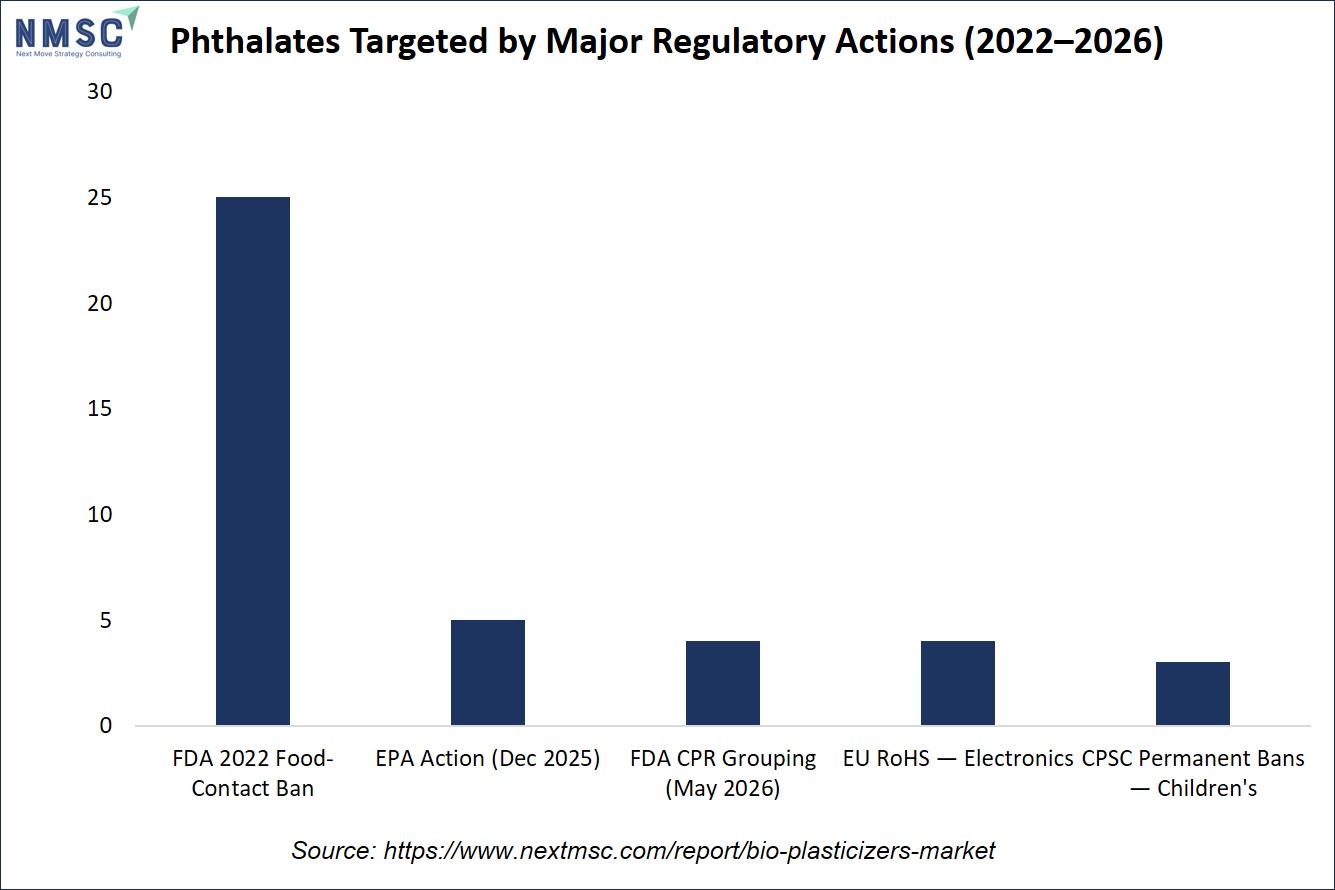
In May 2026, two of the world's most influential chemical regulators moved within days of each other. On May 27, 2026, the U.S. Food and Drug Administration released a scientific evaluation of the eight phthalates still authorized as plasticizers for food contact use, proposing to group four of them—DEHP, DCHP, DIOP, and DINP—for a future cumulative risk assessment. Just months earlier, in December 2025, the U.S. Environmental Protection Agency announced it would begin regulating dozens of uses of five phthalates, including DBP, DEHP, BBP, DCHP, and DIBP.
For bio plasticizer manufacturers, bio-based plasticizers suppliers, and the procurement leaders who depend on them, these are not isolated bureaucratic events—they are the clearest signal yet that the regulatory ground beneath conventional petroleum-based plasticizers is shifting permanently. As phthalate restrictions tighten across the United States and the European Union, demand for REACH compliant plasticizers and FDA approved bio plasticizers is moving from a sustainability preference to a compliance necessity. This guide examines the breaking regulatory developments reshaping the industry and pairs them with proprietary NMSC market intelligence to chart where institutional value will be created through 2035.
For More Information – Download FREE Sample on Bio Plasticizers Market Report
The Regulatory Squeeze Driving a Bio-Based Pivot
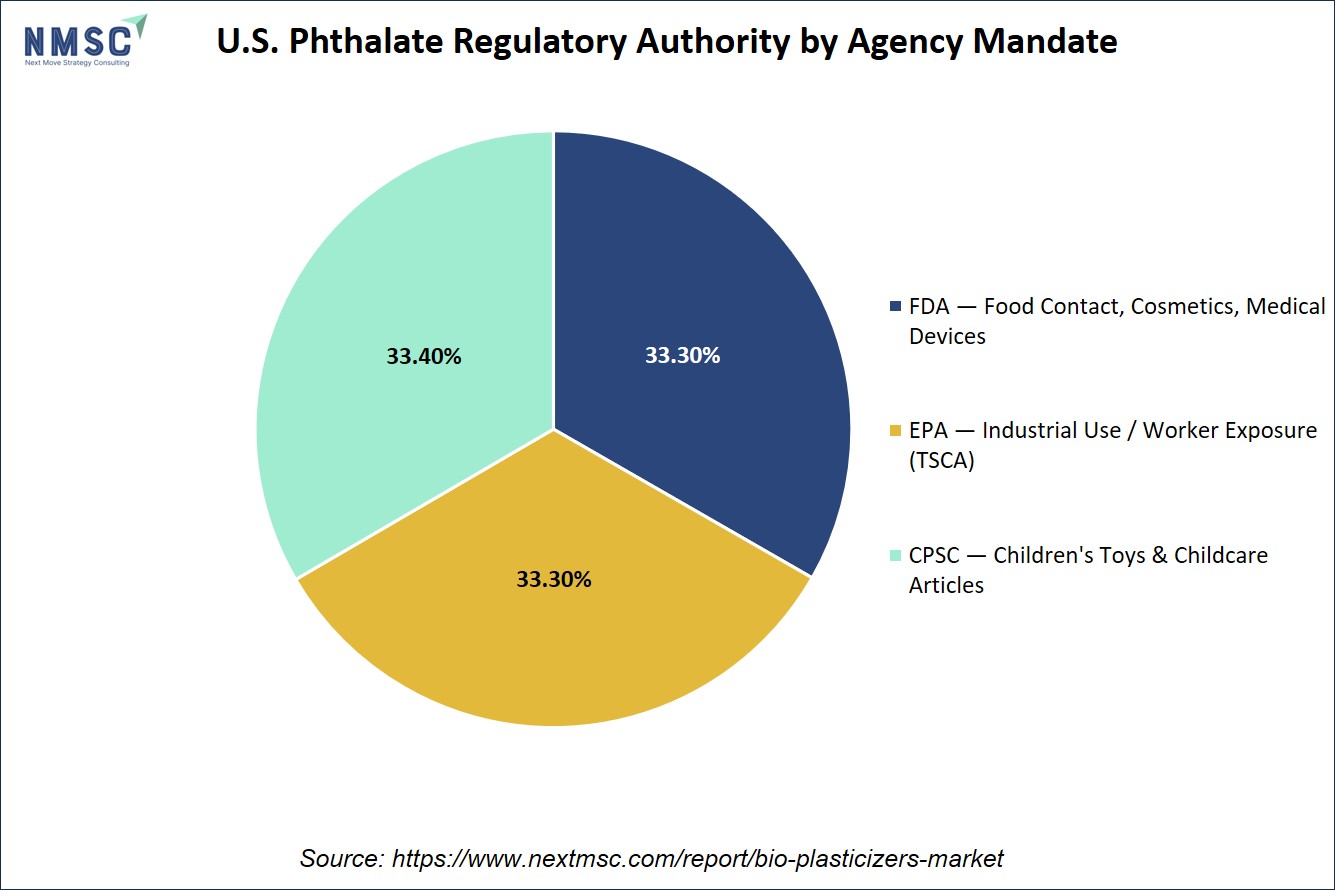
The most consequential recent catalyst for the bio plasticizers market is the accelerating, multi-jurisdictional crackdown on phthalates. In the United States, regulatory authority is deliberately fragmented across three federal agencies, each with a distinct mandate. The EPA governs phthalates under the Toxic Substances Control Act, and following its December 2025 announcement, it must publish a final rule to manage the identified risks within two years. The Consumer Product Safety Commission maintains the most established program of the three, having permanently prohibited DEHP, DBP, and BBP in children's toys and child care articles at concentrations exceeding 0.1%, with a later rule expanding restrictions to DIBP, DINP, DCHP, DPENP, and DHEXP.
The health rationale is becoming harder to contest. Exposure to DEHP and DINP has been associated with adverse health outcomes including preterm births, while several phthalates such as DEHP and DBP are considered possible obesogens that may affect fat storage. Critically, the regulatory landscape is fragmenting further at the state level: six U.S. states have already enacted phthalate regulations, and five more have pending or potential legislation spanning cosmetics, children's products, and food packaging.
Across the Atlantic, the European Union enforces an even more comprehensive framework. Under REACH, DEHP, DBP, BBP, and DIBP are classified as Substances of Very High Concern, requiring specific authorization for continued use, while REACH Annex XVII limits phthalate concentrations in toys, childcare articles, and other consumer goods to 0.1% by weight regardless of where the product was manufactured. The EU's RoHS Directive further restricts four phthalates—DEHP, BBP, DBP, and DIBP—in electrical and electronic equipment.
Notably, the market has been anticipating this shift for years. The FDA's own laboratory analyses of food-contact materials, published in 2018, 2021, and 2022, suggest that manufacturers have been replacing phthalates as their primary plasticizer with alternative compounds—indeed, no phthalates were detected in representative samples of food contact tubing obtained and analyzed in 2021.
NMSC Strategic Perspective on the Regulatory Shift
NMSC's assessment positions this regulatory tightening as the single most decisive catalyst for the bio plasticizers market. According to NMSC, increasing regulatory pressure to replace phthalates and toxic plasticizers—driven by environmental and human health concerns—is expected to contribute approximately +0.9% to the market's CAGR forecast, with Europe at the core and clear spill-over into North America and Asia-Pacific over a two-to-four-year horizon. Our analysis interprets the simultaneous FDA and EPA actions of late 2025 and 2026 not as discrete events but as the convergence point of a structural transition, where regulatory mandates to phase out phthalates have become a decisive catalyst for adoption across packaging, construction, automotive, healthcare, and consumer goods. For European bio plasticizer manufacturers and wholesale bio plasticizers distributors, the strategic imperative is to secure renewable feedstock supply and certification credentials ahead of compliance deadlines, positioning portfolios to capture demand as conventional alternatives are progressively designed out of the market.
Section Summary: A coordinated tightening of phthalate regulations across U.S. federal agencies, individual states, and the European Union is converting bio-based plasticizers from a discretionary sustainability choice into a compliance-driven necessity, with mounting health evidence reinforcing the trajectory.
-
The FDA (May 2026) and EPA (December 2025) actions signal an accelerating, irreversible regulatory squeeze on conventional phthalates.
-
Six U.S. states have enacted phthalate rules, with five more pending, creating a complex compliance patchwork.
-
EU REACH and RoHS frameworks restrict key phthalates to 0.1% by weight, driving demand for REACH compliant plasticizers.
-
FDA testing confirms manufacturers were already substituting phthalates well before formal bans, validating the bio-based pivot.
Industry Impact Analysis
The regulatory squeeze is reshaping competitive dynamics and capital allocation across the chemical sector. Leading manufacturers are responding with certified, performance-equivalent bio-based portfolios. In February 2025, BASF expanded its sustainable plasticizer portfolio in North America with ISCC PLUS-certified biomass-balanced and Ccycled plasticizers such as Palatinol TOTM Advantage 50 and Palatinol DOTP Advantage 50, lowering CO₂ footprints while maintaining performance for regulated PVC applications in automotive, construction, and medical sectors. In October 2024, Evonik Oxeno announced a significant capacity expansion for its INA-based plasticizers ELATUR CH and ELATUR DINCD at its German Marl site, with the capability to produce these using mass-balance or bio-based feedstocks. Meanwhile, in March 2025, Dow took a stake in chemical recycling firm Xycle to secure recycled feedstock supporting sustainable plasticizer supply chains.
The healthcare and medical devices segment is emerging as a particularly critical demand center. Applications such as IV tubing, blood bags, catheters, and respiratory masks require materials with low migration, high chemical stability, and proven biocompatibility—precisely the attributes where bio-based alternatives offer safer substitutes to conventional phthalate-based plasticizers and reduce patient exposure risks. This regulatory-led transition is simultaneously accelerating investment flows toward manufacturers with demonstrated regulatory compliance, safety certifications, and consistent product quality, particularly in North America and Europe where stringent standards prevail.
The countervailing pressure remains cost. NMSC's cost-structure assessments confirm that higher production costs—driven by renewable feedstocks, advanced processing technologies, smaller manufacturing scales, and the price volatility of vegetable oils and organic acids—continue to constrain mass adoption, particularly in price-sensitive emerging markets. This factor is estimated to exert approximately a –0.6% drag on the CAGR forecast.
Section Summary: Regulatory pressure is catalyzing certified product launches, capacity expansions, and strategic feedstock investments among industry leaders, with healthcare emerging as a high-value demand center, even as cost competitiveness remains the principal adoption barrier.
-
BASF, Evonik, and Dow have all executed 2024–2025 strategic moves to secure bio-based and certified plasticizer capacity.
-
Medical applications represent a high-margin growth center due to strict biocompatibility and low-migration requirements.
-
Capital is flowing toward manufacturers with verifiable compliance and certification credentials in North America and Europe.
-
Higher production costs (estimated –0.6% CAGR impact) remain the key constraint, especially in price-sensitive markets.
Pros and Cons of Recent Market Developments
|
Pros |
Cons |
|
Tightening phthalate regulations (FDA, EPA, REACH, RoHS) create durable, compliance-driven demand |
Higher production costs limit adoption in price-sensitive emerging markets |
|
Bio-based plasticizers offer lower toxicity and biocompatibility, ideal for food-contact and medical use |
Feedstock price volatility (vegetable oils, organic acids) complicates cost stability |
|
Certified drop-in solutions (e.g., ISCC PLUS) enable integration without reformulation |
Performance gaps in certain high-demand industrial applications persist |
|
Strong investment appeal supports R&D, capacity expansion, and M&A activity |
Fragmented state-level and multi-jurisdictional rules increase compliance complexity |
|
Alignment with ESG, circular economy, and sustainable packaging mandates |
Smaller manufacturing scale constrains immediate cost parity with conventional plasticizers |
Key Regulatory Indicators Driving Bioplasticizer Demand
|
Regulatory Indicator |
Figure |
|
Phthalates banned by FDA in 2022 (food contact, abandoned uses) |
25 substances |
|
Phthalates currently authorized by FDA for food contact |
9 (8 plasticizers, 1 monomer) |
|
Phthalates proposed for CPR grouping (May 2026) |
4 (DEHP, DCHP, DIOP, DINP) |
|
Phthalate uses EPA intends to regulate (Dec 2025) |
Dozens, across 5 phthalates |
|
EU REACH Annex XVII concentration limit (toys/childcare) |
0.1% by weight |
|
EU RoHS-restricted phthalates (electronics) |
4 (DEHP, BBP, DBP, DIBP) |
|
U.S. states with enacted phthalate regulations |
6 (plus 5 pending) |
U.S. Federal Phthalate Restrictions by Agency and Domain
|
U.S. Federal Agency |
Regulatory Domain |
Key Restricted Phthalates |
|
FDA |
Food contact, cosmetics, medical devices |
DEHP, DCHP, DIOP, DINP (proposed grouping) |
|
EPA |
Industrial use, worker exposure (TSCA) |
DBP, DEHP, BBP, DCHP, DIBP |
|
CPSC |
Children's toys and childcare articles |
DEHP, DBP, BBP, DIBP, DINP, DCHP |
Future Outlook & Forecast
The market's forward trajectory reflects a durable, regulation-anchored growth narrative. According to NMSC, the global Bio-Plasticizers Market was valued at USD 4.35 billion in 2025 and is expected to reach USD 4.72 billion by 2026. Looking ahead, the industry is projected to expand significantly, reaching USD 9.72 billion by 2035, registering a CAGR of 8.36% from 2026 to 2035.
Segment dynamics reinforce a premiumization and compliance thesis. NMSC's analysis indicates that in 2025, epoxidized vegetable oils dominated the market by product type with a 34.78% share, followed by citrate-based bio plasticizers at 18.96% and adipate-based at 12.43%. By feedstock, vegetable oil-based sources led, while starch and sugar-based and bio-synthesized/microbial feedstocks are forecast to expand fastest through 2035. By sales channel, direct B2B sales led with 42.68%, followed by distributors and wholesalers at 23.54%, with online/e-commerce at 15.37% expanding most rapidly.
Geographically, NMSC identifies Asia-Pacific as both the largest production hub and fastest-growing consumption market, while North America and Europe lead in premium product innovation and adoption of regulatory-compliant, high-quality bio plasticizers. Industry sentiment aligns with this trajectory; as Martin Jung, President of BASF Performance Materials, stated, the company aims to "enable our customers' transformation by offering a portfolio with a lower carbon footprint and diverse circular solutions" across the entire lifecycle of plastics.
Strategically, the next decade rewards players who combine renewable feedstock security, sustainability certification, and performance parity with conventional plasticizers. Specialty and high-performance formulations, including isosorbide-based and advanced grades, are expected to register the fastest growth, driven by rising demand for sustainable, non-toxic, high-efficiency polymer solutions.
Section Summary: The bio plasticizers market is positioned for robust growth through 2035, propelled by regulatory necessity, premiumization toward specialty grades, and the strategic monetization of certified, compliant, renewable-feedstock formulations.
-
NMSC projects the market to reach USD 9.72 billion by 2035 at an 8.36% CAGR.
-
Epoxidized vegetable oils (34.78%) lead by product type, while specialty grades grow fastest.
-
Asia-Pacific dominates production; North America and Europe lead premium, compliant innovation.
-
Direct B2B sales (42.68%) dominate channels, while online/e-commerce expands most rapidly.
Next Steps for Stakeholders
For C-level executives and institutional investors seeking to capitalize on the bio plasticizers transition, the following actions are recommended:
-
Secure certification credentials early: Prioritize REACH, FDA, and ISCC-aligned certifications to position portfolios ahead of EPA's two-year final-rule deadline and tightening EU mandates.
-
Lock in feedstock security: Establish long-term supply agreements or backward integration for vegetable oils, citrates, and next-generation microbial feedstocks to mitigate price volatility.
-
Target high-value applications: Concentrate R&D and commercial efforts on healthcare, medical devices, and food-contact segments where compliance premiums and margins are highest.
-
Pursue performance parity: Invest in formulation technologies that match conventional plasticizers on cost and performance to overcome the principal adoption barrier in price-sensitive markets.
-
Map the compliance patchwork: Implement systematic supply-chain monitoring to navigate the fragmented U.S. state-level and multi-jurisdictional regulatory environment.
Conclusion
The near-simultaneous regulatory actions by the FDA and EPA in late 2025 and 2026 represent more than incremental rule-making; they mark a definitive inflection point. As phthalate restrictions tighten across federal agencies, individual states, and the European Union, the bio plasticizers market has firmly transitioned from a sustainability narrative into a compliance imperative. For bio plasticizer manufacturers, bio-based plasticizers suppliers, and the institutional capital backing them, durable value will accrue to those who pair certified, renewable-feedstock formulations with performance parity and feedstock security.
With NMSC projecting the market to reach USD 9.72 billion by 2035 at an 8.36% CAGR, the bio plasticizers sector stands as one of the most resilient, regulation-driven growth opportunities in the specialty chemicals landscape. The phthalate reckoning has arrived—and the bio-based transition is now irreversible.
About the Author
 Sanyukta Deb
— Sanyukta Deb is Digital Marketing Team Lead at Next Move Strategy Consulting, where she has led content strategy and technical SEO for the firm's B2B market research publications for over 2 years. Her editorial process translates NextMSC's primary and secondary research — spanning technology, industrial, and consumer sectors — into commercial narratives, backed by search-intent, keyword, and competitive analysis. She brings 5 years of overall experience in digital marketing and content strategy.
Sanyukta Deb
— Sanyukta Deb is Digital Marketing Team Lead at Next Move Strategy Consulting, where she has led content strategy and technical SEO for the firm's B2B market research publications for over 2 years. Her editorial process translates NextMSC's primary and secondary research — spanning technology, industrial, and consumer sectors — into commercial narratives, backed by search-intent, keyword, and competitive analysis. She brings 5 years of overall experience in digital marketing and content strategy.
About the Reviewer
 Debashree Dey
— Debashree Dey is Assistant Manager at Next Move Strategy Consulting, where she supports cross-vertical market content and communications across diverse industries for 6 years. Her professional background includes senior content writing, communications, and published manuscript authorship, with experience developing audience-focused business narratives and maintaining clear, consistent messaging. Her role supports research-led content development and editorial quality across NextMSC publications.
Debashree Dey
— Debashree Dey is Assistant Manager at Next Move Strategy Consulting, where she supports cross-vertical market content and communications across diverse industries for 6 years. Her professional background includes senior content writing, communications, and published manuscript authorship, with experience developing audience-focused business narratives and maintaining clear, consistent messaging. Her role supports research-led content development and editorial quality across NextMSC publications.


















Add Comment