Amazon's $11.57B Globalstar Deal Reshapes Satellite Internet

Amazon's $11.57 Billion Globalstar Acquisition Intensifies Global LEO Broadband Competition as Regulatory Frameworks Accelerate
Amazon.com's landmark $11.57 billion agreement to acquire Globalstar, announced on April 14, 2026, has fundamentally altered the competitive architecture of the global Satellite Internet Market connectivity sector, positioning the e-commerce and cloud computing giant as a direct challenger to SpaceX's dominant Starlink network. The transaction—confirmed by Reuters and Amazon's official press release—represents one of the largest corporate acquisitions in the history of the commercial satellite industry and signals an accelerating consolidation among operators seeking to capture the rapidly expanding market for low Earth orbit (LEO) broadband services.
Under the terms of the merger agreement, Globalstar shareholders may elect to receive either $90.00 per share in cash or 0.3210 shares of Amazon common stock, subject to a proration mechanism capping aggregate cash elections at 40% of total shares. The transaction is expected to close in 2027, pending regulatory approvals and specific deployment milestones by Globalstar. Concurrent with the acquisition, Amazon and Apple signed an agreement for Amazon Leo to continue powering satellite connectivity features—including Emergency SOS via satellite, Messages, Find My, and Roadside Assistance—for supported iPhone and Apple Watch models, ensuring continuity of critical safety services for hundreds of millions of users globally.
The strategic rationale for the acquisition centers on Globalstar's licensed Band 53/n53 spectrum assets and its established direct-to-device (D2D) technology infrastructure. By integrating Globalstar's globally authorized spectrum licenses with Amazon Leo's expanding constellation—which had surpassed 375 satellites in orbit as of July 2026—Amazon aims to deploy a next-generation D2D satellite system beginning in 2028, designed to deliver voice, text, and data services directly to mobile phones and cellular devices without requiring ground-based cellular tower infrastructure.
"Amazon has been falling behind Starlink on satellite broadband. Acquiring Globalstar allows them to catch up on their D2D spectrum position, and leap ahead on D2D deployment," said Armand Musey, president and founder of Summit Ridge Group, in comments reported by Reuters.
For More Information: Download FREE Sample on Satellite Internet Market Report
Starlink's Commanding Market Position
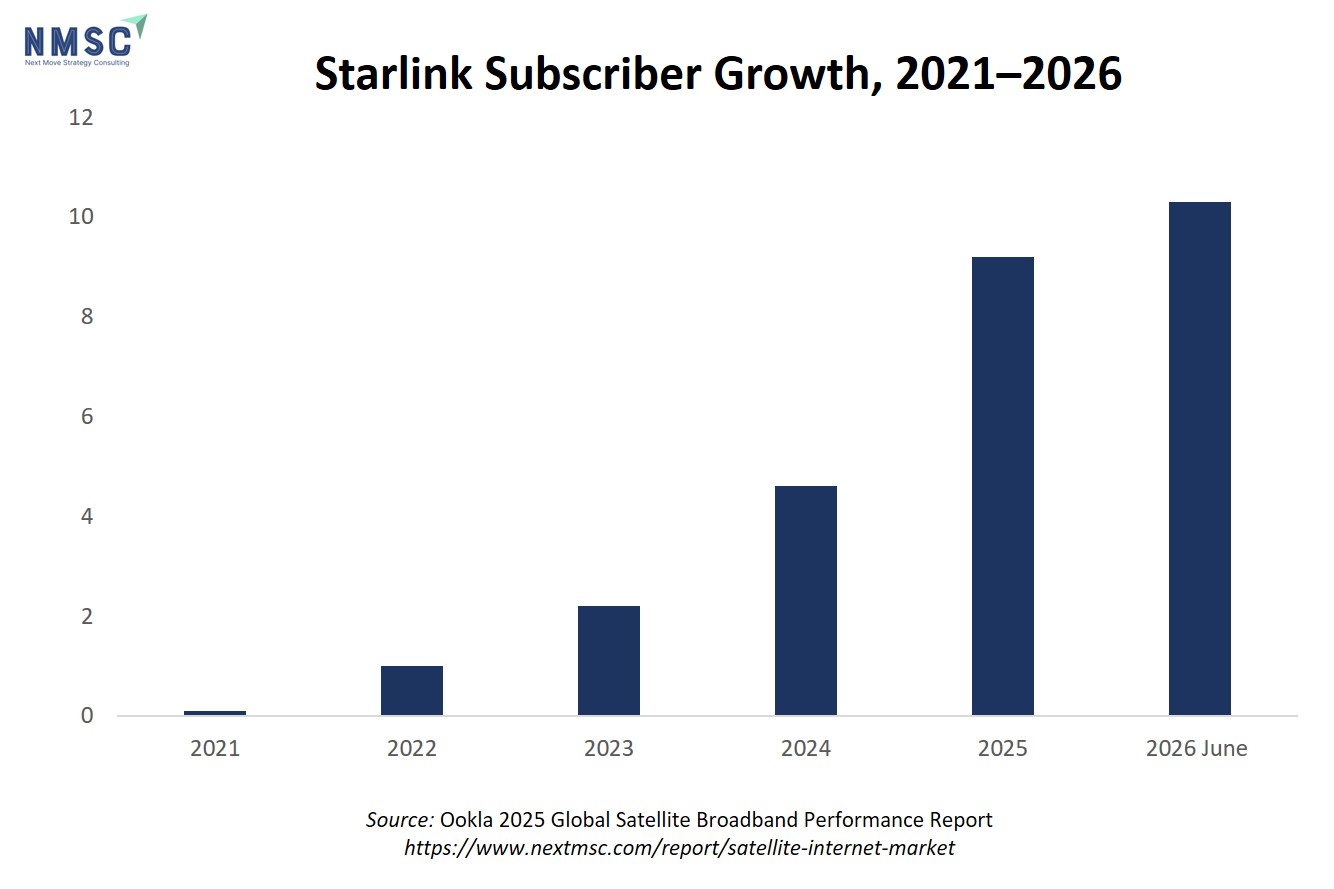
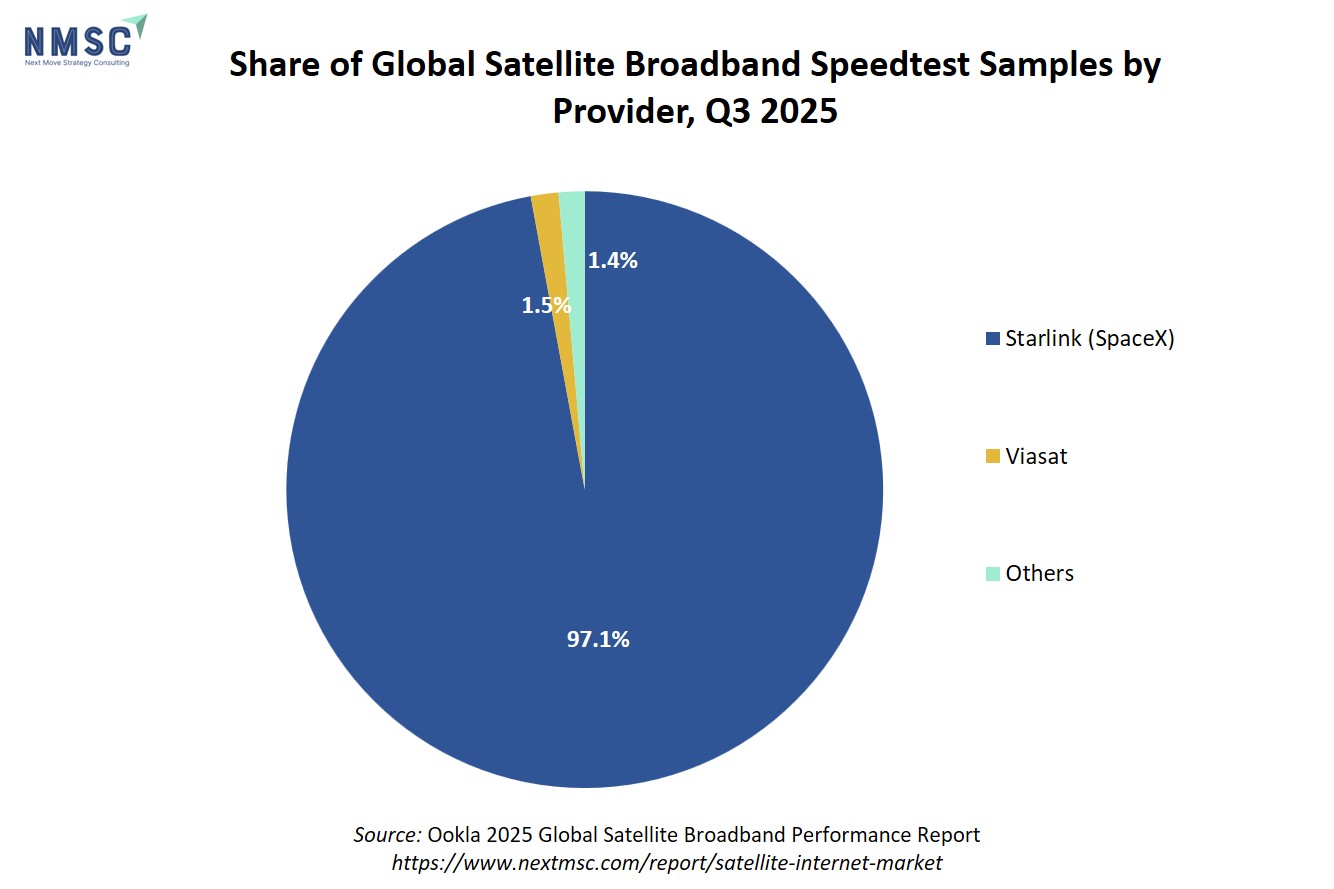
The Amazon-Globalstar transaction unfolds against a backdrop of overwhelming market dominance by SpaceX's Starlink. According to a SpaceX SEC filing dated June 1, 2026, Starlink had accumulated 10.3 million broadband subscribers across 164 countries—a subscriber base that has grown at a compound rate exceeding 100% annually since 2022. Ookla's 2025 Global Satellite Broadband Performance Report documented that Starlink accounted for 97.1% of all global satellite Speedtest samples in the third quarter of 2025, underscoring the network's near-total dominance of measurable satellite broadband traffic.
SpaceX's 2025 financial accounts showed that Starlink-led connectivity supplied 61% of combined SpaceX revenue and generated $4.423 billion in operating income. In 2025 alone, SpaceX conducted 170 Falcon 9 launches dedicated to Starlink deployment. A record 4,517 satellites were deployed globally in 2025—58% more than in 2024—with 87% owned by commercial entities, reflecting the accelerating privatization of orbital infrastructure.
Regulatory Catalysts: FCC Spectrum Rules and the GSMA Playbook
Two significant regulatory developments in 2026 have materially altered the operating environment for satellite internet providers.
On April 30, 2026, the U.S. Federal Communications Commission unanimously adopted new satellite spectrum sharing rules that FCC Chairman Brendan Carr stated could improve capacity for LEO satellite broadband by a factor of seven. The order permits LEO operators to use higher power levels in the 10.7–12.7 GHz, 17.3–18.6 GHz, and 19.7–20.2 GHz frequency bands—restrictions previously maintained to protect legacy geostationary orbit (GEO) satellite systems operated by incumbents such as DirecTV and Viasat. SpaceX, Amazon, and the Commercial Space Federation publicly supported the order.
"The existing decades-old rules no longer reflect today's offerings. In fact, they're holding them back," Chairman Carr stated at the agency's meeting. "Modern satellite designs make it far easier to share spectrum than what yesterday's regulations assume."
On June 24, 2026, the GSMA launched its Satellite Regulatory Playbook, a comprehensive policy framework developed in collaboration with Access Partnership to guide governments in modernizing satellite regulation. The Playbook identifies eight key regulatory pillars—including local establishment rules, national security, consumer protection, infrastructure requirements, end-user terminal deployment, fiscal considerations, emergency services, and enforcement—and emphasizes technology-neutral regulation that promotes consistency across markets.
"As satellite connectivity becomes an increasingly important part of the global communications landscape, policymakers have an opportunity to create regulatory frameworks that are fit for the future," said Michaela Angonius, Head of Policy & Regulation at the GSMA.
Market Intelligence: Structural Growth Drivers
The global Satellite Internet Market is experiencing structural expansion driven by the convergence of declining launch costs, advancing satellite technology, growing demand for connectivity in underserved regions, and the emergence of D2D services that extend broadband access to standard mobile devices without specialized ground equipment.
According to Next Move Strategy Consulting's analysis of the satellite internet market, the sector is positioned for a sustained high-growth trajectory through the forecast period, driven by LEO constellation expansion, enterprise adoption, government connectivity mandates, and the proliferation of satellite-capable consumer devices. The report identifies North America, Asia-Pacific, and Europe as key regional markets, while highlighting Africa and Latin America as high-growth frontiers where terrestrial infrastructure gaps create significant addressable demand for satellite-based solutions.
Deloitte's TMT Predictions 2026 report projects that LEO satellite constellations will generate approximately $15 billion in annual revenues in 2026, citing Gartner research, and forecasts that global LEO subscribers will surpass 15 million by year-end. Deloitte further estimates that cumulative investment in D2D satellites and LEO broadband constellations will reach approximately $10 billion by the end of 2026—a figure that, while substantial in absolute terms, represents a fraction of the approximately $300 billion in annual global telecommunications capital expenditure, according to IDC Research.
The ITU's Facts and Figures 2025 report documented that 6.0 billion people—74% of the global population—were online in 2025, while 2.2 billion remained offline. Deloitte's analysis estimated that approximately 350 million people lived in largely remote areas without mobile internet networks at the end of 2024, representing the core addressable population for LEO and D2D satellite services.
Major Global Satellite Internet Operators — Constellation Status (April 2026)
|
Operator |
Headquarters |
Target Constellation |
Satellites in Orbit |
Key Services |
|
Starlink (SpaceX) |
Hawthorne, CA, USA |
15,000 authorized Gen2; long-term goal 42,000 |
9,500+ operational |
Broadband, D2D, Maritime, Aviation, Defense |
|
Amazon Leo |
Redmond, WA, USA |
3,236 initial satellites |
375+ (July 2026) |
Broadband, D2D (from 2028), Aviation |
|
Eutelsat OneWeb |
Paris/London |
440 next-gen extension planned |
600+ first-gen |
Broadband, Enterprise |
|
Globalstar |
Covington, LA, USA |
32 active LEO; next-gen expansion planned |
24 (IoT/emergency focus) |
D2D, Emergency Messaging, IoT |
|
Telesat Lightspeed |
Ottawa, Canada |
150–200 planned (2026–2027) |
Pre-operational |
Enterprise Broadband |
|
AST SpaceMobile |
Midland, TX, USA |
45–60 targeted in 2026 |
6 in orbit |
D2D, Mobile Broadband |
Regional Expansion and the Digital Divide
Amazon Leo's commercial expansion is accelerating across multiple geographies. In July 2026, Amazon announced that Amazon Leo would power satellite internet services for South Africa's largest internet service provider, Herotel, marking a significant entry into the African market. The company has also secured an agreement to provide in-flight Wi-Fi for Delta Air Lines beginning in 2028, extending satellite broadband into commercial aviation.
The ITU's State of Satellite Broadband 2025 report, published by the Broadband Commission, highlighted the rapid expansion of satellite broadband and the growing role of non-terrestrial networks (NTNs) in connecting remote, rural, and underserved areas. The report noted that space-based communications are increasingly working in combination with mobile technologies to support the United Nations Sustainable Development Goals, while cautioning that regulatory and policy frameworks must evolve to ensure equitable access to space for all nations.
In the United States, satellite broadband's policy significance has grown substantially. Satellite broadband secured more than 22% of federal funding allocations under the Broadband Equity, Access, and Deployment (BEAD) program as of December 2025, according to Broadband Breakfast, reflecting a structural shift in federal broadband policy toward space-based connectivity solutions.
Global Internet Connectivity by Region — ITU Estimates, 2025
|
Region |
Internet Users (% of Population) |
Approx. Offline Population |
Primary Connectivity Challenge |
|
Europe |
~90% |
~70 million |
Quality and affordability gaps in rural areas |
|
CIS (Commonwealth of Independent States) |
~85% |
~40 million |
Rural and remote coverage gaps |
|
Americas |
~80% |
~200 million |
Urban-rural digital divide |
|
Asia-Pacific |
~70% |
~1.3 billion |
Geographic barriers, income disparities |
|
Arab States |
~65% |
~150 million |
Infrastructure gaps, affordability |
|
Africa |
~40% |
~800 million |
Infrastructure deficit, affordability, terrain |
-
Units: Percentage of regional population; approximate offline population in millions
-
Source: ITU Facts and Figures 2025; ITU State of Satellite Broadband 2025
-
Notes: Figures are ITU estimates for 2025. Regional definitions follow ITU's standard geographic groupings. Offline population figures are approximate, derived from ITU's global estimate of 2.2 billion people without internet access in 2025. Africa and Asia-Pacific represent the largest addressable markets for satellite broadband expansion.
Investment Dynamics and Competitive Outlook
The satellite internet sector is experiencing a period of unprecedented capital deployment. Deloitte's analysis indicates that spending on D2D satellite capacity will reach $6 to $8 billion in 2026, with over 1,000 D2D-capable satellites expected in orbit by year-end. The enterprise segment is projected to grow nearly tenfold by 2030, reaching 3.4 million enterprise subscribers—a market segment characterized by substantially higher average revenue per user and lower churn than the consumer segment, according to Omdia research cited by Deloitte.
China's participation in the LEO broadband race is intensifying competitive dynamics at the geopolitical level. China's Guowang constellation and the commercial Qianfan (Spacesail/G60) project both accelerated satellite deployment in 2025, with China logging 92 orbital launch attempts during the year—35% more than in 2024—according to Payload Space data. The European IRIS² constellation and Canada's Telesat Lightspeed are also advancing toward operational status, signaling that the LEO broadband market will become increasingly multipolar over the medium term.
The FCC's April 2026 spectrum sharing order carries international implications. FCC Commissioner Olivia Trusty noted that adopting the new rules would strengthen the United States' position in advancing updated spectrum policies globally—a development that could accelerate regulatory harmonization across jurisdictions and reduce barriers to LEO operator expansion in international markets. The GSMA's concurrent Satellite Regulatory Playbook reinforces this trajectory, providing a structured framework for governments to modernize satellite regulation in ways that support investment, consumer protection, and cross-border service delivery.
Bottom Line
Amazon's $11.57 billion acquisition of Globalstar, combined with the FCC's landmark spectrum sharing order and the GSMA's Satellite Regulatory Playbook, marks a structural inflection point for the global satellite internet sector. The transaction consolidates critical D2D spectrum assets and operational expertise under Amazon Leo's expanding network, positioning the company as a credible long-term competitor to SpaceX's Starlink—which currently commands 10.3 million subscribers across 164 countries and approximately 97% of measurable global satellite broadband traffic. For investors and strategic planners, the sector presents compelling growth opportunities driven by the 2.2 billion people who remain offline globally, the accelerating enterprise adoption of LEO connectivity, and the expanding role of satellite broadband in government-funded rural connectivity programs. However, material risks persist: spectrum interference disputes between LEO and GEO operators, orbital congestion, regulatory fragmentation across jurisdictions, and the high capital intensity of constellation maintenance—with LEO satellites requiring replacement every four to five years—represent ongoing structural challenges. The competitive landscape will intensify as Amazon Leo, Eutelsat OneWeb, Telesat Lightspeed, and Chinese constellations scale operations, potentially compressing margins and accelerating price competition in key emerging markets. Stakeholders who position early across enterprise, aviation, maritime, and government segments stand to capture disproportionate value as the sector transitions from early-growth to mainstream adoption.
About Next Move Strategy Consulting
Next Move Strategy Consulting is a premier market research and management consulting firm that has been committed to provide strategically analysed well documented latest research reports to its clients. The research industry is flooded with many firms to choose from, what makes NMSC different from the rest is its top-quality research and the obsession of turning data into knowledge by dissecting every bit of it and providing fact-based research recommendation that is supported by information collected from over 500 million websites, paid databases, industry journals and one on one consultations with industry experts across a diverse range of industry sectors. The high-quality customized research reports with actionable insights and excellent end-to-end customer service help our clients to take critical business decisions that enables them to move beyond time and have competitive edge in the industry.
We have been servicing over 1000 customers globally that includes 90% of the Fortune 500 companies over a decade. Our analysts are constantly tracking various high growth markets and identifying hidden opportunities in each sector or the industry. We provide one of the industry's best quality syndicate as well as custom research reports across 10 different industry verticals. We are committed to deliver high quality research solutions in accordance to your business needs. Our industry standard delivery solutions that ranges from the pre consultation to after-sales services, provide an excellent client experience and ensure right strategic decision making for businesses.
For more information, please contact:
Next Move Strategy Consulting
5th Floor 867
Boylston St, STE 500,
Boston, MA 02116, U.S.
E-Mail: [email protected]
Direct: +1-217-650-7991
Website: www.nextmsc.com
About the Author
 Sanyukta Deb
— Sanyukta Deb is Digital Marketing Team Lead at Next Move Strategy Consulting, where she has led content strategy and technical SEO for the firm's B2B market research publications for over 2 years. Her editorial process translates NextMSC's primary and secondary research — spanning technology, industrial, and consumer sectors — into commercial narratives, backed by search-intent, keyword, and competitive analysis. She brings 5 years of overall experience in digital marketing and content strategy.
Sanyukta Deb
— Sanyukta Deb is Digital Marketing Team Lead at Next Move Strategy Consulting, where she has led content strategy and technical SEO for the firm's B2B market research publications for over 2 years. Her editorial process translates NextMSC's primary and secondary research — spanning technology, industrial, and consumer sectors — into commercial narratives, backed by search-intent, keyword, and competitive analysis. She brings 5 years of overall experience in digital marketing and content strategy.
About the Reviewer
 Debashree Dey
— Debashree Dey is Assistant Manager at Next Move Strategy Consulting, where she supports cross-vertical market content and communications across diverse industries for 6 years. Her professional background includes senior content writing, communications, and published manuscript authorship, with experience developing audience-focused business narratives and maintaining clear, consistent messaging. Her role supports research-led content development and editorial quality across NextMSC publications.
Debashree Dey
— Debashree Dey is Assistant Manager at Next Move Strategy Consulting, where she supports cross-vertical market content and communications across diverse industries for 6 years. Her professional background includes senior content writing, communications, and published manuscript authorship, with experience developing audience-focused business narratives and maintaining clear, consistent messaging. Her role supports research-led content development and editorial quality across NextMSC publications.

















Add Comment