Commercial Rockets Surge as Space Economy Hits $686 Billion

Space Foundation's 2026 Global Space Economy Report Confirms Record $686 Billion Market, Launch Revenue Up 49.4%, as the Commercial Rocket Sector Enters Its Most Consequential Growth Phase
The global space economy reached a record $686 billion in 2025, according to the Space Foundation's State of the Global Space Economy report released in 2026 — a 12% year-on-year increase that marks the most significant single-year expansion in the sector's modern commercial era. Within that headline figure, the launch segment registered the fastest upstream growth rate of any space industry vertical, with launch revenue surging 49.4% year-on-year — a figure that reflects not merely cyclical demand but a structural transformation in how governments, defence agencies, and commercial operators access orbital infrastructure.
The report's findings arrive at a moment of extraordinary operational momentum. In 2025, the world recorded 330 orbital launch attempts — 317 of which succeeded — the highest annual success count in the history of spaceflight, driven overwhelmingly by the United States (198 launches) and China (93 launches). By August 19, 2026, the global launch count for the current year had already reached 197 orbital attempts, placing 2026 on a trajectory to surpass 2025's record. These are not incremental improvements — they represent a fundamental reconfiguration of the global launch services industry, one that is reshaping the competitive dynamics, investment landscape, and regulatory architecture of the global Commercial Rockets Market.
For More Information: Download FREE Sample on Commercial Rockets Market Report
The $686 Billion Space Economy: A Structural Shift, Not a Cyclical Surge
The Space Foundation's 2026 report documents a space economy that has moved decisively beyond its government-dependent origins. Commercial activity reached $544.3 billion in 2025 — representing 79% of the total global space economy — nearly quadruple the combined spending of all 53 government space budgets tracked in the report. Government space spending reached $141 billion across 53 national budgets, up 7.4% year-on-year, with the United States accounting for 57% of the global government total.
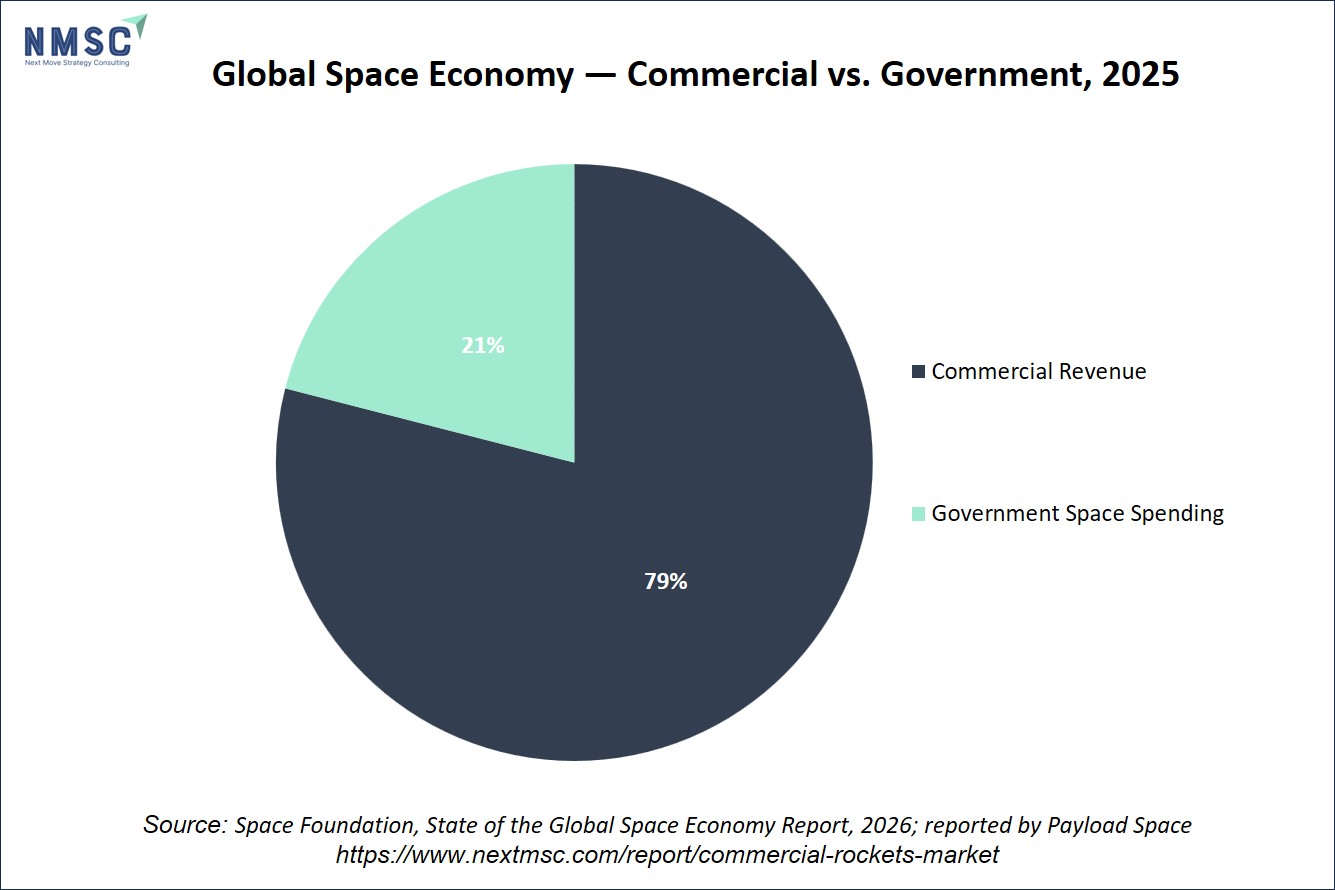
The upstream commercial segments — satellite manufacturing, launch services, and in-space servicing — are growing at rates that dwarf the broader economy. Satellite manufacturing revenue grew 67.2% year-on-year, launch revenue grew 49.4%, and in-space servicing and space situational awareness (SSA) each grew 42.9%. Private investment in space ventures crossed $12 billion in 2025, with expectations to surpass that figure in 2026.
The defence dimension is equally consequential. The Pentagon is seeking to roughly double its national security space budget to $126 billion in FY2027, which would push global military space spending past $150 billion for the first time. Non-U.S. military space spending is projected to nearly double in 2027, to $31.5 billion, as nations across Europe and the Indo-Pacific accelerate sovereign launch and satellite capabilities.
FAA Regulatory Milestone Confirms the Scale of U.S. Commercial Space Expansion
The regulatory dimension of this expansion was formally acknowledged on August 14, 2025, when U.S. Transportation Secretary and Acting NASA Administrator Sean P. Duffy marked the Federal Aviation Administration's 1,000th licensed or permitted commercial space operation — a milestone that encapsulates the velocity of the sector's growth. The first FAA-licensed commercial space operation was conducted in 1989. It took 32 years to reach the 500th operation, and then just four years to reach the next 500.
The FAA ended Fiscal Year 2024 with a record 148 licensed commercial space operations — an increase of more than 30% over the prior fiscal year and a growth of more than 900% over the past decade, from just 14 operations in FY2015. In June 2025 alone, the FAA licensed 21 commercial space operations in a single month — the highest monthly total ever recorded.
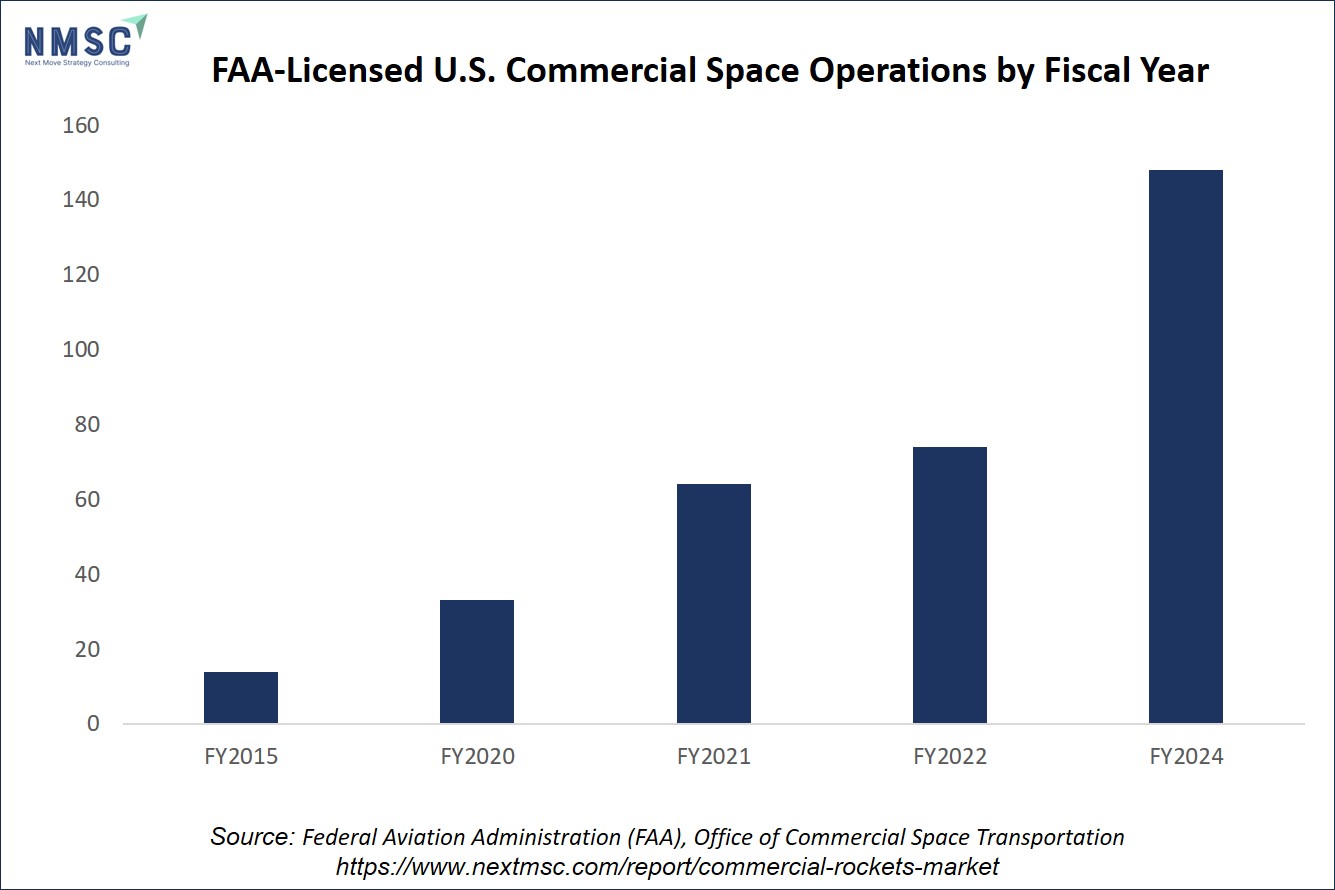
These figures are not merely administrative statistics. They reflect the operational reality of a launch market that has undergone a structural transformation: from a government-dominated, low-cadence activity to a commercially driven, high-frequency industrial operation. The regulatory infrastructure is now being stress-tested by the pace of commercial demand — a dynamic that is reshaping FAA licensing frameworks, range access protocols, and airspace management systems across the United States.
Market Intelligence: NMSC Analysis of the Commercial Rockets Sector
According to Next Move Strategy Consulting's analysis, the global commercial rockets market is projected to reach USD 25.6 billion by 2030, expanding at a CAGR of 13.9% over the 2024–2030 forecast period. The market is segmented by payload type (cargo, satellite, human space, space probes), range (LEO, MEO, GEO), fuel type (solid, liquid, hybrid), and end user (civil and military).
North America holds the dominant regional share, underpinned by the presence of SpaceX, Blue Origin, Boeing Defense Space and Security, Northrop Grumman, and Sierra Nevada Space Systems — companies that collectively represent the most advanced commercial launch ecosystem in the world. Asia-Pacific is the fastest-growing region, driven by India's expanding commercial launch infrastructure under IN-SPACe, China's aggressive domestic launch cadence, and Japan's transition to the H3 rocket platform.
The reusable launch vehicle (RLV) paradigm is the single most consequential structural driver of market expansion. SpaceX's Falcon 9 completed 165 missions in 2025 with a 100% success rate — the most reliable orbital launch vehicle in history by any operational metric. Blue Origin's New Glenn completed its maiden flight in January 2025 and successfully recovered its first stage booster on its second flight in November 2025, becoming the first non-SpaceX orbital-class booster to achieve propulsive landing. These milestones are compressing launch costs, expanding payload access, and accelerating the commercialisation of orbital infrastructure at a pace that was not anticipated even five years ago.
The Launch Bottleneck: Demand Outpacing Supply in 2026
The most consequential near-term market dynamic is not a shortage of rockets — it is a shortage of launch capacity relative to the volume of payloads awaiting orbital deployment. Florida's Space Coast supported 109 orbital launches in 2025, compared to the 45th Space Wing's "Drive to 48" goal set in 2017 — a target that now appears almost quaint against current operational realities.
"There are a lot of critical missions that have to go up, and they have to go up yesterday," Firefly Aerospace CEO Jason Kim stated in 2026. "There are a lot of systems sitting on the ground, waiting for the large heavies in development to launch. There's just so much demand for those kinds of systems."
The demand pressure is structural, not cyclical. Amazon's Project Kuiper constellation — targeting more than 3,000 satellites — began initial launches in 2025 across Atlas V, Falcon 9, Vulcan Centaur, Ariane 6, and New Glenn vehicles. China's Guowang constellation, targeting more than 13,000 satellites in LEO, commenced regular launches in 2025. The U.S. Space Development Agency's Tracking Layer constellation, Golden Dome national missile defence architecture, and a growing pipeline of commercial Earth observation, communications, and in-space servicing missions are all competing for manifest slots on a finite number of operational launch vehicles.
Rocket Lab's VP of Launch Brian Rogers articulated the strategic stakes with precision: "Space companies of the future will control their own access to space. If you don't control your own access to space, it's going to be hard to compete with someone who does." In August 2026, Rocket Lab unveiled GHOST — a deployable launch system designed to enable responsive launch from any location globally — a direct response to the access constraints that are increasingly determining competitive outcomes in the satellite and defence sectors.
Global Space Economy Key Metrics, 2025
|
Metric |
Value (2025) |
YoY Change |
Notes |
|
Total Global Space Economy |
$686B |
+12% |
Record high; 5-yr CAGR ~10% |
|
Commercial Revenue |
$544.3B |
— |
79% of total economy |
|
Government Space Spending |
$141B |
+7.4% |
53 national budgets tracked |
|
U.S. Share of Govt. Spending |
57% |
— |
~$80.4B |
|
Private Investment in Space |
$12B+ |
— |
Crossed $12B threshold in 2025 |
|
Launch Revenue Growth |
+49.4% |
YoY |
Fastest upstream segment |
|
Satellite Manufacturing Growth |
+67.2% |
YoY |
Highest growth rate by sector |
|
In-Space Servicing / SSA Growth |
+42.9% |
YoY |
Emerging segment |
|
PNT Services Share of Commercial |
~41% |
— |
Largest single commercial segment |
|
Projected Pentagon Space Budget (FY27) |
~$126B |
~2x current |
National security space surge |
Competitive Landscape: SpaceX Dominance, New Entrants, and the Reusability Race
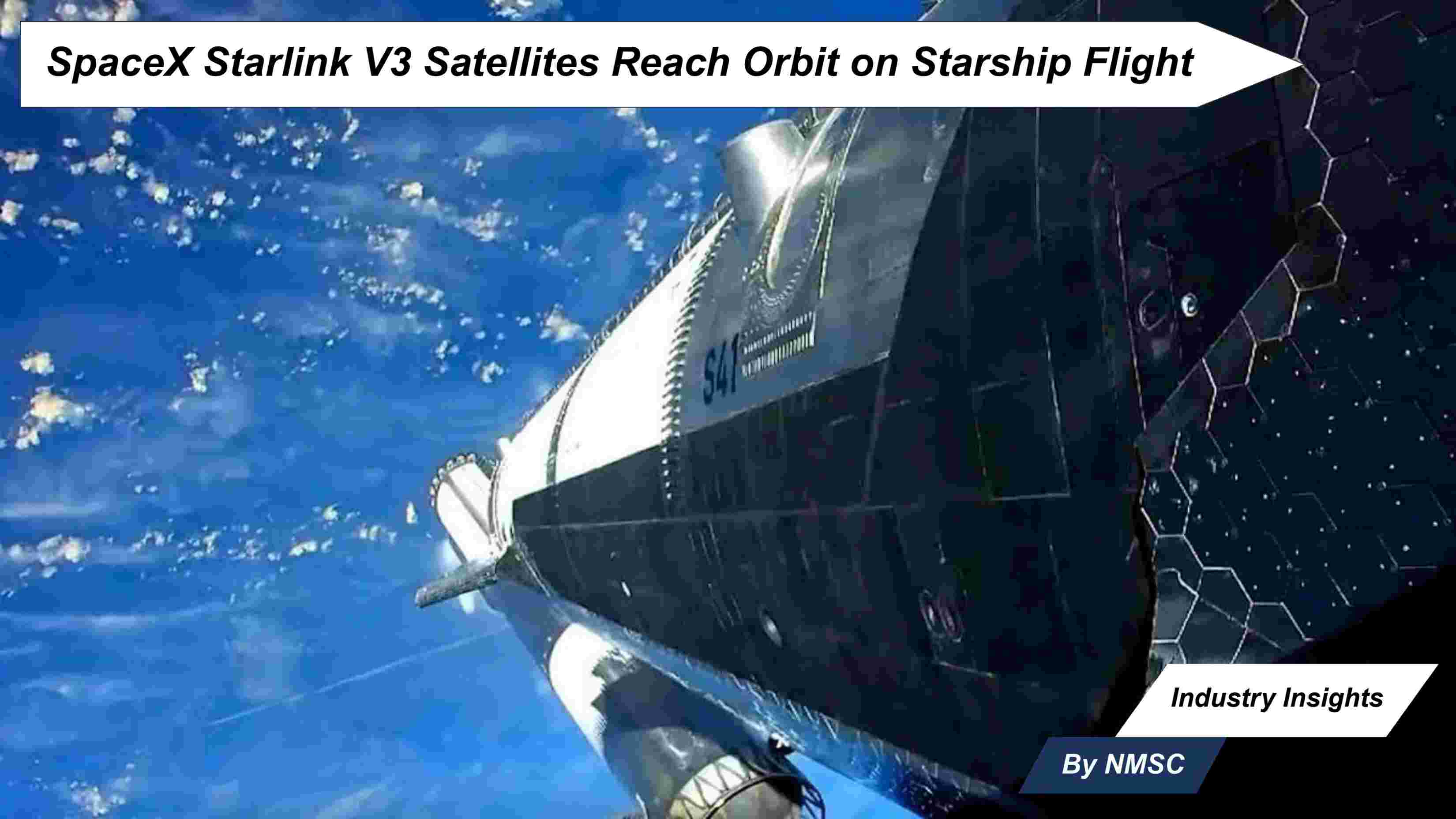
The competitive architecture of the commercial rockets market is defined by an unprecedented concentration of launch capability in a single operator, alongside a rapidly expanding ecosystem of challengers. SpaceX's Falcon 9 completed 165 missions in 2025 — of which approximately 74% were dedicated Starlink launches — while the company's Starship programme conducted five test flights, achieving two successes and advancing the vehicle toward operational deployment.
Blue Origin's New Glenn achieved two successful orbital missions in 2025, including the first propulsive booster recovery by a non-SpaceX orbital-class vehicle. Rocket Lab's Electron vehicle completed 18 missions in 2025 with a 100% success rate, while the company's Neutron medium-lift rocket is advancing toward pad delivery. ULA's Vulcan Centaur completed its first U.S. Space Force mission in August 2025.
China's commercial launch sector is expanding at a pace that warrants close institutional attention. Chinese commercial operators — including LandSpace (Zhuque-3), Galactic Energy (Ceres-1), CAS Space (Kinetica-1), and Orienspace (Gravity-1) — collectively contributed to China's 93 orbital launches in 2025, with multiple maiden flights of new commercial vehicles. China's domestic commercial launch industry is now a credible competitive force in the global small and medium-lift market, with cost structures that are reshaping pricing dynamics for international satellite operators.
India's IN-SPACe framework is enabling a new generation of private launch operators, with Skyroot Aerospace advancing its Vikram rocket programme and ISRO's commercial arm NewSpace India Limited expanding its international launch services portfolio. The Asia-Pacific region's growing share of the commercial rockets market reflects both the scale of domestic satellite demand and the strategic imperative of sovereign launch capability.
Geopolitical and Regulatory Dimensions
The geopolitical dimension of the commercial rockets market has never been more pronounced. The Space Foundation's 2026 report identifies sovereignty as the primary driver of non-U.S. government space investment growth — nations are investing in domestic launch and satellite capabilities not merely for economic returns but as strategic infrastructure. Canada more than doubled its space spending to $612 million in 2025; the United Kingdom, France, and South Korea each grew their space budgets by more than 40%.
The U.S. regulatory environment is simultaneously enabling and constraining commercial launch growth. The FAA's transition to the Part 450 unified licensing framework is designed to streamline the approval process for complex, reusable launch vehicles — a critical reform given that the existing regulatory architecture was designed for expendable rockets operating from fixed launch sites. A 2025 executive order directed federal agencies to accelerate licensing and environmental reviews, reflecting the administration's recognition that regulatory velocity is now a competitive variable in the global launch market.
Range congestion at the Eastern and Western Ranges is emerging as a structural constraint on U.S. launch cadence growth. Florida's Space Coast supported 109 orbital launches in 2025 — a figure that would have been considered impossible a decade ago — but the pace of demand growth is outstripping the rate at which range infrastructure is being modernised. This dynamic is creating commercial opportunities for alternative launch sites, including Rocket Lab's Māhia facility in New Zealand (17 launches in 2025) and emerging spaceports in Norway, Brazil, and Australia.
Bottom Line
The global commercial rockets market is operating at the intersection of record-breaking launch cadence, unprecedented private capital deployment, and accelerating sovereign demand for orbital access. The Space Foundation's confirmation of a $686 billion global space economy in 2025 — with launch revenue growing at 49.4% year-on-year — validates the structural investment thesis underpinning the sector's expansion. With the NMSC-projected market trajectory from USD 10.3 billion in 2023 to USD 25.6 billion by 2030 at a CAGR of 13.9%, the commercial rockets market is positioned for sustained, compounding growth across all payload categories and orbital regimes.
For investors, the most defensible positions lie in companies with reusable launch vehicle programmes, sovereign government contracts, and vertically integrated space systems capabilities. For satellite operators and defence agencies, launch access is no longer a commodity — it is a strategic constraint that is actively determining competitive outcomes. For policymakers, the regulatory and range infrastructure decisions made in the next 24 to 36 months will determine whether the United States maintains its structural advantage in the global launch market or cedes ground to rapidly advancing competitors in China, Europe, and Asia-Pacific. The risk calculus has shifted: in a market growing at this velocity, the cost of regulatory delay and infrastructure underinvestment now materially exceeds the cost of accelerated action.
About Next Move Strategy Consulting
Next Move Strategy Consulting is a premier market research and management consulting firm that has been committed to provide strategically analysed well documented latest research reports to its clients. The research industry is flooded with many firms to choose from, what makes NMSC different from the rest is its top-quality research and the obsession of turning data into knowledge by dissecting every bit of it and providing fact-based research recommendation that is supported by information collected from over 500 million websites, paid databases, industry journals and one on one consultations with industry experts across a diverse range of industry sectors. The high-quality customized research reports with actionable insights and excellent end-to-end customer service help our clients to take critical business decisions that enables them to move beyond time and have competitive edge in the industry.
We have been servicing over 1000 customers globally that includes 90% of the Fortune 500 companies over a decade. Our analysts are constantly tracking various high growth markets and identifying hidden opportunities in each sector or the industry. We provide one of the industry's best quality syndicate as well as custom research reports across 10 different industry verticals. We are committed to deliver high quality research solutions in accordance to your business needs. Our industry standard delivery solutions that ranges from the pre consultation to after-sales services, provide an excellent client experience and ensure right strategic decision making for businesses.
For more information, please contact:
Next Move Strategy Consulting
5th Floor 867 Boylston St, STE 500,
Boston, MA 02116, U.S.
E-Mail: [email protected]
Direct: +1-217-650-7991
Website: www.nextmsc.com
About the Author
 Sanyukta Deb
— Sanyukta Deb is Digital Marketing Team Lead at Next Move Strategy Consulting, where she has led content strategy and technical SEO for the firm's B2B market research publications for over 2 years. Her editorial process translates NextMSC's primary and secondary research — spanning technology, industrial, and consumer sectors — into commercial narratives, backed by search-intent, keyword, and competitive analysis. She brings 5 years of overall experience in digital marketing and content strategy.
Sanyukta Deb
— Sanyukta Deb is Digital Marketing Team Lead at Next Move Strategy Consulting, where she has led content strategy and technical SEO for the firm's B2B market research publications for over 2 years. Her editorial process translates NextMSC's primary and secondary research — spanning technology, industrial, and consumer sectors — into commercial narratives, backed by search-intent, keyword, and competitive analysis. She brings 5 years of overall experience in digital marketing and content strategy.
About the Reviewer
 Debashree Dey
— Debashree Dey is Assistant Manager at Next Move Strategy Consulting, where she supports cross-vertical market content and communications across diverse industries for 6 years. Her professional background includes senior content writing, communications, and published manuscript authorship, with experience developing audience-focused business narratives and maintaining clear, consistent messaging. Her role supports research-led content development and editorial quality across NextMSC publications.
Debashree Dey
— Debashree Dey is Assistant Manager at Next Move Strategy Consulting, where she supports cross-vertical market content and communications across diverse industries for 6 years. Her professional background includes senior content writing, communications, and published manuscript authorship, with experience developing audience-focused business narratives and maintaining clear, consistent messaging. Her role supports research-led content development and editorial quality across NextMSC publications.
















Add Comment