NRO Missions Accelerate Reconnaissance Satellite Market

U.S. National Reconnaissance Office Executes Four Intelligence-Gathering Satellite Missions in 2026 as Global Military Expenditure Reaches $2.9 Trillion, Reshaping the Strategic Landscape for Orbital Surveillance Systems
The United States National Reconnaissance Office (NRO), in partnership with the U.S. Space Force and SpaceX, successfully launched the NROL-95 mission on July 30, 2026, from Space Launch Complex-40 at Cape Canaveral Space Force Station, Florida, aboard a SpaceX Falcon 9 rocket. The mission marks the fourth NRO intelligence-gathering satellite deployment within the 2026 calendar year alone — a launch cadence that underscores the accelerating strategic prioritization of orbital reconnaissance capabilities by the world's foremost space power.
The NROL-95 launch follows three preceding NRO missions in 2026: NROL-105 on January 16, NROL-172 on May 11, and NROL-179 on June 19 — all executed from U.S. Space Force installations in California and Florida. The operational tempo reflects a deliberate institutional shift in U.S. intelligence architecture, one that carries significant implications for the global Reconnaissance Satellite Market and the defense industrial base that supports it.
For More Information: Download FREE Sample on Reconnaissance Satellite Market Report
The NRO's Proliferated Constellation Doctrine
The strategic significance of the 2026 launch cadence extends beyond raw numbers. The mission emblem for NROL-179, launched June 19, 2026, from Vandenberg Space Force Base, explicitly articulated the NRO's evolving operational philosophy. The emblem's design — depicting a proliferated constellation of satellites — and its tagline, "Strength in Numbers," formally describe the NRO's new strategy of deploying numerous, smaller satellites engineered for capability and resilience rather than relying on a limited number of large, high-value orbital assets.
This architectural pivot carries direct market consequences. A proliferated constellation model demands higher production volumes, shorter satellite development cycles, more frequent launch contracts, and expanded ground segment infrastructure — all of which translate into sustained commercial and government procurement activity across the reconnaissance satellite supply chain.
Global Military Expenditure Provides the Macro Foundation
The operational intensity of U.S. reconnaissance satellite programs does not exist in isolation. It is embedded within a broader global rearmament cycle that is reshaping defense procurement priorities across every major economy.
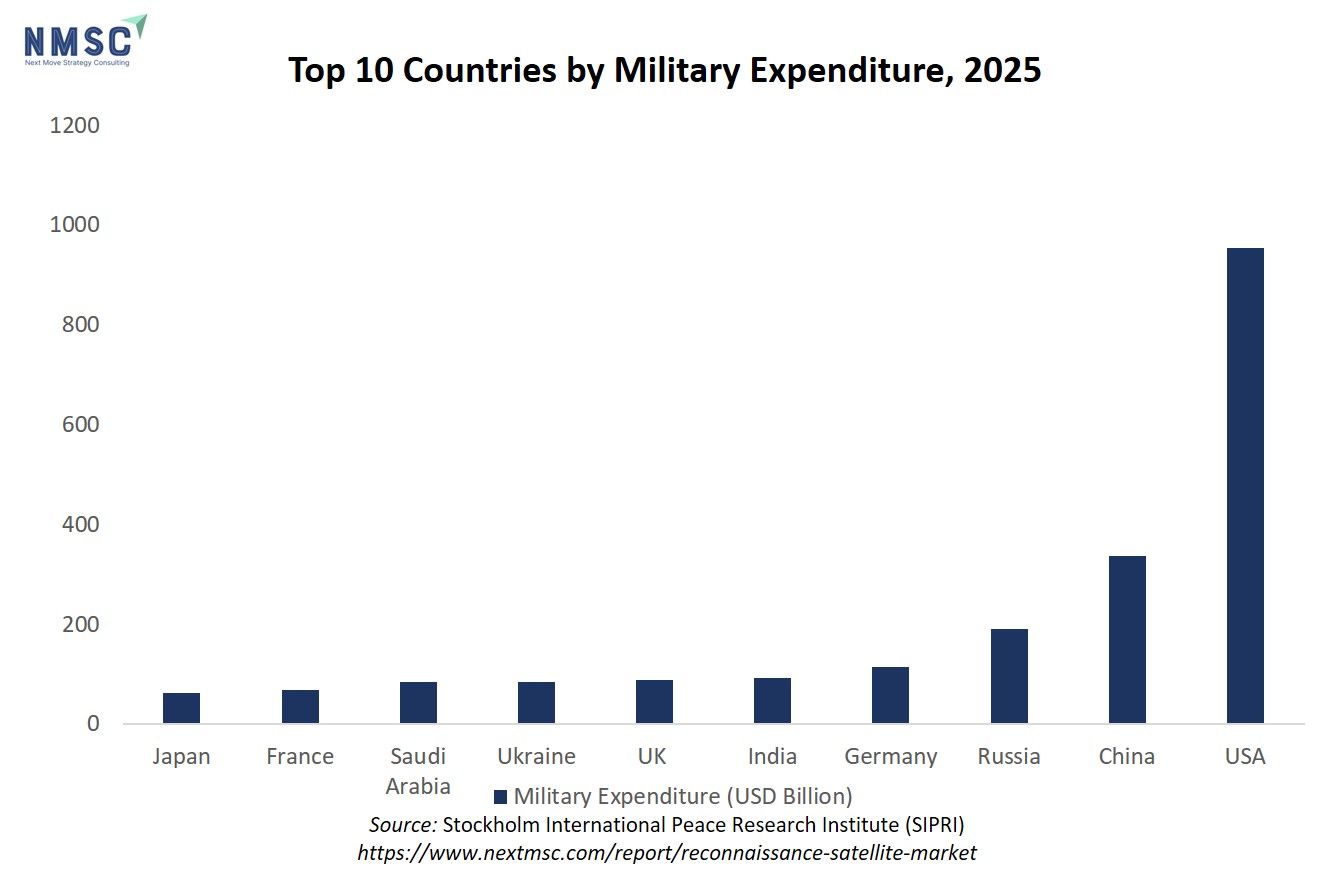
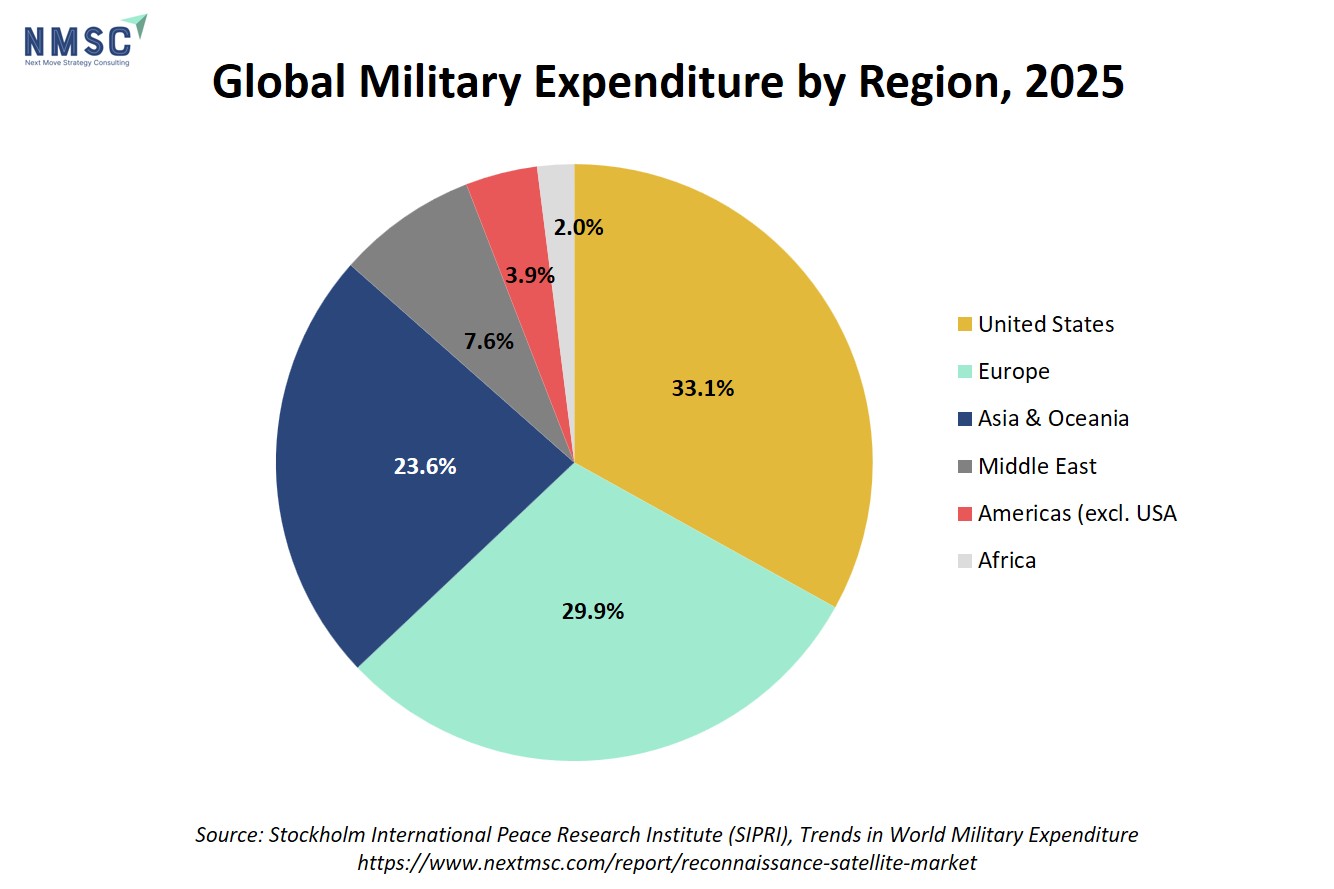
According to data published by the Stockholm International Peace Research Institute (SIPRI) on April 27, 2026, world military expenditure reached $2,887 billion in 2025, representing the eleventh consecutive annual increase and bringing the global military burden to 2.5 percent of GDP — its highest level since 2009.
The geographic distribution of this spending surge is particularly instructive for reconnaissance satellite market participants. European military expenditure rose by 14 percent to $864 billion in 2025, driven by the ongoing Russia-Ukraine conflict and accelerated NATO rearmament commitments. Military spending in Asia and Oceania grew by 8.1 percent to $681 billion — the largest annual increase in the region since 2009 — as China, Japan, Taiwan, and Australia expanded their defense postures in response to intensifying Indo-Pacific tensions.
U.S. Space Force Budget Surge Signals Structural Demand
At the national program level, the U.S. Space Force emerged as one of the primary beneficiaries of Washington's 2026 defense budget cycle. A proposed $39.9 billion for fiscal year 2026 represents a $11.3 billion increase from the prior year — a funding windfall drawn from two sources: $26.1 billion in traditional discretionary spending and $13.8 billion in mandatory funding from a reconciliation bill.
The U.S. Congress separately provided $7.4 billion for space-based systems in the FY2026 Department of Defense appropriations act — $0.8 billion more than the DoD had originally requested. This level of institutional investment in space-based sensing, surveillance, and communications infrastructure creates durable demand conditions for reconnaissance satellite manufacturers, launch service providers, and ground segment integrators.
Defense analysts at the American Enterprise Institute have cautioned, however, that the reliance on reconciliation funding introduces structural uncertainty for multi-year program planning, as programs initiated under one-time appropriations may face funding gaps beyond 2026. This dynamic underscores the importance of distinguishing between cyclical budget surges and the sustained baseline procurement commitments that underpin long-term market growth.
Geopolitical Drivers Reshaping Demand Architecture
Three geopolitical fault lines are directly accelerating procurement of reconnaissance satellite systems across multiple sovereign programs.
-
The Russia-Ukraine Conflict: Russia's military expenditure grew by 5.9 percent in 2025 to $190 billion, representing a military burden of 7.5 percent of GDP — the highest share ever recorded in Russia. Ukraine's spending rose by 20 percent to $84.1 billion, equivalent to 40 percent of GDP. The conflict has demonstrated the operational indispensability of satellite-based intelligence, surveillance, and reconnaissance (ISR) in modern warfare, accelerating procurement decisions across NATO member states.
-
European Rearmament: Germany's military expenditure grew by 24 percent year-on-year to $114 billion in 2025, surpassing the NATO 2.0 percent of GDP threshold for the first time since 1990. Spain's military spending increased by 50 percent to $40.2 billion. The 29 European NATO members collectively spent $559 billion in 2025, with 22 members meeting or exceeding the 2.0 percent GDP threshold. European sovereign investment in space-based ISR capabilities — including Germany's previously announced €35 billion military space capability program — is creating new procurement pipelines outside the traditional U.S.-centric market structure.
-
Indo-Pacific Tensions: China's military spending grew by 7.4 percent to $336 billion in 2025, marking the 31st consecutive annual increase as Beijing continued its military modernization drive. Japan's expenditure rose by 9.7 percent to $62.2 billion, while Taiwan's military spending increased by 14 percent to $18.2 billion — the largest annual increase since at least 1988. These dynamics are driving parallel investments in sovereign reconnaissance satellite programs across the Indo-Pacific theater.
NRO Launch Record: 2025–2026
National Reconnaissance Office Mission Launches, 2025–2026
|
Mission |
Launch Date |
Launch Site |
Launch Vehicle |
|
NROL-95 |
July 30, 2026 |
Cape Canaveral Space Force Station, FL |
SpaceX Falcon 9 |
|
NROL-179 |
June 19, 2026 |
Vandenberg Space Force Base, CA |
SpaceX Falcon 9 |
|
NROL-172 |
May 11, 2026 |
Vandenberg Space Force Base, CA |
SpaceX Falcon 9 |
|
NROL-105 |
January 16, 2026 |
Vandenberg Space Force Base, CA |
SpaceX Falcon 9 |
|
NROL-77 |
December 9, 2025 |
Cape Canaveral Space Force Station, FL |
SpaceX Falcon 9 |
|
NROL-48 |
September 22, 2025 |
Vandenberg Space Force Base, CA |
SpaceX Falcon 9 |
|
NROL-145 |
April 20, 2025 |
Vandenberg Space Force Base, CA |
SpaceX Falcon 9 |
|
NROL-192 |
April 12, 2025 |
Vandenberg Space Force Base, CA |
SpaceX Falcon 9 |
|
NROL-69 |
March 24, 2025 |
Cape Canaveral Space Force Station, FL |
SpaceX Falcon 9 |
|
NROL-57 |
March 21, 2025 |
Vandenberg Space Force Base, CA |
SpaceX Falcon 9 |
|
NROL-153 |
January 9, 2025 |
Vandenberg Space Force Base, CA |
SpaceX Falcon 9 |
Technology Segmentation and Market Structure
The reconnaissance satellite market is structured across several distinct technology segments, each responding to different operational requirements and threat environments. Electro-optical (EO) imaging satellites represent the foundational segment, providing high-resolution visible and infrared imagery for target identification, battle damage assessment, and strategic monitoring. Synthetic Aperture Radar (SAR) satellites offer all-weather, day-and-night imaging capability — a critical operational advantage in contested environments where cloud cover or adversary concealment measures limit optical collection. Signals intelligence (SIGINT) satellites intercept electronic emissions, communications, and radar signatures, providing a complementary intelligence layer to imaging systems.
The NRO's proliferated constellation strategy — as articulated through the NROL-179 mission emblem — signals a structural shift toward smaller, more numerous satellites across all three technology segments. This architectural evolution favors commercial satellite manufacturers capable of high-volume production, modular satellite bus designs, and rapid integration timelines, while simultaneously creating new opportunities for launch service providers operating reusable rocket systems.
According to the Next Move Strategy Consulting analysis of the global Reconnaissance Satellite Market, the sector is positioned for sustained growth through 2030, driven by escalating sovereign defense procurement, the commercialization of ISR capabilities, and the integration of artificial intelligence and machine learning into satellite data processing pipelines. The report identifies North America as the dominant regional market, with Asia-Pacific emerging as the fastest-growing region in response to the Indo-Pacific security environment.
Industry Participants and Competitive Landscape
The reconnaissance satellite market is served by a concentrated group of prime defense contractors and an expanding cohort of commercial new-space entrants. Established primes — including Lockheed Martin, Northrop Grumman, Boeing, Raytheon Technologies, and L3Harris Technologies — continue to dominate classified government programs, leveraging decades of systems integration experience and security-cleared manufacturing infrastructure. European counterparts, including Airbus Defence & Space and Thales Alenia Space, are positioned to benefit from the accelerating European rearmament cycle and the growing demand for sovereign ISR capabilities among NATO members.
The commercial ISR segment has expanded materially, with companies such as Planet Labs, Maxar Technologies, BlackSky Technology, and Satellogic offering sub-meter resolution imagery and near-real-time revisit rates to both government and commercial customers. The convergence of commercial satellite data with classified government systems — a model increasingly adopted by the NRO and allied intelligence agencies — is blurring the traditional boundary between the commercial and government reconnaissance satellite markets, creating new competitive dynamics and partnership structures across the industry.
SpaceX's role as the primary launch vehicle provider for NRO missions — executing all four 2026 NRO launches via Falcon 9 — further illustrates the structural integration of commercial space infrastructure into the national security satellite ecosystem.
Bottom Line
The global reconnaissance satellite market is entering a period of structurally elevated demand, underpinned by three mutually reinforcing forces: the NRO's accelerated proliferated constellation deployment strategy, a historic surge in global military expenditure reaching $2,887 billion in 2025, and the U.S. Space Force's $39.9 billion FY2026 budget allocation. The execution of four NRO intelligence-gathering satellite missions within the first seven months of 2026 alone signals that orbital ISR is no longer a supplementary defense capability — it is a primary strategic instrument. European rearmament, Indo-Pacific military modernization, and the ongoing Russia-Ukraine conflict are simultaneously generating new sovereign procurement pipelines across multiple regional markets. For investors and industry participants, the near-term opportunity set is substantial, particularly in satellite manufacturing, launch services, ground segment integration, and AI-enabled data analytics. Key risks include budget sustainability concerns tied to U.S. reconciliation funding mechanisms, geopolitical escalation affecting allied procurement timelines, and the growing threat of adversarial counter-space capabilities. Strategic positioning in proliferated LEO constellation programs, dual-use commercial ISR platforms, and allied nation partnerships represents the most defensible long-term growth trajectory within this market.
About Next Move Strategy Consulting
Next Move Strategy Consulting is a premier market research and management consulting firm that has been committed to provide strategically analysed well documented latest research reports to its clients. The research industry is flooded with many firms to choose from, what makes NMSC different from the rest is its top-quality research and the obsession of turning data into knowledge by dissecting every bit of it and providing fact-based research recommendation that is supported by information collected from over 500 million websites, paid databases, industry journals and one on one consultations with industry experts across a diverse range of industry sectors. The high-quality customized research reports with actionable insights and excellent end-to-end customer service help our clients to take critical business decisions that enables them to move beyond time and have competitive edge in the industry.
We have been servicing over 1000 customers globally that includes 90% of the Fortune 500 companies over a decade. Our analysts are constantly tracking various high growth markets and identifying hidden opportunities in each sector or the industry. We provide one of the industry's best quality syndicate as well as custom research reports across 10 different industry verticals. We are committed to deliver high quality research solutions in accordance to your business needs. Our industry standard delivery solutions that ranges from the pre consultation to after-sales services, provide an excellent client experience and ensure right strategic decision making for businesses.
For more information, please contact:
Next Move Strategy Consulting
5th Floor 867 Boylston St, STE 500,
Boston, MA 02116, U.S.
E-Mail: [email protected]
Direct: +1-217-650-7991
Website: www.nextmsc.com
About the Author
 Sanyukta Deb
— Sanyukta Deb is Digital Marketing Team Lead at Next Move Strategy Consulting, where she has led content strategy and technical SEO for the firm's B2B market research publications for over 2 years. Her editorial process translates NextMSC's primary and secondary research — spanning technology, industrial, and consumer sectors — into commercial narratives, backed by search-intent, keyword, and competitive analysis. She brings 5 years of overall experience in digital marketing and content strategy.
Sanyukta Deb
— Sanyukta Deb is Digital Marketing Team Lead at Next Move Strategy Consulting, where she has led content strategy and technical SEO for the firm's B2B market research publications for over 2 years. Her editorial process translates NextMSC's primary and secondary research — spanning technology, industrial, and consumer sectors — into commercial narratives, backed by search-intent, keyword, and competitive analysis. She brings 5 years of overall experience in digital marketing and content strategy.
About the Reviewer
 Debashree Dey
— Debashree Dey is Assistant Manager at Next Move Strategy Consulting, where she supports cross-vertical market content and communications across diverse industries for 6 years. Her professional background includes senior content writing, communications, and published manuscript authorship, with experience developing audience-focused business narratives and maintaining clear, consistent messaging. Her role supports research-led content development and editorial quality across NextMSC publications.
Debashree Dey
— Debashree Dey is Assistant Manager at Next Move Strategy Consulting, where she supports cross-vertical market content and communications across diverse industries for 6 years. Her professional background includes senior content writing, communications, and published manuscript authorship, with experience developing audience-focused business narratives and maintaining clear, consistent messaging. Her role supports research-led content development and editorial quality across NextMSC publications.

















Add Comment