LEO Satellite Market: LandSpace Booster Landing Reshapes Launch Race
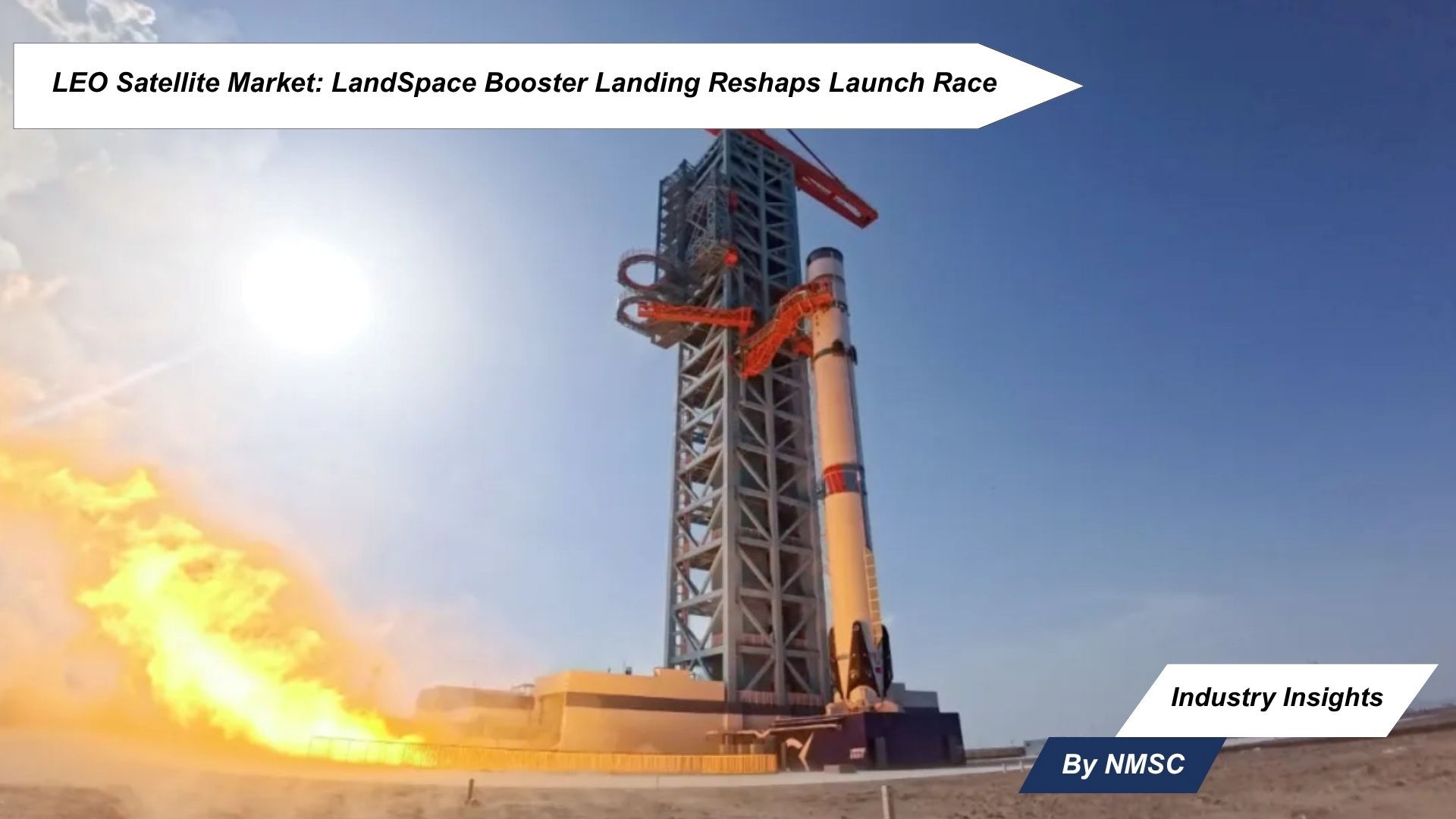
LandSpace Becomes First Chinese Commercial Firm to Land Orbital-Class Rocket Booster, Targeting LEO Constellation Deployment
GANSU, China — August 19, 2026 — Chinese commercial launch company LandSpace successfully recovered the first-stage booster of its ZhuQue-3 (ZQ-3) rocket on Wednesday, marking China's first-ever propulsive land landing of an orbital-class launch vehicle by a private company — a milestone with direct implications for the rapidly expanding LEO Satellite Market, which was valued at USD 8.9 billion in 2023 and is projected to reach USD 25.5 billion by 2030, growing at a CAGR of 16.3% from 2024 to 2030, according to Next Move Strategy Consulting.
The ZQ-3 rocket lifted off from the Dongfeng Commercial Space Innovation Pilot Zone in northwestern Gansu Province at 7:35 a.m. CST on August 19 (2335 UTC, August 18). Following stage separation, the 76.6-meter-tall booster — fueled by liquid methane and powered by nine Tianzhi-series engines — executed a series of precision maneuvers before touching down at a designated landing zone in Minqin County, Gansu Province.
"This mission marks China's first-ever successful recovery attempt of the first stage of an orbital-class launch vehicle using landing legs, and China's first successful booster recovery on land," LandSpace stated following the mission. "It is a pivotal flight test for ZhuQue-3 as it transitions from the technological demonstration and verification phase toward the engineering application phase of reusability."
LandSpace further noted that the mission validated its Hold-Down and Release Mechanism for deploying payloads, describing the flight as a proving ground for "future large-scale constellation deployment, rapid batch deployment, and improved operation efficiency" — signaling the company's intent to compete directly in the LEO satellite launch market.
Key Highlights:
-
Historic First: LandSpace's ZhuQue-3 Y2 mission achieved China's first-ever successful land recovery of an orbital-class rocket booster by a commercial company, placing LandSpace in a select global club alongside SpaceX.
-
Constellation Deployment Ambitions: LandSpace explicitly cited large-scale LEO constellation deployment and rapid batch satellite launches as primary operational targets for its reusable ZQ-3 platform.
-
Technical Advancements: The second ZQ-3 flight incorporated multiple optimizations over its inaugural mission, including a redesigned thermal protection system, an enhanced autonomous Flight Termination System, and a reduced-engine landing burn scheme for improved reliability.
-
Competitive Launch Landscape: SpaceX, which launched its 614th reflown Falcon 9 booster on the same day, continues to lead global rocket reusability; LandSpace's success signals a meaningful acceleration of competition in the commercial launch sector serving LEO operators.
Analyst Insight:
According to analysts at Next Move Strategy Consulting, the successful demonstration of reusable launch technology by a Chinese commercial operator represents a structural shift in the global LEO satellite supply chain. As launch costs decline through booster reusability, satellite constellation operators — particularly those targeting broadband internet, Earth observation, and IoT connectivity — stand to benefit from reduced deployment expenditures and faster constellation build-out timelines.
NMSC analysts note that China's growing commercial launch capabilities, now validated at the orbital-class level, are likely to intensify competitive pressure on Western launch providers and could accelerate the pace of LEO satellite constellation deployment across Asia-Pacific markets — a region already identified as a key growth corridor for the global LEO satellite industry.
Industry Outlook:
LandSpace's booster recovery milestone arrives at a pivotal moment for the global LEO satellite market. With reusable launch vehicles now emerging from multiple national ecosystems — including the United States, China, and Europe — the cost barriers to deploying large-scale LEO constellations are expected to decline materially over the coming years.
For the LEO satellite industry, this development reinforces a broader trend: the commoditization of launch access is accelerating constellation deployment timelines, expanding the addressable market for satellite-based broadband, Earth observation, and direct-to-device connectivity services. As more commercial launch providers achieve reusability milestones, the competitive dynamics of the LEO satellite market are set to intensify, with downstream benefits for operators, service providers, and end users globally.
Source: Spaceflight Now
For More Information: Download FREE Sample on LEO Satellite Market Report
Prepared By: Sanyukta Deb
About the Author
 Sanyukta Deb
— Sanyukta Deb is Digital Marketing Team Lead at Next Move Strategy Consulting, where she has led content strategy and technical SEO for the firm's B2B market research publications for over 2 years. Her editorial process translates NextMSC's primary and secondary research — spanning technology, industrial, and consumer sectors — into commercial narratives, backed by search-intent, keyword, and competitive analysis. She brings 5 years of overall experience in digital marketing and content strategy.
Sanyukta Deb
— Sanyukta Deb is Digital Marketing Team Lead at Next Move Strategy Consulting, where she has led content strategy and technical SEO for the firm's B2B market research publications for over 2 years. Her editorial process translates NextMSC's primary and secondary research — spanning technology, industrial, and consumer sectors — into commercial narratives, backed by search-intent, keyword, and competitive analysis. She brings 5 years of overall experience in digital marketing and content strategy.
About the Reviewer
 Debashree Dey
— Debashree Dey is Assistant Manager at Next Move Strategy Consulting, where she supports cross-vertical market content and communications across diverse industries for 6 years. Her professional background includes senior content writing, communications, and published manuscript authorship, with experience developing audience-focused business narratives and maintaining clear, consistent messaging. Her role supports research-led content development and editorial quality across NextMSC publications.
Debashree Dey
— Debashree Dey is Assistant Manager at Next Move Strategy Consulting, where she supports cross-vertical market content and communications across diverse industries for 6 years. Her professional background includes senior content writing, communications, and published manuscript authorship, with experience developing audience-focused business narratives and maintaining clear, consistent messaging. Her role supports research-led content development and editorial quality across NextMSC publications.

















Add Comment