Apple S11, Qualcomm NPU and Meta AI Glasses Reshape Wearable AI | NextMSC
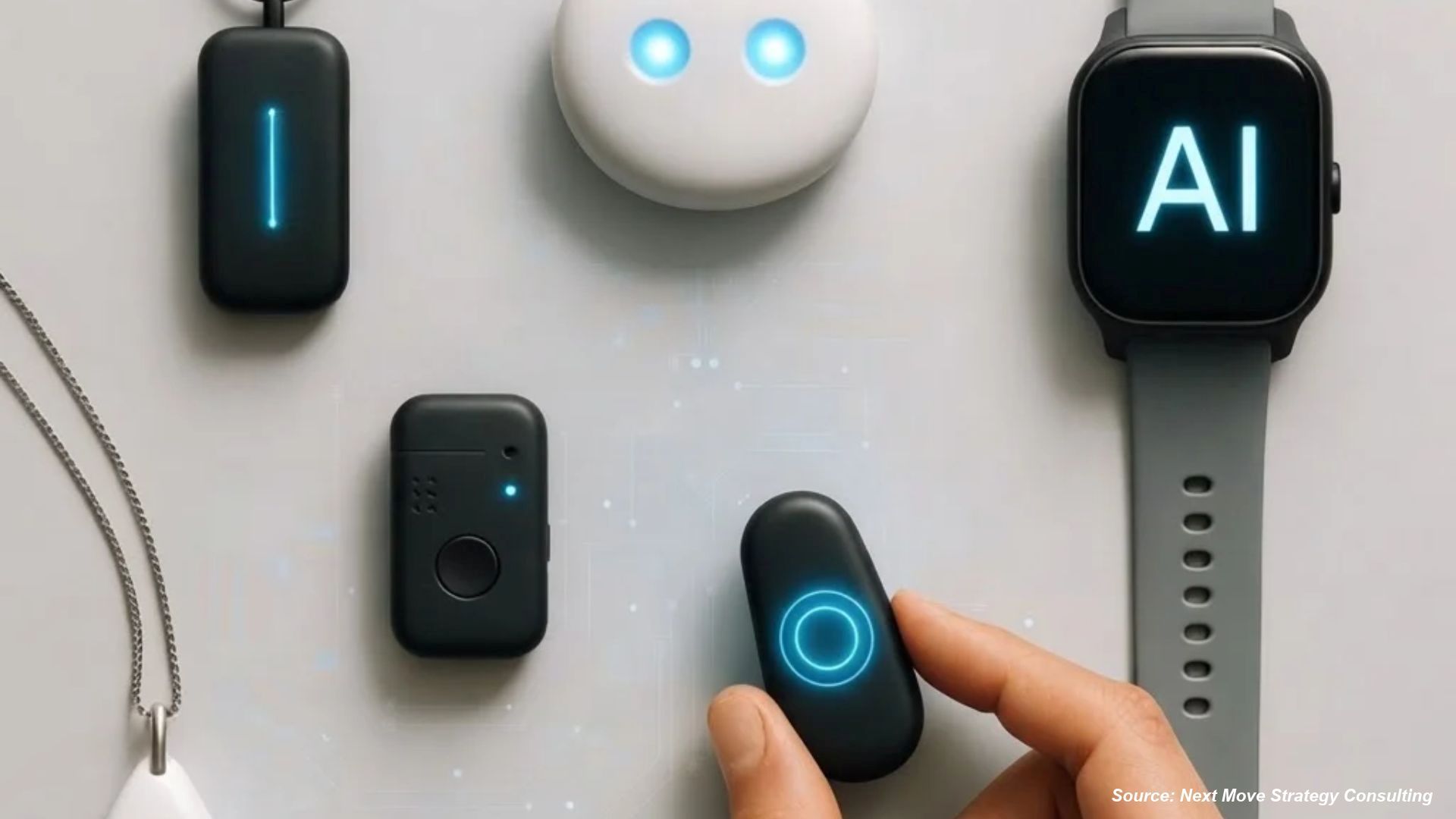
Apple's S11 Chip, Qualcomm's First NPU Wearable Platform, and Meta's 100-Style AI Glasses Lineup Converge in a Single Quarter to Redefine On-Device Intelligence
Within a span of fewer than 90 days — from Qualcomm's Snapdragon Wear Elite debut at Mobile World Congress Barcelona in March 2026 through Apple's Watch Series 12 launch on September 9 and Meta's Connect 2026 event on September 23 — the wearable AI industry crossed a structural threshold that separates the prior generation of passive fitness trackers from a new class of always-on, context-aware, on-device intelligence platforms. The simultaneity of these hardware and software milestones, each from a different layer of the technology stack, signals that the wearable AI market is no longer in an early-adoption phase but is entering a period of rapid mainstream commercialisation driven by dedicated silicon, clinically validated health sensing, and agentic AI software.
According to Next Move Strategy Consulting's Wearable AI Market report, the global wearable AI market was valued at USD 56.4 billion in 2025 and is projected to reach USD 611.3 billion by 2035, growing at a CAGR of 26.90% from 2026 to 2035, with the market already expected to reach USD 71.6 billion by the end of 2026. NextMSC primary research and analysis identifies rising demand for continuous AI-driven health monitoring, advancements in edge AI and on-device processing, and the integration of wearable AI within connected multi-device ecosystems as the three principal forces adding a combined estimated +2.48 percentage points to the market's CAGR trajectory.
For More Information: Download FREE Sample on Wearable AI Market Report
Qualcomm's Snapdragon Wear Elite: The First NPU-Powered Wearable Platform Resets the Hardware Baseline
On March 2, 2026, at MWC Barcelona, Qualcomm Technologies announced the Snapdragon Wear Elite Platform — the world's first wearable chipset to integrate a dedicated neural processing unit (NPU) capable of running billion-parameter AI models directly on the device, without cloud dependency. The platform delivers up to 12 TOPS of AI performance, a 5x improvement in single-core CPU performance, and up to 7x faster GPU throughput compared to the prior Snapdragon W5+ Gen 2 generation, while extending battery life by 30% and enabling a device to charge to 50% capacity in approximately 10 minutes.
The platform's connectivity architecture integrates six technologies simultaneously — 5G RedCap, Micro-Power Wi-Fi, Bluetooth 6.0, UWB, GNSS, and NB-NTN satellite messaging — enabling wearables to maintain AI context synchronisation across environments where prior-generation devices would have dropped connectivity entirely. Google, Samsung, and Motorola confirmed support for the platform at launch.
"Snapdragon is transforming personal computing by enabling a new category of Personal AI devices. Spanning a broad range of form factors, these devices are no longer simply extensions of the smartphone, but active participants in a distributed AI network across mobile, compute, XR, wearables, and more," said Alex Katouzian, Executive Vice President and Group General Manager, Mobile, Compute & XR, Qualcomm Technologies, Inc., at the MWC Barcelona announcement on March 2, 2026.
The significance of the Snapdragon Wear Elite for the broader market is architectural: by embedding a dedicated NPU into a wearable-class chipset for the first time, Qualcomm has removed the latency and privacy constraints that previously forced AI inference to the cloud, enabling real-time, personalised, and privacy-preserving AI experiences at the wrist — a capability that directly expands the addressable market for premium wearable AI devices beyond the segment of users with reliable high-bandwidth connectivity.
Samsung Galaxy Watch Ultra2 and Watch9: The First Commercial Devices on Snapdragon Wear Elite
At Galaxy Unpacked in London on July 22, 2026, Samsung Electronics unveiled the Galaxy Watch Ultra2 and Galaxy Watch9 — the first commercially available smartwatches powered by the Snapdragon Wear Elite platform. The Galaxy Watch Ultra2 features an 800mAh battery (35% greater capacity than its predecessor), a 5,000-nit display (the highest brightness ever achieved in a smartwatch), and a 12% thinner profile despite the larger battery, achieved through internal component redesign. The Galaxy Watch9 carries a 390mAh battery with 20% more capacity than the prior generation.
Both devices run Samsung Health's updated five-pillar AI health coaching framework — Activity, Mindfulness, Nutrition, Sleep, and Vitals — and include an upgraded Sleep Apnea detection algorithm that builds on Samsung's 2024 U.S. Food and Drug Administration De Novo authorisation, the first such regulatory clearance for a consumer smartwatch sleep apnea feature. The Galaxy Watch Ultra2 also introduces Trail Run, a real-time elevation and ascent analytics feature, and underwater diving metrics certified to EN13319 diving instrument standards, developed in collaboration with Mares.
"By integrating the new Snapdragon Wear Elite platform, the next-generation Galaxy Watch will be an even more holistic wellness companion. This marks an important step in our ongoing efforts to deliver more efficient and personalized experiences, right from your wrist," said InKang Song, Executive Vice President and Head of Technology Strategy Team, MX Business, Samsung Electronics, at Galaxy Unpacked London, July 22, 2026.
Apple Watch Series 12: The S11 Chip Turns the Wrist Into a Continuous Clinical-Grade Sensing Platform
On September 9, 2026, Apple introduced the Apple Watch Series 12, powered by the S11 chip — described by Apple as its most powerful wearable chip to date — and a redesigned Health Sensing System featuring new optical and electrical heart sensors. The device now measures heart rate every five seconds continuously throughout the day, and measures heart rate variability (HRV) up to 24 times more frequently than its predecessor, enabling a new AI-derived Readiness Score that synthesises activity load, sleep quality, and daytime vitals into a single 0–10 daily guidance metric. The Readiness algorithm was developed using data from the Apple Heart and Movement Study in collaboration with exercise scientists and physicians.
The S11 chip also enables a new category of Audio Intelligence features — Live Rewind (which surfaces the previous 15 seconds of a conversation as a text snippet), Siri Recap (which generates AI summaries of conversations), and Sound Recognition (which alerts users with hearing impairments to environmental sounds without requiring an iPhone nearby). All audio processing occurs within a hardware-isolated Secure Exclave on the S11 chip, with raw audio deleted immediately after processing and no audio recordings stored or accessible to Apple. The redesigned Health app, arriving later in 2026, will include a Longevity tab with a Health Age feature and access to over 50 biomarker lab tests at approximately 2,000 Quest Diagnostics locations in the U.S. for USD 119. Apple Watch Series 12 starts at USD 399 and became available on September 18, 2026.
"Apple Watch Series 12 is the most advanced health and fitness companion we've ever created. With our new Health Sensing System and S11 chip, Apple Watch Series 12 gives you meaningful insights, like readiness, so you can better understand how to take on your day and care for your health, plus intelligence features that make everyday life easier," said Kaiann Drance, Vice President of Worldwide Apple Watch Product Marketing, Apple, in the company's press release dated September 9, 2026.
Meta Connect 2026: AI Glasses Expand from a Niche Category to a 100-Style Consumer Platform
At Meta Connect 2026 on September 23, Meta announced the Ray-Ban Meta Gen 3 AI glasses — featuring a slimmer design, an action button for direct Meta AI access, and the longest battery life in the Ray-Ban Meta lineup — alongside the company's first audio glasses, the Ray-Ban Meta Audio, which integrate open-ear audio and AI into a frame with 12 hours of battery life and compatibility with optical prescriptions. By the end of 2026, Meta committed to offering more than 100 distinct AI glasses styles across Ray-Ban, Oakley, and Meta Glasses lines, including new collaborations and frame shapes.
A key regulatory development embedded in the Connect 2026 announcements: Meta's AI glasses will include an FDA-cleared hearing enhancement feature for adults with perceived mild to moderate hearing loss, available without a clinic visit or prescription, priced at USD 149.99 (HSA/FSA eligible) or included with a Meta One subscription. Meta also announced that its Muse AI agent — a personal AI capable of taking actions, orchestrating tasks, and operating across devices — will be brought to AI glasses for hands-free, always-on access, activated by voice.
IDC Market Data: Smart Glasses Lead Form-Factor Growth as Hearables Anchor Volume
According to IDC's Worldwide Wearable Device Tracker (updated July 2, 2026), global wearable device shipments totalled 145.7 million units in Q1 2026, growing 4.3% year over year. Smart glasses stand out as the fastest-growing form factor in IDC's five-year outlook, with shipments forecast to reach 13.6 million units in 2026, up 41.4% year over year, driven by the broadening pipeline of AI-enabled eyewear from established players and new entrants. Hearables are forecast to reach 407.6 million units in 2026, growing 4.0% year over year, supported by the integration of AI assistant features, real-time translation, and biometric health monitoring into mainstream earwear. Smart rings are projected at 4.9 million units in 2026, up 12.8% year over year.
Apple maintained the largest unit share globally at 18.1% in Q1 2026, followed by Xiaomi at 11.4%, Huawei at 10.6%, Samsung at 6.9%, and Imagine Marketing (boAt) at 5.0%. IDC forecasts total wearable device shipments to grow at a 2.6% compound annual rate from 2026 through 2030, reaching an estimated 693.2 million units, with near-term growth moderated by memory supply constraints and their upward effect on average selling prices.
The Health Imperative: Chronic Disease Burden Converts Wearable AI from Lifestyle Accessory to Preventive Infrastructure
The commercial momentum behind AI-enabled health wearables is anchored in a structural demographic reality. According to Eurostat's 2024 health statistics, 35.3% of people aged 16 years or over in the EU reported a long-standing illness or health problem, with the share rising to 74.8% among people aged 85 years or over. Among employed people, 25.5% reported such conditions; among unemployed people, the figure reached 41.7%. This chronic condition burden — spanning age groups and labour-market categories — creates a persistent, large-scale demand for continuous, non-clinical monitoring tools that can translate biometric data into actionable early-warning signals between physician visits.
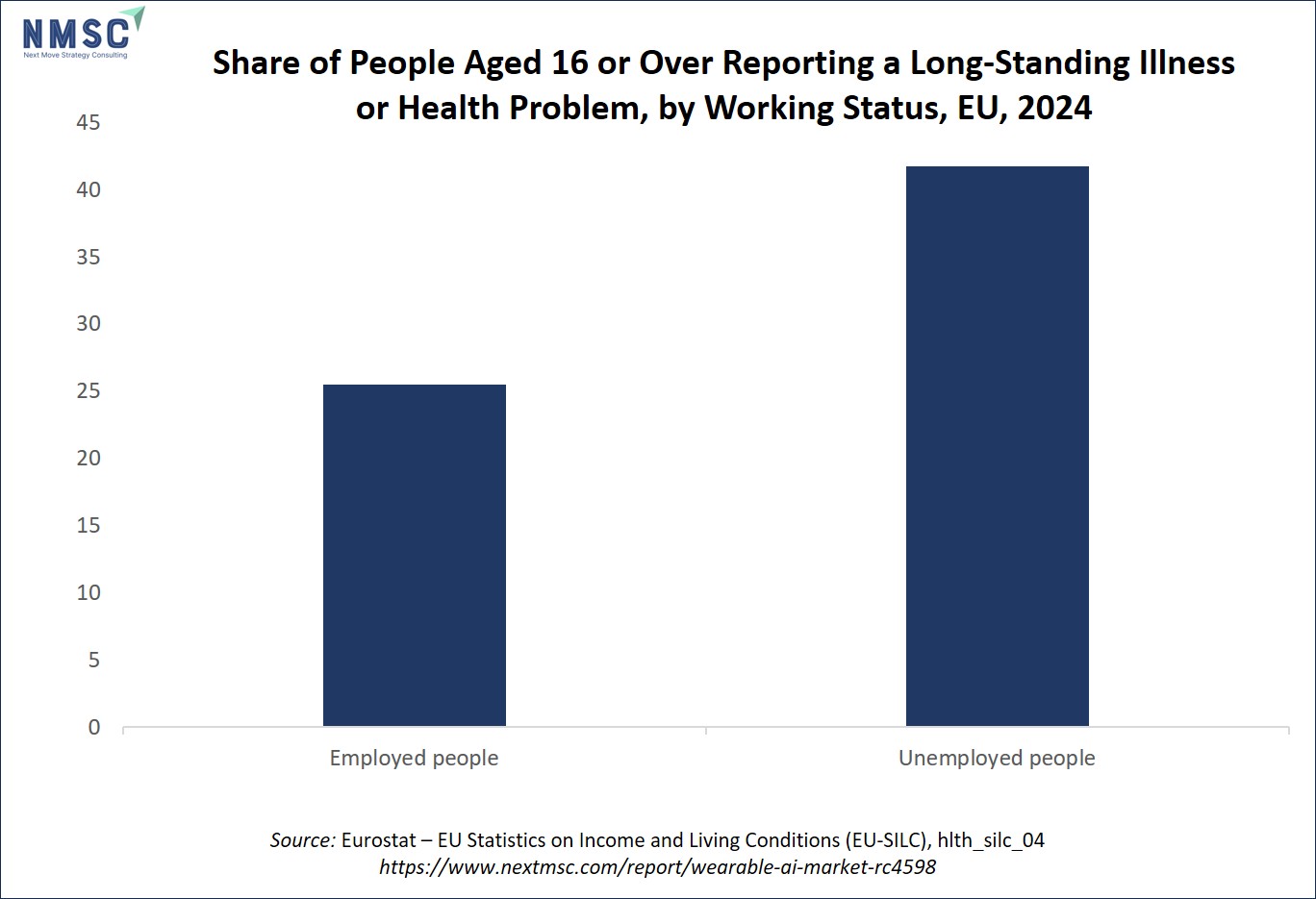
NextMSC primary research and analysis indicates that this shift from episodic measurement to real-time tracking of vital signs, sleep quality, physical activity, and early risk indicators is the single largest demand-side driver of wearable AI adoption, adding an estimated +0.94 percentage points to the market's CAGR forecast — the highest impact of any individual driver identified in NMSC's Growth Catalyst & Risk Assessment Matrix.
Privacy and Regulatory Complexity: The Structural Constraint That Shapes Product Architecture
The same biometric data richness that makes wearable AI clinically valuable also creates the market's most significant structural restraint. According to the European Union Agency for Cybersecurity (ENISA), 68.6% of recorded intrusions led to data breaches that were subsequently leaked on cybercriminal forums for sale, with 2.8% of advertised breaches categorised separately due to their sensitivity — demonstrating that privacy risk in connected health devices is a recurring commercial and consumer trust issue, not a theoretical concern.
The U.S. FDA updated its General Wellness Policy guidance in January 2026, clarifying the regulatory boundary between general wellness wearables and medical devices, and expanding the types of wearable features that fall outside device regulation — a development that accelerates product development timelines for consumer-facing health wearables while maintaining clinical standards for diagnostic applications. The FDA's 2026 guidance update directly influenced the product architecture of both Apple Watch Series 12 (which positions its Vitals app explicitly for wellness purposes, not medical use) and Samsung's Sleep Apnea feature (which builds on its 2024 FDA De Novo authorisation).
NextMSC primary research and analysis estimates that data privacy risks and regulatory complexity subtract an estimated -0.76 percentage points from the market's CAGR forecast, primarily through increased compliance costs, slower innovation cycles in clinically sensitive use cases, and the absence of standardised global data governance frameworks that would otherwise enable cross-border scalability.
NMSC Market Segmentation Snapshot
|
Segment |
Dominant Sub-Segment |
Fastest-Growing Sub-Segment |
Key Insight (NextMSC Primary Research) |
|
By Offering |
Hardware (device units & embedded electronics) |
Subscription-based Services & Data Analytics |
Software and data platforms are emerging as the primary differentiation layer; subscription models drive recurring revenue |
|
By Device Type |
Wrist Wearables (smartwatches & fitness bands) |
Smart Rings, Smart Glasses, Medical Wearables |
Discreet, always-on form factors expanding addressable user base beyond traditional smartwatch buyers |
|
By AI Architecture |
Cloud AI (scalability & centralised processing) |
On-Device AI & Hybrid AI |
Market transitioning toward hybrid architectures balancing real-time responsiveness with advanced analytics |
|
By Distribution Channel |
Retail & E-Commerce |
Enterprise & Healthcare Procurement |
Industrial safety, workforce optimisation, and clinical monitoring driving B2B channel acceleration |
|
By Application |
Health, Wellness & Fitness |
Productivity & Enterprise; Safety & Security |
Enterprise wearables for workflow assistance and worker safety monitoring represent the highest-growth B2B application layer |
IDC Wearable Device Market Share: Top 5 Companies, Q1 2026
|
Company |
Q1 2025 Share |
Q2 2025 Share |
Q3 2025 Share |
Q4 2025 Share |
Q1 2026 Share |
|
Apple |
17.0% |
14.6% |
18.9% |
20.9% |
18.1% |
|
Xiaomi |
13.0% |
12.9% |
10.9% |
10.3% |
11.4% |
|
Huawei |
11.3% |
10.3% |
7.8% |
7.9% |
10.6% |
|
Samsung |
7.9% |
7.2% |
8.1% |
7.7% |
6.9% |
|
Imagine Marketing |
5.0% |
5.2% |
7.6% |
3.7% |
5.0% |
|
Others |
45.8% |
49.6% |
46.7% |
49.5% |
48.0% |
|
Total |
100.0% |
100.0% |
100.0% |
100.0% |
100.0% |
NMSC Strategic Perspective: The Agentic AI Transition Is the Market's Next Inflection Point
The events of 2026 collectively mark the beginning of a transition that NextMSC primary research and analysis identifies as the market's most consequential structural shift: the move from wearables as passive data collectors to wearables as active AI agents capable of taking actions, orchestrating tasks, and operating as independent nodes within a distributed personal computing network.
This transition was articulated with precision by Cristiano Amon, CEO of Qualcomm, at the India AI Summit in February 2026: "We expect AI is going to have a fundamental shift in the mobile industry where the agent is going to be at the very center and you can access the agent from your mobile phone, your glasses or a pendant or for anything that you wear."
NMSC's evaluation identifies three specific mechanisms through which this agentic transition will reshape competitive dynamics in the wearable AI market through 2030:
1. On-Device AI as the New Competitive Moat: The Snapdragon Wear Elite's NPU architecture — and Apple's S11 Secure Exclave — demonstrate that the ability to run large AI models locally, with hardware-enforced privacy, is becoming a baseline expectation rather than a premium differentiator. Companies that cannot deliver on-device inference at acceptable power budgets will face accelerating displacement in the premium segment, where health-conscious consumers and enterprise buyers are unwilling to accept cloud-dependent latency or data exposure.
2. Software Ecosystems Will Capture Disproportionate Value: NextMSC primary research and analysis indicates that companies are shifting focus from hardware specifications to AI-driven software ecosystems — proprietary algorithms, user interfaces, and data platforms. Continuous software updates and feature enhancements are extending device lifecycles and improving customer retention. The Apple Health app's Longevity tab, Samsung Health's five-pillar coaching framework, and Meta's Muse agent integration into glasses all represent this software-led value capture strategy. Brands investing in AI model optimisation and personalised user experiences are gaining a competitive edge, as value creation is increasingly driven by intelligence layers rather than physical device attributes.
3. Form Factor Diversification Will Redistribute Market Share: The 41.4% year-over-year growth in smart glasses shipments forecast by IDC for 2026, combined with Meta's commitment to 100+ AI glasses styles and the 12.8% growth in smart rings, signals that the wrist-centric model of wearable AI is giving way to a multi-form-factor ecosystem. NMSC's assessment indicates that companies anchored exclusively to the smartwatch category face structural share erosion as smart glasses, rings, ear wearables, and medical wearables capture users who prefer discreet, always-on, or application-specific form factors. The addressable market for wearable AI expands materially as each new form factor unlocks a distinct user segment that the smartwatch alone could not serve.
The convergence of these three forces — on-device AI silicon, software-led differentiation, and form factor diversification — is precisely what NMSC's 26.90% CAGR projection reflects: not a linear extrapolation of prior smartwatch growth, but a compounding expansion of the total addressable market as wearable AI penetrates healthcare procurement, enterprise safety, and consumer lifestyle segments simultaneously.
Bottom Line
The wearable AI market entered a new structural phase in 2026, defined by three simultaneous developments that collectively remove the principal barriers to mass adoption. Qualcomm's Snapdragon Wear Elite — the world's first NPU-powered wearable platform — eliminated the cloud-dependency constraint that previously forced AI inference off-device, enabling real-time, privacy-preserving intelligence at the wrist and across diverse form factors. Apple Watch Series 12's S11 chip and Health Sensing System demonstrated that continuous clinical-grade biometric monitoring — heart rate every five seconds, HRV measured 24 times more frequently — is now commercially viable at a USD 399 price point. And Meta's commitment to 100+ AI glasses styles, combined with an FDA-cleared hearing assistance feature, signals that smart eyewear is transitioning from a niche category to a mainstream consumer platform. According to NextMSC primary research and analysis, the global wearable AI market is projected to grow from USD 71.6 billion in 2026 to USD 611.3 billion by 2035 at a CAGR of 26.90%, with the health monitoring, enterprise safety, and agentic AI software segments representing the highest-conviction growth vectors for investors and product developers through the forecast period.
About Next Move Strategy Consulting
Next Move Strategy Consulting is a premier market research and management consulting firm that has been committed to provide strategically analysed well documented latest research reports to its clients. The research industry is flooded with many firms to choose from, what makes NMSC different from the rest is its top-quality research and the obsession of turning data into knowledge by dissecting every bit of it and providing fact-based research recommendation that is supported by information collected from over 500 million websites, paid databases, industry journals and one on one consultations with industry experts across a diverse range of industry sectors. The high-quality customized research reports with actionable insights and excellent end-to-end customer service help our clients to take critical business decisions that enables them to move beyond time and have competitive edge in the industry.
We have been servicing over 1000 customers globally that includes 90% of the Fortune 500 companies over a decade. Our analysts are constantly tracking various high growth markets and identifying hidden opportunities in each sector or the industry. We provide one of the industry's best quality syndicate as well as custom research reports across 10 different industry verticals. We are committed to deliver high quality research solutions in accordance to your business needs. Our industry standard delivery solutions that ranges from the pre consultation to after-sales services, provide an excellent client experience and ensure right strategic decision making for businesses.
For more information, please contact:
Next Move Strategy Consulting
5th Floor 867 Boylston St, STE 500,
Boston, MA 02116, U.S.
E-Mail: [email protected]
Direct: +1-217-650-7991
Website: www.nextmsc.com
About the Author
 Sanyukta Deb
— Sanyukta Deb is Digital Marketing Team Lead at Next Move Strategy Consulting, where she has led content strategy and technical SEO for the firm's B2B market research publications for over 2 years. Her editorial process translates NextMSC's primary and secondary research — spanning technology, industrial, and consumer sectors — into commercial narratives, backed by search-intent, keyword, and competitive analysis. She brings 5 years of overall experience in digital marketing and content strategy.
Sanyukta Deb
— Sanyukta Deb is Digital Marketing Team Lead at Next Move Strategy Consulting, where she has led content strategy and technical SEO for the firm's B2B market research publications for over 2 years. Her editorial process translates NextMSC's primary and secondary research — spanning technology, industrial, and consumer sectors — into commercial narratives, backed by search-intent, keyword, and competitive analysis. She brings 5 years of overall experience in digital marketing and content strategy.
About the Reviewer
 Debashree Dey
— Debashree Dey is Assistant Manager at Next Move Strategy Consulting, where she supports cross-vertical market content and communications across diverse industries for 6 years. Her professional background includes senior content writing, communications, and published manuscript authorship, with experience developing audience-focused business narratives and maintaining clear, consistent messaging. Her role supports research-led content development and editorial quality across NextMSC publications.
Debashree Dey
— Debashree Dey is Assistant Manager at Next Move Strategy Consulting, where she supports cross-vertical market content and communications across diverse industries for 6 years. Her professional background includes senior content writing, communications, and published manuscript authorship, with experience developing audience-focused business narratives and maintaining clear, consistent messaging. Her role supports research-led content development and editorial quality across NextMSC publications.















Add Comment