Are Radar Delays and AI Breakthroughs Redefining Air Combat?
Lede
The Radar Market systems once the defining element of air superiority are now at the center of two critical developments shaping modern defense strategy.
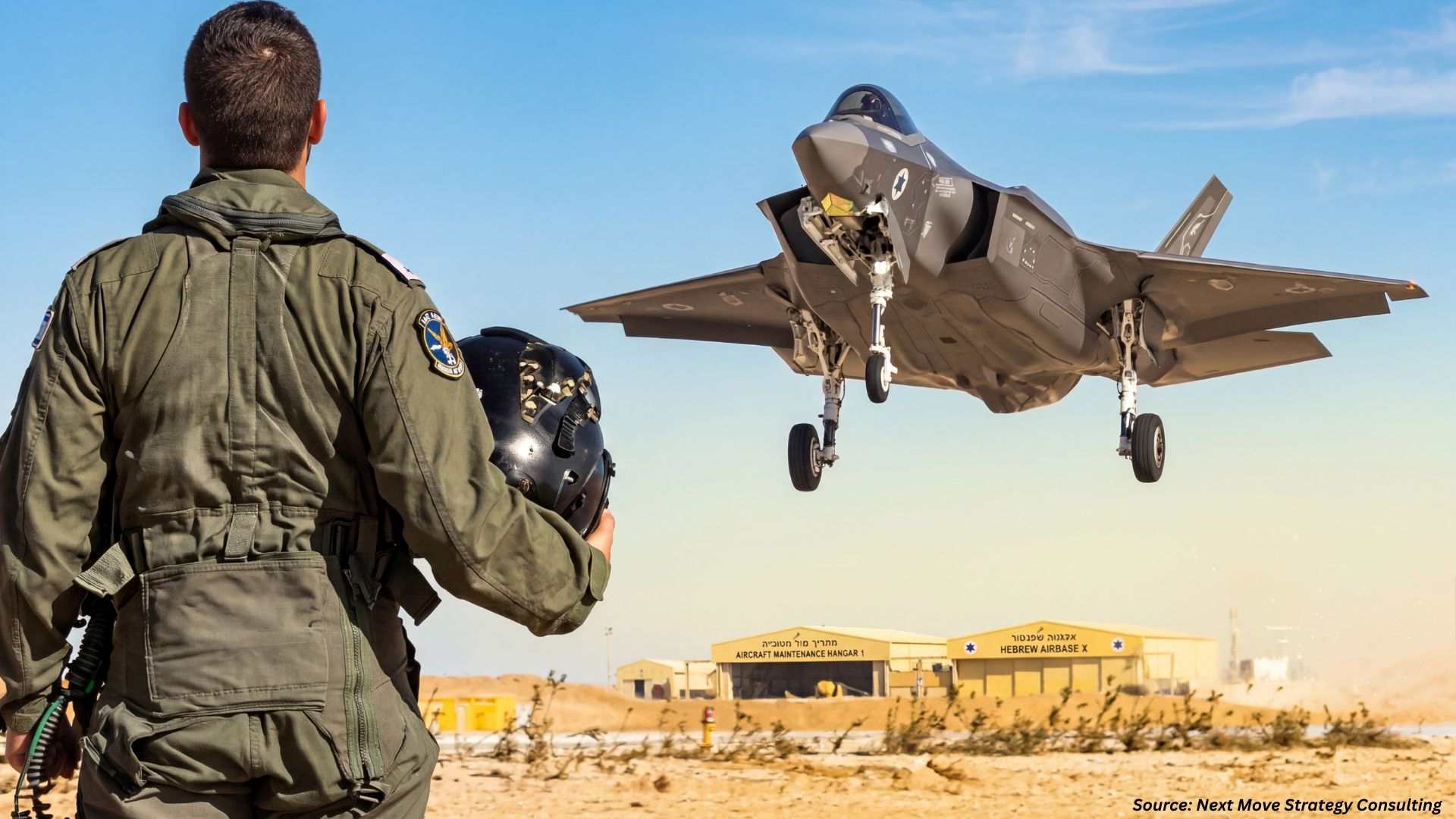
The United States is accepting Lockheed Martin F-35 Lightning II jets without installed radar systems due to upgrade delays, while China is advancing AI-enabled radar capable of maintaining over 99% tracking accuracy under electronic interference.
These parallel developments reveal a deeper transition in defense technology. I find that the emphasis is shifting from fully integrated hardware at delivery to adaptive, upgrade-driven capability models, fundamentally altering how combat readiness is achieved and sustained.
US Accepts F-35 Jets Without Radar Amid Upgrade Delays
The US Department of Defense has begun receiving F-35 aircraft without radar systems as delays affect the next-generation APG-85 radar program. According to Aerospace Global News (March 20, 2026), production timelines for Lot 17 aircraft have outpaced the readiness of the radar, which was originally intended to replace the APG-81 system.
Because the APG-85 differs structurally, the older radar cannot be installed without redesigning the aircraft bulkhead. As a result, the jets are delivered with ballast in place of radar to maintain airworthiness. These aircraft are not combat-coded and are instead used for training until retrofitting becomes possible.
At Next Move Strategy Consulting, I observe that this reflects a calculated industrial decision. Maintaining production continuity outweighs the risks of delayed capability integration. Our analysis indicates that halting production would disrupt supply chains and increase program costs significantly, making phased capability deployment the more viable approach.

F-35 Radar Delay Overview
|
Parameter |
Status |
|
Aircraft Batch |
Lot 17 |
|
Planned Radar |
APG-85 |
|
Current Issue |
Development delay |
|
Interim Measure |
Ballast installation |
|
Operational Use |
Training only |
|
Expected Resolution |
Around 2028 |
It approaches with earlier upgrade cycles, such as the Technology Refresh 3 rollout, where aircraft were delivered with limited capability and later upgraded. This reinforces a broader industry pattern of incremental modernization.
China’s AI Radar Achieves Breakthrough in Electronic Warfare
I observe a contrasting technological leap from China, where an AI-powered airborne radar system has demonstrated over 99% tracking accuracy even under heavy electronic jamming conditions.
Developed by the China Electronics Technology Group Corporation, the system uses cognitive radar principles to continuously adapt to interference by adjusting frequencies, waveforms, and beam directions in real time. Traditional radar systems, by comparison, typically achieve only 70–80% tracking continuity under similar conditions.
At Next Move Strategy Consulting, I observe that this represents a structural shift in radar design philosophy. Instead of relying on fixed operational parameters, radar systems are evolving into intelligent platforms capable of learning and adapting in dynamic environments. Our analysis indicates that this capability could redefine survivability and detection in contested airspace.

Regional Environmental Risks and Technological Barriers in Modern Defense Systems
The radar chart displays regional variations (e.g., North Caucasian, Siberian, Central) in environmental components hydrosphere, soil, and atmosphere against a defined safety or impact limit, highlighting how some regions exceed thresholds while others remain constrained by natural or systemic factors. This pattern can be understood through parallels in modern aerospace systems, where different “layers” of capability face uneven limitations. For example, the U.S. F-35 program shows how system integration barriers can disrupt performance: delays in the advanced APG-85 radar have led to aircraft being delivered without this critical component due to design mismatches and production timing issues . Similarly, just as certain regions in the chart fall below or exceed environmental limits, parts of the F-35 system operate below full capability until upgrades are completed. In contrast, China’s development of AI- and 6G-enabled radar and electronic warfare systems demonstrates an attempt to push beyond such limits, with technologies capable of generating false targets and disrupting radar signals at scale. Overall, the image reflects how both environmental systems and advanced defense technologies are shaped by uneven constraints whether ecological thresholds or technological, organisational, and innovation barriers.

Radar Capability Comparison
|
Capability |
Conventional Radar |
AI Cognitive Radar |
|
Tracking Accuracy |
70–80% |
>99% |
|
Adaptability |
Limited |
Real-time |
|
Response Speed |
Moderate |
Milliseconds |
|
EW Resistance |
Moderate |
High |
Chinese developers opted for controlled machine learning models instead of large language models, emphasizing reliability and predictability in mission-critical systems. This decision reflects a practical engineering approach tailored to operational requirements.
Barriers to Advanced Radar and Electronic Warfare Development
The radar chart illustrates how different types of barriers such as end-user awareness, hidden costs, organisational challenges, limits to innovation, and affect complex technology programs, which can be clearly understood through recent aerospace examples. In the case of the F-35 program, strong organisational barriers and hidden costs have delayed the integration of its next-generation radar, leading to aircraft being delivered without fully functional systems and requiring costly retrofits later. This reflects the chart’s high scores in organisational complexity and transaction costs. At the same time, institutional inertia keeps production moving despite these shortcomings. In contrast, China’s development of AI-driven radar and electronic warfare systems highlights efforts to overcome innovation barriers and accelerate capability growth. Overall, the chart emphasizes that technological progress in advanced defense systems is not only limited by engineering challenges but also by structural, financial, and institutional constraints.

Visual Benchmarking of Key Metrics Across Categories
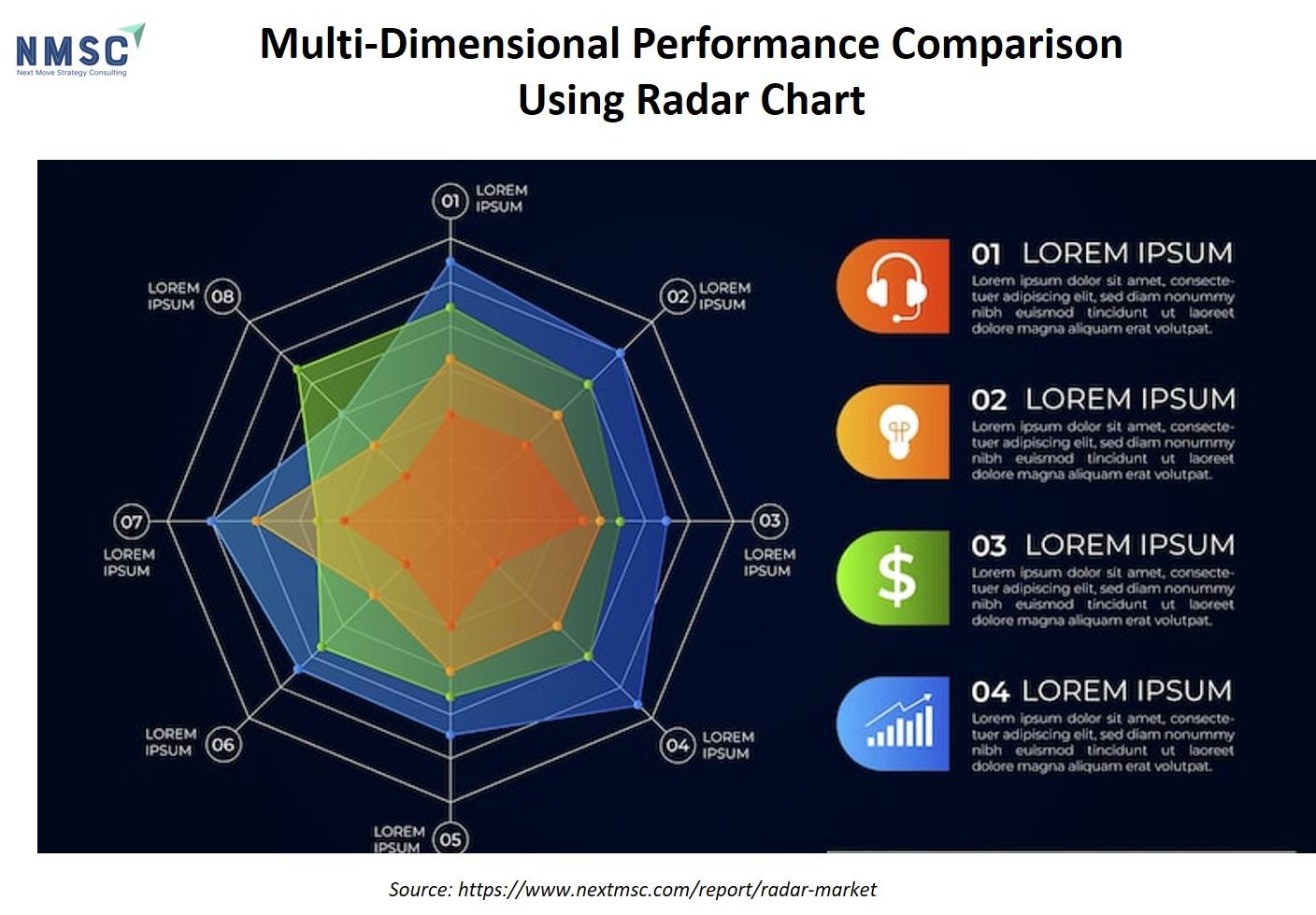
The image illustrates how different segments perform across labeled categories (01–08), using overlapping polygons for comparison. The right-hand side complements the chart with icon-based descriptions, likely representing categories such as customer support, innovation, financial growth, and analytics. This type of visualization is commonly used in business intelligence to benchmark performance, highlight gaps, and support strategic decision-making.
Market Analysis: Evolving Radar and Electronic Warfare Landscape
I see the radar and electronic warfare ecosystem undergoing a rapid transformation between 2024 and 2026. Defense programs are increasingly prioritizing adaptability, software integration, and resilience against electronic threats.
At Next Move Strategy Consulting, I observe that the industry is moving toward software-defined architectures, where hardware serves as a platform for continuous upgrades rather than a fixed capability endpoint. This shift is influencing procurement strategies, lifecycle management, and competitive dynamics across regions.
North America continues to focus on scalable platforms and long-term upgrade cycles, while Asia-Pacific is accelerating AI-driven innovations, particularly in electronic warfare. Europe remains focused on interoperability and multi-role flexibility, balancing technological advancement with alliance integration.
Strategic Trends in Radar Systems
|
Trend |
Industry Impact |
|
AI Integration |
Improves detection and adaptability |
|
Modular Systems |
Enables phased upgrades |
|
EW Focus |
Increases strategic importance |
|
Software-defined Design |
Enhances flexibility |
Long-Term Market Impact and NMSC Perspective
I believe these developments point to a long-term restructuring of the defense technology landscape. The delivery of radar-less F-35s highlights the decoupling of platform production from system readiness, while China’s AI radar demonstrates how software capabilities can redefine performance benchmarks.
At Next Move Strategy Consulting, I observe that future competitive advantage will depend less on initial hardware superiority and more on the ability to upgrade, adapt, and integrate intelligence into existing systems. Our analysis indicates that electronic warfare dominance will become a decisive factor in modern conflict, shaping investment priorities and innovation pipelines for years to come.
What to Do Next
I recommend that defense manufacturers prioritize modular system architectures that allow delayed component integration without disrupting production. Governments should align procurement strategies with lifecycle capability development rather than immediate full-spectrum readiness. Technology providers need to focus on AI-driven sensing and adaptive algorithms, as these will define next-generation radar performance.
Investors, in my view, should closely monitor companies specializing in defense electronics and AI integration, as these segments are likely to see sustained growth driven by geopolitical demand and technological necessity.
Conclusion
I conclude that the current divergence between US production strategy and China’s technological advancement reflects two sides of the same transformation. While the US emphasizes continuity and scalability, China is pushing the boundaries of adaptive radar capability.
At Next Move Strategy Consulting, I believe that the future of air combat will be shaped not just by aircraft platforms, but by the intelligence embedded within them. The ability to adapt in real time will define operational success in increasingly contested environments.
About Next Move Strategy Consulting:
Next Move Strategy Consulting is a premier market research and management consulting firm that has been committed to provide strategically analysed well documented latest research reports to its clients. The research industry is flooded with many firms to choose from, what makes NMSC different from the rest is its top-quality research and the obsession of turning data into knowledge by dissecting every bit of it and providing fact-based research recommendation that is supported by information collected from over 500 million websites, paid databases, industry journals and one on one consultations with industry experts across a diverse range of industry sectors. The high-quality customized research reports with actionable insights and excellent end-to-end customer service help our clients to take critical business decisions that enables them to move beyond time and have competitive edge in the industry.
We have been servicing over 1000 customers globally that includes 90% of the Fortune 500 companies over a decade. Our analysts are constantly tracking various high growth markets and identifying hidden opportunities in each sector or the industry. We provide one of the industry’s best quality syndicate as well as custom research reports across 10 different industry verticals. We are committed to deliver high quality research solutions in accordance to your business needs. Our industry standard delivery solutions that ranges from the pre consultation to after-sales services, provide an excellent client experience and ensure right strategic decision making for businesses.
For more information, please contact:
Next Move Strategy Consulting
5th Floor 867
Boylston St, STE 500,
Boston, MA 02116, U.S.
E-Mail: [email protected]
Direct: +1-217-650-7991
Website: www.nextmsc.com
About the Author
 Sanyukta Deb
— Sanyukta Deb is Digital Marketing Team Lead at Next Move Strategy Consulting, where she has led content strategy and technical SEO for the firm's B2B market research publications for over 2 years. Her editorial process translates NextMSC's primary and secondary research — spanning technology, industrial, and consumer sectors — into commercial narratives, backed by search-intent, keyword, and competitive analysis. She brings 5 years of overall experience in digital marketing and content strategy.
Sanyukta Deb
— Sanyukta Deb is Digital Marketing Team Lead at Next Move Strategy Consulting, where she has led content strategy and technical SEO for the firm's B2B market research publications for over 2 years. Her editorial process translates NextMSC's primary and secondary research — spanning technology, industrial, and consumer sectors — into commercial narratives, backed by search-intent, keyword, and competitive analysis. She brings 5 years of overall experience in digital marketing and content strategy.
About the Reviewer
 Debashree Dey
— Debashree Dey is Assistant Manager at Next Move Strategy Consulting, where she supports cross-vertical market content and communications across diverse industries for 6 years. Her professional background includes senior content writing, communications, and published manuscript authorship, with experience developing audience-focused business narratives and maintaining clear, consistent messaging. Her role supports research-led content development and editorial quality across NextMSC publications.
Debashree Dey
— Debashree Dey is Assistant Manager at Next Move Strategy Consulting, where she supports cross-vertical market content and communications across diverse industries for 6 years. Her professional background includes senior content writing, communications, and published manuscript authorship, with experience developing audience-focused business narratives and maintaining clear, consistent messaging. Her role supports research-led content development and editorial quality across NextMSC publications.

















Add Comment