Wearable Military Computer Market Global Industry Analysis and Forecast (2026–2035)

Wearable Military Computer Market size was USD 1,130.00 Million in 2025, projected to reach USD 3,950.00 Million by 2035, growing at a CAGR of 13.2% from 2026 to 2035. Key drivers include record defense budgets, national soldier system programs and tactical edge AI demand, with North America leading the global market.

Download Free Sample PDF
Base Year (2025)
$1,130.0 Million
Forecast (2035)
$3,950.0 Million
CAGR (2026-2035)
13.2%
Top Region
North America

What Is the Wearable Military Computer Market Size?

The global Wearable Military Computer Market reached USD 1,130.00 Million in 2025 and is estimated at USD 1,290.00 Million in 2026, forecast to reach USD 3,950.00 Million by 2035 at a CAGR of 13.2% between 2026 and 2035. North America leads with approximately 43% share in 2025, while body worn core computers hold approximately 47%.

We observed that soldier computing has moved beyond handheld smartphones toward integrated stacks carried on the torso, helmet and wrist. Armies now buy computing, power, networking and software as one soldier system. This change lifts average spend per soldier, extends contract lifetimes and rewards vendors that supply open software, because commanders expect new applications to reach the squad without replacing hardware.

Our analysis shows that the segment leaders and fastest growing pockets are summarized below.

Wearable Military Computer Market Global Industry Analysis and Forecast (2026–2035) Revenue Forecast

Values in USD Million

2025 $1,130.0 Million
2025
2026 $1,290.0 Million
2026
2027 $1,460.3 Million
2027
2028 $1,653.0 Million
2028
2029 $1,871.2 Million
2029
2030 $2,118.2 Million
2030
2031 $2,397.8 Million
2031
2032 $2,714.4 Million
2032
2033 $3,072.7 Million
2033
2034 $3,478.3 Million
2034
2035 $3,950.0 Million
2035

Key Takeaways

By Product Type: Body worn core computers held the largest share, expanding from USD 535.62 Million in 2025 to USD 1,619.50 Million by 2035; Head mounted display computing systems is the fastest growing at 16.5% CAGR from 2026–2035.

By Application: Situational awareness and navigation held the largest share, expanding from USD 435.05 Million in 2025 to USD 1,224.50 Million by 2035; Targeting and sensor fusion is the fastest growing at 16.92% CAGR from 2026–2035.

By Component: Hardware held the largest share, expanding from USD 807.95 Million in 2025 to USD 2,330.50 Million by 2035; Software is the fastest growing at 17.28% CAGR from 2026–2035.

Dominant Region: North America dominated with approximately 43% revenue share in 2025, anchored by the Soldier Borne Mission Command program and Nett Warrior fielding.

Fastest-Growing Region: Asia-Pacific is expected to register the highest CAGR of 16.5% during 2026–2035, driven by soldier modernization budgets in India, China and South Korea.

Dominant Country: The U.S. led the market with an estimated USD 408.16 Million in 2025, supported by the largest soldier computing budgets and prototype awards.

Fastest-Growing Country: India is projected to grow at 21.60% CAGR from 2026–2035, supported by infantry modernization and rising domestic electronics capacity.

NMSC identifies an incremental revenue opportunity of USD 2,660.00 Million between 2026 and 2035, making soldier worn computing a priority defense investment.

According to NMSC analysis, software and services will lift their combined share from 28.5% in 2025 to 41.0% by 2035.

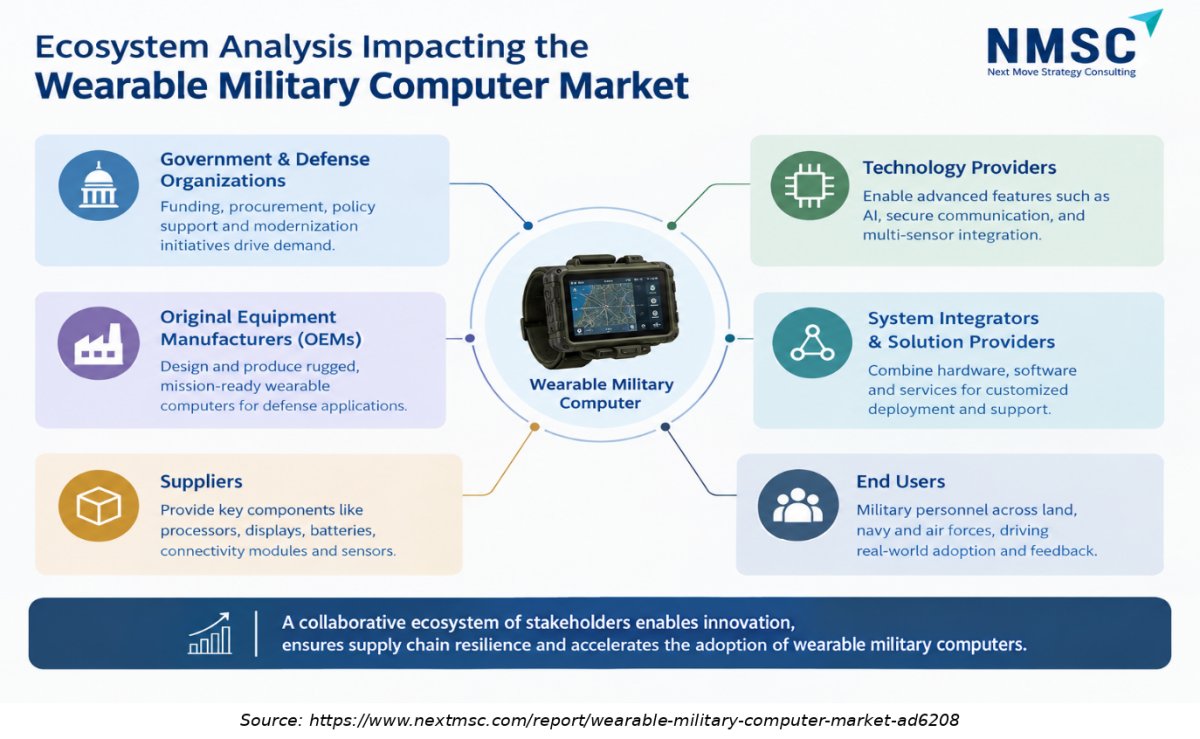
Ecosystem Analysis Impacting the Wearable Military Computer Market

The infographic highlights the key stakeholders shaping the Wearable Military Computer Market, including government and defense organizations, OEMs, component suppliers, technology providers, system integrators, and military end users. Their collaboration supports technological innovation, supply chain resilience, and the adoption of advanced wearable computing solutions for defense operations.

What Does the Wearable Military Computer Market Encompass?

The Wearable Military Computer Market covers computing hardware, embedded software and integration services designed to be carried on the body of a dismounted soldier. Products include torso worn core computers, helmet mounted compute and display systems, and wrist or chest mounted end user devices. NMSC excludes vehicle mounted systems and base level rugged military computers, which belong to adjacent segments, to avoid double counting across reports.

Programs have shifted from separate radios, hubs and phones toward single integrated systems. The U.S. Army moved Integrated Visual Augmentation System work into Soldier Borne Mission Command, while Germany expanded its IdZ ES soldier system to 353 platoon systems. Procurement authorities now demand open software architectures, lightweight batteries and secure networking, which shapes technology adoption and supplier selection across every region covered in this analysis.

Market Drivers & Dynamics

Interactive Dataset
Record defense budgets and rearmament driver +3.1% Europe, North America, Asia-Pacific 2026–2035
National soldier system programs driver +2.8% North America, Europe 2026–2032
Edge AI and sensor fusion demand driver +2.2% Global 2026–2035
Drone and robot control from the soldier driver +1.4% North America, Asia-Pacific, Middle East 2027–2035
Program cancellations and prototype volatility restraint −1.9% North America 2026–2028
Soldier comfort, weight and battery limits restraint −1.5% Global 2026–2031
Cybersecurity and electromagnetic signature risk restraint −1.1% Global 2026–2035
Export controls and sovereign sourcing rules restraint −0.8% Middle East, Asia-Pacific 2026–2035
Source: Next Move Strategy Consulting

Growth Drivers

What is the primary growth driver of the Wearable Military Computer Market?

The primary driver is recording defense spending. World military expenditure reached $2,887 billion in 2025, up 2.9% in real terms, and European spending rose 14% to $864 billion. Our findings suggest that governments direct part of this money to soldier modernization because dismounted forces remain the largest and least digitized element of land power. Each new platoon system carries a computing core, which converts budget growth into recurring demand for wearable hardware and software.

How is soldier system modernization driving the Wearable Military Computer Market growth?
Germany called off systems for a further 8,600 soldiers in April 2026, bringing the Bundeswehr to 353 platoon systems and more than 12,000 individual kits under a framework worth up to €3.1 billion gross. Rheinmetall coordinates more than 30 subcontractors for this work. Our assessment indicates that multiyear framework contracts give suppliers revenue visibility, which supports investment in lighter computers and open interfaces that later programs can reuse.

Growth Inhibitors

What is restraining the Wearable Military Computer Market?

Program volatility is the main restraint. As of July 2026, the Army had determined that none of the 10,000 developed IVAS units will be fielded, and IVAS 1.2 moved into a rapid prototyping effort. The earlier contract was transferred from Microsoft to Anduril in April 2025. We found that this outcome shows how comfort, weight and cost can strand large budgets, so buyers now prefer staged prototypes before committing to volume production.

What Are the Growth Opportunities?

How can power and battery innovation unlock new demand?

Power remains the limiting factor for every soldier worn system. Lighter conformable batteries reduce carried weight and extend mission duration, which improves acceptance by infantry units. Suppliers that integrate flexible batteries with core computers and power distribution hubs can capture content per soldier that is currently split across several vendors. The main beneficiary segment is body worn core computers, which carry the highest power draw.

Where do export programs open new demand?

Allied armies in Europe and Asia Pacific are launching soldier system programs and often prefer modular offers that start with computing or optics and expand later. Safran Electronics & Defense Australasia teamed with BAE Systems Australia and Nova Systems for the Australian next generation soldier system. Vendors that pair computers with local industry partners can win first phase orders. The main beneficiary segment is integration and support services, growing at 17.2% CAGR.

How will training and software upgrades create recurring revenue?

Soldier computers are becoming software platforms that receive frequent applications, maps and AI models. Training modes that reuse the same interface let units rehearse missions on the equipment they will carry in combat. Vendors can monetize human machine interface upgrades, security patches and mission applications through multiyear support contracts. The main beneficiary segment is software, which grows at 17.3% CAGR as armies shift budgets toward sustainment.

Segmentation Analysis

2025 (USD Million)
2035 (USD Million)
Body worn core computers 2025: $535.6 Million | 2035: $1,619.5 Million
Body worn co
Head mounted display computing systems 2025: $267.8 Million | 2035: $1,303.5 Million
Head mounted
Wrist and chest mounted end user devices 2025: $326.6 Million | 2035: $1,027.0 Million
Wrist and ch
Body worn core computers $535.6 Million $1,619.5 Million 11.7%
Head mounted display computing systems $267.8 Million $1,303.5 Million 16.5%
Wrist and chest mounted end user devices $326.6 Million $1,027.0 Million 12.3%

Which product type leads the wearable military computer Market segmentation?

Body worn core computers led with USD 535.62 Million in 2025 and will reach USD 1,619.50 Million by 2035. Head mounted display computing systems are the fastest growing at 16.5% CAGR, reaching USD 1,303.50 Million. Army awards of $159 million to Anduril and $120.5 million to Elbit America for Soldier Borne Mission Command prototypes support this momentum, and head mounted displays will carry compute payloads as optics, batteries and thermal design mature.

2025 (USD Million)
2035 (USD Million)
Situational
Command
control and
Targeting an
Training and
Segment Item 2025 (USD Million) 2035 (USD Million) CAGR
Situational awareness and navigation $10.0 USD Million $40.0 USD Million 15.0%
Command $17.1 USD Million $51.1 USD Million 21.0%
control and communications $24.2 USD Million $62.2 USD Million 11.0%
Targeting and sensor fusion $31.3 USD Million $73.3 USD Million 21.0%
Training and simulation $38.4 USD Million $84.4 USD Million 14.0%

Segment-wise data is locked

Unlock complete segment-wise numbers for By Application.

Unlock Full Data
2025 (USD Million)
2035 (USD Million)
Hardware
Software
Integration
Segment Item 2025 (USD Million) 2035 (USD Million) CAGR
Hardware $10.0 USD Million $40.0 USD Million 27.0%
Software $17.1 USD Million $51.1 USD Million 17.0%
Integration and support services $24.2 USD Million $62.2 USD Million 15.0%

Segment-wise data is locked

Unlock complete segment-wise numbers for By Component.

Unlock Full Data
2025 (USD Million)
2035 (USD Million)
North Americ
U.S.
Canada
Mexico
Europe
Segment Item 2025 (USD Million) 2035 (USD Million) CAGR
North America $10.0 USD Million $40.0 USD Million 25.0%
U.S. $17.1 USD Million $51.1 USD Million 19.0%
Canada $24.2 USD Million $62.2 USD Million 17.0%
Mexico $31.3 USD Million $73.3 USD Million 15.0%
Europe $38.4 USD Million $84.4 USD Million 16.0%

Segment-wise data is locked

Unlock complete segment-wise numbers for By Region.

Unlock Full Data

Growth Opportunities

Our assessment indicates that three opportunity pools offer the clearest returns through 2035.

How can power and battery innovation unlock new demand?

Power remains the limiting factor for every soldier worn system. Lighter conformable batteries reduce carried weight and extend mission duration, which improves acceptance by infantry units. Suppliers that integrate flexible batteries with core computers and power distribution hubs can capture content per soldier that is currently split across several vendors. The main beneficiary segment is body worn core computers, which carry the highest power draw.

Where do export programs open new demand?

Allied armies in Europe and Asia Pacific are launching soldier system programs and often prefer modular offers that start with computing or optics and expand later. Safran Electronics & Defense Australasia teamed with BAE Systems Australia and Nova Systems for the Australian next generation soldier system. Vendors that pair computers with local industry partners can win first phase orders. The main beneficiary segment is integration and support services, growing at 17.2% CAGR.

How will training and software upgrades create recurring revenue?

Soldier computers are becoming software platforms that receive frequent applications, maps and AI models. Training modes that reuse the same interface let units rehearse missions on the equipment they will carry in combat. Vendors can monetize human machine interface upgrades, security patches and mission applications through multiyear support contracts. The main beneficiary segment is software, which grows at 17.3% CAGR as armies shift budgets toward sustainment.

Regional Outlook

2025 (USD Million)
2035 (USD Million)
North Americ
Europe
Asia-Pacific
Middle East
Latin Americ
Region 2025 (USD Million) 2035 (USD Million) CAGR (%)
North America $10.0 USD Million $40.0 USD Million 9.0%
Europe $17.1 USD Million $51.1 USD Million 27.0%
Asia-Pacific $24.2 USD Million $62.2 USD Million 25.0%
Middle East & Africa $31.3 USD Million $73.3 USD Million 23.0%
Latin America $38.4 USD Million $84.4 USD Million 12.0%

Regional data is locked

Unlock complete regional numbers for this market.

Unlock Full Data

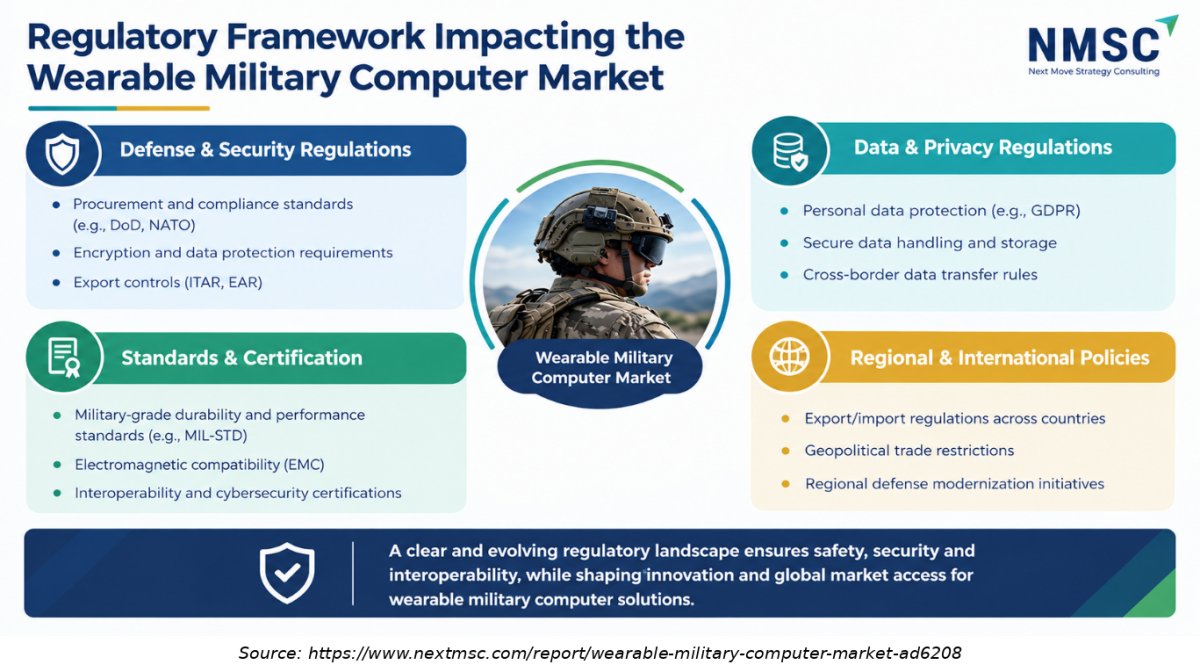
Regulatory Framework Impacting the Wearable Military Computer Market
The infographic highlights the key regulations and standards impacting the Wearable Military Computer Market, including military equipment certification, cybersecurity requirements, data protection, and export control policies. These regulatory frameworks help ensure product reliability, secure communication, operational safety, and compliance with defense requirements across global markets.

Competitive Landscape

NMSC's analysis indicates that competition centers on program awards rather than catalogue sales.

How do companies compete in the wearable military computer industry?

Companies compete through national program positions, software ecosystems and integration depth. Rheinmetall relies on its role as general contractor for German soldier systems, while Anduril builds a partner team around its Lattice platform. Elbit America leverages its see-through display and night vision heritage. Our findings suggest that buyers weigh weight, power and openness above unit price, which shapes the military computer market supply chain.

Which archetypes dominate the market?

Three archetypes dominate. National prime integrators such as Rheinmetall and Safran supply complete soldier systems to home armies. Technology entrants such as Anduril win through software and rapid prototyping. Specialist hardware suppliers such as General Micro Systems sell compact computers into larger programs. Differentiation themes include system openness, battery efficiency, sensor integration and sovereign supply, and each archetype pursues a different mix of these themes.

How do firms differentiate through innovation?

Innovation focuses on reducing size, weight and power while adding AI processing. General Micro Systems packs eight interface legs and optional GPU acceleration in a computer under three pounds. Leonardo DRS introduced its THOR chassis for vehicles in 2026, and embedded military computers of this kind set performance benchmarks that wearable suppliers aim to approach. Pricing strategies increasingly bundle hardware with software subscriptions and support.

What is the level of M&A and partnership activity?

Acquisition activity is limited, but contract and partnership moves are significant. In April 2025 the Army reportedly approved a novation that moved the Microsoft IVAS contract to Anduril. Anduril then assembled a software team with Palantir, L3Harris, Persistent Systems and others. Geographic expansion follows similar teaming, such as Safran with BAE Systems Australia. We found that partnerships offer faster market entry than outright acquisitions in this field.

Key Market Players

Our analysis shows that the verified supplier set is concentrated among soldier system integrators and specialist computing firms.

Rheinmetall AG Anduril Industries, Inc. Elbit Systems Ltd. Safran SA General Micro Systems, Inc.

Latest Developments

We observed that program decisions in 2025 and 2026 reshaped the supplier landscape.

Date Event
October 2025 GMS announced the X7 RAPTOR, a compact open-standard rugged mission computer aimed at wearables, manpacks, portable platforms, and high-volume uncrewed systems
September 2025 Anduril won a $159 million U.S. Army contract for an initial prototyping period under Soldier Borne Mission Command, formerly IVAS Next
February 2025 Rheinmetall secured a Bundeswehr framework contract worth up to €3.1 billion through 2030 for as many as 368 IdZ-ES platoon systems, with an initial firm order valued at about €417 million including VAT

Expert Insights

Lt. Col. Denny Dresch

Product Manager, Integrated Visual Augmentation System (IVAS) | U.S. Army

"[IVAS] complements what’s currently in the Army’s inventory while expanding close combat force capabilities by leveraging the digital architecture for shared awareness and computing at the edge."

Analyst Interpretation

The statement highlights the growing role of wearable military computers in integrating real-time operational information into soldiers' equipment. Edge computing and augmented-reality displays can support access to navigation data, sensor intelligence, and battlefield information without requiring soldiers to rely exclusively on separate devices. Moreover, the integration of wearable computing with existing military digital infrastructure creates opportunities for rugged processors, helmet-mounted displays, and tactical information systems. However, adoption will depend on system reliability, interoperability, battery performance, and suitability for combat environments.

Investment Opportunities

Where are capital inflows concentrating?

Capital is concentrated around funded soldier-modernization programs and multiyear framework contracts. Anduril announced a USD 159 million initial prototyping award for Soldier Borne Mission Command (SBMC) in September 2025, while Elbit America announced a separate USD 120.5 million development award in March 2026. These two awards total USD 279.50 Million; Rivet also announced a separate USD 195.00 Million SBMC agreement in 2025. In Germany, Rheinmetall holds an IdZ-ES framework contract worth up to EUR 3.1 billion gross. These programs may create opportunities for suppliers of rugged displays, batteries, secure networking and computing components. However, the contract values cover broader development or soldier-system requirements and should not be treated entirely as wearable-computer revenue. Multiyear procurement commitments can improve revenue visibility for suppliers, although actual revenue depends on contract execution and delivery schedules.

What infrastructure investment is required?

Suppliers need secure manufacturing, test ranges and software development environments that meet defense security rules. Rheinmetall already coordinates more than 30 subcontractors, which signals the scale of the supply chain involved. Investment in battery cells, ruggedized displays and thermal management capacity reduces delivery risk. Our analysis shows that capacity built for one national program can often serve allied customers with limited redesign.

How do ESG considerations affect investment?

ESG considerations center on soldier safety, responsible AI and supply chain integrity. Lighter computers and batteries reduce physical strain and logistics burdens, which improves soldier welfare. Governments expect human oversight of AI supported targeting, so suppliers must document how algorithms assist decisions. Responsible sourcing of battery materials and electronics is also becoming a contract requirement, and firms with transparent supply chains hold an advantage with institutional investors.

Key Benefits for Stakeholders

What do enterprise and industry leaders gain from this report?

Enterprise and industry leaders gain a segmented view of demand by product type, application and component, with forecasts to 2035. The report identifies where programs are funded, which segments grow fastest and how regional budgets differ. Leaders can use these insights to prioritize product roadmaps, choose teaming partners and plan capacity for programs such as IdZ ES and Soldier Borne Mission Command.

What do investors and financial analysts gain from this report?

Investors and financial analysts gain a reconciled forecast that shows how value shifts from hardware toward software and services. The analysis highlights program risk, including the IVAS fielding outcome, and separates stable framework contracts from prototype stage awards. These insights support valuation work, portfolio screening and timing decisions for suppliers exposed to soldier modernization budgets across North America, Europe and Asia-Pacific.

What do technology vendors and product teams gain from this report?

Technology vendors and product teams gain evidence on weight, power and openness requirements that decide awards. The report shows demand for sensor fusion, edge AI and control of unmanned systems, including military robots that work alongside dismounted units. Product teams can align interfaces with open architectures, target the fastest growing segments and design software roadmaps that match buyer sustainment plans.

Key Market Segments Evaluated

By Product Type

  • Body worn core computers
  • Head mounted display computing systems
  • Wrist and chest mounted end user devices

By Application

  • Situational awareness and navigation
  • Command, control and communications
  • Targeting and sensor fusion
  • Training and simulation

By Component

  • Hardware
  • Software
  • Integration and support services

By Region

  • North America 
    • U.S.
    • Canada
    • Mexico
  • Europe 
    • UK
    • Germany
    • France
    • Italy
    • Spain
    • Sweden
    • Denmark
    • Finland
    • Netherlands
    • Rest of Europe
  • Asia-Pacific 
    • China
    • India
    • Japan
    • South Korea
    • Taiwan
    • Indonesia
    • Vietnam
    • Australia
    • Philippines
    • Malaysia
    • Rest of APAC
  • Middle East & Africa 
    • Saudi Arabia
    • UAE
    • Egypt
    • Israel
    • Turkey
    • Nigeria
    • South Africa
    • Rest of MEA
  • Latin America 
    • Brazil
    • Argentina
    • Chile
    • Colombia
    • Rest of LATAM

Conclusion & Recommendations

The market is positioned to grow from USD 1,290.00 Million in 2026 to USD 3,950.00 Million in 2035 as armies convert prototypes into fielded systems. Growth rests on funded programs in Germany and the United States, and on rising budgets worldwide. Rising interest in AI in military anddefense applications reinforce demand for compute at the soldier level, although the pace will vary by country and by program maturity.

What Strategic Positioning Recommendations Does NMSC Offer?

NMSC recommends that suppliers anchor positions in funded national programs while building open software that other armies can adopt. Partnerships with integrators and battery specialists reduce technical risk and speed entry. Vendors should design for lower weight and power from the start, document cybersecurity controls early and offer staged delivery models that fit prototype first procurement practices increasingly used by large buyers.

How Attractive Is the Wearable Military Computer Market for Investment?
Investment attractiveness is high but selective. The forecast CAGR of 13.2% exceeds many defense electronics segments, and framework contracts add visibility. Software and services, expanding at more than 17% CAGR, offer better margins than hardware. Investors should Favor suppliers with committed program positions, diversified customers and credible roadmaps, and should discount companies that depend on a single unproven prototype award.

What Are the Key Market Shifts and Risks in the Wearable Military Computer Market?

Key shifts include a move from devices to integrated software platforms and from single vendor to partner team delivery. Main risks are program cancellations, as the IVAS outcome showed, and soldier acceptance issues such as comfort and weight. Defensecybersecurity and electromagnetic signature management add engineering burden, and export controls may fragment demand across allied buyers.

What Are the Primary Growth Pathways Through 2035?

Growth pathways include fielding of head mounted systems, which expand at 16.5% CAGR, and wider use of targeting and sensor fusion applications. Asia-Pacific offers the fastest regional growth at 16.5% CAGR, while Europe adds firm volume through IdZ ES deliveries. Recurring software and support contracts will turn fielded hardware into long term revenue streams.

FAQs

Sources & References

1.

Congressional Research Service, Army's IVAS/SBMC (IF13022)

congress.gov/crs-product/IF13022
2.

SIPRI, World Military Expenditure 2025 press release

sipri.org
3.

SIPRI, Military Expenditure 2025 fact sheet

sipri.org
4.

Anduril Industries, SBMC contract announcement

anduril.com
5.

Elbit Systems, Elbit America SBMC award

elbitsystems.com
6.

Elbit America, SBMC award announcement

elbitamerica.com
7.

Rheinmetall AG, IdZ ES call off press release

rheinmetall.com
8.

Safran, soldier systems expertise

safran-group.com
9.

General Micro Systems, X9 Spider Wearable launch

businesswire.com
10.

Leonardo DRS, THOR announcement

investors.leonardodrs.com

About the Author

Mayurima Roy

Mayurima Roy

Mayurima Roy is Research Analyst at Next Move Strategy Consulting, where she has spent 4 years working across the firm's full industry coverage rather than a single fixed vertical. Her work centers on structured research, ongoing trend tracking, competitive assessment, and insight-led content development, translating complex market data into clear, decision-ready narratives that support informed client decision-making across diverse global industries, market sectors, and world regions every day.

About the Reviewer

Supradip Baul

Supradip Baul

Supradip Baul is an accomplished business consultant and strategist with over a decade of rich experience in market intelligence, strategy, technology, and business transformation. His work has included rigorous qualitative and quantitative analysis across multiple industries, helping clients shape investment decisions and long-term roadmaps. Earlier in his career, he was associated with Gartner, where he contributed to industry-leading reports and market share analyses. He has worked with leading global companies and holds an MBA with a dual specialization in Marketing and Finance.

Download Free Sample

Kishu Kanda

KISHU KANDA

Strategy Analyst

Accenture

We purchased the AI Consumer Market Report from this company. Not only did they customize the report to meet our specific requirements, but they also showed great flexibility in accommodating our budget. The report we received fully met our expectations. Additionally, they provided prompt and thorough responses to both our pre-purchase and follow-up questions. We look forward to working with this company again in the future.

Gustaf Hummel Burstrom

GUSTAF HUMMEL BURSTROM

Founder

Revline Tools AB

Joseph and the team at Next Move Strategy Consulting have been excellent to work with, in supplying us with relevant market data and forecasts for our specific category. We had some special requirements and they were able to do a custom package to suit our needs. We would definitely recommend them to any other company needing market data and forecasts

Ross J Mckenzie

ROSS J MCKENZIE

Business Insight Manager

Staysure Group

“Next MSC have been incredibly helpful in providing detailed & robust information on our market, alongside quantifying growth by different segments. The process to procure was simple and easy, with sample reports and regular contact to ensure we had what we needed. Succinct detail on their sources & methodologies is also greatly received, allowing transparency in this respect helps build trust in the detail you pay for. Joseph in particular was fantastic, and helped ensure efficient provision of the insight pack – thank you NMSC!”.

Gaurav Jaiswal

GAURAV JAISWAL

Founder & CEO

Yano Charge Private Limited

The EV Charging market research report provided by the NextMSC was exceptionally detailed and insightful. It offered a comprehensive analysis that proved to be a game-changer for our strategic planning. Truly a testament to the NextMSC’s expertise and thoroughness in EV market landscape & analysis.

Rishabh Jogani

RISHABH JOGANI

Strategy Analyst

Accenture Japan

We are incredibly impressed with the market report on the real estate market in India provided by Next Move Strategy Consulting. The report was thorough, insightful, and well-structured, offering deep analysis and actionable recommendations. It not only captured the current trends and dynamics but also provided a forward-looking perspective that has been invaluable for our strategic planning. Their team demonstrated exceptional professionalism, attention to detail, and a profound understanding of the industry. The data-driven insights and clarity of presentation exceeded our expectations, making complex market trends easy to understand. We highly recommend Next Move Strategy Consulting to anyone looking for reliable and comprehensive market research services. Their expertise has given us the confidence to navigate the complexities of the Indian real estate market with clarity and foresight.

Custom Market Research Services

We will customize the research for you if the listed report does not fully match your requirements.

Get 30% Free Customization

Select License

This website uses cookies to ensure you get the best experience on our website. Learn more

✖