ChatGPT’s Try on Button Moves Virtual Fitting Rooms into the Mainstream
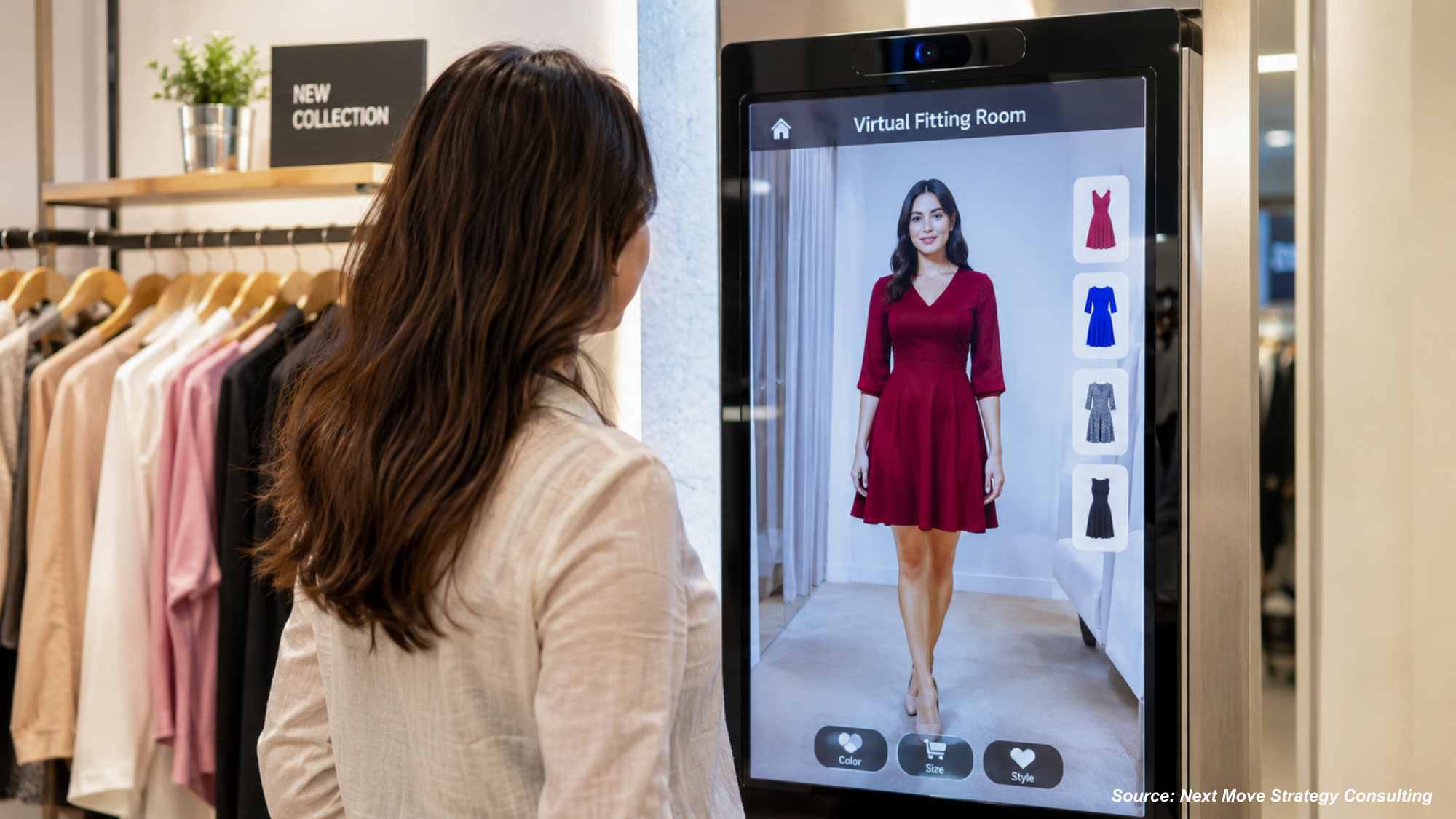
OpenAI’s 1 October Try On Launch, Tesco’s In-Store AIUTA Trial and CATCHES’ Retailer Debut Move Virtual Fitting Rooms From Vendor Pilots Toward Platform Infrastructure
On 1 October 2026, OpenAI announced the global launch of a Try On button inside ChatGPT’s shopping results, letting users upload a selfie or full-body photo and see clothing and accessories rendered on themselves, TechCrunch reported the same day in ChatGPT can now virtually try on clothes for you. The feature runs on OpenAI’s ChatGPT Images 2.5 model and arrived with a Favorites library that stores saved products next to the generated try-on images. Retail Dive, in its 9 October 2026 brief Virtual try on launches on ChatGPT, confirmed that both features are available on ChatGPT’s website and mobile app. TechCrunch noted that OpenAI had already pivoted once in shopping, after an instant checkout feature failed to perform, and that Google launched its own virtual try-on in 2025.
According to Next Move Strategy Consulting’s Virtual Fitting Room Market report, the global virtual fitting room market was valued at USD 1.40 billion in 2025 and is projected to reach USD 11.70 billion by 2035, growing at a CAGR of 23.3% from 2026 to 2035. NextMSC primary research and analysis places 2026 revenue at USD 1.78 billion and attributes the trajectory to rising online return costs and to advances in generative AI try-on technology. The same research projects an absolute revenue gain of USD 9.92 billion between 2026 and 2035.
For More Information: Download FREE Sample on Virtual Fitting Room Market Report
The Financial Logic: Returns Data Meets Cheaper Image Generation
The commercial case rests on returns. The National Retail Federation and Happy Returns, in their 2025 Retail Returns Landscape report released on 15 October 2025, projected total U.S. retail returns of USD 849.9 billion, equal to 15.8% of annual sales, against 16.9% and USD 890 billion in 2024. Returns concentrate online: the report found that 19.3% of online sales are expected to be returned in 2025, and retailers surveyed named increasing online sales and reducing return rates as their top priorities for 2026. NextMSC primary research and analysis links that data to try-on spending through a specific mechanism: apparel and footwear carry fit-related returns that merchants can influence directly, so each avoided return converts into saved freight, handling and markdown cost, which is why finance leaders now sponsor try-on pilots.
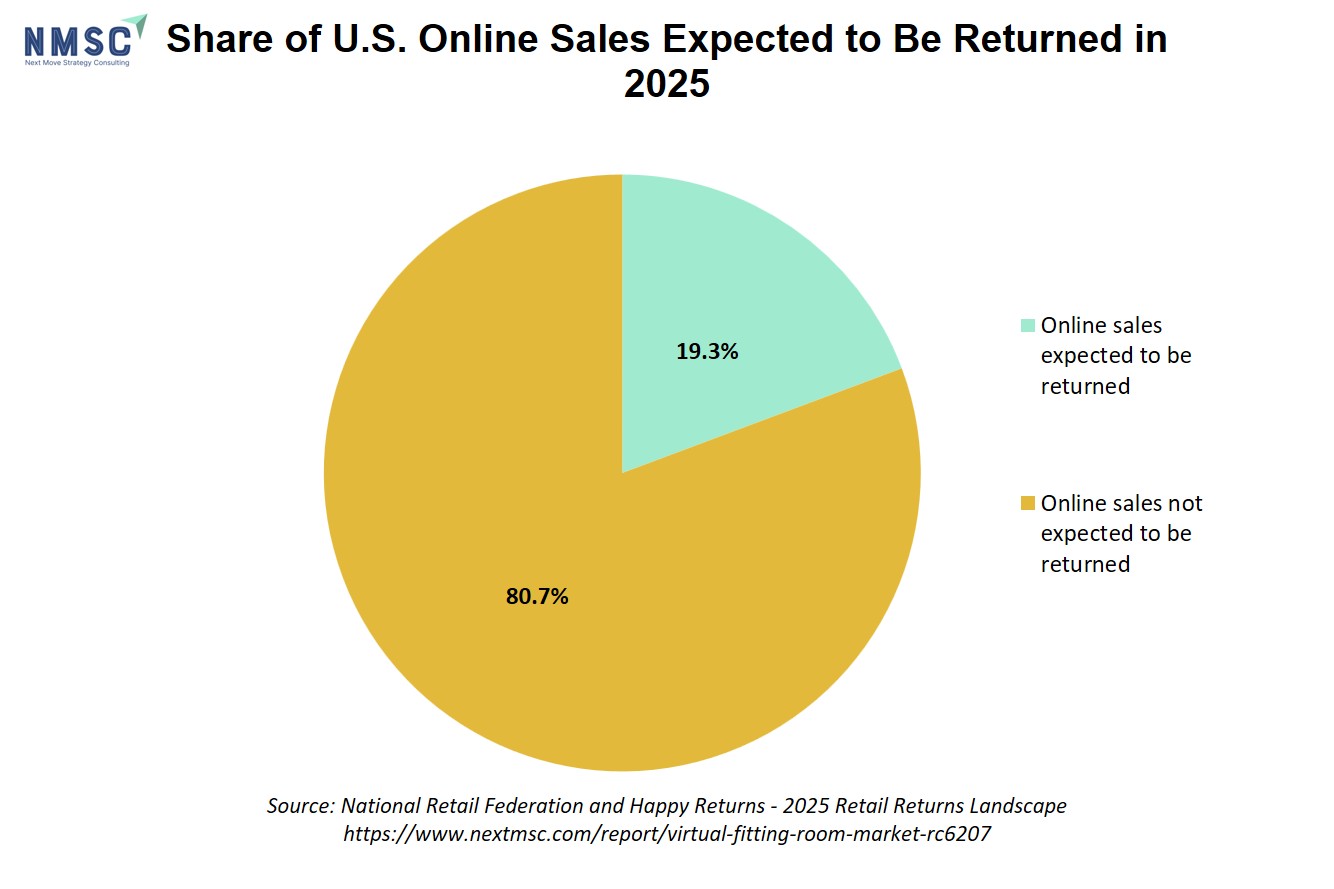
The National Retail Federation and Happy Returns report that retailers expect 19.3% of online sales to be returned in 2025, against 15.8% of total retail sales. The remaining 80.7% is the portion of online sales not expected to be returned, calculated as 100% minus the reported return rate.
Generative image models change the other side of the equation. TechCrunch reported that OpenAI’s try-on feature is built on ChatGPT Images 2.5, which the company says produces more natural lighting and richer textures and reduces image generation latency. Retail Dive traced the wider sequence: Google debuted a try-on tool for women’s tops in 2023, extended it to dresses in 2024 and to shoes in 2025, so OpenAI’s launch brings ChatGPT level with product visualization features that Google added in annual steps. NextMSC primary research and analysis indicates that cheaper image generation widens the range of retailers that can afford try-on, because mid-sized retailers can adopt hosted image services without digitizing every garment as a 3D asset, while vendors that depend on bespoke 3D content face pricing pressure.
Key Industry Developments: Four Announcements in Five Weeks
In September 2026, Tesco began trialling virtual try-on for its F&F clothing range at its Sandhurst Extra store, using a digital screen supplied by AIUTA, according to Retail Technology Innovation Hub’s article Tesco teams with AIUTA to test virtual try-on technology for F&F clothing in Sandhurst Extra store. Shoppers can take or upload a photograph to view around 1,500 F&F menswear and womenswear items, or select a digital model to see garments in different sizes, and the screen sits alongside new changing rooms and a service hub for checkout and returns. The Industry reported on 25 September 2026 that the trial is limited to the Sandhurst Extra store and is designed to explore how technology can help customers feel more confident before making a purchase, and that F&F clothing sales rose 5.1% to more than GBP 1.2 billion in the year to February 2026.
In October 2026, CATCHES opened its sizing and virtual try-on technology to retailers for the first time, launching PredictiveFit at NVIDIA GTC Berlin, with THE OUTNET going live as the first retailer from 21 October 2026, according to CATCHES’ 22 October 2026 Business Wire release. PredictiveFit builds photorealistic try-on visuals from the product data that retailers already hold. The same release reported first performance results from RealFit on the AMIRI website, six months after the technology debuted at NVIDIA GTC San Jose in March 2026, and its headline states that RealFit lifted AMIRI’s online conversion by 55%, a result reported by CATCHES for a single luxury brand.
On 28 October 2026, AIUTA introduced Flash, a virtual try-on model that generates looks in as little as 2 seconds and can visualize a single item or a complete outfit of up to five pieces from a shopper’s photo, according to the company’s release AIUTA Launches the Fastest Virtual Try-On on the Market. AIUTA states that results arrive in 2 to 3 seconds under normal load, excluding photo upload and delivery time, and positions the speed as a way to keep shoppers exploring a retailer’s collection while they are still engaged.
“the result needs to arrive while the shopper still wants to see it.”
- Maísa Benatti, CEO, AIUTA, AIUTA press release, AIUTA Launches the Fastest Virtual Try-On on the Market (EIN Presswire), 28 October 2026.
Four Try-On Developments, September to October 2026
|
Date |
Development |
Detail |
|
September 2026 |
Tesco trials AIUTA virtual try-on in-store at Sandhurst Extra |
Around 1,500 F&F menswear and womenswear items; trial limited to one store |
|
1 October 2026 |
OpenAI launches Try On in ChatGPT shopping results |
Global launch on web and mobile; runs on ChatGPT Images 2.5; Favorites library added |
|
21 to 22 October 2026 |
CATCHES opens PredictiveFit to retailers; THE OUTNET first to go live |
Launched at NVIDIA GTC Berlin; CATCHES reports a 55% online conversion lift for RealFit at AMIRI |
|
28 October 2026 |
AIUTA introduces Flash |
Looks in as little as 2 seconds; outfits of up to five pieces from one shopper photo |
Segment Dynamics: Generative AI Closes on Augmented Reality
NextMSC primary research and analysis shows global revenue compounding from USD 1.40 billion in 2025 to USD 11.70 billion by 2035, with annual revenue passing USD 4 billion in 2030 (USD 4.11 billion) and USD 9 billion in 2034 (USD 9.51 billion).
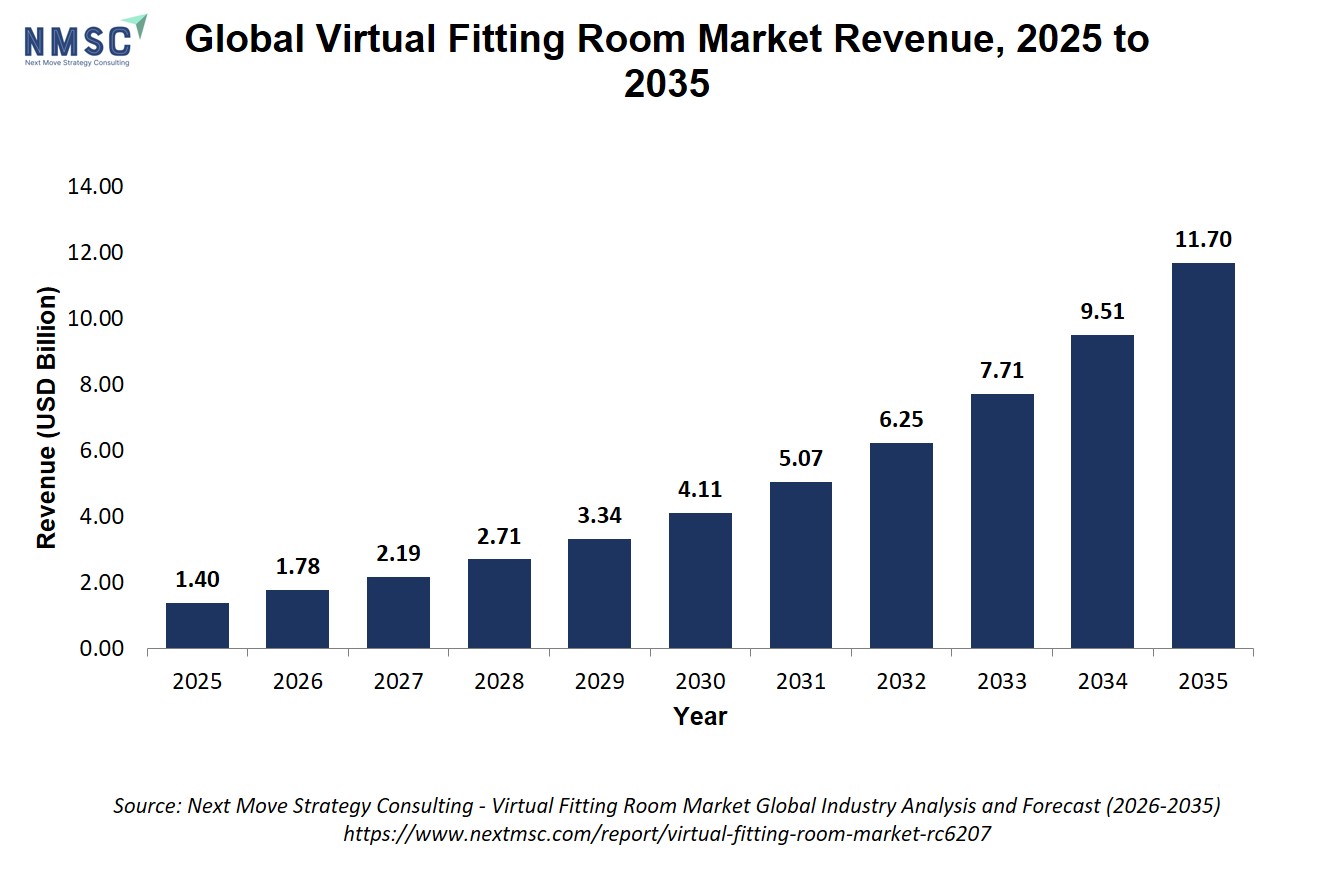
The chart plots NextMSC primary research and analysis for global virtual fitting room revenue, with 2025 as the base year and 2026 to 2035 as forecast values.
According to NextMSC primary research and analysis, augmented reality try-on remains the largest technology segment, at USD 0.74 billion in 2026 and about 42% of technology revenue, supported by footwear, eyewear and jewellery tools that run on a phone camera. Generative AI try-on is the fastest-growing segment at a 28.1% CAGR from 2026 to 2035, rising from USD 0.42 billion in 2025 to USD 5.75 billion by 2035, which on NextMSC’s figures puts it ahead of both 3D avatar and body scanning (USD 3.05 billion) and augmented reality try-on (USD 2.90 billion) at the end of the forecast period.
Virtual Fitting Room Market by Technology, 2025 and 2035
|
Technology Segment |
2025 (USD Billion) |
2035 (USD Billion) |
CAGR 2026-2035 |
|
Augmented reality try-on |
0.64 |
2.90 |
16.4% |
|
Generative AI try-on |
0.42 |
5.75 |
28.1% |
|
3D avatar and body scanning |
0.34 |
3.05 |
24.6% |
|
Total market |
1.40 |
11.70 |
23.3% |
By channel, NextMSC primary research and analysis shows online as the largest, expanding from USD 1.20 billion in 2025 to USD 9.45 billion by 2035, while in-store deployment is the fastest-growing channel at a 27.7% CAGR, the channel in which the Tesco trial sits. By application, apparel is the largest, growing from USD 0.82 billion in 2025 to USD 6.60 billion by 2035, while accessories is the fastest-growing at 25.7%.
Regional Outlook
North America is the largest region, with USD 0.66 billion and a 37% share of 2026 revenue, according to NextMSC primary research and analysis, and the U.S. contributes about USD 0.56 billion of that base. High return costs, strong smartphone penetration and early platform launches support adoption, while state privacy laws shape consent design. NextMSC projects the region to grow at a 21.8% CAGR from 2026 to 2035 as retailers move from pilots to catalogue-wide deployment.
Asia-Pacific is the fastest-growing region at a 25.9% CAGR, rising from USD 0.54 billion in 2026 to USD 4.30 billion by 2035, a path that NextMSC primary research and analysis expects to carry the region past North America, at USD 3.90 billion in 2035, before the forecast ends. India is the fastest-growing country at a 29.2% CAGR, from USD 0.03 billion in 2025 to USD 0.50 billion by 2035, as smartphone growth and a young shopper base lift online fashion sales. In Europe, which NextMSC projects at USD 2.65 billion by 2035 on a 21.5% CAGR, the European Union AI Act raises documentation duties for biometric systems, which slows small vendors and favours established platforms.
Virtual Fitting Room Market by Region, 2025 and 2035
|
Region |
2025 (USD Billion) |
2035 (USD Billion) |
CAGR 2026-2035 |
|
North America |
0.52 |
3.90 |
21.8% |
|
Europe |
0.36 |
2.65 |
21.5% |
|
Asia-Pacific |
0.42 |
4.30 |
25.9% |
|
Middle East & Africa |
0.04 |
0.35 |
24.1% |
|
Latin America |
0.06 |
0.50 |
24.4% |
|
Global |
1.40 |
11.70 |
23.3% |
Growth Drivers and Restraints
NextMSC primary research and analysis quantifies four drivers and three restraints by their effect on the market’s growth rate. Generative AI image models that lower content costs carry the largest positive effect, at +5.1% on CAGR through 2032, ahead of rising online return costs at +4.2% through 2035, while the biometric privacy and consent compliance burden is the largest drag, at -2.8% through 2031.
Virtual Fitting Room Market: Growth Catalyst and Risk Assessment Matrix
|
Factor |
Type |
Impact on CAGR |
Geography |
Timeline |
|
Rising online apparel return costs |
Driver |
+4.2% |
Global, led by North America and Europe |
2026-2035 |
|
Generative AI image models lowering content costs |
Driver |
+5.1% |
Global |
2026-2032 |
|
Retailer investment in omnichannel experiences |
Driver |
+2.6% |
North America, Europe, Asia-Pacific |
2026-2030 |
|
Smartphone camera and mobile commerce penetration |
Driver |
+3.0% |
Asia-Pacific, Latin America, Middle East & Africa |
2026-2035 |
|
Biometric privacy and consent compliance burden |
Restraint |
-2.8% |
North America, Europe |
2026-2031 |
|
Fit accuracy gaps for complex garments |
Restraint |
-2.2% |
Global |
2026-2030 |
|
Fragmented 3D garment digitization workflows |
Restraint |
-1.9% |
Global |
2026-2029 |
NMSC Strategic Perspective: Returns Economics, Not Novelty, Sets the Buying Case
NextMSC primary research and analysis identifies returns pressure rather than novelty as the main purchase trigger in this market, because merchants now judge virtual fitting room results by avoided shipments instead of shopper engagement. That reading is consistent with the announcements of September and October 2026: Tesco framed its trial around shopper confidence in-store, CATCHES led its October release with a conversion result, and AIUTA asked brands to judge speed and quality together. Each vendor is being asked for a measurable outcome, and NextMSC’s analysis indicates that vendors able to publish fit accuracy and return reduction results will hold pricing power.
The ChatGPT launch sharpens a risk that NextMSC primary research and analysis flags in this market: free platform features can cap pricing. When a general-purpose assistant adds try-on inside its shopping results, specialist vendors have to differentiate on depth of fit science, retailer catalogue integration and documented privacy practice rather than on image realism alone. NextMSC’s analysis indicates that vendors with proprietary body data, retailer integrations and documented privacy practice deserve the highest valuations, and that vendors with open interfaces can earn usage-based revenue from assistants run by retailers and platforms.
Regulation is the second variable. NextMSC primary research and analysis puts the combined drag of biometric privacy rules and fit accuracy gaps at about 5.0% of growth, so vendors that process images on the shopper’s device and publish short retention periods hold an advantage in North America and Europe, where consent duties are strictest.
For investors, NextMSC’s analysis points to usage-based revenue models as the favoured structure, because merchant spend scales with traffic and avoided returns, and to the USD 9.92 billion revenue gain between 2026 and 2035 as the pool that consolidation will contest. For retailers, NextMSC primary research and analysis recommends piloting in high-return categories, assigning a finance owner to track avoided shipments and negotiating usage-based pricing.
Competitive Landscape
NextMSC primary research and analysis profiles five companies in this market, listed in ranked order as Alphabet Inc., Walmart Inc., Amazon.com, Inc., Perfect Corp. and 3DLOOK, and identifies three archetypes: search and platform companies that compete on scale and distribution, retail groups that compete on first-party catalogues and shopper data, and independent vendors that compete on depth of fit science and brand services. Competition runs on realism, fit accuracy, catalogue coverage and integration speed, and pricing is shifting toward per-render and per-session fees that scale with merchant traffic.
The announcements of September and October 2026 show where each tier is moving. CATCHES went from a single luxury brand, AMIRI, in March 2026 to a retailer, THE OUTNET, in October 2026; AIUTA is competing on generation speed and invites brands to test it with their own products; and NextMSC’s analysis classes OpenAI’s entry within the first archetype, extending search and platform distribution to a general-purpose assistant. Retail Dive noted that retailers are already experimenting on that platform, citing David’s Bridal’s April 2026 launch on Shopify’s Agentic Storefronts for ChatGPT and Microsoft Copilot and Etsy’s May 2026 debut of its app on ChatGPT.
Bottom Line
The global virtual fitting room market is moving from vendor-led pilots to distribution through the largest consumer platforms and the largest store estates. OpenAI’s 1 October 2026 Try On launch in ChatGPT, Tesco’s in-store trial with AIUTA, CATCHES’ October opening to retailers and AIUTA’s 28 October Flash release arrived within five weeks of one another. According to Next Move Strategy Consulting, the market was valued at USD 1.40 billion in 2025 and is projected to reach USD 11.70 billion by 2035 at a CAGR of 23.3%, with generative AI try-on the fastest-growing technology at 28.1% and Asia-Pacific the fastest-growing region at 25.9%. The commercial anchor is returns: the National Retail Federation and Happy Returns report that 19.3% of online sales are expected to be returned in 2025. NextMSC primary research and analysis indicates that vendors able to document avoided returns, fit accuracy and privacy compliance will hold pricing power as platform features expand, while retailers should tie every pilot to a finance-owned return reduction target.
About Next Move Strategy Consulting
Next Move Strategy Consulting is a premier market research and management consulting firm that has been committed to provide strategically analysed well documented latest research reports to its clients. The research industry is flooded with many firms to choose from, what makes NMSC different from the rest is its top-quality research and the obsession of turning data into knowledge by dissecting every bit of it and providing fact-based research recommendation that is supported by information collected from over 500 million websites, paid databases, industry journals and one on one consultations with industry experts across a diverse range of industry sectors. The high-quality customized research reports with actionable insights and excellent end-to-end customer service help our clients to take critical business decisions that enables them to move beyond time and have competitive edge in the industry.
We have been servicing over 1000 customers globally that includes 90% of the Fortune 500 companies over a decade. Our analysts are constantly tracking various high growth markets and identifying hidden opportunities in each sector or the industry. We provide one of the industry’s best quality syndicate as well as custom research reports across 10 different industry verticals. We are committed to deliver high quality research solutions in accordance to your business needs. Our industry standard delivery solutions that ranges from the pre consultation to after-sales services, provide an excellent client experience and ensure right strategic decision making for businesses.
For more information, please contact:
Next Move Strategy Consulting
5th Floor 867 Boylston St, STE 500,
Boston, MA 02116, U.S.
E-Mail: [email protected]
Direct: +1-217-650-7991
Website: www.nextmsc.com
About the Author
 Sanyukta Deb
— Sanyukta Deb is Digital Marketing Team Lead at Next Move Strategy Consulting, where she has led content strategy and technical SEO for the firm's B2B market research publications for over 2 years. Her editorial process translates NextMSC's primary and secondary research — spanning technology, industrial, and consumer sectors — into commercial narratives, backed by search-intent, keyword, and competitive analysis. She brings 5 years of overall experience in digital marketing and content strategy.
About the Reviewer
 Debashree Dey
— Debashree Dey is Assistant Manager at Next Move Strategy Consulting, where she supports cross-vertical market content and communications across diverse industries for 6 years. Her professional background includes senior content writing, communications, and published manuscript authorship, with experience developing audience-focused business narratives and maintaining clear, consistent messaging. Her role supports research-led content development and editorial quality across NextMSC publications.

















Add Comment