Congo Advances Rubaya Tantalum Deal with U.S. Pact
Industry Insights from Next Move Strategy Consulting
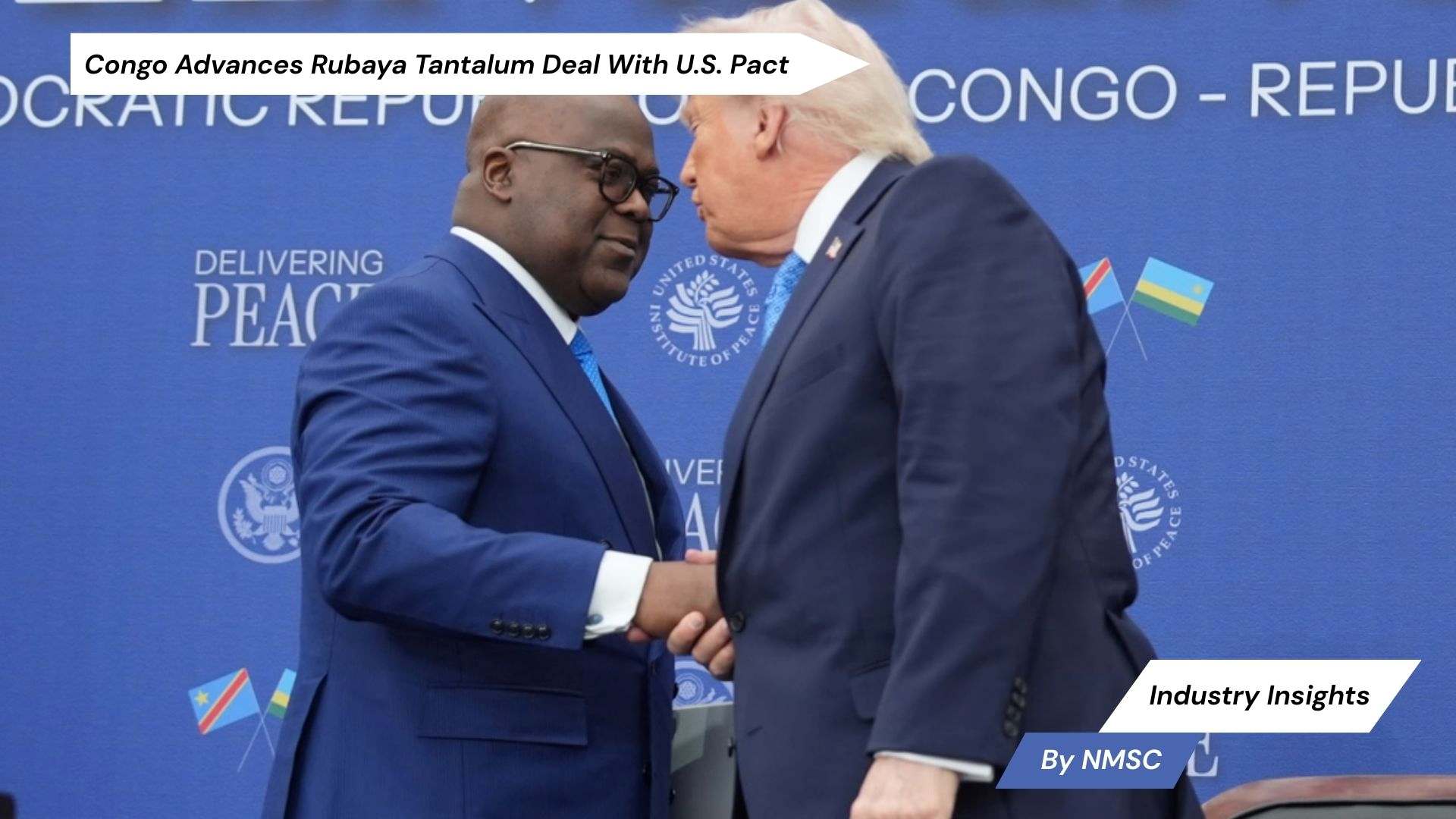
The Democratic Republic of Congo has formally included the Rubaya coltan mine, one of the world’s richest tantalum deposits, in a shortlist of strategic assets presented to the United States under a minerals cooperation framework, according to a government document reviewed by Reuters. The inclusion was confirmed by a senior Congolese official and a U.S. diplomat following a February 5 meeting in Washington designed to advance a strategic minerals partnership agreed in December. By adding Rubaya to the list, Kinshasa signals its intention to position tantalum at the forefront of its engagement with Washington, despite the complex security situation in eastern Congo.
Strategic Significance of Rubaya’s Tantalum Reserves
Located in North Kivu, Rubaya holds several thousand metric tons of coltan with tantalum concentrations ranging between 20% and 40%. The site accounts for around 15% of global coltan output, with all extraction conducted manually by local workers.
Tantalum, processed from coltan ore, is a heat-resistant metal used in semiconductors, aerospace components, computers, mobile phones, and gas turbines. The government document estimates that between $50 million and $150 million would be required to restart and scale commercial production at the mine, with rapid cost recovery anticipated due to strong global demand.
The document further indicates that Rubaya could provide a fully traceable, conflict-free tantalum supply aligned with U.S. procurement standards, an important factor as Washington seeks to expand access to critical minerals and reduce strategic vulnerabilities.
Control Challenges and Ongoing Conflict
Despite its strategic value, Rubaya remains under the control of the AFC/M23 rebel group. A United Nations report last year stated that organized smuggling networks linked to the occupation have routed coltan into Rwanda. The U.N. estimates that the group collects at least $800,000 per month from taxes on Rubaya’s coltan production and trade.
M23 and its political affiliate, the Congo River Alliance, are under U.S. sanctions and are not part of the December peace agreement between Congo and Rwanda brokered by U.S. President Donald Trump. Clashes continue despite the accord.
An AFC/M23 official stated that the group’s objective is not centered on mining assets but on broader political aims. The official also said that a private entity holds the mining title, suggesting that future disputes could arise regarding ownership and state control. The Congolese government did not immediately respond to requests for comment.
Preferential Access Under Strategic Asset Reserve
The U.S. State Department confirmed that Congo formally presented its initial Strategic Asset Reserve list during the February 5 meeting, though it did not disclose the specific assets. Under the framework agreement, eligible U.S. companies are to receive preferential access to approved projects, with the objective of promoting transparent investment, job creation, and long-term stability in the DRC.
Private-sector firms have been invited to request the asset list and signal interest in qualifying projects. Congo and several U.S. or allied companies have already signed initial supply agreements under the broader minerals security pact, although the document does not name the firms involved or confirm whether formal negotiations regarding Rubaya have begun.
Broader Strategic Assets Offered to U.S. Investors
In addition to Rubaya, Congo’s priority list for U.S. investors includes the Manono lithium deposit in Tanganyika, the Chemaf copper-cobalt complex in Haut-Katanga and Lualaba, the STL Germanium–Gallium expansion in Lubumbashi, three proposed cobalt refineries, hydro projects linked to Gecamines, Congo’s section of the Lobito rail corridor, and gold prospects such as Kibali South and Moku Beverendi.
Next Move Strategy Consulting’s View
The decision to include Rubaya in the U.S.–DRC minerals framework highlights the increasing strategic importance of tantalum within global supply chains. With Rubaya contributing a significant share of global coltan production, potential U.S. access could reshape procurement strategies and reinforce efforts to establish traceable and compliant sourcing channels. However, the mine’s current control by sanctioned rebels introduces operational and geopolitical uncertainties that may influence investment timelines. While demand fundamentals appear supportive, execution will depend on developments in regional security and governance.
As global competition for critical minerals intensifies, the positioning of Rubaya within the U.S.–DRC partnership underscores the intersection of resource diplomacy, security considerations, and long-term supply chain strategy in the tantalum market.
Source: MSN
Prepared by: Next Move Strategy Consulting
About the Author
 Sanyukta Deb
— Sanyukta Deb is Digital Marketing Team Lead at Next Move Strategy Consulting, where she has led content strategy and technical SEO for the firm's B2B market research publications for over 2 years. Her editorial process translates NextMSC's primary and secondary research — spanning technology, industrial, and consumer sectors — into commercial narratives, backed by search-intent, keyword, and competitive analysis. She brings 5 years of overall experience in digital marketing and content strategy.
Sanyukta Deb
— Sanyukta Deb is Digital Marketing Team Lead at Next Move Strategy Consulting, where she has led content strategy and technical SEO for the firm's B2B market research publications for over 2 years. Her editorial process translates NextMSC's primary and secondary research — spanning technology, industrial, and consumer sectors — into commercial narratives, backed by search-intent, keyword, and competitive analysis. She brings 5 years of overall experience in digital marketing and content strategy.
About the Reviewer
 Debashree Dey
— Debashree Dey is Assistant Manager at Next Move Strategy Consulting, where she supports cross-vertical market content and communications across diverse industries for 6 years. Her professional background includes senior content writing, communications, and published manuscript authorship, with experience developing audience-focused business narratives and maintaining clear, consistent messaging. Her role supports research-led content development and editorial quality across NextMSC publications.
Debashree Dey
— Debashree Dey is Assistant Manager at Next Move Strategy Consulting, where she supports cross-vertical market content and communications across diverse industries for 6 years. Her professional background includes senior content writing, communications, and published manuscript authorship, with experience developing audience-focused business narratives and maintaining clear, consistent messaging. Her role supports research-led content development and editorial quality across NextMSC publications.
















Add Comment