Corrugated Packaging Market Trends Update 2026
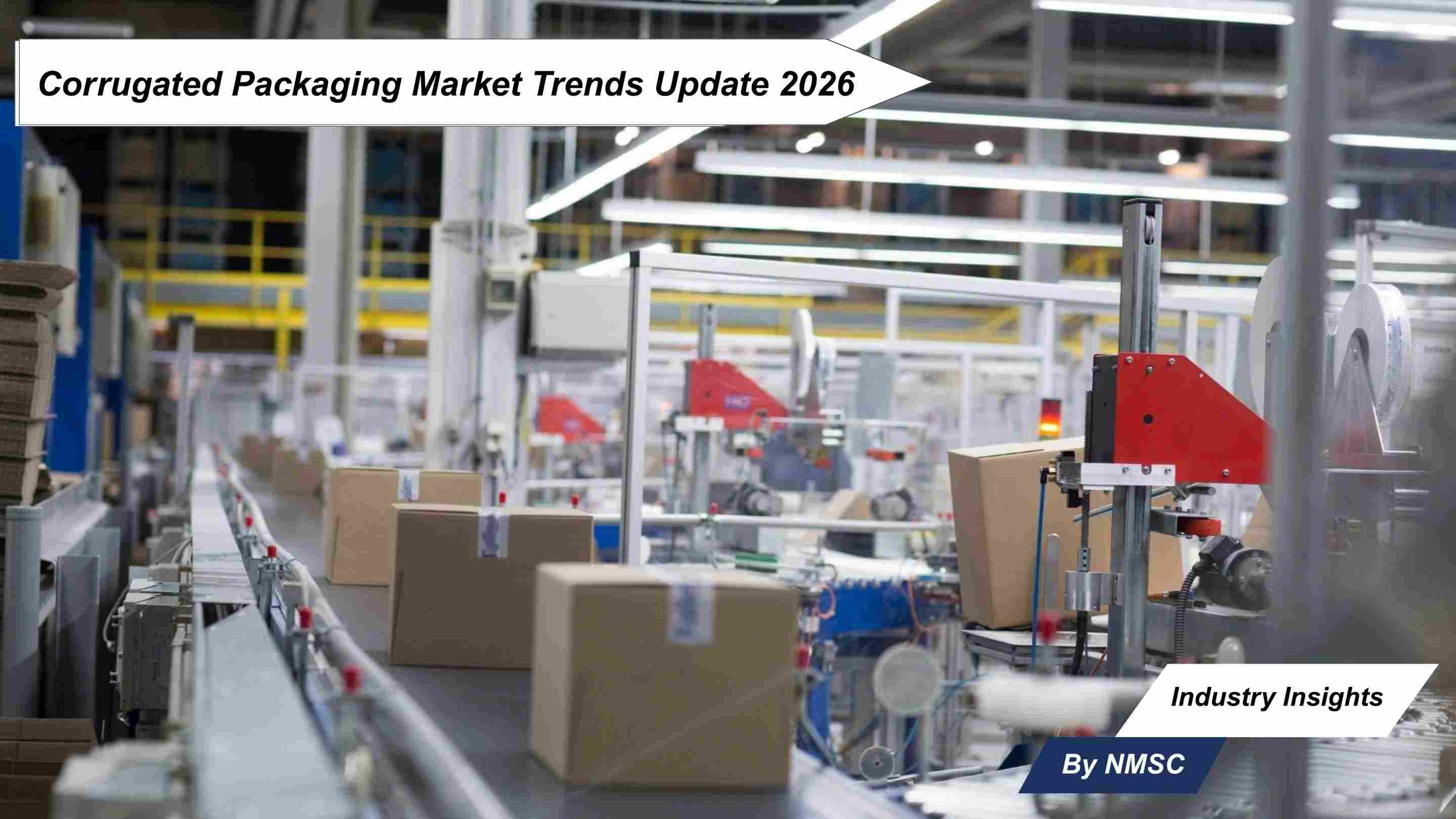
Smithers Study: Global Corrugated Packaging Market Forecast to Reach $265 Billion by 2031
LONDON, United Kingdom August 24, 2026 A new industry study by Smithers, published today, projects the global corrugated packaging segment to reach $265 billion by 2031, as the broader packaging market valued at USD 1.23 Trillion in 2026 and forecast to reach USD 1.95 Trillion by 2035 at a 5.25% CAGR navigates a structural reset driven by e-commerce expansion, sustainability regulation, and automation economics.
The Smithers report, titled The Future of Corrugated Packaging to 2031, identifies six converging, permanent forces shaping the global corrugated market: automation economics, sustainability regulation, demand-side change, e-commerce growth, consolidation, and geopolitics. The EU's Packaging and Packaging Waste Regulation (PPWR), which entered into application on August 12, 2026, is introducing mandatory recyclability grading and extended producer responsibility eco-modulation fees, fundamentally reshaping material selection across the packaging value chain.
Corrugated packaging's approximately 90% OCC (old corrugated containers) recycling rate positions it favorably against competing substrates under the new regulatory framework. High-performance recycled containerboard (HPRC) lightweighting, right-sizing, and format evolution including fanfold and paper mailers replacing regular containerboard are expected to drive revenue growth ahead of tonne volume growth across 2026–2031.
Eric Chartrain, Associate Consultant at Smithers, noted: "Following more than two decades of reliable structural growth since the globalisation era of the 1990s, the sector has entered a cyclical and structural reset since the beginning of the current decade. Unlike prior downturns driven by a single shock, the industry has absorbed multiple simultaneous disruptions: COVID-19, the Ukraine war, Middle East conflicts and Strait of Hormuz tensions, escalating US-China trade friction, and persistent global inflation across all input costs. Growth is expected to recover to the 2021 peak level by 2031, but along a decidedly non-linear trajectory."
Key Highlights:
-
The global corrugated packaging market is currently valued at $240 billion in 2026, with a forecast to reach $265 billion by 2031, according to Smithers
-
E-commerce remains the clear growth engine, led by electrical goods (+3.4% CAGR) and personal & household care (+2.3% CAGR)
-
Automation is widening the competitive gap: top-quartile operators run 20–40% lower costs than bottom-quartile peers
-
Over 80% of U.S. and European consumers now rate private-label products as equal or superior to branded goods, reshaping demand dynamics across most categories
-
PPWR's void-space rules are accelerating right-sizing investment across global fulfillment networks
Analyst Insight:
According to analysts at Next Move Strategy Consulting, the corrugated packaging segment's strong recyclability credentials and e-commerce-driven demand align directly with the broader packaging market's structural growth trajectory. NMSC analysts note that rising e-commerce fulfillment volumes identified as the primary driver contributing an estimated +1.4% to the packaging market's CAGR through 2035 are directly reinforcing corrugated packaging's dominant position within the Paper and Paperboard Packaging segment, which held approximately 36% of the global packaging market in 2025. The enforcement of PPWR further accelerates fiber-based substitution, a trend NMSC analysts expect to compound corrugated's competitive advantage over plastic and multi-material substrates through the forecast period.
Industry Outlook:
The Smithers study underscores that the global packaging market is entering a period of non-linear but sustained recovery. As PPWR compliance requirements intensify and e-commerce fulfillment infrastructure expands globally, corrugated packaging manufacturers investing in HPRC, barrier-coated, and digital-print grades are best positioned to capture incremental market share through 2031. The convergence of regulatory pressure, automation investment, and shifting consumer preferences toward private-label and sustainable packaging formats is expected to define competitive dynamics across the packaging value chain in the years ahead. Stakeholders should monitor extended producer responsibility compliance costs and input-cost volatility as key risk factors that could affect margin consistency across the sector.
Source: The Packaging Portal
For More Information: Download FREE Sample on Packaging Market Report
Prepared By: Sanyukta Deb
About the Author
 Sanyukta Deb
— Sanyukta Deb is Digital Marketing Team Lead at Next Move Strategy Consulting, where she has led content strategy and technical SEO for the firm's B2B market research publications for over 2 years. Her editorial process translates NextMSC's primary and secondary research — spanning technology, industrial, and consumer sectors — into commercial narratives, backed by search-intent, keyword, and competitive analysis. She brings 5 years of overall experience in digital marketing and content strategy.
Sanyukta Deb
— Sanyukta Deb is Digital Marketing Team Lead at Next Move Strategy Consulting, where she has led content strategy and technical SEO for the firm's B2B market research publications for over 2 years. Her editorial process translates NextMSC's primary and secondary research — spanning technology, industrial, and consumer sectors — into commercial narratives, backed by search-intent, keyword, and competitive analysis. She brings 5 years of overall experience in digital marketing and content strategy.
About the Reviewer
 Debashree Dey
— Debashree Dey is Assistant Manager at Next Move Strategy Consulting, where she supports cross-vertical market content and communications across diverse industries for 6 years. Her professional background includes senior content writing, communications, and published manuscript authorship, with experience developing audience-focused business narratives and maintaining clear, consistent messaging. Her role supports research-led content development and editorial quality across NextMSC publications.
Debashree Dey
— Debashree Dey is Assistant Manager at Next Move Strategy Consulting, where she supports cross-vertical market content and communications across diverse industries for 6 years. Her professional background includes senior content writing, communications, and published manuscript authorship, with experience developing audience-focused business narratives and maintaining clear, consistent messaging. Her role supports research-led content development and editorial quality across NextMSC publications.


















Add Comment