Deutsche Bank’s Vault Core Deal Tests Banking-as-a-Platform at Tier-1 Scale

Germany’s largest lender will cut 15 core systems to two on Thought Machine’s Vault Core, while Flagstar and FIS signal that bank platform spending is moving to phased, API-first programmes
On 27 August 2026, Deutsche Bank signed a ten-year global licensing agreement with Thought Machine to adopt the Vault Core platform as the technology foundation of its retail modernisation, covering banking and lending products for Personal Banking and Wealth Management clients in Germany. FinTech Futures reported in its article “Deutsche Bank selects Thought Machine for major core systems overhaul” that the bank intends to reduce the core banking systems it operates from 15 to two, with Vault Core the first selection, and that the contract lifts Thought Machine’s tier-1 client roster to 20 banks. Ten days earlier, on 17 August 2026, Fiserv and Flagstar Bank announced that the US regional lender had chosen Finxact as the system of record for its consolidated core, and on 3 September 2026 FIS launched an Embedded Banking Platform with M&T Bank among its pilot institutions. Read together, the three announcements show bank technology budgets moving away from single-event core conversions and toward phased, composable platform layers.
According to Next Move Strategy Consulting’s Banking-as-a-Platform Market report, the global Banking-as-a-Platform market was valued at USD 18.31 billion in 2025 and is projected to reach USD 87.30 billion by 2035, growing at a CAGR of 14.8% from 2026 to 2035, with 2026 revenue placed at USD 25.21 billion. NextMSC primary research and analysis identifies legacy core modernisation, open banking and API mandates, and fintech demand for embedded finance as the principal growth drivers, and places North America ahead of other regions with a revenue share of approximately 36% in 2025.
For More Information: Download FREE Sample on Banking-as-a-Platform Market Report
The Financial Logic: Consolidation, Cost and Real-Time Processing
The Deutsche Bank decision rests on consolidation arithmetic. In its 27 August 2026 press release, Thought Machine said that Vault Core’s modular architecture separates cloud hosting from product logic, which allows Deutsche Bank to retire legacy systems progressively instead of in a single cutover. GFT Technologies announced on the same day, in its release “Deutsche Bank appoints GFT as transformation partner for core banking modernisation”, that it had been appointed transformation and systems-integration partner for what it described as a decade-long partnership. Replacing fifteen fragmented cores with two changes the operating cost base of a Tier-1 bank, because every core retired removes a separate set of interfaces, reconciliation routines and support contracts.
“Vault Core provides a modern, cloud-native foundation that enhances resilience, scalability and flexibility.”
- Christian Rhino, Chief Information Officer, Deutsche Bank, Thought Machine press release, Deutsche Bank selects Thought Machine for landmark core banking transformation, 27 August 2026.
The Flagstar programme shows the same logic at regional-bank scale. Banking Dive reported in its 21 August 2026 article “Flagstar picks cloud-native core to replace legacy patchwork” that the $87.7 billion-asset lender spent about a year narrowing 12 candidates to one, and that its two existing cores, Fiserv’s DNA and one from Fidelity National Information Services, are being replaced by a single Finxact core. Flagstar Chief Financial Officer Lee Smith said at a May investor conference that core consolidation is expected to produce $40 million to $45 million in annualised cost savings. Chief Information and Operations Officer Chris Higgins said that not all 12 candidates had ready-made core platforms, a finding that surprised him given how long the industry has discussed cloud and API-driven core ledgers. According to Fiserv’s release, conversions will follow a phased approach, and Banking Dive reported that the two migrations are planned for summer 2027 and summer 2028.
The mechanism that connects these deals to platform demand is real-time processing. Flagstar Chief Technology Officer Jason Pope told Banking Dive that removing the end-of-day batch window gives the bank a single authoritative version of its data, which feeds fraud decisions, liquidity reporting and artificial intelligence capabilities from current rather than day-old records. A bank that adopts a real-time core still needs engagement layers, API gateways and partner connections around it, and those surrounding layers are the purchases that platform vendors compete for.
Four Platform Moves That Frame the Market
|
Announcement |
Date |
Scale and structure |
|
Deutsche Bank and Thought Machine |
27 August 2026 |
Ten-year global licence; Vault Core for Personal Banking and Wealth Management in Germany; 15 core systems to be reduced to two |
|
Flagstar Bank and Fiserv (Finxact) |
17 August 2026 |
Single consolidated core replacing two legacy cores; phased conversions, with migrations planned for summer 2027 and summer 2028 |
|
FIS Embedded Banking Platform |
3 September 2026 |
Pilot banks Cogent Bank, Commercial Bank of California and M&T Bank; accounts and payments planned for the fourth quarter of 2026 |
|
Temenos and additiv AG |
17 July 2026 |
Acquisition completed for preliminary consideration of CHF 226.7 million; targets wealth and AI-enabled orchestration |
Key Industry Developments: Embedded Delivery and Vendor Revenue
FIS positioned its Embedded Banking Platform, announced on 3 September 2026, as its first embedded finance offering built specifically for banks. In the FIS release, the bank keeps the customer relationship, the software partner owns the user experience and FIS supplies the infrastructure, with accounts held on the bank’s own balance sheet rather than on a third-party virtual ledger. FIS says this structure leaves customer ownership and regulatory control with the bank, and it gives a corporate bank a route to reach customers inside the business software they already use. Account opening and payments are planned for the fourth quarter of 2026, which makes the pilot a near-term test of whether embedded delivery can run on bank-owned ledgers at scale.
The vendor revenue data in Temenos’ Interim Report and Accounts 2026 shows how these shifts reach income statements. Non-IFRS total revenues for the first half of 2026 were USD 534.4 million, up 7% on the pro forma prior-year figure, and annual recurring revenue reached USD 880.6 million, up 11%. Maintenance revenue rose 14% to USD 266.2 million and services revenue rose 15% to USD 72.0 million, while subscription and SaaS revenue fell 3% to USD 196.2 million. The report notes that subscription and SaaS revenue, profit and cash collection tend to be stronger in the second half of the year, so the first-half decline is not a full-year indicator.
Temenos Revenue by Line, First Half of 2026 (USD million, non-IFRS)
|
Revenue line |
H1 2026 |
H1 2025 (pro forma) |
Change |
|
Subscription and SaaS |
196.2 |
201.7 |
-3% |
|
Maintenance |
266.2 |
233.5 |
+14% |
|
Services |
72.0 |
62.8 |
+15% |
|
Total revenues |
534.4 |
497.9 |
+7% |
The regional split of Temenos’ revenue shows where demand for banking platforms is shifting. Revenue from external customers in Europe fell from USD 160.8 million to USD 142.4 million between the first halves of 2025 and 2026, and in the Americas from USD 139.3 million to USD 120.7 million. Over the same period Asia Pacific rose from USD 99.0 million to USD 123.4 million and the Middle East and Africa from USD 118.6 million to USD 147.9 million, making the Middle East and Africa the largest region in the first half of 2026 against total revenues of USD 534.4 million.
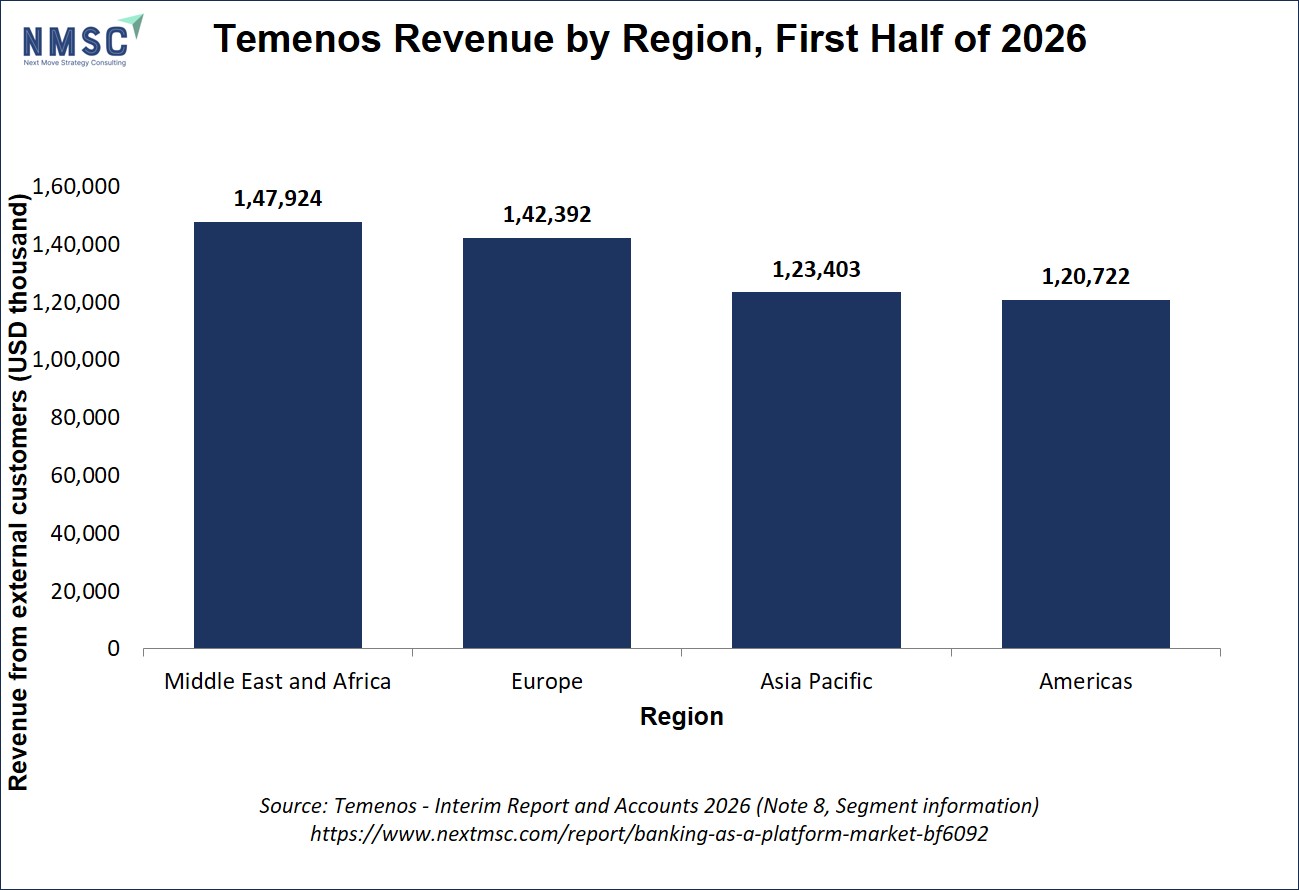
Temenos disclosed the regional figures in the segment information note of its interim report, so they are company-reported figures rather than third-party estimates, and the interim statements are unaudited. NextMSC primary research and analysis separately identifies Asia-Pacific as the fastest-growing region for the Banking-as-a-Platform market, which is directionally consistent with the gain in Temenos’ Asia Pacific revenue.
Demand Signals: Account Ownership and Real-Time Payment Volumes
The World Bank’s Global Findex Database 2025, titled Connectivity and Financial Inclusion in the Digital Economy, reports that 79% of adults worldwide held an account in 2024, up from 74% in 2021 and 51% in 2011, while 1.3 billion adults still lack an account. Each additional account holder adds transaction volume that a bank’s platform must process, authenticate and report on, which is why account growth feeds directly into infrastructure spending in regions where first accounts are still being opened.
India illustrates the transaction load that follows. Business Standard reported on 1 September 2026, citing data released by the National Payments Corporation of India, that the Unified Payments Interface processed a record 24.51 billion transactions in August 2026, up 3.6% on July and 22% on the same month a year earlier. NextMSC primary research and analysis identifies instant payment scale as the main load driver behind Asia-Pacific’s 18.35% CAGR for the Banking-as-a-Platform market between 2026 and 2035, the fastest rate among the regions it covers.
Demand-Side Indicators for Banking Platforms
|
Indicator |
Value |
Period |
|
Adults worldwide with an account |
79% |
2024 |
|
Adults worldwide with an account |
74% |
2021 |
|
Adults worldwide without an account |
1.3 billion |
2024 |
|
UPI transactions, India |
23.66 billion |
July 2026 |
|
UPI transactions, India |
24.51 billion |
August 2026 |
Growth Drivers and Restraints: What the Evidence Shows
Three drivers are visible in the dated evidence. Core replacement is moving from planning to contract, as the Deutsche Bank and Flagstar agreements show. Embedded delivery is moving from concept to pilot, as the FIS launch shows. Account ownership and payment volumes keep rising, as the World Bank and Business Standard data show, which adds processing load for bank platforms. Each driver produces a measurable commitment: a ten-year licence, a $40 million to $45 million annual savings target, a fourth-quarter 2026 go-live date.
Two restraints are equally visible. Migration complexity delays recognition of vendor revenue, because Flagstar’s conversions are sequenced across two summers and the bank will run multiple environments in parallel, a cost its Chief Technology Officer described as a deliberate trade-off against concentrated risk. Revenue timing also matters for vendors themselves: Temenos’ interim report records a 3% decline in first-half subscription and SaaS revenue even as annual recurring revenue grew 11%, which shows that annual recurring revenue and recognised subscription revenue can move in opposite directions within a half-year.
NMSC Strategic Perspective: Platform Layers Replace Big-Bang Conversions
NextMSC primary research and analysis treats the August and September 2026 announcements as confirmation of a structural change in how banks buy technology. The separation of the digital engagement layer from the system of record has become the commercial logic of the market: a bank that keeps its existing core can still launch modern products through platform layers, which widens the buyer base beyond institutions able to fund a full core replacement and pulls mid-sized banks and credit unions into platform spending.
The segment data in the NextMSC report points the same way. Platform Software held the largest offering share in 2025, at approximately 54% of market revenue or USD 9.88 billion, while Integrated Banking Platforms is the fastest-growing offering at an 18.66% CAGR between 2026 and 2035. By revenue model, usage-based pricing is the fastest-growing route at 23.38%, and by deployment, public cloud leads growth at 19.97%. NextMSC places North America’s 2025 revenue at USD 6.59 billion, anchored by regional bank core modernisation of the kind Flagstar has now contracted.
The implication for vendors is that proof at tier-1 scale now decides shortlists. Deutsche Bank’s selection of a cloud-native core, and Thought Machine’s roster of 20 tier-1 banks, make large-bank references a decisive commercial asset in the market. For buyers, the implication is operational: phased programmes lower execution risk but extend the period in which parallel environments run, so the savings case depends on keeping that period short.
Competitive Landscape: Core Suites, Cloud-Native Specialists and Integrators
Banking Dive reported that the three largest US core providers are Fiserv, FIS and Jack Henry & Associates, with nearly 20 other companies offering core services. Fiserv’s Finxact win at Flagstar, announced on 17 August 2026, adds a large regional bank to its cloud-native client base while it retires one of its own legacy DNA cores at the same customer. FIS is extending from core processing into embedded delivery with its 3 September 2026 launch, and it competes for the same bank technology budgets as Fiserv and Jack Henry.
Thought Machine competes as a cloud-native specialist, with Vault Core also used by Afin Bank, Shawbrook, Zopa Bank and Pathward, according to FinTech Futures. GFT Technologies competes for the integration layer, a segment that Deutsche Bank’s decade-long transformation makes commercially significant. Temenos, whose interim report lists an installed base of 950+ for core banking, completed its acquisition of additiv AG on 17 July 2026 to strengthen wealth and orchestration capabilities around its core. Each of these moves is traceable to a named company release or filing, and together they show competition shifting from feature lists toward delivery capacity and reference clients.
Bottom Line
The Deutsche Bank agreement of 27 August 2026 turns core replacement from a technology refresh into a multi-year platform commitment, with 15 core systems due to fall to two. Flagstar’s phased Finxact programme, scheduled for summer 2027 and summer 2028, and the FIS Embedded Banking Platform launched on 3 September 2026 point the same way: banks are buying layers, not monoliths. Temenos’ interim report shows the commercial consequence, with maintenance revenue up 14% and Asia Pacific revenue rising to USD 123.4 million while Europe fell to USD 142.4 million. According to NextMSC primary research and analysis, the market grows from USD 25.21 billion in 2026 to USD 87.30 billion by 2035, with Integrated Banking Platforms and usage-based pricing expanding fastest. For vendors, the test is proof at tier-1 scale. For banks, it is execution discipline across phased migrations and the cost of running parallel environments.
About Next Move Strategy Consulting
Next Move Strategy Consulting is a premier market research and management consulting firm that has been committed to provide strategically analysed well documented latest research reports to its clients. The research industry is flooded with many firms to choose from, what makes NMSC different from the rest is its top-quality research and the obsession of turning data into knowledge by dissecting every bit of it and providing fact-based research recommendation that is supported by information collected from over 500 million websites, paid databases, industry journals and one on one consultations with industry experts across a diverse range of industry sectors. The high-quality customized research reports with actionable insights and excellent end-to-end customer service help our clients to take critical business decisions that enables them to move beyond time and have competitive edge in the industry.
We have been servicing over 1000 customers globally that includes 90% of the Fortune 500 companies over a decade. Our analysts are constantly tracking various high growth markets and identifying hidden opportunities in each sector or the industry. We provide one of the industry’s best quality syndicate as well as custom research reports across 10 different industry verticals. We are committed to deliver high quality research solutions in accordance to your business needs. Our industry standard delivery solutions that ranges from the pre consultation to after-sales services, provide an excellent client experience and ensure right strategic decision making for businesses.
For more information, please contact:
Next Move Strategy Consulting
5th Floor 867 Boylston St, STE 500,
Boston, MA 02116, U.S.
E-Mail: [email protected]
Direct: +1-217-650-7991
Website: www.nextmsc.com
About the Author
 Sanyukta Deb
— Sanyukta Deb is Digital Marketing Team Lead at Next Move Strategy Consulting, where she has led content strategy and technical SEO for the firm's B2B market research publications for over 2 years. Her editorial process translates NextMSC's primary and secondary research — spanning technology, industrial, and consumer sectors — into commercial narratives, backed by search-intent, keyword, and competitive analysis. She brings 5 years of overall experience in digital marketing and content strategy.
About the Reviewer
 Debashree Dey
— Debashree Dey is Assistant Manager at Next Move Strategy Consulting, where she supports cross-vertical market content and communications across diverse industries for 6 years. Her professional background includes senior content writing, communications, and published manuscript authorship, with experience developing audience-focused business narratives and maintaining clear, consistent messaging. Her role supports research-led content development and editorial quality across NextMSC publications.















Add Comment