OCC's Stablecoin Rule Lands as Bank Blockchain Settlement Reaches Scale

OCC's Final GENIUS Act Rule, Broadridge's USD 7.5 Trillion Monthly Repo Volume and Swift's 17-Bank Ledger Pilot Point to Blockchain Moving Into Core Bank Settlement
On October 21, 2026, the Office of the Comptroller of the Currency (OCC) issued its final rule implementing the GENIUS Act, setting federal requirements for permitted payment stablecoin issuers, foreign payment stablecoin issuers and certain custody activities conducted by OCC-supervised entities. The rule and the Act take effect on January 18, 2027, which gives issuers a fixed compliance date. The Office of the Comptroller of the Currency said it received hundreds of comments on its proposal from crypto-focused companies, community bankers, trade groups and academics, and that Bank Secrecy Act, anti-money laundering and sanctions requirements will follow in a separate rulemaking coordinated with the Department of the Treasury. The decision arrives while tokenized settlement already runs at institutional scale: Broadridge Financial Solutions reported on October 8, 2026 that its Distributed Ledger Repo platform processed USD 7.5 trillion in September, and Swift said on July 9, 2026 that 17 banks are preparing live transactions on its blockchain-based ledger.
According to Next Move Strategy Consulting's Blockchain in Banking and Finance Market report, the global blockchain in banking and finance market was valued at USD 7.60 billion in 2025 and is projected to reach USD 62.50 billion by 2035, growing at a CAGR of 22.9% from 2026 to 2035. NextMSC primary research and analysis also places the 2026 market at USD 9.80 billion, with North America holding about 36% of 2025 revenue and platforms and infrastructure accounting for about 41%.
For More Information: Download FREE Sample on Blockchain in Banking and Finance Market Report
What the OCC Rule Settles, and What It Leaves Open
The OCC's release describes a rule built around reserve backing, redemption and risk management for payment stablecoin issuers, together with custody activities by OCC-supervised entities. Two companion issuances published the same day, Bulletin 2026-51 on waivers and application submission and Bulletin 2026-52 on revised reporting forms, set out the filing and reporting procedures for issuers. The agency said it will announce in a separate news release when it begins accepting and processing applications and waiver requests, and that it will adjust the framework if the industry's evolution requires it.
What the OCC's Final GENIUS Act Rule Covers
|
Item |
What the OCC said |
Timing |
|
Regulated parties |
Permitted payment stablecoin issuers and foreign payment stablecoin issuers under OCC jurisdiction, plus certain custody activities of OCC-supervised entities |
Effective January 18, 2027 |
|
Standards named by the Comptroller |
Reserve backing, redemption and risk management |
Effective January 18, 2027 |
|
Excluded from this rule |
Bank Secrecy Act, anti-money laundering and sanctions requirements |
Separate rulemaking with the Department of the Treasury; no date given |
|
Applications and waivers |
Bulletin 2026-51 gives submission guidance; the OCC will announce separately when it begins accepting requests |
Opening date not announced as of October 21, 2026 |
|
Reporting forms |
Bulletin 2026-52 revises forms and instructions for permitted payment stablecoin issuers |
Issued October 21, 2026 |
“We are providing a clear, practical framework for payment stablecoin innovation”
-Jonathan V. Gould, Comptroller of the Currency, Office of the Comptroller of the Currency, OCC News Release 2026-92, October 21, 2026.
The scope matters for banks. By Swift's own description, its ledger carries bank-issued tokenized deposits that remain on each bank's own ledger, with final settlement completed through existing systems, whereas the OCC rule is written for payment stablecoin issuers. The two instruments are therefore supervised and operated differently, and NextMSC's report states that their relative shares of regulated settlement value through 2030 have not been established by the cited sources. What the OCC rule changes is the supervisory certainty around one of the two instruments, and it sets a January 18, 2027 start date for the federal framework.
The Financial Logic: Production Volumes Already Exceed the Pilot Stage
Broadridge Financial Solutions reported that its Distributed Ledger Repo (DLR) platform, which settles repo transactions with tokenized securities inside existing trading and post-trade workflows, averaged USD 357 billion in daily transactions in June 2026, USD 365 billion in July, USD 351 billion in August and USD 359 billion in September. Monthly volumes were USD 7.5 trillion, USD 8.0 trillion, USD 7.4 trillion and USD 7.5 trillion. Broadridge described the June daily average as a 68% increase year over year and the July average as a 28% increase, and its fiscal 2026 annual report states that daily volume on the platform tripled over 13 months to about USD 360 billion.
Broadridge Distributed Ledger Repo Volumes
|
Month |
Average daily repo volume |
Monthly volume |
Broadridge release date |
|
August 2025 |
More than USD 280 billion |
USD 5.9 trillion |
September 10, 2025 |
|
June 2026 |
USD 357 billion |
USD 7.5 trillion |
July 7, 2026 |
|
July 2026 |
USD 365 billion |
USD 8.0 trillion |
August 10, 2026 |
|
August 2026 |
USD 351 billion |
USD 7.4 trillion |
September 2, 2026 |
|
September 2026 |
USD 359 billion |
USD 7.5 trillion |
October 8, 2026 |
Two readings follow from the series. Daily volume has held between USD 351 billion and USD 365 billion in every month from June to September 2026, so the platform is no longer compounding month by month. The year-over-year rate also fell from 68% to 28% between two consecutive releases, against a comparison base that Broadridge had already lifted above USD 280 billion a day by August 2025. Tokenized repo has therefore become a large, steady production flow, and Broadridge's next growth vector is breadth: on September 2, 2026 it announced the addition of G7 securities to the network for cross-border repo, and its October 8 release describes the newly launched DLX platform as extending the same infrastructure to issuance, trading, settlement, servicing and custody.
Payments show the same shift at smaller scale. J.P. Morgan reported on March 31, 2026 that its Kinexys business has processed over USD 3 trillion in transaction volume since inception, with average daily transactions exceeding USD 5 billion, and that Mitsubishi Corporation became the first Japanese corporate to adopt Kinexys Digital Payments for intragroup US dollar cash management across Singapore, London and New York. The programmable payments operate outside traditional banking cut-off times and holidays, which is the operational gap that Swift's ledger also targets.
Swift stated in its July 9, 2026 announcement that 75% of payments on its network reach beneficiary banks within 10 minutes, and often in seconds. The ledger addresses a different constraint, which is availability: it lets banks move funds for customers overnight and on weekends before final settlement completes through existing systems.
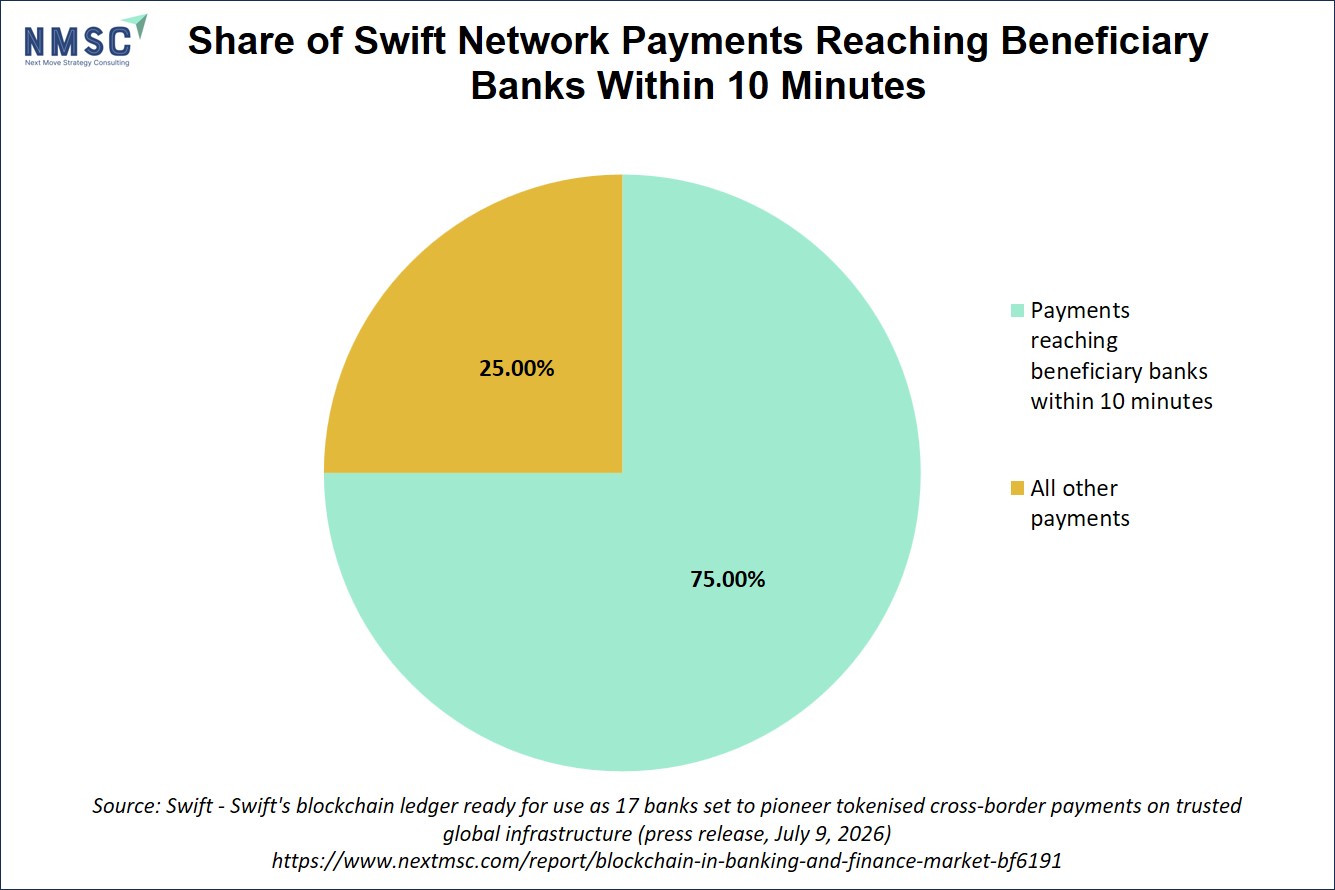
Swift published the 75% figure in the same announcement in which it declared its ledger ready for initial use. The remaining 25 is the balance of the whole and is not a separately published category.
Key Industry Developments: Central Banks, Swift and Bank Networks Converge
Swift said on July 9, 2026 that its blockchain-based ledger is ready for initial use, designed and built with feedback from financial institutions in nine months. Seventeen banks from six continents are preparing live transactions using bank-issued tokenized deposits: ANZ, BNP Paribas, BNY, Citi, DBS, First Abu Dhabi Bank, FirstRand Bank, HSBC, Itaú Unibanco, Lloyds Bank, Mashreq, MUFG Bank, OCBC, Standard Chartered, UBS, UOB and Wells Fargo. Swift said the ledger will expand in functionality and availability after the initial controlled go-live phase. Cointelegraph reported on August 19, 2026 that Standard Chartered and HSBC completed the first live cross-border transaction on the ledger, connecting the two banks' separate tokenized deposit systems about a month after launch.
“We see interoperability as the key enabler for scaling tokenised deposits beyond individual institutions.”
-Andreas Kubli, Managing Director, Group Head of Digital Assets, UBS, Swift press release, July 9, 2026.
Central banks are testing the same architecture. The Bank for International Settlements (BIS) Innovation Hub reported on May 27, 2026 that Project Agorá, which involves seven central banks and more than 40 private sector financial institutions, showed that atomic settlement of wholesale cross-border transactions with tokenized central bank reserves and tokenized commercial bank deposits is achievable across currencies and jurisdictions. The Bank of Canada has also joined, and testing was to advance to real-value transactions. Cointelegraph reported on July 31, 2026 that the BIS said 28 financial institutions and central banks had completed real-value settlements of 800,000 Swiss francs across 17 transaction scenarios in six currencies, with an average settlement time of about 80 seconds. The BIS notes that its Innovation Hub projects are experimental in nature.
Five 2026 Developments in Tokenized Bank Settlement
|
Date |
Organization |
Development |
Reported scale |
|
March 31, 2026 |
J.P. Morgan |
Mitsubishi Corporation adopts Kinexys Digital Payments |
Over USD 3 trillion since inception; average daily transactions above USD 5 billion |
|
May 27, 2026 |
Bank for International Settlements |
Project Agorá prototype report |
Seven central banks; more than 40 private sector institutions |
|
July 9, 2026 |
Swift |
Blockchain-based ledger ready for initial use |
17 banks from six continents preparing live transactions |
|
July 31, 2026 (reported) |
Bank for International Settlements |
Project Agorá real-value tests, reported by Cointelegraph |
28 institutions; 800,000 Swiss francs; 17 scenarios; six currencies; average about 80 seconds |
|
October 8, 2026 |
Broadridge Financial Solutions |
September repo volume reported alongside DLX launch |
USD 359 billion average daily; USD 7.5 trillion monthly |
Segment Dynamics: Where the Deployments Sit
NextMSC primary research and analysis divides the market by component, application and network type, and the external deployments map onto its fastest-growing segments. Platforms and infrastructure were the largest component in 2025 at USD 3.10 billion, about 41% of revenue, and are projected to reach USD 22.00 billion by 2035. Solutions and applications are the fastest-growing component at a 24.1% CAGR from 2026 to 2035, rising from USD 2.70 billion to USD 24.50 billion. By application, payments and settlement led in 2025 at USD 2.80 billion, while tokenization and capital markets is the fastest-growing application at a 26.2% CAGR, which fits the tokenized repo volumes Broadridge reports. By network type, private permissioned networks led with USD 3.60 billion in 2025, and public and hybrid networks are growing fastest at a 29.5% CAGR, reaching USD 22.00 billion by 2035. Swift's design, which keeps bank-issued tokenized deposits on each bank's own ledger, is consistent with the permissioned model that leads today.
Regional Outlook
On NextMSC regional estimates, North America held about 36% of 2025 revenue at USD 2.75 billion and is projected to reach USD 20.30 billion by 2035, a 21.6% CAGR. Asia-Pacific grows from USD 1.85 billion to USD 17.00 billion at 24.0%, Europe from USD 2.00 billion to USD 15.00 billion at 21.8%, and Latin America from USD 0.45 billion to USD 4.20 billion at 25.3%. Middle East and Africa is the fastest-growing region at 26.0%, rising from USD 0.55 billion to USD 6.00 billion, and India is the fastest-growing country at 29.7%, from USD 0.20 billion to USD 2.90 billion. The Swift pilot roster mirrors that spread. It includes North American banks (BNY, Citi, Wells Fargo), European institutions (BNP Paribas, Lloyds Bank, UBS), Asia-Pacific banks (ANZ, DBS, MUFG Bank, OCBC, UOB), Gulf and African banks (First Abu Dhabi Bank, Mashreq, FirstRand Bank) and Brazil's Itaú Unibanco, so every NextMSC region has at least one participant.
Growth Drivers and Restraints: The External Evidence
The evidence below comes only from named external sources and is separate from NextMSC's own estimates.
-
Driver, federal rulebook: the OCC's final rule covers reserve backing, redemption, risk management and custody, and takes effect on January 18, 2027 (Office of the Comptroller of the Currency, October 21, 2026).
-
Driver, production volume: Broadridge Financial Solutions reported USD 7.5 trillion of tokenized repo in September 2026 and describes daily platform volume as having tripled over 13 months in its fiscal 2026 annual report.
-
Driver, bank network reach: 17 banks on six continents are preparing live transactions on Swift's ledger, which will expand after its controlled go-live phase (Swift, July 9, 2026).
-
Driver, central bank validation: the Bank for International Settlements reported on May 27, 2026 that atomic cross-border settlement with tokenized reserves and deposits is achievable (Project Agorá).
-
Restraint, interoperability: UBS's Andreas Kubli names it as the enabler for scaling beyond single institutions, and the first Standard Chartered and HSBC transaction links only two of the 17 pilot banks (Cointelegraph, August 19, 2026).
-
Restraint, incomplete rulebook: as of its October 21 release, the OCC had not announced when applications open, and Bank Secrecy Act, anti-money laundering and sanctions rules sit in a separate rulemaking.
-
Restraint, experimental status: the BIS states that its Innovation Hub projects are experimental, and Swift's ledger expands only after the initial controlled go-live phase.
-
Restraint, plateauing volume: Broadridge's daily repo volume stayed between USD 351 billion and USD 365 billion from June to September 2026, and its year-over-year growth rate fell from 68% in June to 28% in July.
NMSC Strategic Perspective: Regulatory Clarity Is Arriving Faster Than Interoperability
NextMSC primary research and analysis reads the October 2026 evidence as a divergence between two timelines. The regulatory timeline is now fixed: the OCC rule and the GENIUS Act share a January 18, 2027 effective date, and the application process is the next announced step. The interoperability timeline is not. Swift's ledger is in a controlled go-live phase with 17 banks, Project Agorá has moved to real-value tests of 800,000 Swiss francs, and Broadridge's repo platform operates on its own network.
NextMSC's report concludes that interoperability standards will decide whether growth holds near 22.9% or slips lower, and that institutions favor permissioned ledgers for core settlement while using public networks selectively for distribution, collateral and interoperability pilots. The external evidence supports the first conclusion directly. UBS's Andreas Kubli identifies interoperability as the condition for scaling beyond individual institutions, and Cointelegraph reported the Standard Chartered and HSBC transaction as a demonstration of interoperability between two banks' separate tokenized deposit systems.
Two limits keep this from being a straight-line forecast. NextMSC's report states that the relative shares of bank deposit tokens and regulated payment stablecoins in settlement value through 2030 have not been established, and Broadridge's own monthly volumes have held in a narrow band since June 2026. NextMSC's analysis shows platforms and infrastructure keeping the largest share of spend through 2030 before applications gain ground, which points vendors toward the connective layer between ledgers.
Competitive Landscape
Competition combines bank-led networks, market infrastructure providers and shared-ledger operators. J.P. Morgan's Kinexys anchors bank-led payments with more than USD 3 trillion of cumulative volume. Broadridge, which describes DLR as the world's largest institutional platform for settling tokenized real assets, reported USD 359 billion in average daily volume for September 2026, announced the addition of G7 securities on September 2, 2026 and launched DLX as a multi-asset extension. Swift positions its ledger as a shared orchestration layer over bank-issued tokenized deposits. HSBC said in Swift's announcement that it is scaling tokenized deposits across multiple markets and is among the first banks to connect its Tokenized Deposit Service to the ledger, and Standard Chartered and HSBC followed with the first live transaction. The competitive question is shifting from whose token a bank issues to which network connects the tokens.
Bottom Line
The OCC's final GENIUS Act rule, issued on October 21, 2026, gives payment stablecoin issuers a defined federal framework from January 18, 2027, while anti-money laundering and sanctions rules remain to be written with the Department of the Treasury. Production data show that blockchain settlement in banking no longer depends on that rule to reach scale: Broadridge Financial Solutions' repo platform averaged USD 359 billion a day in September 2026, J.P. Morgan reported average daily Kinexys transactions above USD 5 billion in March 2026, and 17 banks on six continents are preparing live transactions on Swift's ledger. The binding constraints are now interoperability and scope. Bank deposit tokens, stablecoins and central bank reserves sit on separate ledgers, and the Bank for International Settlements describes its Project Agorá work as experimental. NextMSC primary research and analysis projects revenue of USD 62.50 billion by 2035, a 22.9% CAGR, and places interoperability standards at the center of whether that pace holds.
About Next Move Strategy Consulting
Next Move Strategy Consulting is a premier market research and management consulting firm that has been committed to provide strategically analysed well documented latest research reports to its clients. The research industry is flooded with many firms to choose from, what makes NMSC different from the rest is its top-quality research and the obsession of turning data into knowledge by dissecting every bit of it and providing fact-based research recommendation that is supported by information collected from over 500 million websites, paid databases, industry journals and one on one consultations with industry experts across a diverse range of industry sectors. The high-quality customized research reports with actionable insights and excellent end-to-end customer service help our clients to take critical business decisions that enables them to move beyond time and have competitive edge in the industry.
We have been servicing over 1000 customers globally that includes 90% of the Fortune 500 companies over a decade. Our analysts are constantly tracking various high growth markets and identifying hidden opportunities in each sector or the industry. We provide one of the industry’s best quality syndicate as well as custom research reports across 10 different industry verticals. We are committed to deliver high quality research solutions in accordance to your business needs. Our industry standard delivery solutions that ranges from the pre consultation to after-sales services, provide an excellent client experience and ensure right strategic decision making for businesses.
For more information, please contact:
Next Move Strategy Consulting
5th Floor 867 Boylston St, STE 500,
Boston, MA 02116, U.S.
E-Mail: [email protected]
Direct: +1-217-650-7991
Website: www.nextmsc.com
About the Author
 Priyanshu Das
— Priyanshu Das is SEO Executive at Next Move Strategy Consulting, where he has led on-page and off-page SEO, keyword research, and SEO audits for the firm's B2B market research publications for 2 years. His audit process combines technical crawl analysis, backlink profile review, and competitor keyword gap mapping — using tools including Screaming Frog and Google Search Console — to prioritize fixes by organic search-visibility impact, informed by his own prior in-house and agency SEO experience.
About the Reviewer
 Debashree Dey
— Debashree Dey is Assistant Manager at Next Move Strategy Consulting, where she supports cross-vertical market content and communications across diverse industries for 6 years. Her professional background includes senior content writing, communications, and published manuscript authorship, with experience developing audience-focused business narratives and maintaining clear, consistent messaging. Her role supports research-led content development and editorial quality across NextMSC publications.
















Add Comment