Banking-as-a-Platform Market Global Industry Analysis and Forecast (2026-2035)

Banking-as-a-Platform Market size was USD 17.4 billion in 2026, projected to reach USD 78.9 billion by 2035, growing at a CAGR of 18.2% from 2026 to 2035. Key drivers include rising embedded finance partnerships, accelerating legacy core banking replacement, and expanding neobank and fintech licensing activity, with North America leading the market.

Download Free Sample PDF
Base Year (2025)
$14.80 Billion
Forecast (2035)
$78.90 Billion
CAGR (2026-2035)
18.2%
Top Region
North America

What Is the Banking-as-a-Platform Market Size?
The global banking-as-a-platform market size was valued at USD 14.8 billion in 2025 and is estimated at USD 17.4 billion in 2026, forecast to reach USD 78.9 billion by 2035, expanding at an 18.2% CAGR between 2026 and 2035. North America leads with approximately 40% share, while Retail Banking dominates all other banking type segments with approximately 46% share.

We observed that growth is broad-based across every segmentation axis, with embedded finance adoption and fintech and neobank platform demand driving the dominant structural shifts through 2035.

Banking-as-a-Platform Market Global Industry Analysis and Forecast (2026-2035) Revenue Forecast
Values in USD Billion

2025 $14.80 Billion
2025
2026 $17.49 Billion
2026
2027 $20.68 Billion
2027
2028 $24.44 Billion
2028
2029 $28.89 Billion
2029
2030 $34.15 Billion
2030
2031 $40.36 Billion
2031
2032 $47.71 Billion
2032
2033 $56.39 Billion
2033
2034 $66.65 Billion
2034
2035 $78.90 Billion
2035

Key Takeaways

By Component: Platform/Software held the largest share of approximately 72% (USD 10.66 billion) in 2025; Services is the fastest-growing sub-segment at 20.9% CAGR from 2026–2035.

By Deployment Mode: Cloud held the largest share of the deployment mode category in 2025; Cloud is also the fastest-growing sub-segment through 2035 on accelerating core banking migration to cloud-native architectures.

By Organization Size: Large Enterprises held the largest share of the organization size category in 2025; SMEs is the fastest-growing sub-segment through 2035 on expanding composable banking adoption among smaller financial institutions.

By Banking Type: Retail Banking held the largest share of approximately 46% (USD 6.81 billion) in 2025; SME & Business Banking is the fastest-growing sub-segment at 23.2% CAGR from 2026–2035.

By End User: Banks & Credit Unions held the largest share of approximately 48% (USD 7.10 billion) in 2025; Non-Financial Brands (Embedded Finance) is the fastest-growing sub-segment at 27.0% CAGR from 2026–2035.

Dominant Region: North America dominated with approximately 40% revenue share (USD 5.91 billion) in 2025.

Fastest-Growing Region: Middle East & Africa is expected to register the highest CAGR of 22.8% during 2026–2035.

Dominant Country: U.S. led with approximately USD 4.73 billion in 2025.

Fastest-Growing Country: India is the fastest-growing country at approximately 25.7% CAGR from 2026–2035.

Market Opportunity: The banking-as-a-platform market is expected to create an absolute dollar opportunity of USD 61.5 billion between 2026 and 2035, presenting significant investment potential across the core banking, digital engagement, and embedded finance value chain.

According to Next Move Strategy Consulting analysis, incumbent banks are increasingly licensing composable banking infrastructure to non-financial brands seeking embedded finance capabilities, a shift that favors platform vendors with proven multi-tenant, API-first architectures over legacy monolithic core providers as banking-as-a-service partnerships scale through 2035.

What Does the Banking-as-a-Platform Market Encompass?
The market encompasses cloud-native core banking, digital engagement, and embedded finance software that enables banks, fintechs, and non-financial brands to compose and launch financial products through modular, API-first infrastructure, forming a structurally distinct segment of the broader digital banking software market. Our assessment indicates that the scope spans platform and software licensing alongside implementation, consulting, and managed services deployed across cloud, on-premise, and hybrid environments serving SMEs and large enterprises. The category has evolved from monolithic core banking replacement projects into composable, banking-as-a-service infrastructure supporting embedded finance partnerships.
Regulatory frameworks such as open banking mandates and evolving bank-fintech partnership oversight shape platform adoption timelines across regulated financial institutions. We observed that technology adoption is shifting toward AI-native orchestration layers that automate product configuration, credit decisioning, and wealth advisory workflows. Next Move Strategy Consulting's analysis indicates that this structural shift, combined with rising embedded finance partnerships between banks and non-financial brands, is redefining vendor selection criteria across the market.

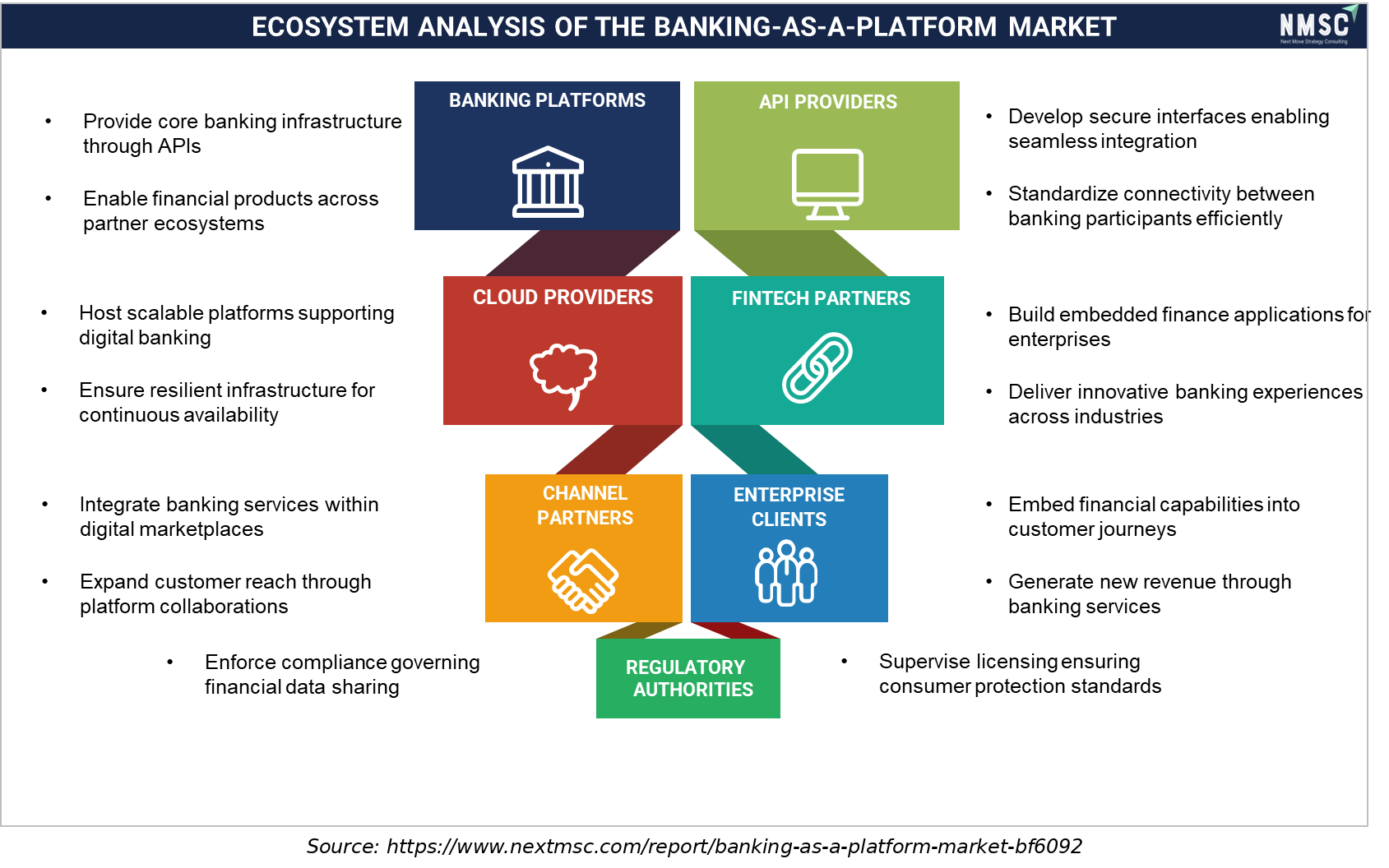
ECOSYSTEM ANALYSIS OF THE BANKING-AS-A-PLATFORM MARKET

The Banking-as-a-Platform ecosystem connects banking platforms with API providers, cloud providers, fintech partners, channel partners, enterprise clients, and regulatory authorities to deliver secure, scalable, and embedded financial services. Cloud infrastructure and APIs enable seamless integration, fintechs drive innovation, channel partners expand service reach, enterprise clients consume banking capabilities, and regulators ensure compliance, fostering a collaborative and interoperable digital banking ecosystem.

Market Drivers & Dynamics

Interactive Dataset
Rising embedded finance partnerships with non-financial brands driver +3.4% Global 2026–2035
Accelerating legacy core banking replacement among regional banks driver +2.8% Europe, Asia-Pacific 2026–2035
Expanding neobank and fintech licensing activity driver +2.6% Asia-Pacific, Latin America 2026–2035
Growing AI-driven orchestration and advisory platform demand driver +2.1% North America, Europe 2026–2033
Open banking regulatory mandates expanding API-first infrastructure adoption driver +1.7% Europe, Middle East & Africa 2026–2035
Rising SME and business banking digitalization driver +1.3% Global 2027–2035
Integration complexity with legacy bank IT infrastructure restraint −1.5% Global 2026–2035
Regulatory uncertainty around bank-fintech partnership oversight restraint −0.9% North America 2026–2032
High switching costs deterring core banking platform migration restraint −0.7% Global 2026–2035
Source: Next Move Strategy Consulting

Growth Drivers

What Is the Primary Growth Driver of the Banking-as-a-Platform Market?

Rising embedded finance partnerships with non-financial brands is the primary driver of the market. Retailers, travel companies, and technology platforms increasingly partner with licensed banking-as-a-platform providers to embed financial products without pursuing full banking licenses. We observed that this structural shift, reinforced by accelerating legacy core banking replacement among regional banks such as Akbank AG's 2026 migration to Mambu, continues to anchor baseline demand across banks and fintech buyers.

How Is Neobank Licensing Activity Driving Banking-as-a-Platform Market Growth?
Expanding neobank and fintech licensing activity is accelerating market growth toward composable, API-first platform adoption. Outpayce's selection of Mambu to launch its multi-currency digital wallet illustrates the scale of fintech demand entering the market. Our assessment indicates that this shift, combined with Temenos' 2026 acquisition of additiv to strengthen AI-driven wealth orchestration, is compressing the capability gap between traditional core banking vendors and specialized fintech infrastructure providers.

Growth Inhibitors

What Is Restraining Banking-as-a-Platform Market Expansion?
Integration complexity with legacy bank IT infrastructure restrains broader platform adoption among incumbent financial institutions operating decades-old core systems. Regulatory uncertainty around bank-fintech partnership oversight further complicates embedded finance program design in certain jurisdictions. We found that this combination of integration and regulatory barriers is concentrating near-term platform investment among digitally mature institutions and greenfield fintech launches, slowing adoption pace among smaller, resource-constrained regional banks.

Segmentation Analysis

2025 (USD Billion)
2035 (USD Billion)
Platform/Software 2025: $10.66 Billion | 2035: $52.07 Billion
Platform/Sof
Services 2025: $4.14 Billion | 2035: $26.83 Billion
Services
Platform/Software $10.66 Billion $52.07 Billion 17.1%
Services $4.14 Billion $26.83 Billion 20.9%

Which Component Segment Dominates the Banking-as-a-Platform Market?

Platform/Software led the market with USD 10.66 billion in 2025, supported by entrenched licensing revenue from core banking, digital engagement, and embedded finance platform deployments. We observed that Services is the fastest-growing component segment, expanding at a 20.9% CAGR from 2026 to 2035, as banks and fintechs increasingly rely on implementation and managed services partners to accelerate phased core migrations such as Akbank AG's 2026 Mambu deployment.

2025 (USD Billion)
2035 (USD Billion)
Cloud
On-Premise
Hybrid
Segment Item 2025 (USD Billion) 2035 (USD Billion) CAGR
Cloud $10.0 USD Billion $40.0 USD Billion 9.0%
On-Premise $17.1 USD Billion $51.1 USD Billion 23.0%
Hybrid $24.2 USD Billion $62.2 USD Billion 9.0%

Segment-wise data is locked

Unlock complete segment-wise numbers for By Deployment Mode.

Unlock Full Data
2025 (USD Billion)
2035 (USD Billion)
SMEs
Large Enterp
Segment Item 2025 (USD Billion) 2035 (USD Billion) CAGR
SMEs $10.0 USD Billion $40.0 USD Billion 10.0%
Large Enterprises $17.1 USD Billion $51.1 USD Billion 24.0%

Segment-wise data is locked

Unlock complete segment-wise numbers for By Organization Size.

Unlock Full Data
2025 (USD Billion)
2035 (USD Billion)
Retail Banki
Corporate an
SME and Busi
Wealth and I
Segment Item 2025 (USD Billion) 2035 (USD Billion) CAGR
Retail Banking $10.0 USD Billion $40.0 USD Billion 27.0%
Corporate and Commercial Banking $17.1 USD Billion $51.1 USD Billion 13.0%
SME and Business Banking $24.2 USD Billion $62.2 USD Billion 15.0%
Wealth and Investment Banking $31.3 USD Billion $73.3 USD Billion 13.0%

Segment-wise data is locked

Unlock complete segment-wise numbers for By Banking Type.

Unlock Full Data

Which Banking Type Leads Banking-as-a-Platform Market Demand?
Retail Banking remained the leading banking type within the market, valued at USD 6.81 billion in 2025 given its foundational role across account origination, payments, and consumer lending platform deployments. Our findings suggest that SME & Business Banking is the fastest-growing banking type, registering a 23.2% CAGR from 2026 to 2035, as platform vendors expand business banking modules to serve rising SME digitalization and embedded finance demand from business software platforms.

2025 (USD Billion)
2035 (USD Billion)
Banks and Cr
Fintechs and
Non-Bank Fin
Non-Financia
Segment Item 2025 (USD Billion) 2035 (USD Billion) CAGR
Banks and Credit Unions $10.0 USD Billion $40.0 USD Billion 26.0%
Fintechs and Neobanks $17.1 USD Billion $51.1 USD Billion 16.0%
Non-Bank Financial Institutions $24.2 USD Billion $62.2 USD Billion 18.0%
Non-Financial Brands (Embedded Finance) $31.3 USD Billion $73.3 USD Billion 8.0%

Segment-wise data is locked

Unlock complete segment-wise numbers for By End User.

Unlock Full Data

Which End User Segment Leads Banking-as-a-Platform Adoption?

Banks & Credit Unions remained the leading end user within the market, valued at USD 7.10 billion in 2025 given sustained core banking replacement and digital engagement platform investment among incumbent institutions. Our analysis shows that Non-Financial Brands are the fastest-growing end user, registering a 27.0% CAGR from 2026 to 2035, as retailers, travel companies, and technology platforms increasingly embed licensed banking infrastructure to launch branded financial products.

Growth Opportunities

Our analysis shows that three forward-looking opportunities stand out for stakeholders positioning within the banking-as-a-platform market over the 2026–2035 forecast period.

How Can Phased Migration Services Unlock Value for Services Providers?

Phased, low-disruption core banking migration presents a whitespace opportunity for services providers as regional banks seek alternatives to full rip-and-replace implementations. Providers that replicate the Akbank AG and Innovance migration model stand to capture recurring implementation revenue as mid-tier and regional banks pursue incremental modernization pathways rather than multi-year, high-risk core replacement programs.

Where Does AI-Driven Wealth Orchestration Create New Revenue for Platform Vendors?

Wealth and investment banking clients represent an underpenetrated opportunity as platform vendors expand beyond transactional core banking into AI-driven advisory orchestration. Vendors that replicate Temenos' 2026 additiv acquisition model stand to capture premium licensing revenue as banks and wealth managers seek integrated advisory capabilities embedded directly within their core banking infrastructure.

How Can Regional Partnership Networks Benefit Vendors Expanding Into Emerging Markets?

Vendors expanding into emerging markets represent an underpenetrated opportunity through regional partnership networks rather than direct enterprise sales. Vendors that replicate Temenos' 2026 Interswitch Group partnership model can secure long-term distribution relationships with regional financial institutions pursuing embedded finance and correspondent banking capabilities across underserved African and Southeast Asian markets.

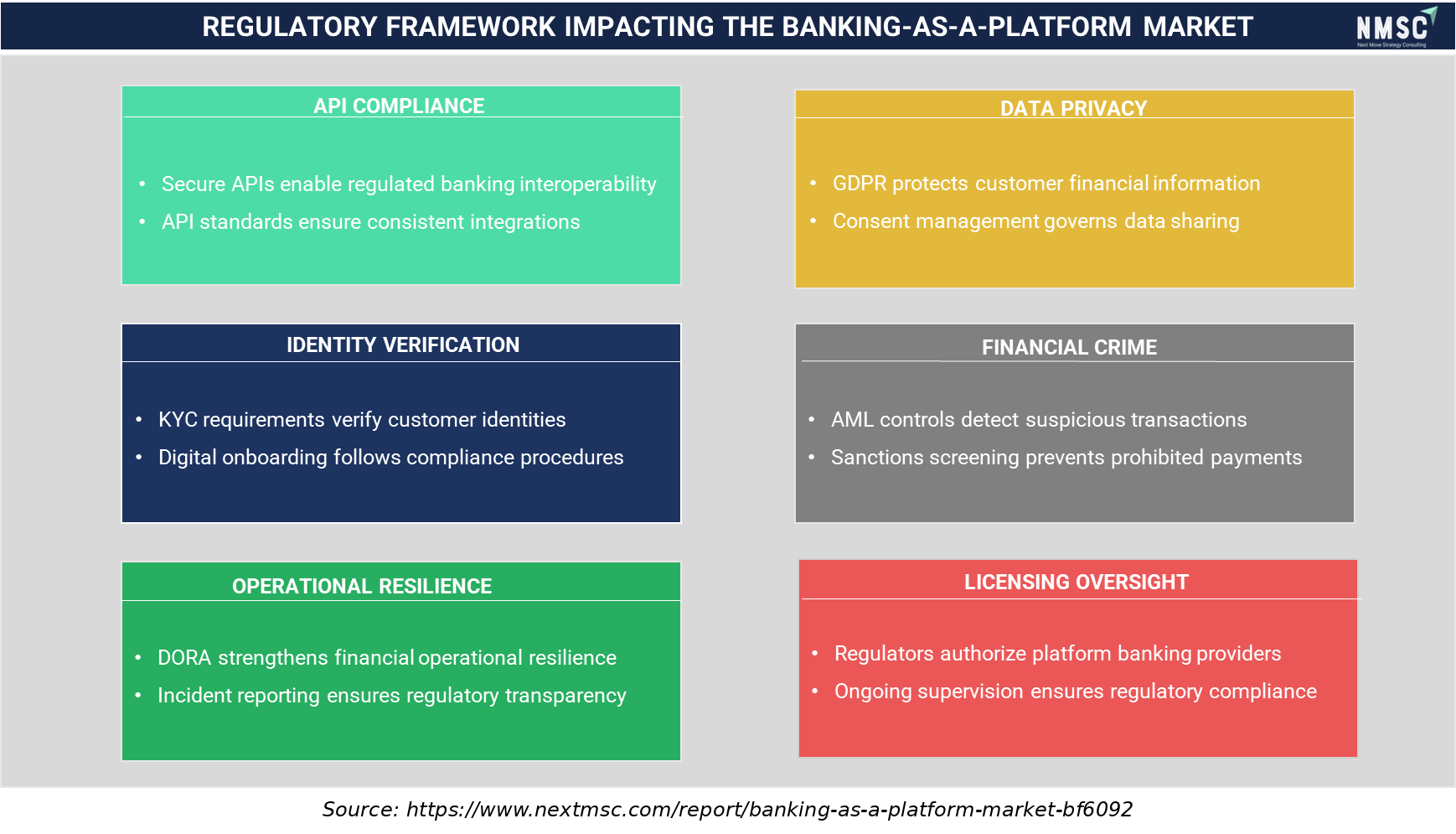
REGULATORY FRAMEWORK IMPACTING THE BANKING-AS-A-PLATFORM MARKET

The Banking-as-a-Platform market is shaped by regulations governing API compliance, data privacy, identity verification, financial crime prevention, operational resilience, and licensing oversight. Standards such as GDPR, KYC/AML requirements, and DORA promote secure data sharing, customer protection, cyber resilience, and regulatory transparency. These frameworks enable trusted digital banking ecosystems while ensuring platform providers maintain compliance, security, and operational stability across embedded financial services.

Regional Outlook

2025 (USD Billion)
2035 (USD Billion)
North Americ
Europe
Asia-Pacific
Latin Americ
Middle East
Region 2025 (USD Billion) 2035 (USD Billion) CAGR (%)
North America $10.0 USD Billion $40.0 USD Billion 9.0%
Europe $17.1 USD Billion $51.1 USD Billion 27.0%
Asia-Pacific $24.2 USD Billion $62.2 USD Billion 25.0%
Latin America $31.3 USD Billion $73.3 USD Billion 23.0%
Middle East & Africa $38.4 USD Billion $84.4 USD Billion 12.0%

Regional data is locked

Unlock complete regional numbers for this market.

Unlock Full Data

Competitive Landscape

We observed that the market features a moderately consolidated competitive landscape, with diversified enterprise core banking majors competing alongside cloud-native composable specialists on architecture modernity and implementation speed. Key Takeaways

Dimension Description
Market Structure Moderately consolidated; the top companies profiled in this report collectively account for a majority of global banking-as-a-platform market revenue, while numerous regional and specialized vendors serve niche fintech and neobank demand.
Innovation Focus AI-driven orchestration, composable core migration, and embedded finance infrastructure dominate current innovation pipelines across leading vendors.
M&A Activity Selective capability expansion through acquisition, exemplified by Temenos' June 2026 acquisition of additiv to strengthen its wealth and AI orchestration proposition.

How Do Companies Compete in the Banking-as-a-Platform Market?

Companies compete primarily on implementation speed, architecture modernity, and platform breadth across the industry. Diversified enterprise vendors such as Temenos and FIS leverage broad core banking and digital engagement portfolios to serve multinational financial institutions, while cloud-native specialists such as Mambu and Thought Machine compete on composable architecture and rapid, low-disruption migration timelines for digitally native fintechs and challenger banks.

Which Competitive Archetypes Dominate the Banking-as-a-Platform Market?

Two archetypes dominate the market: diversified enterprise core banking majors offering broad, multi-capability platform portfolios, and cloud-native composable specialists focused on rapid, API-first deployment. Temenos and FIS exemplify the diversified archetype through combined core, digital, and wealth capabilities, while Mambu and Thought Machine exemplify the composable specialist archetype through modular, cloud-native architecture purpose-built for fast-moving fintech and neobank clients.

How Are Companies Differentiating Through Innovation in Banking-as-a-Platform?

Innovation and differentiation strategy increasingly center on AI-driven orchestration and phased migration capability. Temenos' June 2026 acquisition of additiv and Mambu's April 2026 phased migration partnership with Akbank AG and Innovance both illustrate how leading vendors differentiate through advisory-layer AI integration and lower-risk implementation pathways. Our analysis shows that vendors unable to demonstrate rapid, incremental migration capability risk exclusion from regional bank modernization shortlists.

What M&A and Expansion Activity Is Shaping the Banking-as-a-Platform Market?

Mergers, acquisitions, and partnership expansion continue to shape competitive positioning within the industry. Temenos' acquisition of additiv and its Interswitch Group distribution partnership, both announced in June 2026, illustrate how leading vendors are pursuing both inorganic capability expansion and regional partnership networks to strengthen platform breadth and emerging market distribution reach simultaneously.

Key Market Players

Our assessment indicates that the following 20 companies are actively shaping platform innovation, AI capability development, and go-to-market strategy within the global banking-as-a-platform market.

Temenos AG Fiserv, Inc. FIS (Fidelity National Information Services, Inc.) Finastra Oracle Corporation SAP SE Infosys Limited (Finacle) Tata Consultancy Services Limited (TCS BaNCS) Mambu Thought Machine Backbase nCino, Inc. Q2 Holdings, Inc. Alkami Technology, Inc. Sopra Steria Group (Sopra Banking Software) Avaloq Group AG Intellect Design Arena Limited Marqeta, Inc. Galileo Financial Technologies, LLC Solarisbank SE

Latest Developments

We found that recent developments within the market are concentrated on capability acquisitions and regional distribution partnerships, reflecting the industry's shift toward AI-driven, composable platform strategies.

Date Event
February 2025 FirstRand Group selected Finxact by Fiserv to modernize its banking infrastructure with a cloud-native, real-time core banking platform, enabling faster deployment of digital banking services across multiple markets.

Expert Insights

Chris Dean

CEO & Co-founder | Treasury Prime

"The future of banking is embedded, with regulated institutions and technology firms working closely together to deliver critical financial services within new channels and apps, and the most successful fintechs are forging direct partnerships with banks."

Analyst Interpretation

Chris Dean's statement underscores the rapid evolution of the Banking-as-a-Platform (BaaP) market, where embedded finance and API-enabled banking are reshaping the financial services landscape. As businesses increasingly integrate banking capabilities directly into digital platforms and applications, banks are collaborating with fintech providers to deliver regulated financial products through third-party ecosystems. This trend is accelerating demand for BaaP solutions that enable scalable, secure, and compliant banking services, driving innovation in embedded payments, lending, and account services while expanding new revenue opportunities for financial institutions.

Investment Opportunities

What Capital Inflows Are Targeting the Banking-as-a-Platform Market?

Capital inflows into the market are increasingly directed toward AI orchestration capability and regional distribution partnerships. Temenos' June 2026 acquisition of additiv illustrates the scale of capital committed to advisory-layer AI integration. We observed that investors favor vendors demonstrating composable, low-disruption migration capability, viewing implementation speed as a proxy for long-term regional bank and fintech contract retention.

How Is Infrastructure Investment Supporting Banking-as-a-Platform Deployment?

Infrastructure investment is expanding cloud-native, multi-currency processing capacity to support rising fintech and cross-border payments demand. Mambu's selection by Outpayce for multi-currency digital wallet infrastructure exemplifies the scale of platform investment entering the market. Our findings suggest that vendors are investing in phased migration tooling to support incremental, lower-risk core banking modernization across Europe, Asia-Pacific, and Middle East & Africa.

What ESG Considerations Are Shaping Banking-as-a-Platform Investment Decisions?

Governance considerations are central to investment decisions across the industry, with data sovereignty and financial inclusion as key criteria. Temenos' partnership with Interswitch Group to expand platform access across African markets illustrates how vendors are prioritizing financial inclusion-linked distribution strategies. We found that investors increasingly favor vendors demonstrating regulatory-compliant, regionally distributed infrastructure, treating it as a governance indicator alongside data-handling compliance.

Key Benefits for Stakeholders

How Does This Report Benefit Enterprise and Industry Leaders?

Enterprise and industry leaders gain access to validated segmentation, competitive benchmarking, and regional demand forecasts that support sourcing and platform-selection decisions across the banking-as-a-platform industry. Our analysis shows that detailed component, banking type, and end-user breakdowns help procurement teams align specifications with regulatory and integration requirements while identifying underserved segments for portfolio expansion.

How Does This Report Benefit Investors and Financial Analysts?

Investors and financial analysts benefit from consistent, single-point market size and CAGR estimates that support valuation and capital-allocation decisions across the banking-as-a-platform supply chain. We observed that the report's regional and segment-level growth differentials help identify which vendors are best positioned to capture above-market growth in Middle East & Africa and embedded finance categories through 2035.

How Does This Report Benefit Technology Vendors and Product Teams?

Technology vendors and product teams gain insight into emerging platform requirements, including AI-driven orchestration, phased migration tooling, and multi-currency infrastructure, that are reshaping the industry. Our findings suggest that this analysis helps R&D teams prioritize development roadmaps around composable architecture and advisory-layer AI capabilities that are increasingly required by bank, fintech, and embedded finance buyer specifications.

Key Market Segments Evaluated

By Component

  • Platform/Software
  • Services

By Deployment Mode

  • Cloud
  • On-Premise
  • Hybrid

By Organization Size

  • SMEs
  • Large Enterprises

By Banking Type

  • Retail Banking
  • Corporate & Commercial Banking
  • SME & Business Banking
  • Wealth & Investment Banking

By End User

  • Banks & Credit Unions
  • Fintechs & Neobanks
  • Non-Bank Financial Institutions
  • Non-Financial Brands (Embedded Finance)

Conclusion & Recommendations

The long-term outlook remains highly favorable, with the market expected to grow more than fourfold from USD 17.4 billion in 2026 to USD 78.9 billion by 2035 at an 18.2% CAGR. We observed that this trajectory rests on accelerating embedded finance partnerships, expanding neobank licensing, and rising AI-driven orchestration adoption that together sustain demand across the forecast period.

What Strategic Positioning Should Stakeholders Pursue?

Stakeholders should pursue composable, AI-native platform strategies combined with regional partnership networks to compete against both legacy incumbents and fintech-native challengers. Our assessment indicates that vendors integrating advisory-layer AI with phased migration capability, following the pattern of Temenos' additiv acquisition and Mambu's Akbank AG deployment, are best positioned to secure long-term bank and fintech contracts across the banking-as-a-platform market.

How Attractive Is the Banking-as-a-Platform Market for New Investment?
The banking-as-a-platform industry presents a highly attractive investment case, supported by a USD 61.5 billion absolute dollar opportunity between 2026 and 2035 and above-average growth in Middle East & Africa and embedded finance categories. We found that investment attractiveness is highest for vendors combining composable architecture with AI orchestration capability, positioning them to serve both incumbent bank and fintech-native buyer segments simultaneously.

What Market Shifts and Key Risks Should Stakeholders Monitor?

Stakeholders should monitor integration complexity with legacy bank IT infrastructure, regulatory uncertainty around bank-fintech partnership oversight, and high switching costs as key risks to the market. Our analysis shows that vendors unable to demonstrate low-disruption migration pathways risk losing regional bank modernization contracts to competitors with proven phased implementation models, particularly as switching-cost sensitivity remains elevated among incumbent institutions.

What Are the Key Growth Pathways for the Banking-as-a-Platform Market?

Key growth pathways include scaling embedded finance partnerships with non-financial brands, expanding AI-driven wealth orchestration capability, and deepening regional distribution networks in underserved markets. Next Move Strategy Consulting's analysis indicates that vendors pursuing these pathways while maintaining core platform integration depth will be best positioned to capture the banking-as-a-platform market's projected growth through 2035.

FAQs

About the Author

Liza Phukan

Liza Phukan

Liza Phukan is Research Associate at Next Move Strategy Consulting, where she has covered emerging industries and market research across sectors for 3.5 years. Her work includes analyzing industry developments, validating market data, and developing structured business content from research findings. She uses secondary research and data-validation practices to turn complex market information into clear decision-useful market analysis for business audiences and support report development and B2B.

About the Reviewer

Supradip Baul

Supradip Baul

Supradip Baul is an accomplished business consultant and strategist with over a decade of rich experience in market intelligence, strategy, technology, and business transformation. His work has included rigorous qualitative and quantitative analysis across multiple industries, helping clients shape investment decisions and long-term roadmaps. Earlier in his career, he was associated with Gartner, where he contributed to industry-leading reports and market share analyses. He has worked with leading global companies and holds an MBA with a dual specialization in Marketing and Finance.

Download Free Sample

Amos Chang

AMOS CHANG

Strategy Consultant

Kardex Group

I have bought the intralogistics market reports from NMSC two times so far. Joseph and his team are always very helpful and flexible in responding to any customization requirements on the report. Their expertise in market reports really helps us steer the day-to-day business. I will definitely recommend and come back myself whenever there is a need.

Ross J Mckenzie

ROSS J MCKENZIE

Business Insight Manager

Staysure Group

“Next MSC have been incredibly helpful in providing detailed & robust information on our market, alongside quantifying growth by different segments. The process to procure was simple and easy, with sample reports and regular contact to ensure we had what we needed. Succinct detail on their sources & methodologies is also greatly received, allowing transparency in this respect helps build trust in the detail you pay for. Joseph in particular was fantastic, and helped ensure efficient provision of the insight pack – thank you NMSC!”.

Henri Knyphausen

HENRI KNYPHAUSEN

Partner at Singulier [Ex-BCG]

Singulier

I recently engaged NEXTMSC.com for a commercial due diligence project within the intralogistics sector, and I am pleased to provide a reference based on my experience. In utilizing NEXTMSC.com's services, I found their report to offer valuable insights into market dynamics and key industry players. The initial report provided a solid foundation for our analysis. However, as we were investigating a smaller target in the market, and I had specific customization requests requiring additional research. These requests included detailed information on product portfolios of various players and sub-market sizes, both inclusive and exclusive of certain product categories. NEXTMSC.com demonstrated commendable responsiveness and agility in accommodating these customization requests. Within a timeframe of 1-2 weeks, they delivered a revised report that met our specific needs. Furthermore, they were receptive to my follow-up inquiries, ensuring clarity and understanding of the data provided. The final deliverable significantly contributed to our due diligence efforts. One of NEXTMSC.com's notable strengths lies in their qualitative research capabilities. However, for future engagements, I would recommend the inclusion of a quantified market model in Excel format. Such a model would offer the ability to conduct in-depth analyses and explore various market segments, including country-specific data and subcomponent breakdowns. Based on my positive experience, I would not hesitate to work with NEXTMSC.com again. Their responsiveness, willingness to accommodate customization requests, and commitment to delivering actionable insights make them a reliable partner for commercial research projects.

Semih Kavaklioglu

SEMIH KAVAKLIOGLU

Co-Founder & Sales Manager

Decortie

I work a lot in the marketing industry and I know that research is an essential part of any campaign. I have used Market research reports for my own products and I found them to be very informative and well-researched. The team here produces insightful reports for a good price

Nishant Awate

NISHANT AWATE

Business Development Global Sales

Zehnder Group Deutschland GmbH

Our experience working with Next Move Strategy Consulting was positive. The team was responsive, professional, and open to incorporating our specific requirements throughout the project. The India AHU market study was comprehensive and well structured, covering market value and volume forecasts, product and application segments, and key industry trends. The inclusion of both AHU and residential MVHR market insights made the study particularly relevant for our strategic market assessment. Overall, the report provides a solid foundation for evaluating market potential, identifying priority segments, and supporting business-development decisions in India.

Custom Market Research Services

We will customize the research for you if the listed report does not fully match your requirements.

Get 30% Free Customization

Select License

This website uses cookies to ensure you get the best experience on our website. Learn more

✖