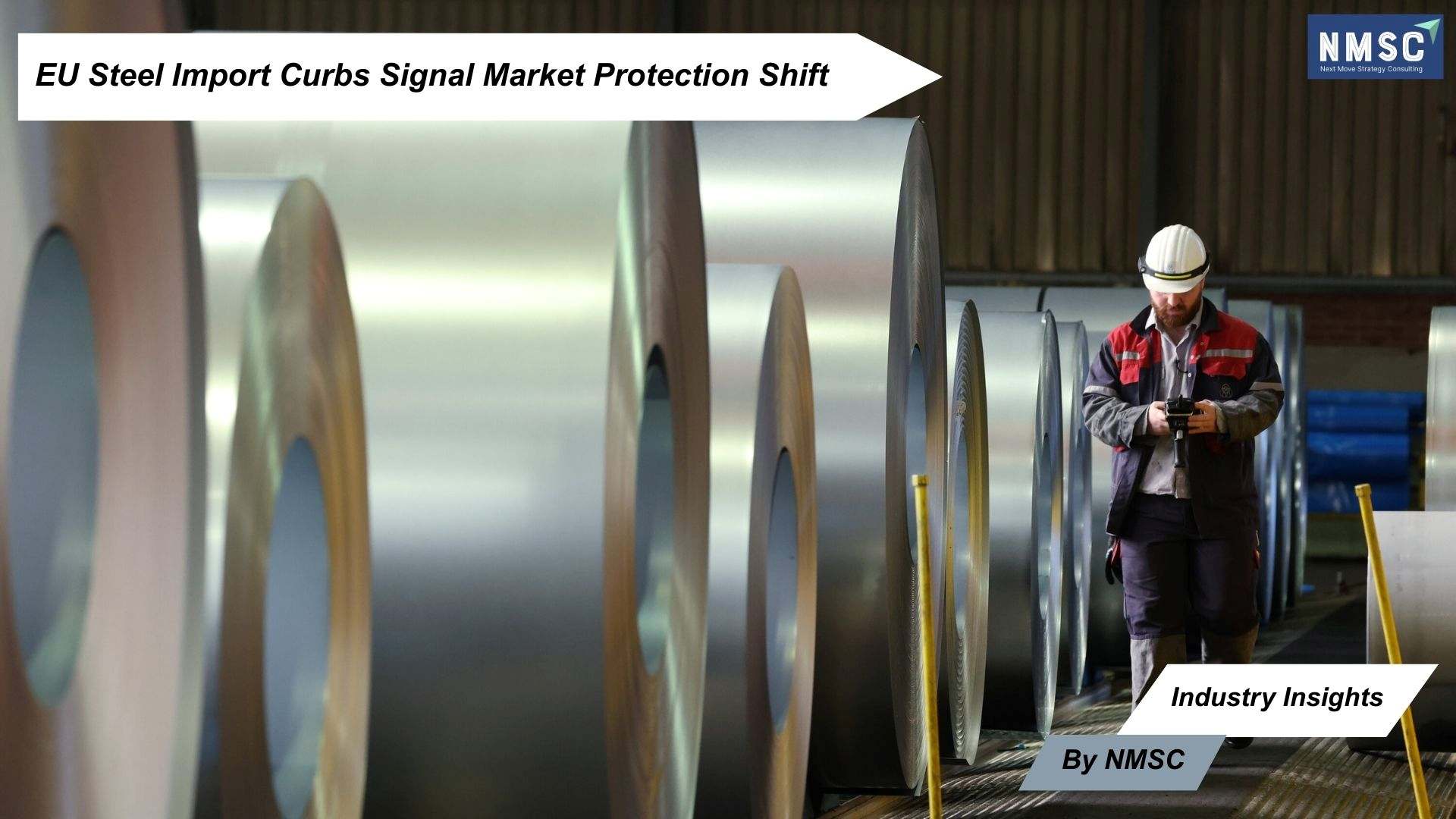
EU Steel Import Curbs Signal Market Protection Shift
Industry Insights from Next Move Strategy Consulting
The European Commission has introduced a proposal aimed at tightening steel import regulations across the European Union, reflecting growing concerns over global steel overcapacity and its impact on domestic producers. The proposed measures include reduced tariff-free import volumes, increased duties on excess imports, and new traceability requirements designed to strengthen oversight of the steel supply chain. The initiative is expected to play a significant role in shaping the regional steel trade environment while reinforcing the EU’s long-term industrial and decarbonisation objectives.
Stronger Trade Controls to Address Market Imbalances
Under the proposed regulation, tariff-free steel import volumes would be limited to 18.3 million tonnes annually, representing a 47% reduction compared with 2024 limits. Imports exceeding this quota would be subject to out-of-quota duties of 50%, significantly higher than current levels. The measures would apply to steel imports from all countries except members of the European Economic Area (EEA), which includes EU countries along with Iceland, Liechtenstein, and Norway.
By tightening quotas and raising duties, the proposal aims to counteract the impact of excess global steel supply and stabilize the EU’s domestic steel industry.
New Traceability Standards for Steel Imports
A key component of the proposal is the introduction of a “melt & pour” requirement, which would require importers to disclose where steel was melted and where it was poured into its final form. This requirement is intended to improve traceability within the EU steel supply chain and strengthen regulatory transparency for imported materials. The measure reflects a broader effort to enhance monitoring of steel trade flows while supporting fair market conditions.
Global Overcapacity Driving Policy Action
The European Commission highlighted global steel overcapacity as a major concern influencing the proposal. Global excess production capacity is projected to reach 721 million tonnes by 2027, equivalent to roughly five times the EU’s annual steel consumption. This imbalance has increased pressure on regional producers and intensified calls for stronger trade safeguards. Negotiations between the European Commission, the European Parliament, and the Council will focus on finalising the regulation so that it can take effect by 1 July, coinciding with the expiration of the EU’s current steel safeguard measures.
Strategic Importance of the Steel Sector
The proposal also underscores the strategic role of steel in Europe’s industrial base. Approximately 2.5 million jobs are linked to steel production across the region, highlighting the sector’s economic significance. In addition to employment considerations, the regulation aligns with the EU’s broader decarbonisation goals, reflecting the importance of maintaining a stable and competitive steel industry during the transition to lower-emission production processes.
Industry Outlook
According to Next Move Strategy Consulting, evolving trade policies and regulatory frameworks are becoming increasingly important factors influencing the global steel market. Measures such as import controls and supply-chain traceability requirements are expected to shape competitive dynamics and encourage greater transparency across international steel trade. As governments respond to global overcapacity and industrial sustainability priorities, policy-driven market adjustments are likely to play a defining role in the future direction of the steel industry.
Source: The Brussels Times Newsroom
Prepared By: Next Move Strategy Consulting
About the Author
 Sanyukta Deb
— Sanyukta Deb is Digital Marketing Team Lead at Next Move Strategy Consulting, where she has led content strategy and technical SEO for the firm's B2B market research publications for over 2 years. Her editorial process translates NextMSC's primary and secondary research — spanning technology, industrial, and consumer sectors — into commercial narratives, backed by search-intent, keyword, and competitive analysis. She brings 5 years of overall experience in digital marketing and content strategy.
Sanyukta Deb
— Sanyukta Deb is Digital Marketing Team Lead at Next Move Strategy Consulting, where she has led content strategy and technical SEO for the firm's B2B market research publications for over 2 years. Her editorial process translates NextMSC's primary and secondary research — spanning technology, industrial, and consumer sectors — into commercial narratives, backed by search-intent, keyword, and competitive analysis. She brings 5 years of overall experience in digital marketing and content strategy.
About the Reviewer
 Debashree Dey
— Debashree Dey is Assistant Manager at Next Move Strategy Consulting, where she supports cross-vertical market content and communications across diverse industries for 6 years. Her professional background includes senior content writing, communications, and published manuscript authorship, with experience developing audience-focused business narratives and maintaining clear, consistent messaging. Her role supports research-led content development and editorial quality across NextMSC publications.
Debashree Dey
— Debashree Dey is Assistant Manager at Next Move Strategy Consulting, where she supports cross-vertical market content and communications across diverse industries for 6 years. Her professional background includes senior content writing, communications, and published manuscript authorship, with experience developing audience-focused business narratives and maintaining clear, consistent messaging. Her role supports research-led content development and editorial quality across NextMSC publications.















Add Comment