NASA Advances Metal 3D Printing Qualification
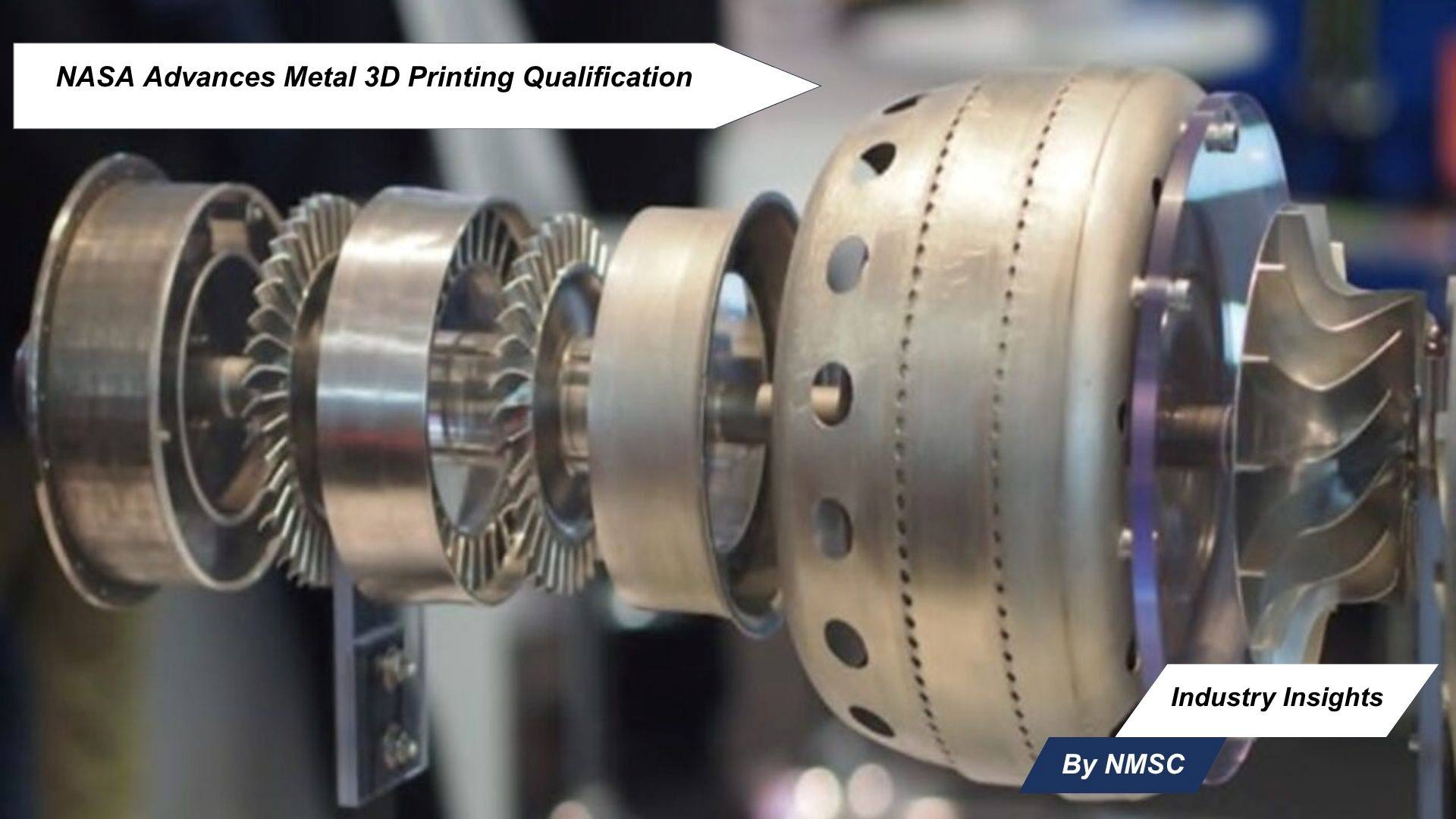
NASA Selects Phase3D for Real-Time Metal Additive Manufacturing Qualification Program
HUNTSVILLE, United States — August 18, 2026 — NASA Marshall Space Flight Center has selected Phase3D to demonstrate a "born qualified" approach to metal additive manufacturing, deploying real-time in-situ inspection technology on a production-scale laser powder bed fusion system to fundamentally transform how flight-critical components are certified. The programme carries broad implications for the 3D Printing Metals Market, where qualification bottlenecks have long constrained wider adoption of metal additive manufacturing in aerospace and other safety-critical industries.
Under the newly announced programme, Phase3D will deploy its Fringe Inspection and Fringe Qualification systems on a large-format EOS M300-4 quad-laser system, working alongside a confidential U.S. aerospace prime and space propulsion manufacturer. The initiative will capture more than 50,000 individual build layers of topology-optimised Invar 36 brackets — representative of structural spaceflight components — generating one of the most comprehensive in-situ inspection datasets yet assembled for production-scale qualification research.
The programme directly addresses one of the most persistent barriers in metal additive manufacturing: post-build qualification. NASA estimates that certifying a single metal additively manufactured component for spaceflight currently requires more than 18 months, with rejection rates reaching as high as 30 percent for certain applications. By measuring quality continuously throughout the build process rather than solely after completion, the "born qualified" methodology seeks to reduce reliance on costly downstream inspection while providing traceable, auditable manufacturing records.
The work aligns with NASA Civil Space Shortfalls 1490 through 1494 and supports established aerospace standards including NASA-STD-6030, NASA-STD-6033, and SAE AMS7032, which define requirements for qualifying metal additive manufactured components and processes for flight-critical applications.
Key Highlights:
-
Real-Time Layer Inspection: Phase3D's Fringe Inspection system uses structured light projection to generate calibrated, metrology-grade three-dimensional height measurements after each powder layer deposition and laser exposure, enabling continuous process monitoring throughout the build.
-
Unprecedented Dataset Scale: The programme will capture data across more than 50,000 individual build layers, with results correlated against post-build CT scanning to establish quantitative go/no-go qualification thresholds applicable to future production programmes.
-
Multi-Standard Compliance: The qualification workflows are aligned with NASA-STD-6030, NASA-STD-6033, and SAE AMS7032, ensuring that quality data is objective, traceable, and suitable for aerospace certification.
-
Cross-Industry Applicability: Although focused on spaceflight hardware, the technologies and workflows being developed are directly applicable to defence, energy, medical devices, and industrial manufacturing sectors facing identical qualification challenges.
Analyst Insight:
According to analysts at Next Move Strategy Consulting, the NASA-Phase3D programme represents a pivotal inflection point for the metal additive manufacturing qualification landscape. The shift from post-build verification to continuous, layer-wise quality assurance has the potential to significantly compress certification timelines and reduce per-part qualification costs — two factors that have historically limited the scalability of metal 3D printing in regulated industries.
NMSC analysts note that as the 3D Printing Metals Market — valued at USD 1.44 billion in 2023 and projected to reach USD 8.34 billion by 2030 at a CAGR of 28.6% — transitions from prototyping into serial production, the adoption of standardised, real-time qualification frameworks will be a critical enabler of sustained market expansion, particularly within aerospace, defence, and healthcare verticals.
Industry Outlook:
The selection of Phase3D by NASA Marshall Space Flight Center signals a broader industry shift toward embedding quality assurance directly within the manufacturing process rather than treating it as a separate, post-production stage. As metal additive manufacturing scales across regulated industries, the demand for deployable, standards-aligned in-situ inspection technologies is expected to intensify.
The data generated through this programme — correlating real-time layer measurements with CT-detected porosity and post-build inspection outcomes — is anticipated to inform qualification thresholds across future production programmes well beyond the aerospace sector. For manufacturers in defence, energy, and medical devices, the frameworks being validated through this initiative offer a credible pathway toward reducing inspection bottlenecks, shortening time-to-certification, and supporting wider adoption of metal additive manufacturing at production scale.
As Dr. Niall O'Dowd, Founder and CEO of Phase3D, stated: "With Fringe Inspection, the part is qualified as it is built. Every powder layer, every weld and every anomaly becomes part of a calibrated, defensible record of quality."
Source: Metrology and Quality News – Metrology.news
For More Information: Download FREE Sample on 3D Printing Metals Market Report
Prepared By: Sanyukta Deb
About the Author
 Sanyukta Deb
— Sanyukta Deb is Digital Marketing Team Lead at Next Move Strategy Consulting, where she has led content strategy and technical SEO for the firm's B2B market research publications for over 2 years. Her editorial process translates NextMSC's primary and secondary research — spanning technology, industrial, and consumer sectors — into commercial narratives, backed by search-intent, keyword, and competitive analysis. She brings 5 years of overall experience in digital marketing and content strategy.
Sanyukta Deb
— Sanyukta Deb is Digital Marketing Team Lead at Next Move Strategy Consulting, where she has led content strategy and technical SEO for the firm's B2B market research publications for over 2 years. Her editorial process translates NextMSC's primary and secondary research — spanning technology, industrial, and consumer sectors — into commercial narratives, backed by search-intent, keyword, and competitive analysis. She brings 5 years of overall experience in digital marketing and content strategy.
About the Reviewer
 Debashree Dey
— Debashree Dey is Assistant Manager at Next Move Strategy Consulting, where she supports cross-vertical market content and communications across diverse industries for 6 years. Her professional background includes senior content writing, communications, and published manuscript authorship, with experience developing audience-focused business narratives and maintaining clear, consistent messaging. Her role supports research-led content development and editorial quality across NextMSC publications.
Debashree Dey
— Debashree Dey is Assistant Manager at Next Move Strategy Consulting, where she supports cross-vertical market content and communications across diverse industries for 6 years. Her professional background includes senior content writing, communications, and published manuscript authorship, with experience developing audience-focused business narratives and maintaining clear, consistent messaging. Her role supports research-led content development and editorial quality across NextMSC publications.

















Add Comment