EU’s Automotive OBD Access Overhaul Redraws Carmaker and Repairer Roles
Regulation 2026/699 took effect on 23 June, Euro 7 reaches new car and van types on 29 November, and Snap-on’s October filing shows OEM-dealer diagnostics activity falling faster than independent-shop sales
On 23 June 2026, Commission Delegated Regulation (EU) 2026/699 entered into force across the European Union, giving vehicle manufacturers a defined legal route to protect on-board diagnostics (OBD) data against cyberattacks while obliging them to keep that data open to independent workshops and diagnostic tool makers. The European Commission adopted the act on 23 March 2026, and EUR-Lex, the EU’s legal database, records its publication in the Official Journal of the European Union on 3 June 2026, with entry into force on the twentieth day after publication. The act responds to the Court of Justice of the European Union’s 5 October 2023 judgment in Case C-296/22, which, as the Council of the European Union’s document 7952/26 records, barred manufacturers from making OBD access conditional on requirements beyond those in Regulation (EU) 2018/858. A second deadline is less than two weeks away: from 29 November 2026, EU approval authorities must refuse emission type-approval to new car and van types that do not meet Euro 7, a regime that also places on-board monitoring data on the standard OBD port.
According to Next Move Strategy Consulting’s Automotive On-Board Diagnostics (OBD) Market analysis, the global Automotive OBD Market was valued at USD 68.14 billion in 2025 and is projected to reach USD 181.77 billion by 2035, growing at a CAGR of 9.92% from 2026 to 2035. NextMSC primary research and analysis places the 2026 value at USD 77.62 billion and identifies emission regulation, fleet telematics and rising software content per vehicle as the structural forces behind that trajectory, with Asia-Pacific holding about 36% of 2025 revenue.
For More Information: Download FREE Sample on Automotive OBD Market Report
How Regulation 2026/699 Resolves the Secure-Gateway Dispute
The regulation grew out of a conflict between two EU rulebooks. Regulation (EU) 2019/2144 requires manufacturers to protect vehicles against cyberattacks, while Regulation (EU) 2018/858 obliges them to give independent operators unrestricted, standardised and non-discriminatory access to OBD information. In the explanatory memorandum to the draft act, circulated by the Council of the European Union on 1 April 2026 as document 7952/26, the European Commission concluded that existing legislation prevented manufacturers from applying effective protective measures to OBD access. It therefore amended points 1, 2, 6 and 7 of Annex X to Regulation (EU) 2018/858 and introduced a new Appendix 4 that lays down the conditions and procedures for applying security measures. Before adopting the act, the Commission ran a four-week public feedback period from 4 November to 2 December 2025, to which 54 stakeholders responded, and the Member States Expert Group endorsed the draft on 28 January 2026.
Legislative Timeline of Delegated Regulation (EU) 2026/699
|
Date |
Milestone |
Detail |
|
4 November – 2 December 2025 |
Public feedback period |
Four-week consultation on the Commission’s Have your say portal; 54 stakeholders provided feedback |
|
28 January 2026 |
Member State endorsement |
Member States Expert Group endorsed the draft act |
|
20 February 2026 |
Data protection opinion |
European Data Protection Supervisor delivered its opinion on the draft |
|
23 March 2026 |
Adoption |
Commission adopted the act as document C(2026) 1811 final |
|
3 June 2026 |
Publication |
Published in the Official Journal of the European Union |
|
23 June 2026 |
Entry into force |
Twentieth day following publication, under Article 2 |
What Manufacturers, Workshops and Tool Makers Must Now Do
According to the analysis the law firm Noerr published on 22 June 2026, Appendix 4 allows manufacturers to require authentication of the diagnostic tool and its manufacturer and, where access involves changes to the vehicle, authentication of the independent operator and in certain cases the individual employee. Noerr notes that the act sets no separate transition period for Appendix 4, so the security rules applied from 23 June 2026, and it lists staged obligations after that date: API information for activities other than software updates from 23 September 2026; a general deadline of 23 December 2026 for providing software, web services and information to independent diagnostic tool manufacturers; VIN-related information packages only through an API from 23 June 2027; and obligations covering software-update-dependent activities from 23 June 2028.
The regulation text, as published on EUR-Lex, adds a financial condition. In the cases referred to in point 3.2 of the act’s security rules, a manufacturer may refuse to issue access credentials unless the tool manufacturer attests that the operator holds liability insurance of at least EUR 1 million for bodily injury and EUR 0.5 million for property damage and pursues a legitimate business activity in the automotive sector.
The act also widens what counts as repair information. Noerr reports that Annex X now covers further information on ADAS/DCAS, battery diagnostics, battery repair and the safe handling of battery components, and that access to the vehicle data stream extends beyond the OBD port to other on-board interfaces and remote systems used within the authorised network. In its explanatory memorandum, the European Commission states that the new measures are expected to significantly improve the repairability of electric vehicles and reduce their repair costs.
FIGIEFA, which represents distributors of automotive spare parts in Europe, endorsed the draft act in its feedback to the Commission’s public consultation, which ran from 4 November to 2 December 2025, describing it as a sound balance between independent operators’ access rights and manufacturers’ cybersecurity needs. The association also warned of a new paradigm for the aftermarket in which independent operators depend significantly more on vehicle manufacturers, notably for timely information to build multi-brand diagnostic tools and for manufacturer servers to be available for authentication.
Euro 7 Moves OBD Data Into Type-Approval From 29 November
Regulation (EU) 2024/1257, known as Euro 7, applies from 29 November 2026 to new types of category M1 and N1 vehicles and from 29 November 2027 to all new vehicles in those categories, according to EUR-Lex. The European Parliament Legislative Observatory’s summary of the final act sets 29 May 2028 for new types of buses, lorries and trailers and 29 May 2029 for new vehicles. The regulation requires on-board monitoring (OBM) systems capable of monitoring exhaust emissions, and the European Commission’s Implementing Regulation (EU) 2025/1707, published in September 2025, requires manufacturers to make all stored OBM data and the OBM instantaneous signals that support emissions testing accessible through the standard OBD port using a generic scan tool. The implementing act defines OBM data to include battery durability data.
Euro 7 Application Dates by Vehicle Category
|
Date |
Applies to |
Requirement |
|
29 November 2026 |
New types of cars and vans (M1, N1) |
Approval authorities must refuse emission type-approval to non-compliant new types |
|
29 November 2027 |
All new cars and vans (M1, N1) |
Regulation applies to new vehicles in these categories |
|
29 May 2028 |
New types of buses, lorries and trailers |
Regulation applies to new types in these categories |
|
29 May 2029 |
All new buses, lorries and trailers |
Regulation applies to new vehicles in these categories |
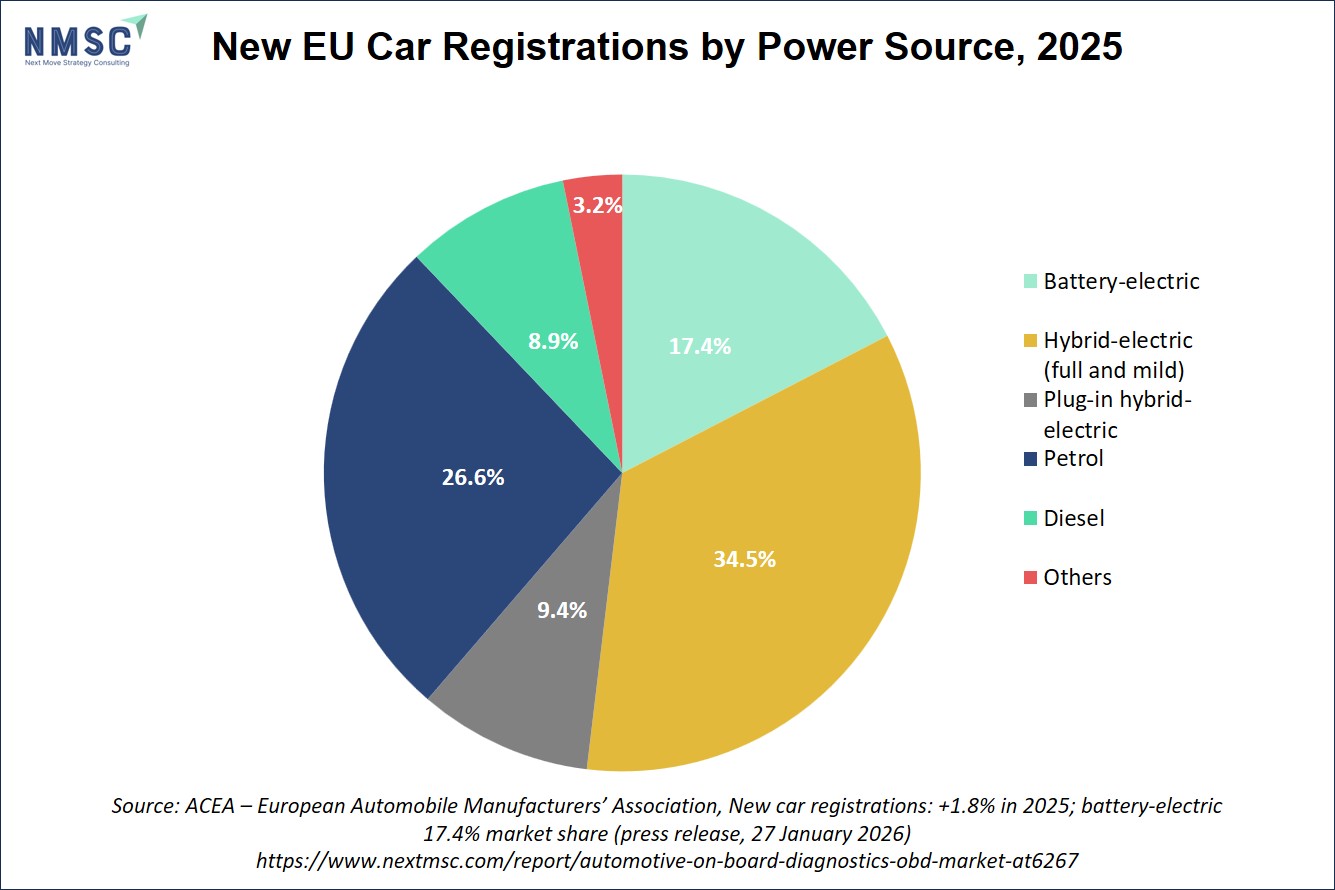
The powertrain mix that diagnostic tools must read is shifting in parallel. ACEA, the European Automobile Manufacturers’ Association, reported on 27 January 2026 that 10,822,831 new cars were registered in the European Union in 2025, up 1.8%, of which 1,880,370 were battery-electric (a 17.4% share), 3,733,325 hybrid-electric (34.5%) and 1,015,887 plug-in hybrid (9.4%). The combined share of petrol and diesel cars fell to 35.5% from 45.2% in 2024, and ACEA describes the 2025 figures as provisional. Because Annex X now obliges manufacturers to supply battery diagnostics and battery repair information, independent tool makers need that information for the vehicles that ACEA’s data show gaining share.
Snap-on’s October Filing Shows Where Diagnostic Demand Is Under Pressure
Snap-on Incorporated, which reports diagnostics and repair information as a business group of its own, published its third-quarter 2026 results on 22 October 2026. Net sales of USD 1,183.7 million were 0.6% below the prior-year quarter, and the Repair Systems & Information Group reported segment sales of USD 454.7 million against USD 464.8 million a year earlier, an organic decline of 5.5% that the company attributed primarily to reduced activity with OEM dealerships. The Snap-on Incorporated 10-Q filing for the quarter ended 3 October 2026 puts numbers on the split: a double-digit decline in activity with OEM dealerships and only a low single-digit reduction in sales of diagnostic and repair information products to independent repair shop owners and managers.
“Our proprietary databases are increasingly effective at streamlining work in independent vehicle repair shops”
- Nick Pinchuk, Chairman and Chief Executive Officer, Snap-on Incorporated, Snap-on Announces Third Quarter 2026 Results (Form 8-K, Exhibit 99), October 22, 2026.
Independent shops are the buyers that Regulation 2026/699 is written to serve, and they are the customers Snap-on cites when describing where its databases are gaining traction. The prior-year Repair Systems & Information operating margin of 30.4% included a USD 22.0 million benefit from a legal settlement, equal to 480 basis points, which accounts for 480 of the 490 basis points of the decline to 25.5%. Elsewhere in the company, the Commercial & Industrial Group posted sales of USD 404.3 million and a 7.4% organic gain, while the Snap-on Tools Group’s sales fell 7.0% organically after a rise in diesel prices led franchisees to cut inventories, according to the same release.
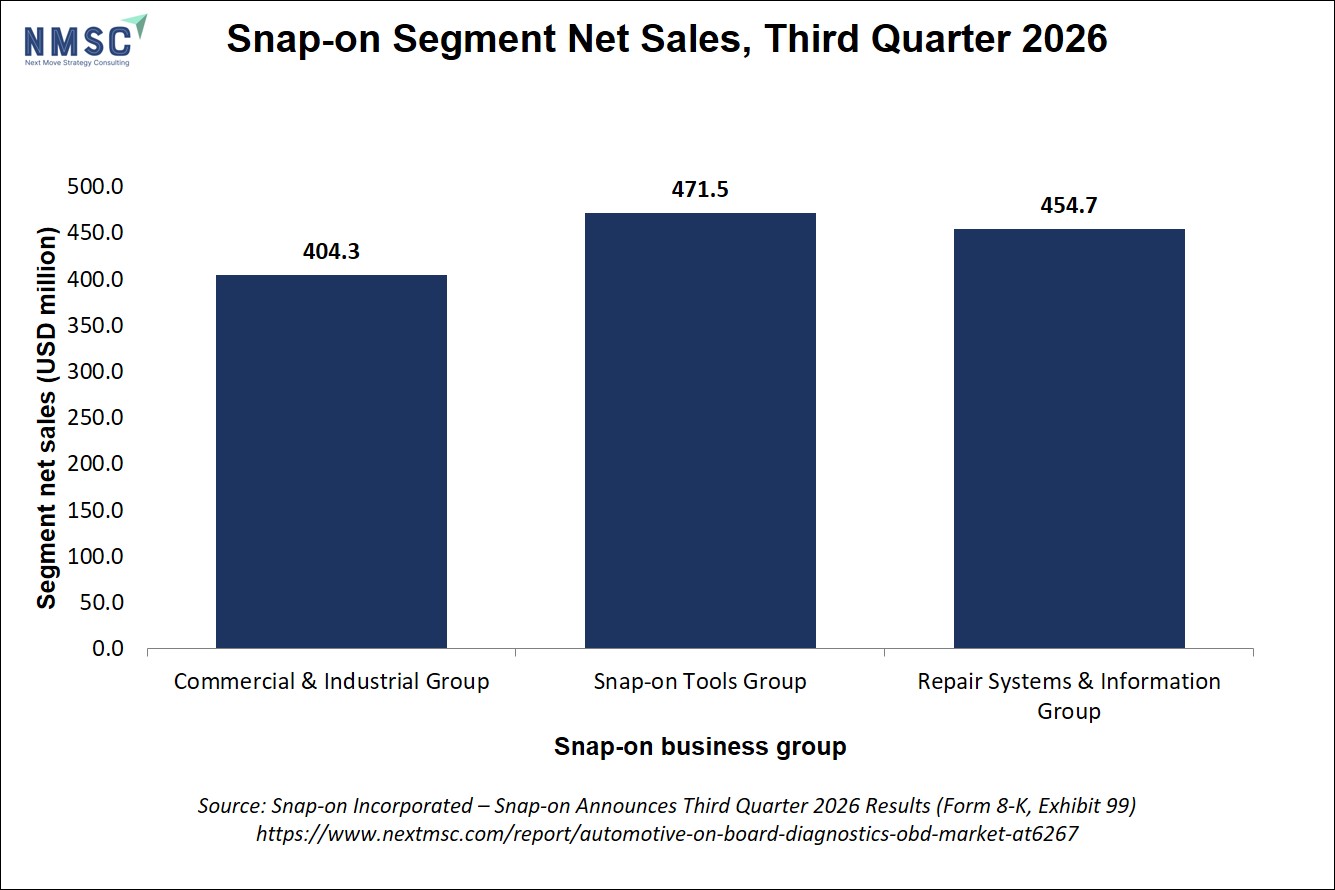
Segment net sales are shown before intersegment eliminations of USD 146.8 million, which Snap-on deducts to reach total net sales of USD 1,183.7 million.
Snap-on Segment Results, Third Quarter 2026 Against Third Quarter 2025
|
Segment |
Net sales Q3 2026 (USD million) |
Net sales Q3 2025 (USD million) |
Organic sales change |
Operating margin Q3 2026 |
Operating margin Q3 2025 |
|
Commercial & Industrial Group |
404.3 |
367.7 |
+7.4% |
18.5% |
15.6% |
|
Snap-on Tools Group |
471.5 |
506.0 |
-7.0% |
18.0% |
21.7% |
|
Repair Systems & Information Group |
454.7 |
464.8 |
-5.5% |
25.5% |
30.4% |
NMSC Strategic Perspective: Regulation Sets the Floor, Software Sets the Growth
NextMSC primary research and analysis treats regulation, not discretionary demand, as the anchor of this market. Its model attributes +2.10% to CAGR to tightening emission and OBD rules, including Euro 7, the U.S. EPA framework, China VI and Bharat Stage VI, and values cybersecurity and privacy limits on OBD port access at −0.75% of CAGR through 2030, within a combined drag of about 1.85% that also includes rising battery-electric share. Regulation 2026/699 bears directly on the port-access drag: by defining which security measures are lawful, it narrows the room for manufacturers to close the OBD port to independent tool makers and turns an open-ended legal dispute into a compliance schedule that ends in June 2028.
By offering, NextMSC primary research and analysis puts hardware at USD 38.16 billion in 2025, rising to USD 83.61 billion by 2035 at a 7.75% CAGR, software at USD 19.08 billion rising to USD 65.44 billion at 12.68%, and services at USD 10.90 billion rising to USD 32.72 billion at 11.22%. The gap in growth rates follows the mechanism the regulation formalises: each new diagnostic standard, from OBDonUDS to remote monitoring, converts a one-time hardware sale into recurring licence and data revenue. Appendix 4’s authentication, traceability and API requirements add recurring integration work for tool makers, which favours vendors with software depth over those selling protocol-limited hardware.
Regionally, NextMSC primary research and analysis sizes Asia-Pacific, the largest region, at USD 24.53 billion in 2025, against USD 18.40 billion for North America and USD 16.35 billion for Europe. Middle East & Africa is the fastest-growing region at 11.57% CAGR from 2026 to 2035, India the fastest-growing country at 15.41%, and the U.S. the largest national market at USD 14.72 billion in 2025. Europe, where the new access rules apply, is projected to grow at 8.21%, a mature pace tempered by falling combustion volumes and strict data protection rules, so value creation there depends on software and services more than on unit volume.
Competitive Landscape
NextMSC primary research and analysis identifies three competitive archetypes: global tier-one suppliers such as Robert Bosch GmbH, DENSO Corporation, ZF Friedrichshafen AG and Aptiv PLC, which embed diagnostics in controllers, gateways and vehicle architecture; workshop tool specialists including Snap-on, Autel, Launch Tech and TEXA, which compete on vehicle coverage and repair information; and fleet and telematics providers such as Geotab, which compete on analytics and scale. The Snap-on Incorporated Q2 2026 results release, dated 23 July 2026, reported that the company completed its acquisitions of Hi-Force Hydraulic Tools and Diesel Laptops during the quarter, the latter to add capabilities in diagnostics, repair information and digital solutions for commercial truck and off-highway vehicle markets. The third-quarter release shows USD 15.6 million of acquisition-related sales in the Repair Systems & Information Group. For all vendors, 23 December 2026 is the general date by which manufacturers must have supplied independent diagnostic tool manufacturers with the software, web services and information the act requires.
Bottom Line
Regulation (EU) 2026/699 entered into force on 23 June 2026 and replaced a stalemate over secure gateways with a dated compliance schedule that runs to June 2028. Euro 7 reaches new car and van types on 29 November 2026 and places on-board monitoring data, including battery durability data, on the standard OBD port. Snap-on’s third-quarter filing shows the commercial pressure behind these rules: diagnostics and repair information sales fell 5.5% organically as OEM dealership activity weakened, while sales of diagnostic products to independent shops slipped at only a low single-digit rate. ACEA data show battery-electric cars at 17.4%, hybrid-electric cars at 34.5% and plug-in hybrids at 9.4% of EU registrations in 2025. NextMSC primary research and analysis expects the global market to grow from USD 68.14 billion in 2025 to USD 181.77 billion by 2035 at a 9.92% CAGR, with software, at 12.68%, growing faster than hardware, at 7.75%.
About Next Move Strategy Consulting
Next Move Strategy Consulting is a premier market research and management consulting firm that has been committed to provide strategically analysed well documented latest research reports to its clients. The research industry is flooded with many firms to choose from, what makes NMSC different from the rest is its top-quality research and the obsession of turning data into knowledge by dissecting every bit of it and providing fact-based research recommendation that is supported by information collected from over 500 million websites, paid databases, industry journals and one on one consultations with industry experts across a diverse range of industry sectors. The high-quality customized research reports with actionable insights and excellent end-to-end customer service help our clients to take critical business decisions that enables them to move beyond time and have competitive edge in the industry.
We have been servicing over 1000 customers globally that includes 90% of the Fortune 500 companies over a decade. Our analysts are constantly tracking various high growth markets and identifying hidden opportunities in each sector or the industry. We provide one of the industry’s best quality syndicate as well as custom research reports across 10 different industry verticals. We are committed to deliver high quality research solutions in accordance to your business needs. Our industry standard delivery solutions that ranges from the pre consultation to after-sales services, provide an excellent client experience and ensure right strategic decision making for businesses.
For more information, please contact:
Next Move Strategy Consulting
5th Floor 867 Boylston St, STE 500,
Boston, MA 02116, U.S.
E-Mail: [email protected]
Direct: +1-217-650-7991
Website: www.nextmsc.com
About the Author
 Priyanshu Das
— Priyanshu Das is SEO Executive at Next Move Strategy Consulting, where he has led on-page and off-page SEO, keyword research, and SEO audits for the firm's B2B market research publications for 2 years. His audit process combines technical crawl analysis, backlink profile review, and competitor keyword gap mapping — using tools including Screaming Frog and Google Search Console — to prioritize fixes by organic search-visibility impact, informed by his own prior in-house and agency SEO experience.
About the Reviewer
 Sanyukta Deb
— Sanyukta Deb is Digital Marketing Team Lead at Next Move Strategy Consulting, where she has led content strategy and technical SEO for the firm's B2B market research publications for over 2 years. Her editorial process translates NextMSC's primary and secondary research — spanning technology, industrial, and consumer sectors — into commercial narratives, backed by search-intent, keyword, and competitive analysis. She brings 5 years of overall experience in digital marketing and content strategy.















Add Comment