FCC LiDAR Drone Ban Proposal Signals Shift in 3D Camera Market
FCC Moves to Ban LiDAR-Equipped Foreign Drones, Disrupting 3D Camera and Sensing Market
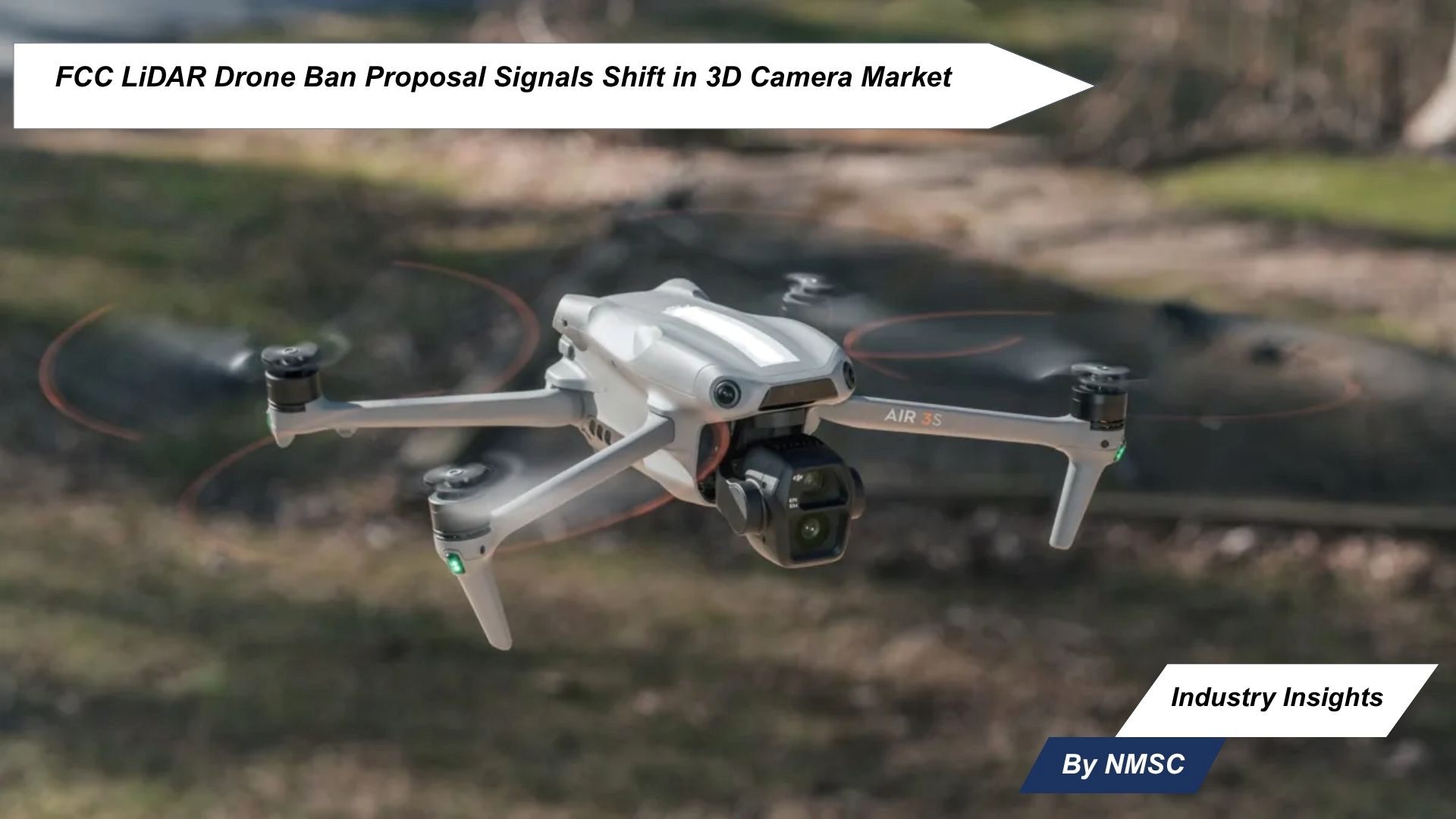
WASHINGTON, D.C., United States — August 11, 2026 — The U.S. Federal Communications Commission (FCC) is advancing a regulatory proposal that would prohibit the further importation and sale of foreign-manufactured drones equipped with Light Detection and Ranging (LiDAR) sensors, classifying them as "military-grade" technology. The move, which directly targets widely used consumer models from DJI — including the Mini 5 Pro, Air 3S, and Neo 2 — carries significant implications for the global 3D Camera Market, which was valued at USD 2.29 billion in 2019 and is projected to reach USD 54.44 billion by 2030, growing at a CAGR of 33.3%, according to Next Move Strategy Consulting.
The FCC's Public Notice DA 26-758, issued on July 21, 2026, proposes to halt the importation and marketing of previously authorized foreign-made unmanned aircraft systems (UAS) that integrate LiDAR sensors. The agency cited the technology's capacity for "enhanced capability to conduct detailed three-dimensional terrain mapping, penetrate dense foliage to reveal hidden structures, assist in autonomous navigation in GPS-denied environments, and conduct covert reconnaissance under a range of environmental conditions" as the basis for the reclassification.
The proposal marks a significant policy shift, as LiDAR sensors in the affected consumer drone models are primarily deployed for obstacle avoidance and flight safety — not military applications. Under the updated definition, any foreign-made drone carrying LiDAR sensors, regardless of weight class or intended use, would be subject to the sales and import restriction. If adopted following the public comment period, which closes September 2, 2026, a 180-day transition period would begin in mid-September 2026, with the sales ban expected to take effect in mid-to-late March 2027.
DJI, the dominant player in the consumer drone segment, has formally opposed the proposal, characterizing it as a "total reversal" of the FCC's prior regulatory position. In its official statement, DJI noted: "Although the proposal is framed as targeting 'military-grade' drones, the FCC's definition could include drones with thermal imaging or LiDAR capabilities… People could continue using DJI products they already own, but the same models in use today might no longer be available to purchase in the future." The company emphasized that it does not design or manufacture military-grade equipment and has consistently opposed the weaponization of civilian drones.
Key Highlights:
-
Regulatory Scope: FCC Public Notice DA 26-758 proposes to reclassify foreign-made drones with LiDAR sensors as "military-grade," targeting models including the DJI Mini 5 Pro, Air 3S, Mavic 4 Pro, Neo 2, Avata 360, and Lito X1 — all of which integrate LiDAR for obstacle avoidance and 3D spatial sensing.
-
Implementation Timeline: Public comments close September 2, 2026; a final FCC decision is expected in the first week of September 2026; a 180-day transition period would follow, with the sales ban projected to take effect in mid-to-late March 2027.
-
Market Disruption: The proposal does not affect existing drone ownership or operation, but would eliminate new retail supply of LiDAR-equipped foreign drone models from U.S. channels — directly impacting the consumer and professional 3D aerial imaging segment.
-
Safe Harbor Models: DJI models without LiDAR integration — including the Mini 4K and Mini 4 Pro, which use binocular vision and infrared sensors — fall outside the proposed restriction and remain eligible for continued U.S. sale.
Analyst Insight:
According to analysts at Next Move Strategy Consulting, the FCC's proposed reclassification of LiDAR-equipped drones as military-grade technology represents a pivotal regulatory inflection point for the broader 3D camera and sensing market. NMSC analysts note that LiDAR-based 3D imaging is a foundational technology across multiple high-growth verticals — including autonomous vehicles, industrial automation, precision agriculture, and aerial mapping — and that regulatory restrictions on consumer-grade LiDAR deployment in the U.S. could accelerate demand for domestically sourced or allied-nation alternatives. This dynamic is expected to reshape competitive positioning within the 3D camera market and may catalyze investment in non-drone LiDAR and structured-light 3D imaging platforms as enterprise and professional users seek compliant alternatives.
Industry Outlook:
The FCC's proposed LiDAR drone ban underscores the growing intersection of national security policy and commercial imaging technology — a convergence that is increasingly shaping procurement decisions across the 3D camera market. For manufacturers of LiDAR sensors, Time-of-Flight cameras, and structured-light 3D imaging systems, the regulatory shift creates both near-term market disruption and longer-term opportunity, as demand migrates toward compliant platforms. The outcome of the public comment process and the FCC's final ruling in September 2026 will be closely monitored by industry stakeholders, given the potential for the policy framework to extend beyond drones to other LiDAR-integrated consumer and professional imaging devices. As the global 3D camera market advances toward its projected USD 54.44 billion valuation by 2030, regulatory clarity around dual-use sensing technologies will be a critical determinant of market structure and investment flows.
Source: The New Camera
For More Information: Download FREE Sample on 3D Camera Market Report
Prepared By: Sanyukta Deb
About the Author
 Sanyukta Deb
— Sanyukta Deb is Digital Marketing Team Lead at Next Move Strategy Consulting, where she has led content strategy and technical SEO for the firm's B2B market research publications for over 2 years. Her editorial process translates NextMSC's primary and secondary research — spanning technology, industrial, and consumer sectors — into commercial narratives, backed by search-intent, keyword, and competitive analysis. She brings 5 years of overall experience in digital marketing and content strategy.
Sanyukta Deb
— Sanyukta Deb is Digital Marketing Team Lead at Next Move Strategy Consulting, where she has led content strategy and technical SEO for the firm's B2B market research publications for over 2 years. Her editorial process translates NextMSC's primary and secondary research — spanning technology, industrial, and consumer sectors — into commercial narratives, backed by search-intent, keyword, and competitive analysis. She brings 5 years of overall experience in digital marketing and content strategy.
About the Reviewer
 Debashree Dey
— Debashree Dey is Assistant Manager at Next Move Strategy Consulting, where she supports cross-vertical market content and communications across diverse industries for 6 years. Her professional background includes senior content writing, communications, and published manuscript authorship, with experience developing audience-focused business narratives and maintaining clear, consistent messaging. Her role supports research-led content development and editorial quality across NextMSC publications.
Debashree Dey
— Debashree Dey is Assistant Manager at Next Move Strategy Consulting, where she supports cross-vertical market content and communications across diverse industries for 6 years. Her professional background includes senior content writing, communications, and published manuscript authorship, with experience developing audience-focused business narratives and maintaining clear, consistent messaging. Her role supports research-led content development and editorial quality across NextMSC publications.


















Add Comment