U.S. Finalizes $225M CHIPS Award for Bosch’s SiC Facility in California
U.S. Commerce Department Finalizes $225M CHIPS Award for Bosch's California SiC Facility as Global EV Output Surpasses 22 Million Units, Reshaping Automotive Chip Supply Chains
On July 13, 2026, the U.S. Department of Commerce's CHIPS Program Office signed a Direct Funding Agreement with Robert Bosch Semiconductor LLC for up to USD 225 million in incentives under the CHIPS and Science Act — the largest single CHIPS award directed at silicon carbide (SiC) semiconductor production for automotive applications to date. The award anchors Bosch's USD 2 billion investment to transform its Roseville, California facility — the company's first U.S. semiconductor production site — into a state-of-the-art SiC manufacturing hub, with commercial production expected to commence before year-end 2026. The transaction is a structural signal: automotive-grade SiC capacity is now a matter of national industrial policy, not merely a supplier roadmap decision.
This policy-backed capacity push arrives at a moment of accelerating structural demand. According to Next Move Strategy Consulting's Automotive Semiconductor Market report, the global automotive semiconductor market was valued at USD 79.75 billion in 2025 and is projected to reach USD 215.46 billion by 2035, growing at a CAGR of 10.45% between 2026 and 2035. The market is expected to reach USD 88.08 billion by the end of 2026, reflecting the compounding effect of electrification-driven chip intensity, ADAS proliferation, and the architectural transition toward software-defined vehicles — three forces that simultaneously expand the semiconductor bill of materials per vehicle and compress the qualification timelines that historically moderated deployment velocity.
For More Information: Download FREE Sample on Automotive Semiconductor Market Report
The Electrification Multiplier: Why 22 Million EVs in 2025 Rewrites Semiconductor Demand Calculus
The International Energy Agency's Global EV Outlook 2026 reported that nearly 22 million electric cars were produced globally in 2025 — a year-over-year increase of more than 25%. China alone produced 16 million electric cars in 2025, outstripping domestic demand by 20% and driving Chinese electric car exports to double to a record high of more than 2.5 million units. The European Union's electric car production rose 30% from 2024 to reach nearly 3.2 million units in 2025.
The semiconductor consequence of this production surge is not linear. A battery electric vehicle (BEV) carries a semiconductor content profile fundamentally different from an internal combustion engine vehicle: power modules, battery management ICs, gate drivers, high-voltage control systems, and onboard charging semiconductors collectively elevate chip value per vehicle to a level that ICE platforms cannot approach. According to NextMSC primary research and analysis, BEVs accounted for the highest semiconductor intensity per vehicle in the automotive market, driven by demand for wide bandgap power devices — specifically silicon carbide MOSFETs and gallium nitride components — embedded in traction inverters and onboard charging systems to improve efficiency and thermal performance.
The Bosch Roseville investment is a direct industrial response to this demand trajectory. Bosch has produced and delivered more than 60 million SiC chips worldwide since its first-generation SiC product entered production in 2021. The Roseville facility, once fully operational, will represent the company's largest SiC manufacturing site globally, with Bosch committing to invest USD 7.5 billion in U.S. operations over the next five years.
"Silicon carbide semiconductors are the enabling technology behind electrification in multiple critical industries including energy, automotive, and defense," said Bill Frauenhofer, Executive Director for Semiconductor Innovation and Investment at the U.S. Department of Commerce, in the NIST press release dated July 13, 2026. "The CHIPS Program incentive supports Bosch's effort to onshore silicon carbide technology that will bolster supply chain resiliency for our country."
Broader Market Context: $827 Billion in Chip Supply Chain Investment and Record Semiconductor Sales
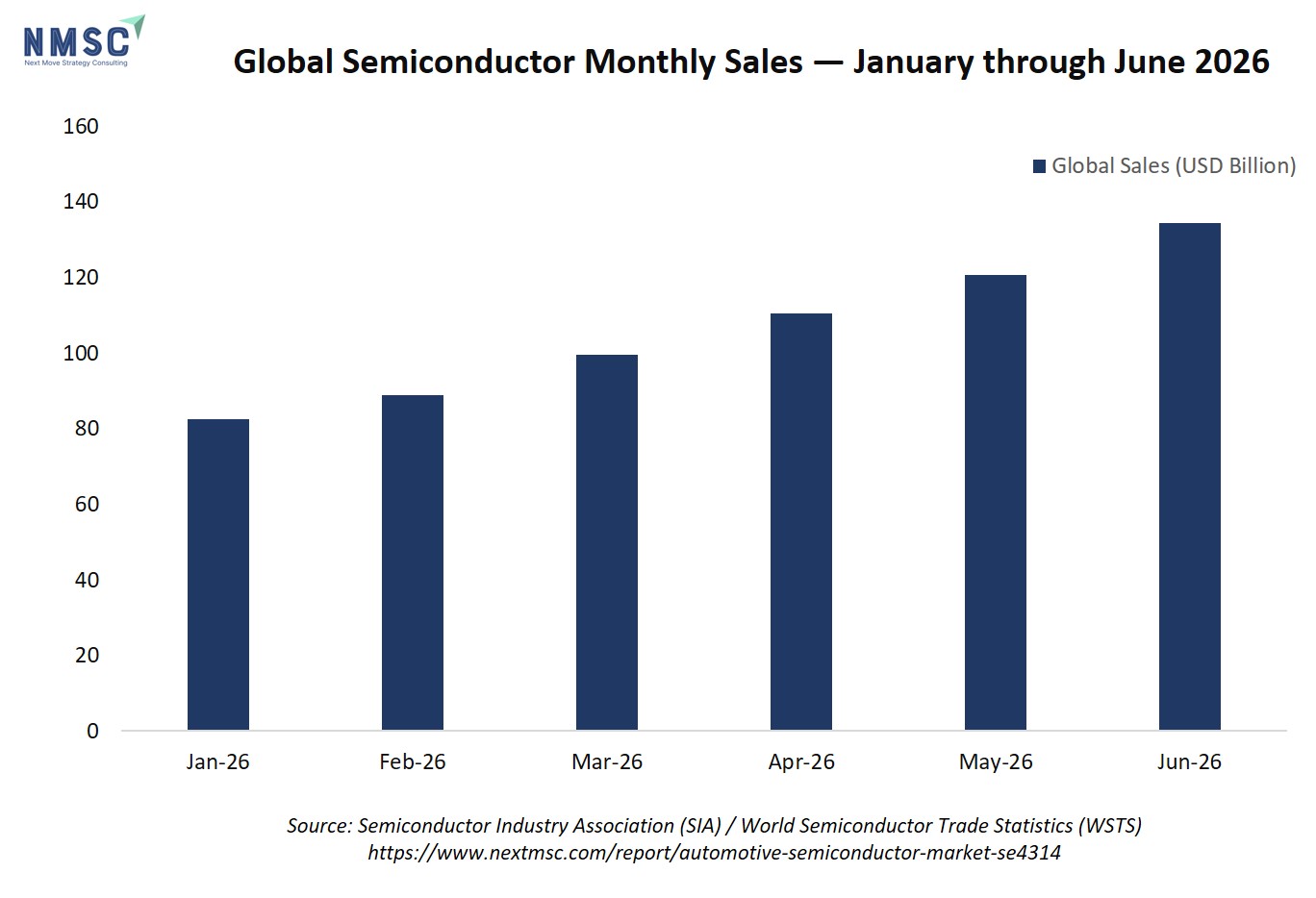
The Bosch award is one node in a far larger capital reallocation. As of September 22, 2026, the Semiconductor Industry Association (SIA) tracked over USD 827 billion in semiconductor supply chain investments across the United States alone. Globally, the SIA reported that global semiconductor sales reached USD 403.3 billion in Q2 2026, an increase of 35.1% compared to Q1 2026. June 2026 sales alone were USD 134.5 billion — a 123.6% increase year-over-year and 9.7% above May 2026.
"Global chip sales are expected to exceed $1.5 trillion in 2026, with Q2 sales substantially outpacing sales in Q1 2026," said John Neuffer, President and CEO of the Semiconductor Industry Association, in the SIA press release dated August 6, 2026. "Strong sales across the Americas, the Asia Pacific region, and China continue to drive market growth, underscoring the strength of global chip demand and the vital role semiconductors play in powering the next generation of technology innovation and economic competitiveness."
Within this broader semiconductor expansion, automotive applications represent one of the most structurally durable demand segments — insulated from the cyclical volatility of consumer electronics by multi-year OEM qualification cycles, long vehicle platform lifespans, and the irreversible architectural shift toward electrification and software-defined vehicle systems.
M&A Consolidation: Infineon's $2.5 Billion Marvell Acquisition and onsemi's SiC Portfolio Expansion
The Bosch CHIPS award is the most recent in a sequence of structural moves that have reshaped the competitive architecture of the automotive semiconductor market since early 2025.
In August 2025, Infineon Technologies AG completed the acquisition of Marvell Technology's Automotive Ethernet business in an all-cash transaction valued at USD 2.5 billion. The transaction, initially announced in April 2025, received all necessary regulatory approvals and positions Infineon to strengthen its market-leading microcontroller position while expanding its offerings for zonal architectures in the context of software-defined vehicle evolution. The acquired Marvell Automotive Ethernet business was projected to generate USD 225–250 million in revenue in 2025 with a gross margin of approximately 60%.
In January 2025, onsemi completed the acquisition of Qorvo's Silicon Carbide JFET technology portfolio — including the United Silicon Carbide subsidiary — for USD 115 million. The acquisition is expected to expand onsemi's addressable market opportunity by USD 1.3 billion within five years, reinforcing its SiC portfolio for EV powertrain and energy management applications.
These transactions reflect a competitive dynamic identified in NextMSC primary research and analysis: automotive semiconductor vendors are no longer competing primarily on component pricing but on fabrication resilience, portfolio breadth, and the ability to secure design-win control across multi-year vehicle platforms. The Infineon-Marvell deal specifically targets the zonal architecture transition — the shift from distributed electronic control units (ECUs) to centralized domain and zonal controllers — which requires high-bandwidth automotive Ethernet solutions that Marvell's business directly supplies.
Major M&A Transactions and Strategic Capital Deployments in the Automotive Semiconductor Market (2025–2026)
|
Transaction |
Acquirer |
Target / Asset |
Value (USD) |
Completion Date |
Strategic Rationale |
|
Automotive Ethernet Business Acquisition |
Infineon Technologies AG |
Marvell Technology's Automotive Ethernet Business |
USD 2.5 billion |
August 2025 |
Strengthen zonal architecture and in-vehicle networking portfolio for software-defined vehicles |
|
SiC JFET Technology Acquisition |
onsemi |
Qorvo's SiC JFET Portfolio (incl. United Silicon Carbide) |
USD 115 million |
January 15, 2025 |
Expand SiC addressable market by USD 1.3B within five years; reinforce EV powertrain positioning |
|
CHIPS Act Direct Funding Agreement |
Robert Bosch Semiconductor LLC |
U.S. Department of Commerce CHIPS Program |
USD 225 million (award) / USD 2B (total investment) |
July 13, 2026 |
Establish first U.S. SiC production site; onshore critical wide bandgap semiconductor capacity |
NMSC Strategic Perspective: Three Structural Forces Converging on a Single Inflection Point
According to NextMSC primary research and analysis, the automotive semiconductor market is not experiencing a single demand driver but a simultaneous convergence of three structural forces — each of which independently would sustain above-market growth, and which together are compressing the timeline to the USD 215.46 billion forecast by 2035.
Force 1 — Electrification-Driven Chip Intensity: The transition from ICE to BEV platforms does not merely substitute one powertrain for another; it replaces a mechanically dominated system with an electronically governed one. Every BEV requires power modules, battery management ICs, gate drivers, motor control chips, and high-voltage isolation components that have no ICE equivalent. As global BEV production scales — with the IEA recording 22 million electric cars produced in 2025 alone — the aggregate semiconductor content embedded in the global vehicle fleet expands at a rate that exceeds vehicle production growth. NextMSC primary research and analysis confirms that BEVs accounted for the highest semiconductor value per vehicle across all propulsion types, with wide bandgap technologies — SiC and GaN — increasingly embedded in inverter and onboard charging systems.
Force 2 — Zonal Architecture and ADAS Compute Consolidation: NextMSC primary research and analysis identifies a clear architectural transition from distributed ECUs toward centralized domain and zonal controllers. This consolidation requires high-performance microcontrollers, networking chipsets, and automotive Ethernet solutions — precisely the portfolio that Infineon's USD 2.5 billion Marvell acquisition was designed to address. ADAS platforms integrating radar, cameras, LiDAR, and high-performance vision processors further elevate semiconductor content per vehicle, with AI-accelerated processors now anchoring real-time perception, sensor fusion, and over-the-air update capabilities.
Force 3 — Policy-Backed Supply Localization: The USD 827 billion in U.S. semiconductor supply chain investments tracked by the SIA, combined with the European Chips Act 2.0 and Asia-Pacific domestic fabrication programs, represents a structural shift in how automotive-grade semiconductor capacity is planned and financed. Governments are now co-investors in automotive chip supply chains, reducing the geopolitical concentration risk that amplified the 2021–2022 chip shortage and creating durable, regionally distributed capacity that supports long-term OEM sourcing strategies.
"The overall semiconductor market recovery is continuing, industrial, data centers and automotive currently have the most potential," said Haviv Ilan, CEO of Texas Instruments, as cited in NextMSC's Automotive Semiconductor Market report.
The intersection of these three forces — rising chip content per vehicle, architectural consolidation driving higher-value semiconductor integration, and policy-backed supply resilience — is what underpins the 10.45% CAGR that NextMSC projects through 2035. This is not a market growing because of generic technology adoption; it is a market growing because the fundamental architecture of the automobile is being rebuilt around semiconductor platforms.
Segmentation Spotlight: Logic Devices Lead, Mature Nodes Anchor Volume, Mid-Range Vehicles Drive Scale
According to NextMSC primary research and analysis, the automotive semiconductor market's segmentation reveals a nuanced demand structure that resists simplistic characterization.
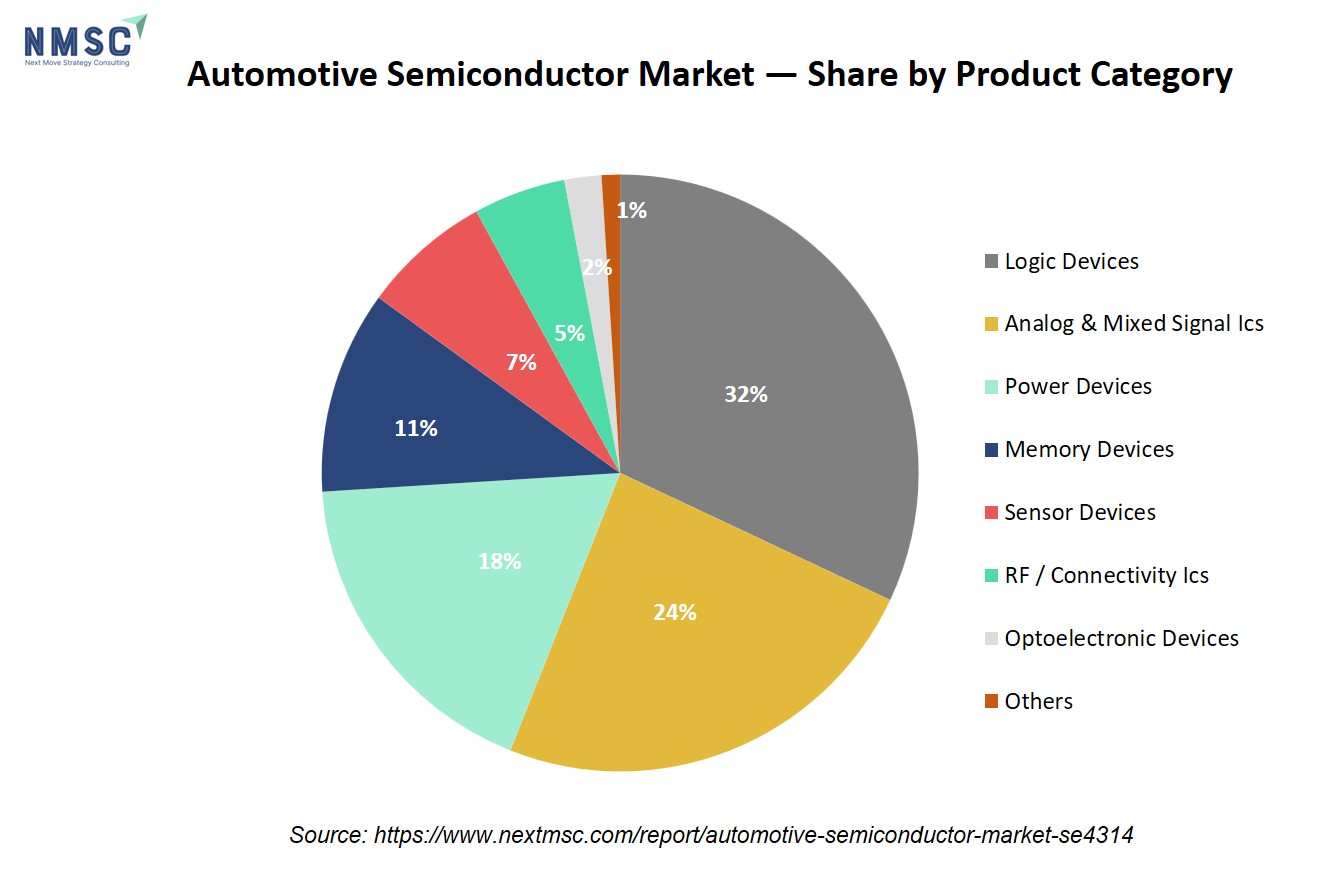
By Product Category: Logic devices — encompassing microcontrollers, microprocessors, system-on-chip (SoC) platforms, and application-specific ICs — accounted for the largest share of the market, driven by their fundamental role in real-time control, processing, and system integration across powertrain, body electronics, ADAS, and centralized vehicle architectures. Analog and mixed-signal ICs held a significant share, primarily due to their extensive use in power management, signal conditioning, and data conversion across ADAS, infotainment, and electrified powertrains. Power devices followed closely, driven by rising demand for SiC and GaN components used in EV traction inverters and battery systems.
By Technology Node: Mature nodes (above 65nm) held the largest share of automotive MCU production, supported by long vehicle lifecycles, stringent reliability standards, and suitability for analog, power, and mixed-signal applications. Advanced nodes below 16nm gained traction in ADAS and infotainment processors, where higher compute density and energy efficiency are essential.
By Vehicle Price Segment: Mid-range vehicles captured the leading share, balancing production scale with expanding penetration of ADAS features, electrified powertrains, and advanced connectivity technologies — a combination that elevates semiconductor content without requiring the ultra-premium compute architectures of luxury platforms.
By Sales Channel: Tier 1 Suppliers maintained dominance, as OEMs increasingly rely on system integrators for ECU development, domain controller assembly, and end-to-end semiconductor integration within vehicle platforms.
Regional Dynamics: North America Onshores, Asia-Pacific Scales, Europe Regulates
|
Region |
Primary Demand Driver |
Key Policy / Investment Development |
Semiconductor Priority |
|
North America |
High ADAS penetration; AI-enabled vehicle architectures; early EV platform adoption |
USD 827B+ in U.S. chip supply chain investments (SIA, September 2026); Bosch USD 2B Roseville SiC facility (CHIPS Act, July 2026) |
High-performance compute, SiC power devices, automotive Ethernet |
|
Europe |
Regulatory-led electrification; EU Chips Act 2.0; functional safety compliance |
EU Industrial Accelerator Act (March 2026); countervailing duties on Chinese BEVs maintained through 2029 |
Power-efficient semiconductors, functional safety-certified MCUs, ISO 26262-compliant components |
|
Asia-Pacific |
Large-scale EV production; vertically integrated OEM ecosystems; China's 16M EV output in 2025 |
China's domestic EV policy alignment; ROHM-Suchi Semicon India manufacturing partnership (March 2026) |
Power devices, motor control ICs, battery management ICs, connectivity processors |
|
Latin America |
Export-oriented vehicle assembly; North American platform alignment |
Gradual EV infrastructure expansion; Brazil reinstated tariffs on Chinese EVs in 2025 |
Microcontrollers, safety modules, power management solutions |
|
Middle East & Africa |
Premium vehicle imports; smart mobility initiatives |
Gradual EV infrastructure investment in Gulf economies |
ADAS processors, connectivity modules, energy-efficient control systems |
Recent Industry Developments: A Compressed Timeline of Structural Moves
The pace of competitive repositioning in the automotive semiconductor market has accelerated materially since late 2025, with three developments of particular strategic significance:
July 2026 — Bosch CHIPS Act Award: The U.S. Department of Commerce finalized a USD 225 million Direct Funding Agreement with Robert Bosch Semiconductor LLC, supporting a USD 2 billion investment in the Roseville, California SiC facility. Sample production has already commenced, with commercial production expected in 2026. Bosch plans to invest USD 7.5 billion in U.S. operations over the next five years.
March 2026 — ROHM Co. and Suchi Semicon India Partnership: ROHM Co. and Suchi Semicon established a strategic manufacturing partnership in India, focusing on establishing a production framework for power devices and integrated circuits, with mass production shipments targeted for late 2026. This partnership reflects the broader trend of automotive semiconductor suppliers establishing localized manufacturing presence in high-growth emerging markets.
November 2025 — Micron Automotive-Grade UFS 4.1 Storage: Micron Technology launched the world's first automotive-grade UFS 4.1 storage, specifically designed for intelligent mobility applications. The product provides the high-speed data transfer required for next-generation ADAS platforms and large-scale digital cockpits — directly addressing the memory bandwidth constraints that have historically limited the deployment of AI-accelerated perception systems in production vehicles.
Growth Inhibitor: Qualification Cycles as a Structural Moderator
NextMSC primary research and analysis identifies extended automotive semiconductor qualification cycles and rigid capacity allocation frameworks as the primary structural moderator of near-term deployment velocity. Automotive-grade chips undergo multi-year reliability testing before full-scale integration, limiting rapid supplier switching or accelerated deployment. Production commitments are secured well in advance of vehicle launches, reducing short-term flexibility in response to demand shifts. While this qualification discipline ensures performance integrity and reinforces supplier stickiness, it inherently tempers immediate revenue acceleration — a dynamic that investors and procurement strategists must account for when modeling near-term market entry timelines.
Key Companies Profiled in the NMSC Report
NextMSC primary research and analysis profiles 20 companies across the automotive semiconductor competitive landscape, including:
-
Infineon Technologies AG
-
NXP Semiconductors
-
STMicroelectronics
-
Texas Instruments Incorporated
-
Renesas Electronics Corporation
-
Semiconductor Components Industries, LLC (onsemi)
-
Analog Devices, Inc.
-
Micron Technology, Inc.
-
Robert Bosch GmbH
-
ROHM Co.
-
Microchip Technology Inc.
-
Melexis
-
Allegro MicroSystems, Inc.
-
Sony Semiconductor Solutions Corporation
-
Elmos Semiconductor SE
-
Toshiba Electronic Devices & Storage Corporation
-
ams-OSRAM AG
-
Qualcomm
-
NVIDIA
-
Wolfspeed
Bottom Line
The automotive semiconductor market is undergoing a structural transformation that is simultaneously supply-side and demand-side in nature. On the demand side, the IEA's confirmation of 22 million electric cars produced globally in 2025 — up more than 25% year-over-year — translates directly into expanded semiconductor content per vehicle, as BEV platforms require power modules, battery management ICs, and wide bandgap power devices that have no ICE equivalent. On the supply side, the U.S. Department of Commerce's USD 225 million CHIPS Act award to Bosch — anchoring a USD 2 billion SiC facility in Roseville, California — signals that governments are now structural co-investors in automotive-grade semiconductor capacity, reducing the geopolitical concentration risk that defined the 2021–2022 shortage era. Infineon's USD 2.5 billion acquisition of Marvell's Automotive Ethernet business and onsemi's SiC JFET portfolio expansion further consolidate the competitive landscape around suppliers with vertically integrated manufacturing, deep qualification histories, and platform-level design-win control. According to NextMSC primary research and analysis, the global automotive semiconductor market is projected to grow from USD 88.08 billion in 2026 to USD 215.46 billion by 2035 at a CAGR of 10.45% — a trajectory anchored by electrification, ADAS proliferation, and the irreversible architectural shift toward software-defined vehicles.
About Next Move Strategy Consulting
Next Move Strategy Consulting is a premier market research and management consulting firm that has been committed to provide strategically analysed well documented latest research reports to its clients. The research industry is flooded with many firms to choose from, what makes NMSC different from the rest is its top-quality research and the obsession of turning data into knowledge by dissecting every bit of it and providing fact-based research recommendation that is supported by information collected from over 500 million websites, paid databases, industry journals and one on one consultations with industry experts across a diverse range of industry sectors. The high-quality customized research reports with actionable insights and excellent end-to-end customer service help our clients to take critical business decisions that enables them to move beyond time and have competitive edge in the industry.
We have been servicing over 1000 customers globally that includes 90% of the Fortune 500 companies over a decade. Our analysts are constantly tracking various high growth markets and identifying hidden opportunities in each sector or the industry. We provide one of the industry's best quality syndicate as well as custom research reports across 10 different industry verticals. We are committed to deliver high quality research solutions in accordance to your business needs. Our industry standard delivery solutions that ranges from the pre consultation to after-sales services, provide an excellent client experience and ensure right strategic decision making for businesses.
For more information, please contact:
Next Move Strategy Consulting
5th Floor 867 Boylston St, STE 500,
Boston, MA 02116, U.S.
E-Mail: [email protected]
Direct: +1-217-650-7991
Website: www.nextmsc.com
About the Author
 Sanyukta Deb
— Sanyukta Deb is Digital Marketing Team Lead at Next Move Strategy Consulting, where she has led content strategy and technical SEO for the firm's B2B market research publications for over 2 years. Her editorial process translates NextMSC's primary and secondary research — spanning technology, industrial, and consumer sectors — into commercial narratives, backed by search-intent, keyword, and competitive analysis. She brings 5 years of overall experience in digital marketing and content strategy.
Sanyukta Deb
— Sanyukta Deb is Digital Marketing Team Lead at Next Move Strategy Consulting, where she has led content strategy and technical SEO for the firm's B2B market research publications for over 2 years. Her editorial process translates NextMSC's primary and secondary research — spanning technology, industrial, and consumer sectors — into commercial narratives, backed by search-intent, keyword, and competitive analysis. She brings 5 years of overall experience in digital marketing and content strategy.
About the Reviewer
 Debashree Dey
— Debashree Dey is Assistant Manager at Next Move Strategy Consulting, where she supports cross-vertical market content and communications across diverse industries for 6 years. Her professional background includes senior content writing, communications, and published manuscript authorship, with experience developing audience-focused business narratives and maintaining clear, consistent messaging. Her role supports research-led content development and editorial quality across NextMSC publications.
Debashree Dey
— Debashree Dey is Assistant Manager at Next Move Strategy Consulting, where she supports cross-vertical market content and communications across diverse industries for 6 years. Her professional background includes senior content writing, communications, and published manuscript authorship, with experience developing audience-focused business narratives and maintaining clear, consistent messaging. Her role supports research-led content development and editorial quality across NextMSC publications.















Add Comment