Quantum Glass Battery Market Accelerates on Regulatory & Commercial Catalysts
China's Landmark Solid-State Battery Standard and Record Global Storage Deployment Converge to Reshape the Next-Generation Energy Storage Landscape
On July 1, 2026, China's first national standard for vehicle solid-state batteries — designated GB/T 43568-2026 — entered into force, establishing mandatory technical thresholds that include a six-hour, 120°C vacuum test and a requirement that liquid electrolyte content remain below 5% by weight. The standard, developed under the auspices of China's National Technical Committee of Auto Standardization, formally defines the boundary between semi-solid and all-solid-state battery architectures for the first time in any major jurisdiction, creating a legally binding commercial qualification framework for the world's largest electric vehicle market.
The regulatory development carries global market significance that extends well beyond China's borders. In August 2026, a Chinese-led proposal for the world's first international standard for automotive solid-state batteries was approved as a new work item by the International Electrotechnical Commission (IEC), with CATL, BYD, and other major Chinese producers named as lead contributors. The IEC approval signals that China is positioning itself not merely as the dominant manufacturer of next-generation battery technologies, but as the architect of the global regulatory framework that will govern them — a development with profound implications for the competitive positioning of developers, OEMs, and materials suppliers operating across the global Quantum Glass Battery Market.
According to analysis by Next Move Strategy Consulting, the global Quantum Glass Battery Market is projected to reach USD 47.26 billion by 2030, registering a compound annual growth rate (CAGR) of 18.8% over the 2025–2030 forecast period, with the market estimated at USD 19.97 billion in 2025.
For More Information: Download FREE Sample on Quantum Glass Battery Market Report
China's Regulatory Offensive: Redefining the Global Competitive Landscape
The entry into force of GB/T 43568-2026 represents a structural inflection point for the global solid-state and glass-electrolyte battery sector. By establishing a formal, enforceable definition of all-solid-state battery architecture — anchored to measurable electrolyte composition thresholds and thermal performance criteria — China has effectively created a qualification gateway that all suppliers seeking access to its domestic EV market must now clear.
The standard's thermal test requirement — a six-hour exposure at 120°C under vacuum conditions — is particularly significant for glass-electrolyte platforms. Unlike polymer-based semi-solid electrolytes, which degrade at elevated temperatures, inorganic glass and ceramic electrolytes are inherently stable at these conditions, providing a structural performance advantage that the new standard formally rewards. This regulatory alignment between the technical attributes of glass-electrolyte chemistries and China's mandatory qualification criteria creates a commercially meaningful differentiation pathway for quantum glass battery developers seeking to access the world's largest EV market.
Simultaneously, the IEC new work item approval elevates the stakes for non-Chinese developers. If the Chinese-led IEC standard is adopted globally — a process that typically takes two to four years — it would effectively export China's domestic qualification framework to international markets, compelling developers in the United States, Europe, Japan, and South Korea to align their product roadmaps with Chinese-defined technical thresholds. For quantum glass battery developers, early engagement with the IEC standardisation process represents a strategic imperative, not merely a compliance exercise.
China Daily reported in late August 2026 that Changan Automobile expects to complete vehicle validation of solid-state batteries in 2026 and take initial orders, while multiple domestic OEMs have announced pilot production lines targeting hundred-ton-level output of solid-state cells. This convergence of regulatory clarity and OEM commercialisation activity in China is accelerating the timeline for meaningful market entry across the entire solid-state battery ecosystem.
Record Battery Storage Deployment Establishes the Macro Demand Foundation
The regulatory catalyst arrives against a backdrop of record-breaking global battery storage deployment. According to the International Energy Agency's commentary published May 29, 2026, total battery storage capacity additions reached 108 gigawatts (GW) worldwide in 2025 — approximately 40% more than in 2024 and the fastest annual growth rate in the history of the power sector. Installed battery storage capacity is now eleven times higher than it was in 2021.
Annual growth of this scale exceeds the historical peak for gas-fired power capacity additions, which reached approximately 107 GW in 2002, underscoring the structural transformation underway in global power systems.
China continued to lead global battery storage deployment in 2025, adding just over 63 GW — approximately one-third more than in 2024 — and accounting for roughly 58% of global additions. The United States added 19 GW, representing year-on-year growth of approximately 60%, with utility-scale batteries accounting for over 16 GW of that total. Europe recorded approximately 6.2 GW of additions, slightly lower than 2024 in aggregate, but with a clear structural shift toward utility-scale systems, where additions more than doubled to approximately 4.6 GW. Australia emerged as the most notable growth market, with additions surging to nearly 8 GW — almost nine times higher than the prior year — supported by state- and federal-level incentives. The Middle East added more than 3 GW, more than three times its 2024 level, driven almost entirely by Saudi Arabia.
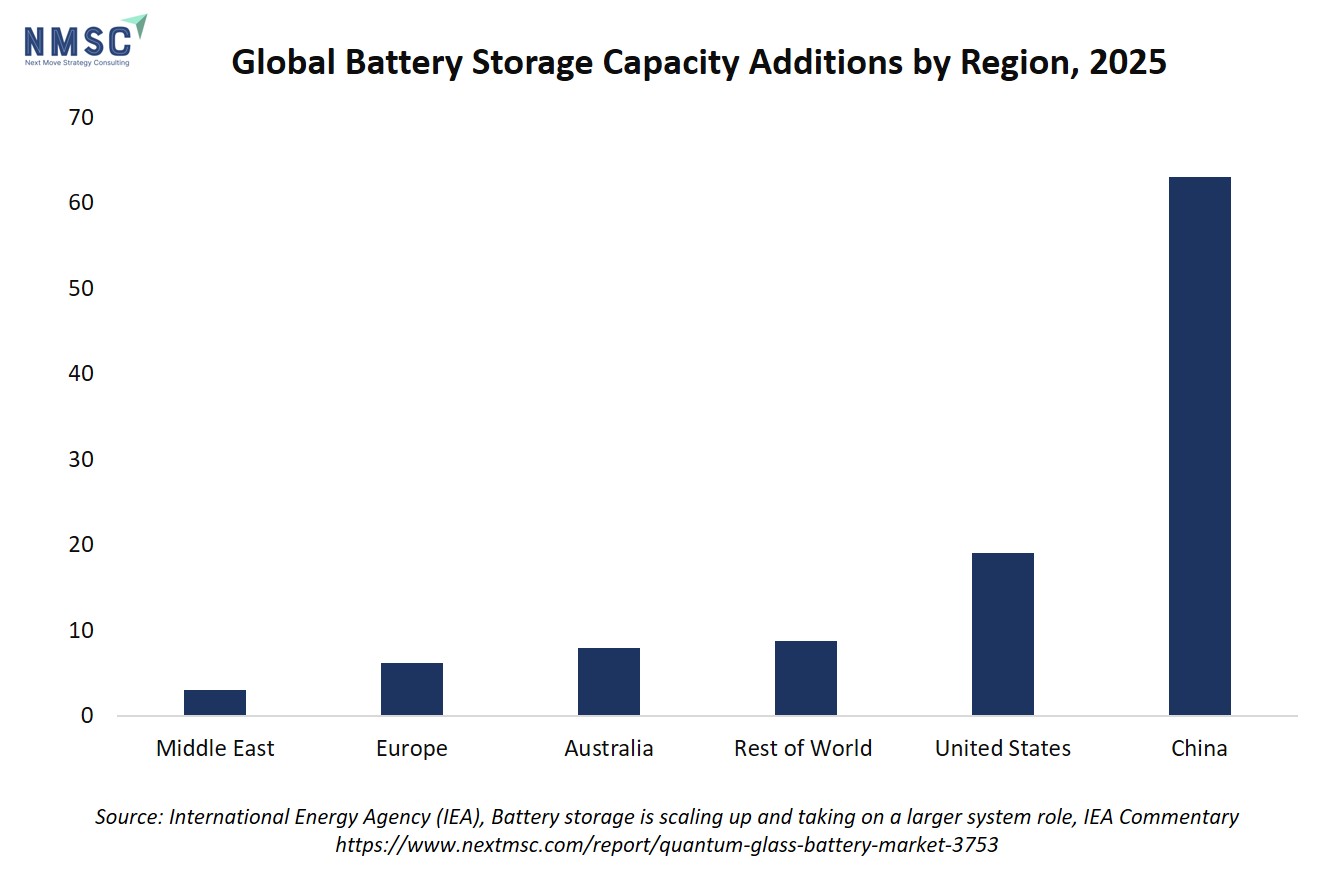
Utility-scale installations accounted for approximately 87 GW — around four-fifths of total 2025 additions — while behind-the-meter capacity contributed the remainder. The average duration of utility-scale battery projects commissioned in 2025 rose to three hours, up from approximately two hours in 2023, reflecting the growing value of energy-shifting applications in power systems with rising shares of variable renewables. Battery storage now accounts for approximately 18% of installed dispatchable capacity in Australia, compared with 7% in China, 5% in the United States, and 4% in Europe.
Battery storage costs declined by more than 90% between 2010 and 2025, driven by innovation, competition, and economies of scale. For quantum glass battery developers, this cost trajectory creates both a competitive challenge — as incumbent lithium-ion chemistries become progressively cheaper — and a strategic opportunity, as the performance premium of glass-electrolyte platforms in safety, energy density, and cycle life becomes more commercially differentiated at scale.
EV Battery Deployment Reaches 1.2 TWh in 2025
The IEA's Global EV Outlook 2026 confirms that electric vehicle battery deployment reached 1.2 terawatt-hours (TWh) in 2025, an increase of almost 30% compared to 2024 and more than seven times greater than in 2020. Light-duty vehicles remained the dominant segment, representing more than 85% of 2025 EV battery deployment. The fastest growth came from electric trucks, for which battery demand more than doubled — largely driven by a sharp acceleration in sales in China — with electric trucks accounting for approximately 8% of global EV battery deployment in 2025, up from less than 5% in 2024.
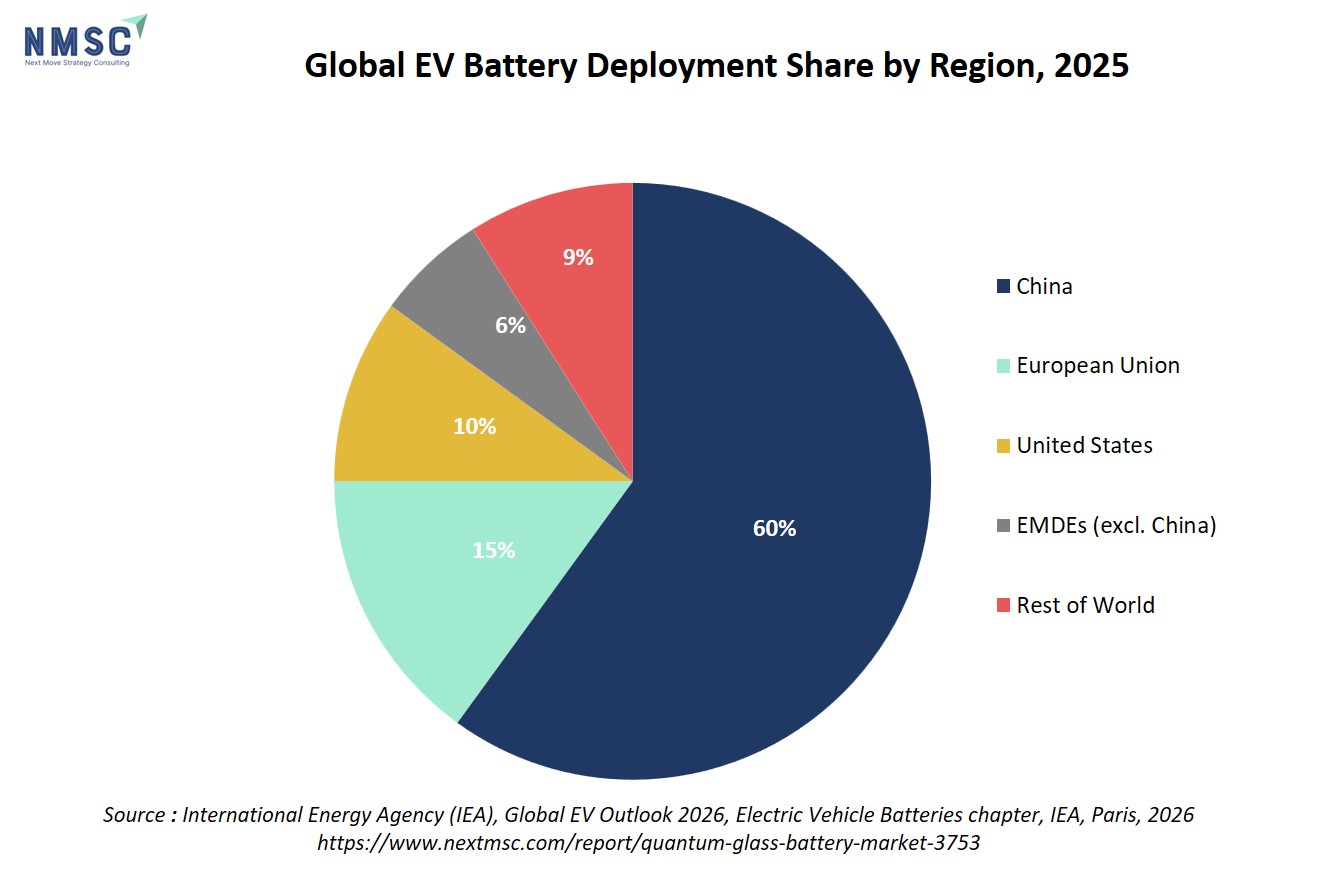
Regionally, EV battery deployment expanded in China — which accounted for 60% of the global total — and the European Union, which represented almost 15%, while deployment stagnated in the United States at approximately 10%. Growth in emerging markets and developing economies (EMDEs) other than China continued, representing 6% of global EV battery deployment in 2025.
Average battery prices declined by a further 8% in 2025, supported by continued improvements in manufacturing efficiency, advances in battery chemistries, and intensifying global market competition. In 2025, battery pack prices in China were 30% lower than in North America and 35% lower than in Europe, compared to respective differentials of 20% and 25% in 2022, indicating that regional price disparities are widening rather than converging.
Global Battery Storage Capacity Additions by Region, 2025
|
Region |
2025 Additions (GW) |
Year-on-Year Change |
Share of Global Total (%) |
|
China |
63.0 |
~+33% vs. 2024 |
~58% |
|
United States |
19.0 |
~+60% vs. 2024 |
~18% |
|
Rest of World |
8.8 |
N/A |
~8% |
|
Australia |
8.0 |
~+9x vs. 2024 |
~7% |
|
Europe |
6.2 |
Slightly lower vs. 2024 |
~6% |
|
Middle East |
3.0 |
~+3x vs. 2024 |
~3% |
|
Global Total |
108.0 |
+40% vs. 2024 |
100% |
Market Segmentation: Solid-State Glass Batteries Lead Commercialisation
According to NMSC's analysis, the quantum glass battery market is segmented by battery type into quantum dot batteries and solid-state glass batteries. Solid-state glass batteries — which pair glass electrolytes with lithium-metal anodes — emerge as the primary commercialisation pathway because they fit directly into existing solid-state R&D roadmaps and meet OEM expectations for higher energy density and improved safety. The entry into force of China's GB/T 43568-2026 standard reinforces this trajectory, as the standard's thermal and composition thresholds are structurally aligned with the performance characteristics of inorganic glass and ceramic electrolyte systems.
By capacity, the market is categorised into small-format, medium-format, and large-format batteries. Medium-format cells and modules designed for automotive pack-level integration are emerging as the most commercially viable entry point, as vehicle manufacturers prioritise safety, range, and standardised module geometries. Evidence from OEM collaboration disclosures and IEA battery market analyses confirms that medium-format pilot lines align most closely with existing vehicle assembly processes, enabling faster technical qualification and smoother integration into next-generation EV platforms.
By application, the market encompasses powering wearable devices, storing solar energy, stabilising the electricity grid, and other applications. EV applications and stationary storage are identified as the most accessible early markets. Stationary storage customers typically exhibit greater tolerance for price premiums when solutions deliver clear advantages in safety and longevity — making this segment a more accessible initial commercialisation pathway than the highly cost-sensitive automotive sector. By end user, the market is segmented into automotive OEMs, electronics manufacturers, energy providers, and other end users, with automotive OEMs and energy providers emerging as the most critical early revenue channels due to their capacity to commit to long-term procurement volumes.
Competitive Landscape: OEM Partnerships and Manufacturing Scale-Up
The competitive landscape of the quantum glass battery sector is defined by a bifurcated structure: a small set of deep-technology specialists — including QuantumScape Battery, Inc., Solid Power Inc., Ilika, and Ampcera — own differentiated cell intellectual property, while large OEMs and battery conglomerates shape demand through licensing arrangements, equity stakes, and long-term supply agreements.
QuantumScape reported its second-quarter 2026 business results in July 2026, highlighting progress on its Eagle Line pilot manufacturing milestone and disclosing customer billings as the company advances its QSE-5 solid-state battery cell toward commercial qualification. The company ended Q2 2026 with nearly USD 1 billion in cash and marketable securities, providing a funding runway that extends the commercialisation timeline without requiring near-term equity dilution.
In July 2025, QuantumScape expanded its collaboration with PowerCo to accelerate QSE-5 solid-state battery production, including licensing arrangements to scale up capacity annually. In October 2025, Panasonic Holdings Corporation established a new pilot production line for solid-state batteries at its Osaka facility, reinforcing Japan's strategic role in the global solid-state manufacturing ecosystem. In December 2024, Solid Power, Inc. amended its joint development agreement with Ford Motor Company, extending the partnership until December 2025.
At CES 2026 in January, ProLogium Technology unveiled its fourth-generation superfluidized all-inorganic solid-state battery, featuring a room-temperature ionic conductivity of 57 mS/cm — a figure that, if validated at scale, would represent a significant advance in glass and ceramic electrolyte performance. The announcement, made in partnership with Germany's FEV Group for module-level integration, illustrated the growing role of European engineering firms in validating Asian-developed solid-state cell technologies for OEM qualification.
The IEA's Global EV Outlook 2026 confirms that global nameplate manufacturing capacity for lithium-ion batteries reached more than 4 TWh by the end of 2025, up roughly 30% compared to 2024, with China accounting for over 80% of the global total. This manufacturing concentration underscores the strategic imperative for quantum glass battery developers to establish differentiated supply-chain positions — particularly in glass and ceramic electrolyte processing, precision coating, and inline metrology — that are not replicable through conventional lithium-ion manufacturing infrastructure.
Key Global EV Battery Market Metrics, 2025
|
Metric |
2025 Value |
Comparative Context |
|
Global EV Battery Deployment |
1.2 TWh |
+30% vs. 2024; >7x vs. 2020 |
|
China Share of Global EV Battery Deployment |
~60% |
Largest single market globally |
|
EU Share of Global EV Battery Deployment |
~15% |
Second-largest regional market |
|
US Share of Global EV Battery Deployment |
~10% |
Stagnant growth in 2025 |
|
EMDEs (excl. China) Share |
~6% |
Reflects growing global electrification |
|
LFP Share of EV Batteries Deployed Globally |
>55% |
Up from ~50% in 2024 |
|
LFP Share of Stationary Storage Installations |
>90% |
Dominant chemistry for grid storage |
|
Average Battery Price Decline (2025) |
-8% |
Driven by manufacturing efficiency and competition |
|
China Battery Pack Price vs. North America |
30% lower |
Regional price disparity widened vs. 2022 |
|
China Battery Pack Price vs. Europe |
35% lower |
Widened from 25% in 2022 |
|
Global Li-ion Nameplate Manufacturing Capacity |
>4 TWh |
+30% vs. 2024; China holds >80% share |
|
Battery Cost Decline (2010–2025) |
>90% |
Driven by innovation, competition, and scale |
|
EV Battery Demand Outlook 2030 (STEPS) |
~3 TWh |
Up from 1.2 TWh in 2025 |
Regional Outlook
North America emerges as one of the most strategically significant regions for quantum glass battery development, anchored by U.S. Department of Energy grant programs, manufacturing tax credits, and national supply-chain readiness initiatives. The United States represents the core commercialisation hub, with DOE roadmaps prioritising solid-state manufacturing capacity and pushing developers to establish pilot lines and equipment partnerships domestically to access milestone-based grants and tax credits. The Clean Investment Monitor's Q2 2026 update confirms that battery manufacturing investment in the United States remained active through mid-2026, with producers increasingly shifting focus toward battery energy storage systems as EV-related demand softened. Canada contributes as an upstream and materials-driven market, supported by strong critical mineral reserves and an expanding battery materials processing ecosystem.
Europe positions itself as one of the most important commercial markets for quantum glass batteries, driven by strong OEM participation through programs such as the European Battery Alliance and cohesive industrial policy frameworks. Germany stands at the forefront of European adoption, anchored by its automotive ecosystem and significant investments through PowerCo. The Nordic region — particularly Sweden and Finland — offers strategic value through advanced materials processing capabilities and a sustainability-focused policy environment aligned with the safety and durability characteristics of glass-electrolyte cells.
Asia-Pacific remains the global centre for cell production, equipment manufacturing, and electrolyte innovation. China's dominant position across the lithium-ion supply chain extends into early-stage solid-state and glass-electrolyte battery exploration, now reinforced by the world's first national solid-state battery standard. Japan plays a technically critical role due to its strengths in ceramics, glass processing, and precision materials, while South Korea offers a highly advanced ecosystem anchored by large battery manufacturers and world-class materials suppliers. The IEA notes that the share of Chinese producers in global electric car battery deployment increased further in 2025, reaching almost 75%, with their market share in the European Union exceeding 50% — almost double their share in 2023.
Investment Landscape and Risk Factors
Investment analysis for quantum glass batteries is governed by three convergent variables: demand de-risking via OEM commitments, demonstrable manufacturing yield improvements, and public funding access. China's GB/T 43568-2026 standard adds a fourth variable — regulatory qualification — that now functions as a prerequisite for market access in the world's largest EV market, materially reshaping the risk calculus for developers and investors alike.
The IEA's Global EV Outlook 2026 identifies solid-state batteries as progressing but still requiring demonstration at scale, noting that all-SSB cells are being produced at small scale for testing purposes but that their manufacturing remains more complex and costly than conventional lithium-ion cells. The IEA further notes that premium markets — where customers value additional range and performance — could support early adoption, providing margins for manufacturers to navigate scale-up challenges and work toward lower production costs. The IEA projects that solid-state batteries are expected to remain limited to premium segments until the first half of the 2030s.
The principal risk inhibitor for the quantum glass battery market remains manufacturing yield and cost at scale — a constraint explicitly disclosed in multiple recent company filings. Achieving production at gigawatt scale demands new deposition tools, highly uniform coatings, and extremely low defect rates, all of which remain more mature in conventional lithium-ion supply chains.
Supply chain concentration also presents a systemic risk. The IEA confirms that production capacity and technical expertise for essential battery components — including active materials and their precursors — remain heavily concentrated in China, which accounts for over 80% of global lithium-ion manufacturing capacity. China's export controls on key battery components, most recently expanded in October 2025 and then paused for one year, underscore the vulnerabilities associated with concentrated supply chains and reinforce the strategic importance of establishing diversified upstream supply chains for glass and ceramic electrolyte materials.
Bottom Line
The quantum glass battery market is entering a critical commercial inflection phase, catalysed by China's landmark GB/T 43568-2026 solid-state battery standard — effective July 1, 2026 — and the IEC approval of a Chinese-led international standardisation initiative in August 2026, both of which are reshaping the global regulatory and competitive landscape. These developments coincide with record-breaking global battery storage deployment of 108 GW in 2025 and EV battery deployment of 1.2 TWh, establishing the strongest macro demand foundation in the sector's history. According to NMSC analysis, the market is projected to expand from USD 19.97 billion in 2025 to USD 47.26 billion by 2030 at a CAGR of 18.8%, with the 2028–2030 window identified as the most probable timeframe for meaningful commercial ramp-up. The primary demand drivers — EV electrification, grid-scale stationary storage, and government-backed industrial policy — are structurally aligned with the performance attributes of glass-electrolyte platforms. However, manufacturing yield at scale, supply chain concentration in China, and the evolving regulatory qualification landscape remain the principal risk factors governing the pace of commercialisation. For investors, the most defensible near-term entry points lie in upstream materials suppliers, precision coating and metrology equipment firms, and licensing or IP plays that reduce capital intensity while offering scalable royalty streams. Alignment with China's regulatory qualification timeline and active engagement with the IEC standardisation process will be decisive strategic differentiators over the forecast period.
About Next Move Strategy Consulting
Next Move Strategy Consulting is a premier market research and management consulting firm that has been committed to provide strategically analysed well documented latest research reports to its clients. The research industry is flooded with many firms to choose from, what makes NMSC different from the rest is its top-quality research and the obsession of turning data into knowledge by dissecting every bit of it and providing fact-based research recommendation that is supported by information collected from over 500 million websites, paid databases, industry journals and one on one consultations with industry experts across a diverse range of industry sectors. The high-quality customized research reports with actionable insights and excellent end-to-end customer service help our clients to take critical business decisions that enables them to move beyond time and have competitive edge in the industry.
We have been servicing over 1000 customers globally that includes 90% of the Fortune 500 companies over a decade. Our analysts are constantly tracking various high growth markets and identifying hidden opportunities in each sector or the industry. We provide one of the industry's best quality syndicate as well as custom research reports across 10 different industry verticals. We are committed to deliver high quality research solutions in accordance to your business needs. Our industry standard delivery solutions that ranges from the pre consultation to after-sales services, provide an excellent client experience and ensure right strategic decision making for businesses.
For more information, please contact:
Next Move Strategy Consulting
5th Floor 867
Boylston St, STE 500,
Boston, MA 02116, U.S.
E-Mail: [email protected]
Direct: +1-217-650-7991
Website: www.nextmsc.com
About the Author
 Sanyukta Deb
— Sanyukta Deb is Digital Marketing Team Lead at Next Move Strategy Consulting, where she has led content strategy and technical SEO for the firm's B2B market research publications for over 2 years. Her editorial process translates NextMSC's primary and secondary research — spanning technology, industrial, and consumer sectors — into commercial narratives, backed by search-intent, keyword, and competitive analysis. She brings 5 years of overall experience in digital marketing and content strategy.
Sanyukta Deb
— Sanyukta Deb is Digital Marketing Team Lead at Next Move Strategy Consulting, where she has led content strategy and technical SEO for the firm's B2B market research publications for over 2 years. Her editorial process translates NextMSC's primary and secondary research — spanning technology, industrial, and consumer sectors — into commercial narratives, backed by search-intent, keyword, and competitive analysis. She brings 5 years of overall experience in digital marketing and content strategy.
About the Reviewer
 Debashree Dey
— Debashree Dey is Assistant Manager at Next Move Strategy Consulting, where she supports cross-vertical market content and communications across diverse industries for 6 years. Her professional background includes senior content writing, communications, and published manuscript authorship, with experience developing audience-focused business narratives and maintaining clear, consistent messaging. Her role supports research-led content development and editorial quality across NextMSC publications.
Debashree Dey
— Debashree Dey is Assistant Manager at Next Move Strategy Consulting, where she supports cross-vertical market content and communications across diverse industries for 6 years. Her professional background includes senior content writing, communications, and published manuscript authorship, with experience developing audience-focused business narratives and maintaining clear, consistent messaging. Her role supports research-led content development and editorial quality across NextMSC publications.
















Add Comment