FDA Clears Molecular Designs' Flu-RSV Panel as RSV Testing Turns Multiplex

Molecular Designs' November 4 Clearance of a Single-Run Flu A, Flu B and RSV Panel Marks RSV Diagnostics' Shift From Single-Target Assays to Multiplex Workflows
On November 13, 2026, Molecular Designs, a Birmingham, Alabama-based developer of molecular infectious-disease assays, announced that the U.S. Food and Drug Administration had cleared its SimplicityDx Panel FluA/FluB/RSV, the company's first FDA-cleared assay. The FDA's 510(k) database records the submission as K262789, received on August 6, 2026 and decided on November 4, 2026 with a Substantially Equivalent determination. The multiplex real-time RT-PCR test detects and differentiates influenza A, influenza B and respiratory syncytial virus (RSV) RNA in anterior nasal swabs from symptomatic patients, and it reaches laboratories as the CDC Respiratory Illnesses Data Channel reports, in its November 13, 2026 update, that seasonal flu activity is increasing in many parts of the country while RSV activity remains low in most areas.
According to Next Move Strategy Consulting's RSV Diagnostic Testing Market report, the global RSV diagnostic testing market was valued at USD 2.80 billion in 2024 and is projected to reach USD 4.08 billion by 2030, growing at a CAGR of 6.49% from 2025 to 2030. NextMSC primary research and analysis attributes this trajectory to wider recognition of RSV disease burden beyond infants, the replacement of older methods by rapid and multiplex molecular assays, and the arrival of RSV vaccines and long-acting monoclonal antibodies that widen the population for whom clinicians seek a confirmed diagnosis.
For More Information: Download FREE Sample on RSV Diagnostic Testing Market Report
A Flu-RSV Panel Designed Around Laboratory Throughput
The panel carries targets for influenza A, influenza B and RSV plus an internal control, and it is designed to run with Molecular Designs' own Simplicity Dx Extraction products. Its breakaway format lets a laboratory run only the tests needed in each batch with minimal pipetting, which the company says reduces waste and eases inventory pressure in laboratories facing staffing limits or seasonal swings in volume. The test is for prescription use only and for laboratories certified under the Clinical Laboratory Improvement Amendments to perform high-complexity testing, which limits it to reference and hospital laboratories rather than waived point-of-care sites.
“This is a defining moment for Molecular Designs. Earning FDA clearance requires rigorous manufacturing, robust quality systems and scientific discipline, and our team built all three.”
— Michael Clark, Chief Executive Officer, Molecular Designs, Molecular Designs press release distributed through Newswise, November 13, 2026.
Dr. Greer Massey, Chief Scientific Officer of Molecular Designs, said in the same November 13, 2026 announcement that the company designed the panel around how clinical laboratories actually work, with quality and efficiency as priorities from the start, and that choices from the assay format to the run controls came from working alongside laboratory teams. The company's rationale for a three-target run is operational: influenza and RSV often circulate at the same time, and testing for all three viruses in one run helps laboratories keep pace when respiratory season stretches capacity.
The clearance is one of four RSV-capable test announcements since May 2025 that place RSV detection in four different care settings, from the high-complexity laboratory to the home.
RSV-Capable Tests Reaching or Approaching the U.S. Market, 2025–2026
|
Developer |
Product |
Format and setting |
Regulatory status |
|
SEKISUI Diagnostics |
OSOM RSV Test |
Rapid immunochromatographic antigen test on anterior nasal swabs; results in 15 minutes; professional healthcare settings |
Launched May 21, 2025; cleared for children aged 6 months to 6 years and adults aged 60 and older |
|
ACON Laboratories |
Flowflex Plus RSV + Flu A/B + COVID 4-in-1 Home Test |
Home test detecting four respiratory viruses from a single nasal swab |
510(k) clearance announced October 27, 2025; first respiratory home test cleared for children aged 6–23 months when an adult administers it |
|
Co-Diagnostics |
Co-Dx PCR Flu A/B & RSV test on the Co-Dx PCR Pro instrument |
Multiplex PCR test targeting decentralized point-of-care settings |
Dual 510(k) and CLIA Waiver by Application submitted August 6, 2026; clearance and waiver not yet granted at the time of the announcement |
|
Molecular Designs |
SimplicityDx Panel FluA/FluB/RSV |
Multiplex real-time RT-PCR on anterior nasal swabs; high-complexity CLIA laboratories; prescription use |
FDA 510(k) K262789: received August 6, 2026; decision November 4, 2026; Substantially Equivalent; announced November 13, 2026 |
The Surveillance Data Behind the Testing Demand
The scale of RSV testing is documented in the Centers for Disease Control and Prevention's Morbidity and Mortality Weekly Report of February 19, 2026 (volume 75, issue 6), which covers July 1, 2024 through June 30, 2025. Laboratories reporting to the National Respiratory and Enteric Virus Surveillance System (NREVSS) submitted 3,767,034 RSV specimen tests, of which 178,911, or 4.8%, were positive. Weekly positivity peaked at 11.0% in the week ending December 21, 2024, and national RSV epidemic onset and offset fell in the weeks ending November 9, 2024 and March 29, 2025.
RSV Burden in the United States, July 2024–June 2025
|
Indicator |
CDC finding |
|
RSV specimen tests reported to NREVSS |
3,767,034 |
|
Positive results |
178,911 (4.8%) |
|
Peak weekly positivity |
11.0%, week ending December 21, 2024 |
|
Epidemic onset and offset |
Weeks ending November 9, 2024 and March 29, 2025 |
|
Estimated outpatient visits, October 1, 2024–May 3, 2025 |
3.6–6.5 million |
|
Estimated hospitalizations, same period |
190,000–350,000 |
|
Estimated deaths, same period |
10,000–23,000 |
|
RSV-associated deaths recorded by the National Vital Statistics System |
672, of which 552 (82.1%) were among adults aged 65 and older |
The Centers for Disease Control and Prevention's RSV-Associated Hospitalization Surveillance Network (RSV-NET) adjusts its rates with multipliers that account for underdetection caused by diagnostic test sensitivity and testing practices. After adjustment, RSV-associated hospitalization rates were highest in infants aged 0–11 months at 1,116.7 per 100,000 population, followed by children aged 12–23 months at 770.6 and adults aged 75 years and older at 426.9. The report's pediatric New Vaccine Surveillance Network recorded 1,053.9 and 647.5 for the same two pediatric groups.
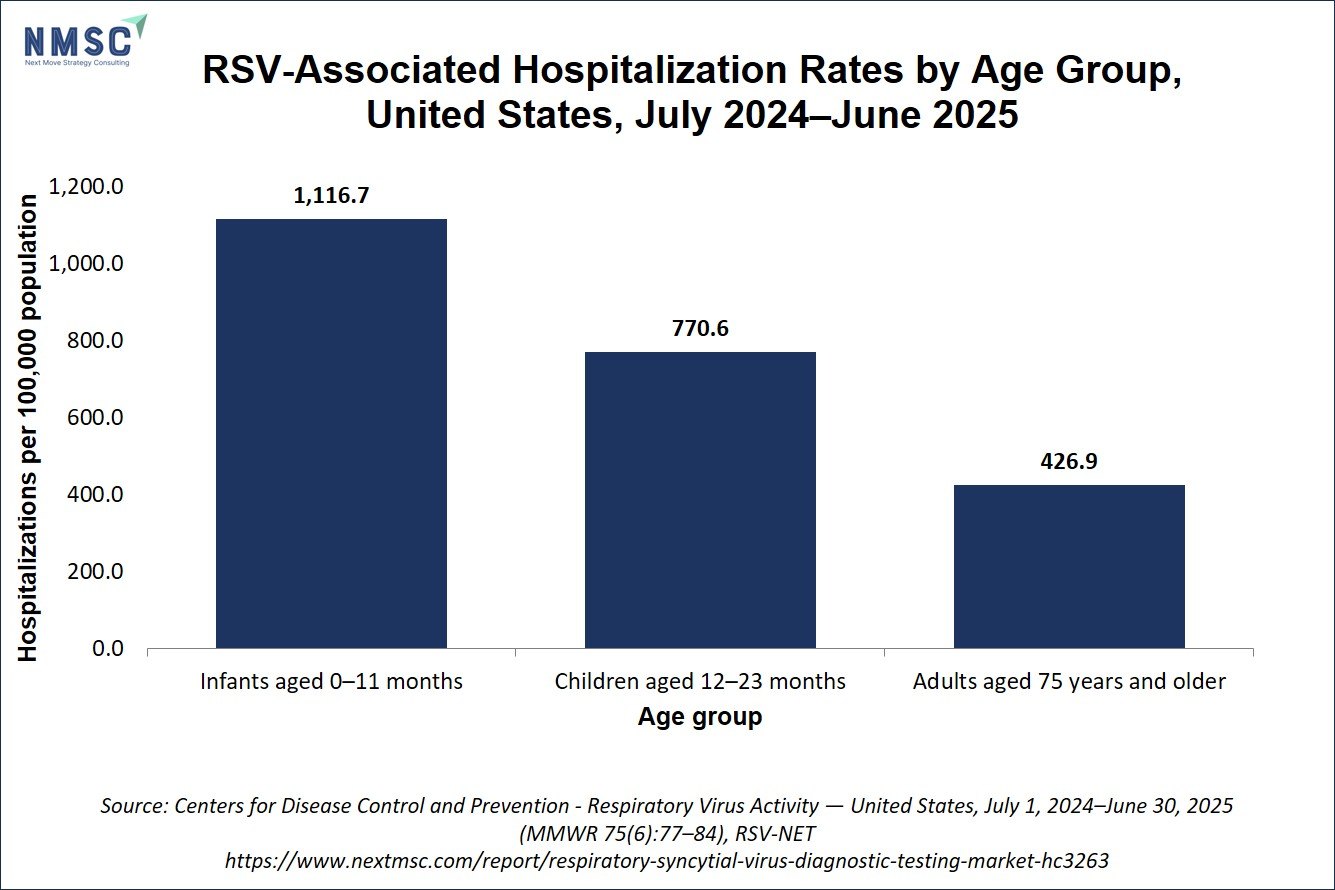
The 95% confidence intervals published by the Centers for Disease Control and Prevention for these RSV-NET rates are 1,078.4–1,157.9 for infants aged 0–11 months, 743.1–800.3 for children aged 12–23 months and 366.6–510.8 for adults aged 75 years and older.
The same report flags the limits of what testing currently captures. Death certificate counts likely omit RSV deaths because not all persons who die after RSV are tested for the virus, so the Centers for Disease Control and Prevention treats the 672 recorded deaths as minimum counts, and NREVSS reporting is voluntary, so participating laboratories may not represent every region or age group. Each gap is a testing gap, and each is a place where broader, faster and cheaper assays change the measured burden.
The seasonal outlook sharpens the commercial timing. The CDC Respiratory Illnesses Data Channel reported on November 13, 2026 that the amount of acute respiratory illness causing people to seek health care is low but increasing, and that CDC expects the 2026-2027 season to resemble the last one, with COVID-19, flu and RSV projected to cause about the same number of peak hospitalizations. A panel cleared in early November reaches laboratories before the winter overlap of influenza and RSV that the company cites as the reason for three-target testing.
Prevention Products Change Who Clinicians Test
The Centers for Disease Control and Prevention's report describes three options for protecting infants in their first RSV season, and a single-dose vaccine for older adults. An interim evaluation cited in the report found that after pediatric RSV prevention products were introduced, RSV-associated hospitalization rates in infants aged 0–7 months fell by 28% to 43% compared with seasons before the products. Infants aged 0–11 months nonetheless still recorded the highest hospitalization rates of any age group in 2024–25.
RSV Immunization Options Described in the CDC's February 2026 Report
|
Product type |
Eligible group |
Timing and dosing detail |
|
Maternal RSV vaccine |
Infants, protected through vaccination during pregnancy |
Given at 32–36 weeks' gestation |
|
Nirsevimab |
Infants aged under 8 months who are born during or entering their first RSV season |
Long-acting monoclonal antibody |
|
Clesrovimab |
Infants aged under 8 months who are born during or entering their first RSV season |
Long-acting monoclonal antibody |
|
RSV vaccine for adults |
All adults aged 75 years and older; adults aged 50–74 years at increased risk for severe RSV disease |
Single dose recommended |
NextMSC primary research and analysis treats these products as a demand factor for diagnostics rather than a substitute for them. Prevention lowers hospitalization among protected groups, yet the report shows that children aged 12–23 months and adults aged 75 and older remain among the three highest-rate groups, and a recommendation to vaccinate older adults raises the value of correctly separating RSV from influenza, COVID-19 and other respiratory illnesses at the point of care.
Segment and Regional Dynamics
NextMSC primary research and analysis segments the RSV diagnostic testing market by method (rapid antigen detection tests, molecular diagnostics, chromatographic immunoassays and other methods), by product (kits and reagents, instruments and other products) and by end user (hospitals, clinics, laboratories and others), across North America, Europe, Asia-Pacific and the Rest of the World. The Molecular Designs panel maps onto the molecular diagnostics method, the kits-and-reagents product group and the laboratory end-user group. The same research records that RT-PCR and real-time PCR assays are replacing cell culture because of higher sensitivity and faster turnaround, and that multiplex PCR assays detecting RSV alongside other respiratory pathogens are a defining product trend, with the caveat that multiplex systems can show lower sensitivity and specificity than single-target assays.
On the regional side, NextMSC primary research and analysis describes North America as a mature region focused on advanced testing methods, citing FDA Emergency Use Authorization for combination tests and the launch of multiplex assays. Europe is characterized by research into RSV burden in older adults, the start of vaccination programmes and cost-effectiveness analyses in Denmark, Finland, the Netherlands and Spain-Valencia. Asia-Pacific, particularly India and Korea, shows growing awareness of RSV's public health impact, including diagnostic tests developed in India for global use.
Growth Drivers and Restraints
NextMSC primary research and analysis lists limited uptake of advanced testing in adult outpatient settings, difficulty in differentiating RSV from other illnesses, unresolved cost-effectiveness questions for vaccination strategies and low awareness of RSV burden outside infancy as the main restraints. The Centers for Disease Control and Prevention's own caveats, including the adjustment of RSV-NET rates for underdetection and the treatment of recorded deaths as minimum counts, corroborate the testing-gap restraint with federal surveillance evidence. On the driver side, the pipeline visible in 2025 and 2026 filings addresses these restraints directly: ACON Laboratories and SEKISUI Diagnostics widen the tested age range, and Co-Diagnostics is seeking a CLIA waiver that would move PCR-based RSV testing out of central laboratories.
NMSC Strategic Perspective: RSV Moves From Stand-Alone Test to Panel Target
NextMSC primary research and analysis reads the November 4, 2026 clearance as evidence that RSV is increasingly purchased as one target inside a respiratory panel rather than as a stand-alone test. The FDA record, Molecular Designs' batch-oriented breakaway format and the SEKISUI Diagnostics, ACON Laboratories and Co-Diagnostics announcements since May 2025 each place RSV detection in a different setting: the high-complexity laboratory, professional rapid antigen testing, the home and point-of-care PCR awaiting a CLIA waiver. The mechanism for suppliers is volume concentration. Because influenza and RSV often circulate together, a laboratory running one three-target panel per specimen consumes a single consumable where a sequential workflow would consume two, and the supplier that owns the panel, the extraction chemistry and the batch format captures that spend.
The second shift concerns who is tested. The Centers for Disease Control and Prevention's report places infants aged 0–11 months first at 1,116.7 per 100,000, children aged 12–23 months second at 770.6, and adults aged 75 and older third at 426.9, and it recommends a single RSV vaccine dose for all adults aged 75 and older and for adults aged 50–74 at increased risk. NextMSC primary research and analysis expects wider vaccine eligibility to enlarge the group of adults for whom a confirmed RSV result matters, since a vaccinated or unvaccinated older adult with respiratory symptoms still requires separation of RSV from influenza and COVID-19. Because NextMSC's research also finds that RT-PCR uptake in adult outpatient settings is limited, adult outpatient care is the clearest setting where point-of-care and home formats can extend testing reach.
For suppliers, NextMSC primary research and analysis highlights three decision points: whether to pair assays with proprietary extraction and instrument ecosystems, as Molecular Designs has done; whether to pursue CLIA-waived formats, the route Co-Diagnostics has chosen through its concurrent submission; and whether to extend labelling to young children and older adults, as SEKISUI Diagnostics and ACON Laboratories have done with age-specific clearances. For investors, maintaining the sensitivity and specificity of single-target assays inside multiplex systems, a challenge noted in the NextMSC report, is the principal execution risk to monitor.
Competitive Landscape
The NextMSC report profiles 15 companies and provides market share data for 10 of them, including bioMérieux, Becton Dickinson and Company, QIAGEN, F. Hoffmann-La Roche, Thermo Fisher Scientific, Bio-Rad Laboratories, Abbott Laboratories, Siemens Healthineers, Danaher Corporation, Hologic and Cepheid. According to NextMSC primary research and analysis, these participants compete on test speed, sensitivity and panel breadth, while the cost and limited standardization of nucleic acid tests remain obstacles.
The 2025 and 2026 regulatory activity shows smaller developers contesting specific settings. Molecular Designs secured its first FDA-cleared assay with a laboratory panel. Co-Diagnostics announced on July 1, 2026 that it had completed its clinical and analytical performance studies, including 27 individual analytical studies and more than 10,000 PCR test cup runs, and its Chief Executive Officer Dwight Egan described the completion as a significant execution milestone before the company submitted its dual 510(k) and CLIA Waiver by Application on August 6, 2026. ACON Laboratories and SEKISUI Diagnostics have each secured clearances that extend RSV testing to young children, with ACON Laboratories reaching the home.
Bottom Line
The November 13, 2026 announcement that Molecular Designs received FDA clearance for a single-run influenza A, influenza B and RSV panel confirms that RSV diagnostics are moving from stand-alone assays toward multiplex workflows across laboratory, point-of-care and home settings. CDC data for the 2024–25 season show why the demand base is broad: 3,767,034 RSV tests were reported, hospitalization rates were highest in infants at 1,116.7 per 100,000, adults aged 75 and older recorded 426.9 per 100,000, and RSV was associated with an estimated 190,000–350,000 hospitalizations. According to Next Move Strategy Consulting, the global RSV diagnostic testing market was valued at USD 2.80 billion in 2024 and is projected to reach USD 4.08 billion by 2030 at a CAGR of 6.49%. NextMSC primary research and analysis identifies broader adult testing, multiplex accuracy and the clearance of CLIA-waived point-of-care formats as the three developments that will set how quickly that trajectory is realised.
About Next Move Strategy Consulting
Next Move Strategy Consulting is a premier market research and management consulting firm that has been committed to provide strategically analysed well documented latest research reports to its clients. The research industry is flooded with many firms to choose from, what makes NMSC different from the rest is its top-quality research and the obsession of turning data into knowledge by dissecting every bit of it and providing fact-based research recommendation that is supported by information collected from over 500 million websites, paid databases, industry journals and one on one consultations with industry experts across a diverse range of industry sectors. The high-quality customized research reports with actionable insights and excellent end-to-end customer service help our clients to take critical business decisions that enables them to move beyond time and have competitive edge in the industry.
We have been servicing over 1000 customers globally that includes 90% of the Fortune 500 companies over a decade. Our analysts are constantly tracking various high growth markets and identifying hidden opportunities in each sector or the industry. We provide one of the industry’s best quality syndicate as well as custom research reports across 10 different industry verticals. We are committed to deliver high quality research solutions in accordance to your business needs. Our industry standard delivery solutions that ranges from the pre consultation to after-sales services, provide an excellent client experience and ensure right strategic decision making for businesses.
For more information, please contact:
Next Move Strategy Consulting
5th Floor 867 Boylston St, STE 500,
Boston, MA 02116, U.S.
E-Mail: [email protected]
Direct: +1-217-650-7991
Website: www.nextmsc.com
About the Author
 Priyanshu Das
— Priyanshu Das is SEO Executive at Next Move Strategy Consulting, where he has led on-page and off-page SEO, keyword research, and SEO audits for the firm's B2B market research publications for 2 years. His audit process combines technical crawl analysis, backlink profile review, and competitor keyword gap mapping — using tools including Screaming Frog and Google Search Console — to prioritize fixes by organic search-visibility impact, informed by his own prior in-house and agency SEO experience.
About the Reviewer
 Debashree Dey
— Debashree Dey is Assistant Manager at Next Move Strategy Consulting, where she supports cross-vertical market content and communications across diverse industries for 6 years. Her professional background includes senior content writing, communications, and published manuscript authorship, with experience developing audience-focused business narratives and maintaining clear, consistent messaging. Her role supports research-led content development and editorial quality across NextMSC publications.

















Add Comment