Five Million Robots Now Run Factories, and Someone Must Keep Them Running

IFR’s Record 5 Million-Robot Fleet, KBR’s 10-Year Maintenance Award and the ABB–Vale Alliance Show Automation Revenue Shifting From Installation Day to Asset Lifetime
On 24 September 2026, the International Federation of Robotics (IFR) reported in its World Robotics 2026 release that the global operational stock of industrial robots rose 9% to a record 5 million units in 2025, driven by an 11% jump in annual installations to more than 600,000 new units. IFR President Jane Heffner noted that the five-million mark is more than double the level of seven years earlier. Each of those machines needs commissioning support, preventive maintenance, software updates and network security for the rest of its working life, so a record installation year enlarges the base of recurring service work available to system integrators, equipment makers and maintenance contractors.
According to Next Move Strategy Consulting’s Industrial Automation Services Market report, the global industrial automation services market was valued at USD 255.82 billion in 2025 and is projected to reach USD 586.56 billion by 2035, growing at a CAGR of 8.19% from 2026 to 2035. NextMSC primary research and analysis places the market at USD 288.89 billion in 2026, with project engineering and implementation holding the largest service-type share in 2025 at 42%, or USD 107.44 billion.
For More Information: Download FREE Sample on Industrial Automation Services Market Report
The Installed-Base Arithmetic Behind Service Demand
IFR’s country data show where that installed base is being built. China installed 354,000 units in 2025, up 20% and equal to 59% of global deployments. The United States passed Japan to become the second-largest market, with installations up 12% to almost 38,500 units, while Japan fell 19% to 36,219 units. The Republic of Korea installed 30,000 units, down 1%, and India installed almost 10,500 units, up 15%. IFR forecasts global installations to rise 9% to 655,000 units in 2026 and to reach 806,000 units in 2029.
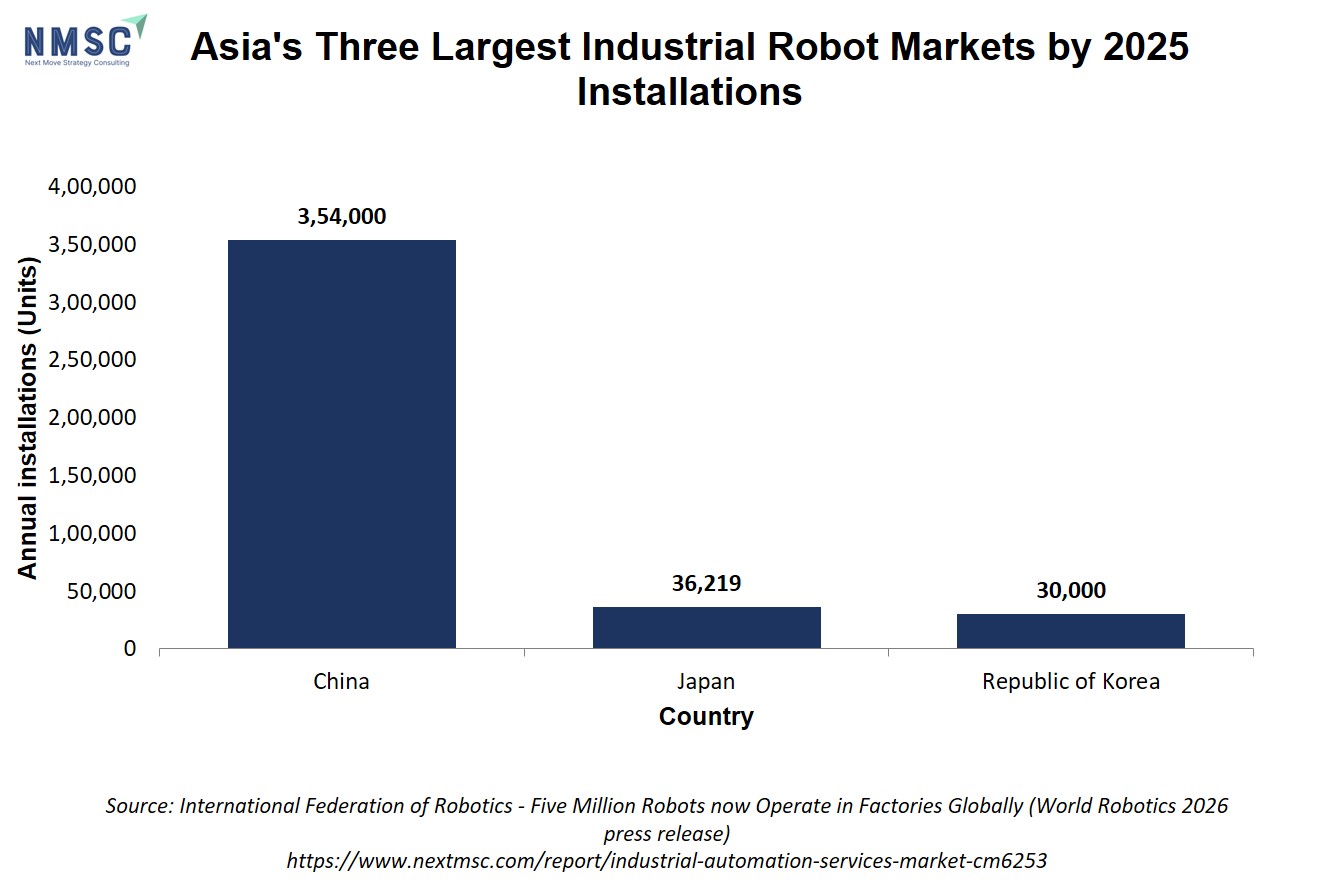
IFR reported that China installed 354,000 industrial robots in 2025, compared with 36,219 units in Japan and 30,000 units in the Republic of Korea. The United States, ranked second worldwide, is outside Asia and is not shown.
IFR World Robotics 2026: Industrial Robot Metrics for 2025
|
Metric |
2025 value |
Change |
|
Global operational stock of industrial robots |
5 million units (record) |
+9% |
|
Global annual installations |
More than 600,000 units |
+11% |
|
China installations |
354,000 units (59% of global) |
+20% |
|
United States installations |
Almost 38,500 units |
+12% |
|
Japan installations |
36,219 units |
-19% |
|
Germany installations |
Fewer than 25,000 units |
-8% |
|
India installations |
Almost 10,500 units |
+15% |
|
Forecast global installations, 2026 |
655,000 units (IFR forecast) |
+9% |
Jane Heffner, President of the International Federation of Robotics, framed the shift in the federation’s 24 September 2026 release:
“Industrial automation is progressing at high speed.”
- Jane Heffner, President, International Federation of Robotics, IFR press release, Five Million Robots now Operate in Factories Globally, 24 September 2026.
The service implication follows from IFR’s own outlook slides. The federation lists cybersecurity becoming as important as safety, robots operating as part of connected production systems under an IT-meets-OT model, and a tight supply of skilled professionals among the forces shaping automation adoption (IFR World Robotics 2026 press conference presentation, 24 September 2026). Each condition pulls work toward providers that can integrate, secure and maintain equipment after the commissioning date, not only deliver it.
Key Industry Developments: Outsourced Maintenance, Agentic Reliability and Plant-Wide Replication
On 18 February 2026, KBR and Rabigh Refining & Petrochemical Company (Petro Rabigh) announced a 10-year general maintenance services contract, with an optional two-year extension, covering the Polymer I and Polymer II plants in Saudi Arabia. KBR’s local joint venture subsidiary, KBR Al Yusr, will deliver preventive, predictive, corrective and cycled shutdown maintenance supported by AI and machine-learning tools, and KBR described the award as Petro Rabigh’s first large-scale outsourcing of maintenance services. Petro Rabigh President and Chief Executive Officer Othman Al Ghamdi said the company’s priorities in the transition are safety, reliability, risk management and cost efficiency (KBR press release, 18 February 2026).
On 23 July 2026, Rockwell Automation and Augury announced a strategic technology and go-to-market partnership that connects Augury’s Reliability Agent, which flags emerging machine faults and recommends corrective actions, with Rockwell’s Fiix MAX maintenance assistant, which turns those recommendations into work orders and maintenance workflows. Rockwell cited its 11th annual State of Smart Manufacturing Report, which found that only 43% of collected data is used effectively, as the gap the joint offer targets, and said the initial offer was expected in September (Rockwell Automation press release, 23 July 2026).
On 12 August 2026, ABB and Vale signed a strategic alliance to extend automation, AI and integrated IT/OT systems from Vale’s Conceição II Model Plant in Itabira, Minas Gerais, to other iron ore processing plants in Brazil. ABB acted as consultant, systems integrator and technology provider on the model plant, which the announcement credits with a 25% productivity increase since implementation in 2024, a 40% rise in premium ore for direct reduction and a 26% reduction in iron losses in tailings. Joachim Braun, President of ABB’s Process Industries Division, described the agreement as a framework for a consistent approach to automation, electrification and digitalization across multiple operations (ABB press release, 12 August 2026).
Three 2026 Service-Led Automation Agreements
|
Date |
Companies |
Service scope |
Documented result |
|
18 February 2026 |
KBR and Petro Rabigh (Saudi Arabia) |
10-year general maintenance contract, optional two-year extension; preventive, predictive, corrective and shutdown maintenance |
First large-scale maintenance outsourcing by Petro Rabigh |
|
23 July 2026 |
Rockwell Automation and Augury |
Technology and go-to-market partnership linking the Reliability Agent to Fiix MAX maintenance workflows |
43% of collected data used effectively, per Rockwell’s 11th State of Smart Manufacturing Report; initial offer expected in September |
|
12 August 2026 |
ABB and Vale (Brazil) |
Strategic alliance to replicate the Conceição II automation and IT/OT model across iron ore plants |
Conceição II: +25% productivity, +40% premium ore for direct reduction, -26% iron losses in tailings |
Segment Dynamics: Managed Operations and Automation Software Set the Pace
According to NextMSC primary research and analysis, managed operations is the fastest-growing service type, expanding at a 16.1% CAGR from 2026 to 2035, from USD 30.70 billion in 2025 to USD 117.31 billion in 2035, as operators outsource remote supervision, managed infrastructure and managed operational technology cybersecurity. Maintenance and support, valued at USD 71.63 billion in 2025, grows at 7.8%, and consulting and advisory, at USD 46.05 billion, grows at 7.3%. By technology, NextMSC research identifies automation software as the fastest-growing category at a 17.1% CAGR, while programmable logic controllers held the largest share in 2025 at 22%, or USD 56.28 billion.
The KBR award at Petro Rabigh illustrates the managed-operations pattern: a plant owner moving maintenance from an in-house function to a decade-long contract with one provider, which converts a variable maintenance budget into a recurring service line for the contractor.
Regional Outlook: Asia-Pacific Leads, Middle East and Africa Accelerates
NextMSC primary research and analysis places Asia-Pacific at the head of the market with a 34% revenue share, or USD 86.98 billion, in 2025, and China as the largest national market at USD 38.50 billion. IFR’s installation data are consistent with that position, since China took 59% of global installations in 2025. IFR also reports that Chinese manufacturers supplied 195,000 units in their home market, a 55% domestic share against 57% in 2024, as installations of foreign robots rose 27% against 15% for domestic suppliers (IFR China press release, 24 September 2026). NextMSC research reads a fleet split between domestic and foreign brands as a driver of multi-vendor integration and maintenance work.
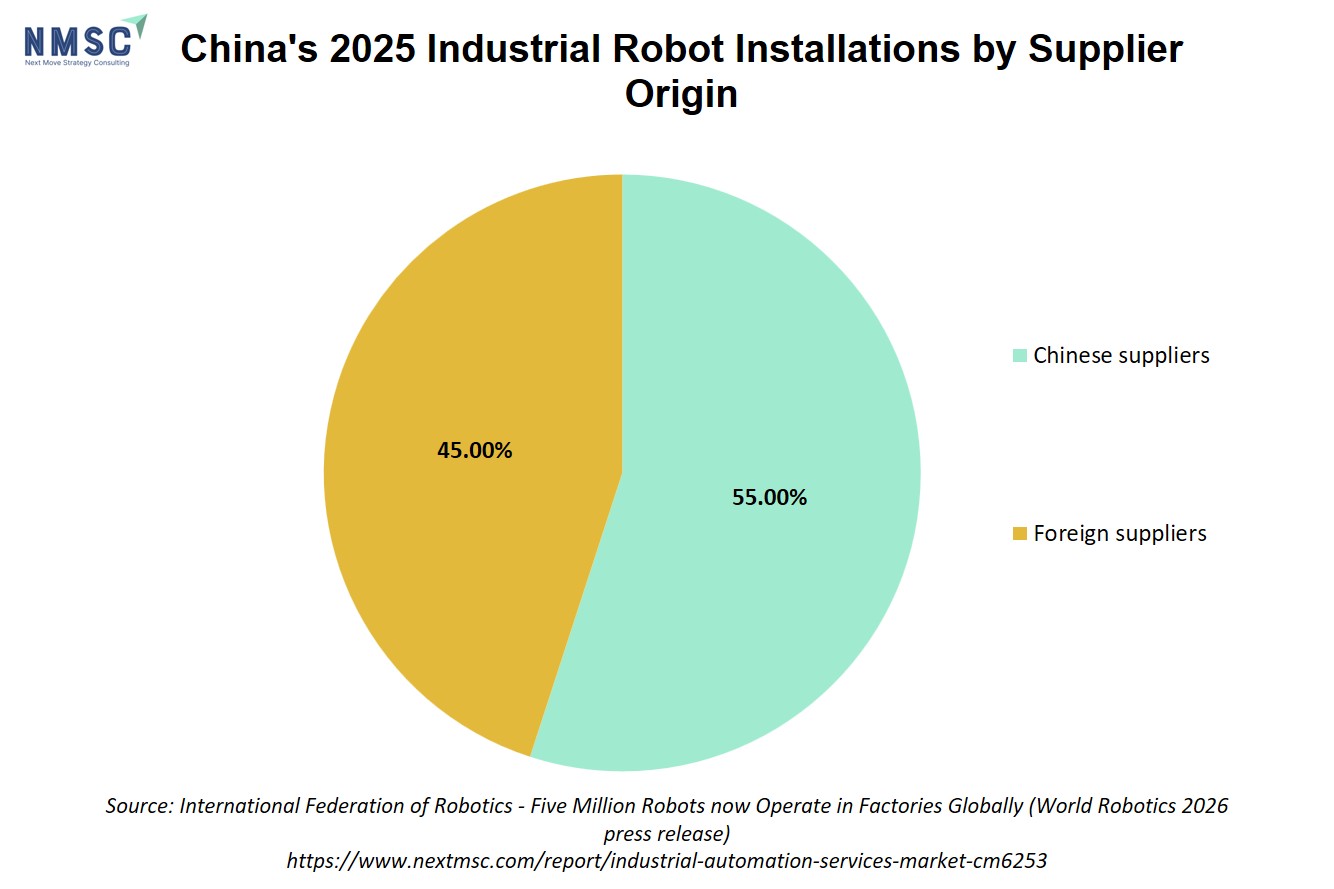
IFR reported that Chinese manufacturers sold 195,000 units in their home market in 2025, a 55% domestic share compared with 57% in 2024. The foreign-supplier share is shown as the 45.0% remainder of the 100% total.
Middle East and Africa is the fastest-growing region in NextMSC’s model at a 15.8% CAGR from 2026 to 2035, with Saudi Arabia the fastest-growing country at 12.2%. The Petro Rabigh contract, covering polymer plants in Saudi Arabia, is an example of the demand pattern behind those rates. India grows at 11.2% in NextMSC’s forecast, and IFR reports that Indian installations reached almost 10,500 units in 2025, up 15%, after growing 27% a year on average between 2020 and 2025.
Growth Drivers and Restraints
External evidence from regulators, statistical agencies and IFR points to two demand drivers and two constraints. BLS does not publish openings for automation engineers separately, so the manufacturing total is used here as the closest published gauge of staffing pressure at plants.
Industrial Automation Services: Growth Drivers and Restraints Evidence Matrix
|
Factor |
Type |
Evidence |
Source |
|
Operational technology cyber exposure |
Driver |
The Cybersecurity and Infrastructure Security Agency (CISA), the Department of War, the Department of Energy, the FBI and the Department of State published Adapting Zero Trust Principles to Operational Technology on 29 April 2026. CISA’s Chris Butera said CISA has observed threat actors such as Volt Typhoon targeting OT systems, and CISA urged OT owners, operators and integrators to use the guide. |
CISA, 29 April 2026 |
|
Labor scarcity and reshoring |
Driver |
IFR expects reshoring policy and labor scarcity to provide long-run opportunities for robotics in the United States, and expects China’s market to grow 5% to 10% a year on average to 2029 as demographic change tightens labor supply. |
IFR, 24 September 2026 |
|
Skilled-workforce tightness |
Restraint |
U.S. manufacturing job openings were 584,000 in September 2026 (preliminary), a rate of 4.4%, against 389,000 and 3.0% in September 2025. |
U.S. BLS JOLTS, 3 November 2026 |
|
Trade tension and policy uncertainty |
Restraint |
IFR says uncertainty and trade tensions will burden the U.S. robotics market in the short term; Germany’s installations fell 8% to fewer than 25,000 units in 2025. |
IFR, 24 September 2026 |
NMSC Strategic Perspective: Revenue Follows the Installed Base, Not the Install Date
NextMSC primary research and analysis reads the IFR milestone, the KBR award and the ABB–Vale alliance as one pattern: automation revenue is moving from one-time project work toward contracts that run for the life of the asset. NextMSC’s model places project engineering and implementation at USD 107.44 billion in 2025, yet managed operations grows at 16.1% a year to 2035, more than twice the 7.5% CAGR NextMSC projects for project engineering.
External data show why operators accept that shift. CISA’s April 2026 guidance pushes asset visibility, identity controls and supply-chain security into operational technology environments, work that favors providers able to monitor networks continuously. U.S. manufacturing openings of 584,000 in September 2026 leave plant operators short of in-house engineers, which makes outsourced remote supervision and maintenance a staffing solution as well as a technology choice. NextMSC identifies brownfield modernization demand as the primary driver of its forecast, with managed operational technology cybersecurity adoption reinforcing it.
For investors and suppliers, NextMSC research identifies a USD 297.67 billion absolute dollar opportunity between 2026 and 2035. NextMSC’s analysis indicates that providers combining validated managed-service credentials with scaled regional delivery, particularly across Asia-Pacific and Middle East and Africa, hold the strongest position, while providers dependent on commissioning revenue face exposure as customers extend contracts across asset lifetimes.
Competitive Landscape
NextMSC profiles 20 companies in the market, including Siemens AG, Schneider Electric SE, ABB Ltd, Emerson Electric Co. and Rockwell Automation, Inc., and characterizes the structure as moderately consolidated, with global automation majors competing against specialized robotics and instrumentation providers on service breadth, technology depth and installed-base reach. The 2026 events above show three distinct routes: ABB’s integrator-led alliance with a single large operator, Rockwell Automation’s software partnership that embeds AI-driven reliability into its maintenance platform, and KBR’s engineering-services contract that places a decade of plant maintenance under one provider. Each was announced by the companies concerned on the dates cited above.
Bottom Line
IFR’s World Robotics 2026 report puts the global industrial robot fleet at a record 5 million units and forecasts installations of 655,000 in 2026 and 806,000 in 2029, enlarging the base of equipment that must be integrated, secured and maintained. NextMSC primary research and analysis values the industrial automation services market at USD 255.82 billion in 2025 and projects USD 586.56 billion by 2035 at an 8.19% CAGR, with managed operations growing at 16.1%. The 2026 evidence points the same way: KBR’s 10-year maintenance contract at Petro Rabigh, Rockwell Automation and Augury’s maintenance-execution partnership, and the ABB and Vale alliance to replicate a plant-wide automation model all tie revenue to asset lifetimes rather than installation dates. CISA’s operational technology guidance and 584,000 open U.S. manufacturing jobs in September 2026 add demand for outsourced monitoring and engineering capacity. Asia-Pacific leads with a 34% share, and Middle East and Africa is the fastest-growing region at 15.8%. Providers with credible managed-service capability and regional delivery scale are best placed; those reliant on one-time projects are most exposed.
About Next Move Strategy Consulting
Next Move Strategy Consulting is a premier market research and management consulting firm that has been committed to provide strategically analysed well documented latest research reports to its clients. The research industry is flooded with many firms to choose from, what makes NMSC different from the rest is its top-quality research and the obsession of turning data into knowledge by dissecting every bit of it and providing fact-based research recommendation that is supported by information collected from over 500 million websites, paid databases, industry journals and one on one consultations with industry experts across a diverse range of industry sectors. The high-quality customized research reports with actionable insights and excellent end-to-end customer service help our clients to take critical business decisions that enables them to move beyond time and have competitive edge in the industry.
We have been servicing over 1000 customers globally that includes 90% of the Fortune 500 companies over a decade. Our analysts are constantly tracking various high growth markets and identifying hidden opportunities in each sector or the industry. We provide one of the industry’s best quality syndicate as well as custom research reports across 10 different industry verticals. We are committed to deliver high quality research solutions in accordance to your business needs. Our industry standard delivery solutions that ranges from the pre consultation to after-sales services, provide an excellent client experience and ensure right strategic decision making for businesses.
For more information, please contact:
Next Move Strategy Consulting
5th Floor 867 Boylston St, STE 500,
Boston, MA 02116, U.S.
E-Mail: [email protected]
Direct: +1-217-650-7991
Website: www.nextmsc.com
About the Author
 Sanyukta Deb
— Sanyukta Deb is Digital Marketing Team Lead at Next Move Strategy Consulting, where she has led content strategy and technical SEO for the firm's B2B market research publications for over 2 years. Her editorial process translates NextMSC's primary and secondary research — spanning technology, industrial, and consumer sectors — into commercial narratives, backed by search-intent, keyword, and competitive analysis. She brings 5 years of overall experience in digital marketing and content strategy.
About the Reviewer
 Debashree Dey
— Debashree Dey is Assistant Manager at Next Move Strategy Consulting, where she supports cross-vertical market content and communications across diverse industries for 6 years. Her professional background includes senior content writing, communications, and published manuscript authorship, with experience developing audience-focused business narratives and maintaining clear, consistent messaging. Her role supports research-led content development and editorial quality across NextMSC publications.
















Add Comment