France Activates World’s First Wireless, Self-Charging EV Highway
Industry Insights from Next Move Strategy Consulting
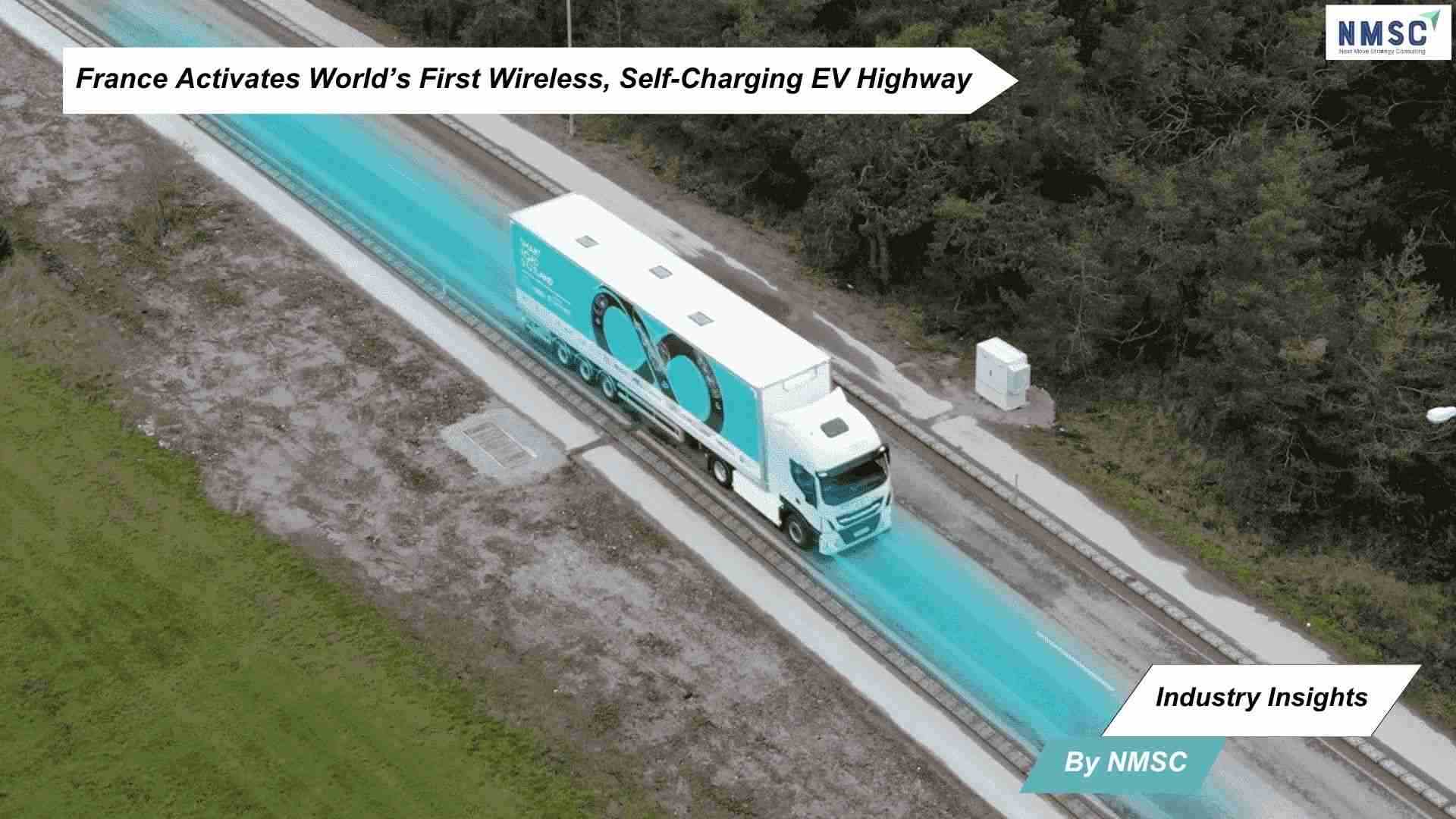
France has brought into service the world’s first roadway capable of charging electric vehicles while they are in motion. Situated just outside Paris alongside the A10 motorway, the trial stretches 1.5 kilometres and can charge multiple buses, cars and heavy-duty trucks simultaneously as they drive.
A technical breakthrough for on-the-move charging
Independent tests by laboratories at Gustave Eiffel University verified that the system is designed to deliver a continuous power flow exceeding 200 kW and can peak at about 300 kW comparable with some of the fastest public chargers available today.
How the system operates
Power transfer is achieved through copper coils embedded beneath the asphalt. Those coils generate a magnetic field that couples with special receivers fitted to vehicles, allowing energy to flow without physical contact. Because the technology relies on a magnetic field rather than exposed connectors, it is reported to operate in heavy rain, ice and snow without performance loss.
Practical benefits and implications
Early reports indicate the road can add substantial range in a matter of minutes, which could address a central obstacle to wider EV adoption vehicle range anxiety. Faster in-motion charging may reduce the need for very large, heavy batteries on long-range vehicles and cut downtime for long trips.
Key features at a glance
-
Location: 1.5-kilometre trial near Paris, alongside the A10 motorway.
-
Power: continuous delivery of more than 200 kW, peaking at ~300 kW. Simultaneous charging of buses, cars and heavy trucks while moving.
-
Technology: copper coils under pavement generate a magnetic field to transfer energy to vehicle receivers.
-
Weather resilience: designed to operate in rain, ice and snow.
-
Design durability: charging infrastructure embedded in pavement (no moving parts).
-
Developer & policy alignment: developed by Electreon and aligned with France’s transport ambition to deploy some 9,000 km of wireless charging roads by 2035.
According to Next Move Strategy Consulting
This milestone represents a practical demonstration of in-road wireless charging at scale and could shift planning for long-distance electric mobility. If the technology proves reliable and is rolled out more widely, fleet operators (especially buses and heavy trucks) may be early adopters because on-the-move charging reduces range limits and the need for oversized batteries. Embedding charging infrastructure in pavements also suggests lower mechanical maintenance risks compared with mobile or moving hardware solutions. However, the long-term impact will hinge on deployment pace, interoperability with existing vehicle platforms and the economics of installing such systems at scale.
Source: Indian Express
Prepared by: Next Move Strategy Consulting
About the Author
 Sanyukta Deb
— Sanyukta Deb is Digital Marketing Team Lead at Next Move Strategy Consulting, where she has led content strategy and technical SEO for the firm's B2B market research publications for over 2 years. Her editorial process translates NextMSC's primary and secondary research — spanning technology, industrial, and consumer sectors — into commercial narratives, backed by search-intent, keyword, and competitive analysis. She brings 5 years of overall experience in digital marketing and content strategy.
Sanyukta Deb
— Sanyukta Deb is Digital Marketing Team Lead at Next Move Strategy Consulting, where she has led content strategy and technical SEO for the firm's B2B market research publications for over 2 years. Her editorial process translates NextMSC's primary and secondary research — spanning technology, industrial, and consumer sectors — into commercial narratives, backed by search-intent, keyword, and competitive analysis. She brings 5 years of overall experience in digital marketing and content strategy.
About the Reviewer
 Debashree Dey
— Debashree Dey is Assistant Manager at Next Move Strategy Consulting, where she supports cross-vertical market content and communications across diverse industries for 6 years. Her professional background includes senior content writing, communications, and published manuscript authorship, with experience developing audience-focused business narratives and maintaining clear, consistent messaging. Her role supports research-led content development and editorial quality across NextMSC publications.
Debashree Dey
— Debashree Dey is Assistant Manager at Next Move Strategy Consulting, where she supports cross-vertical market content and communications across diverse industries for 6 years. Her professional background includes senior content writing, communications, and published manuscript authorship, with experience developing audience-focused business narratives and maintaining clear, consistent messaging. Her role supports research-led content development and editorial quality across NextMSC publications.
















Add Comment