Textile Market By Product Form {Fiber (Natural Fiber, Manmade Fiber, and Others), Yarn (Cotton, Blended, Synthetic Filament), Fabric and Others)}, By Material Type (Natural, Synthetic, Semi-Synthetic, Blended), By Sales Channel (Direct B2B, Distributors, Trading Houses, Digital), and By Customer Type {Textile Manufacturers (Spinners, Weavers, and Others), Apparel Manufacturers, and Others}– Global Analysis & Forecast, 2025–2035
Industry: Retail and Consumer | Publishing Date: June 2, 2026 | Last Updated: September 30, 2026 | No of Pages: N/A | No. of Tables: N/A | No. of Figures: N/A | Format: PDF | Report Code: RC4599
Industry Outlook
The global Textile Market size was valued at USD 1.91 trillion in 2025 and is expected to be valued at USD 2.05 trillion by the end of 2026. The industry is projected to grow, hitting USD 3.91 trillion by 2035, with a CAGR of 7.43% between 2026 and 2035.
Textile Market Size & Forecast
Based on NMSC’s primary research, we observed that the global textile market demonstrates stable expansion, driven by sustained demand from apparel, home furnishings, and industrial applications, alongside rapid shifts toward sustainability and functional fabrics. Further, fiber producers, yarn and fabric manufacturers, and apparel converters align production strategies with evolving consumer preferences, while brands and retailers actively shape demand through fast fashion cycles, premiumization, and private-label expansion. In addition, through our interactions with textile manufacturers and machinery providers, we found that automation, digital printing, and advanced finishing technologies significantly improve production efficiency, reduce waste, and enhance product customization. Technology providers and chemical suppliers integrate performance-enhancing solutions such as moisture-wicking, antimicrobial, and durable coatings, strengthening the role of technical textiles across automotive, healthcare, and construction applications. At the same time, sustainability certification bodies and regulatory authorities enforce stricter compliance related to water usage, chemical discharge, and traceability, driving industry-wide adoption of eco-friendly processes and recycled materials.
Moreover, distributors, exporters, and logistics partners play a critical role in maintaining supply continuity amid shifting trade policies and sourcing realignments. Asia-Pacific leads production and export activity, supported by integrated manufacturing ecosystems, cost advantages, and strong government support, while Europe and North America focus on high-value textiles, innovation, and sustainable production standards. Emerging markets, including India and Southeast Asia, demonstrate accelerated capacity expansion driven by export competitiveness and domestic consumption growth. Furthermore, leading textile manufacturers and global brands compete through vertical integration, sustainable sourcing, and rapid design-to-market capabilities. Strategic investments in recycling technologies, circular textile initiatives, and digital supply chain platforms strengthen long-term operational resilience. We also identified that financial institutions and investment entities actively support capacity expansion, modernization, and ESG-aligned initiatives, reinforcing industry transformation. Overall, textile market operates as a highly interconnected ecosystem, where raw material suppliers, manufacturers, technology providers, brands, regulators, and end users collectively drive growth, efficiency, and sustainability, establishing a robust and evolving industry landscape.
What Are the Key Textile Industry Trends?
How Are Emotional & Sensory Textures Redefining Consumer Engagement in Textiles?
Based on NMSC’s primary research, we noticed that emotional and sensory textures fundamentally redefine fabric design and consumer engagement across the textile market. In this context, a decisive shift toward 3D tactility emerges, where materials such as matte velvets, raised herringbones, and intentionally irregular artisanal weaves dominate new product development strategies. Our evaluation of recent collections, retail merchandising formats, and product positioning confirms that these textures create a deeper psychological connection by delivering comfort, warmth, and physical engagement, which directly influences purchasing decisions. Further, textured fabrics command stronger shelf visibility and premium perception compared to flat, screen-oriented materials. This shift establishes textiles as experiential surfaces rather than passive materials, enabling brands to differentiate offerings, strengthen identity, and build long-term consumer loyalty through sensory-driven product innovation.
How Is AI-Driven Demand Forecasting Reshaping Production Planning in the Market?
From our market analysis, we observed that AI-driven demand forecasting is emerging as a key trend transforming production planning across the textile market. In this context, manufacturers are increasingly using predictive analytics and real-time sales data to align production with actual demand patterns. Furthermore, this approach reduces overproduction, minimizes inventory buildup, and improves working capital efficiency. At the same time, brands and manufacturers are leveraging AI-enabled insights to optimize assortment planning, pricing strategies, and supply chain responsiveness. As a result, production systems are shifting from forecast-based mass manufacturing to demand-driven, data-led models, enabling faster decision-making, reduced waste, and improved profitability across textile value chains.
How Does Digital-Artisanal Fusion Redefine Scalable Textile Innovation?
From our market evaluations, we determined that digital-artisanal fusion redefines textile innovation by integrating advanced manufacturing technologies with the aesthetic depth of traditional craftsmanship. Furthermore, digital jacquard systems and precision laser-cutting technologies replicate complex hand-stitched embroidery, lacework, and heritage patterns with high accuracy while preserving visual irregularity and design uniqueness. Our analysis of production environments and design workflows shows that this integration enables large-scale manufacturing without compromising the authenticity associated with handcrafted textiles. Simultaneously, this approach significantly accelerates speed-to-market while maintaining premium design value. Consequently, manufacturers deliver differentiated products that combine scalability with exclusivity, allowing brands to meet growing consumer demand for authenticity while maintaining operational efficiency and consistent quality across global production networks.
Supply Chain Structure of the Textile Market
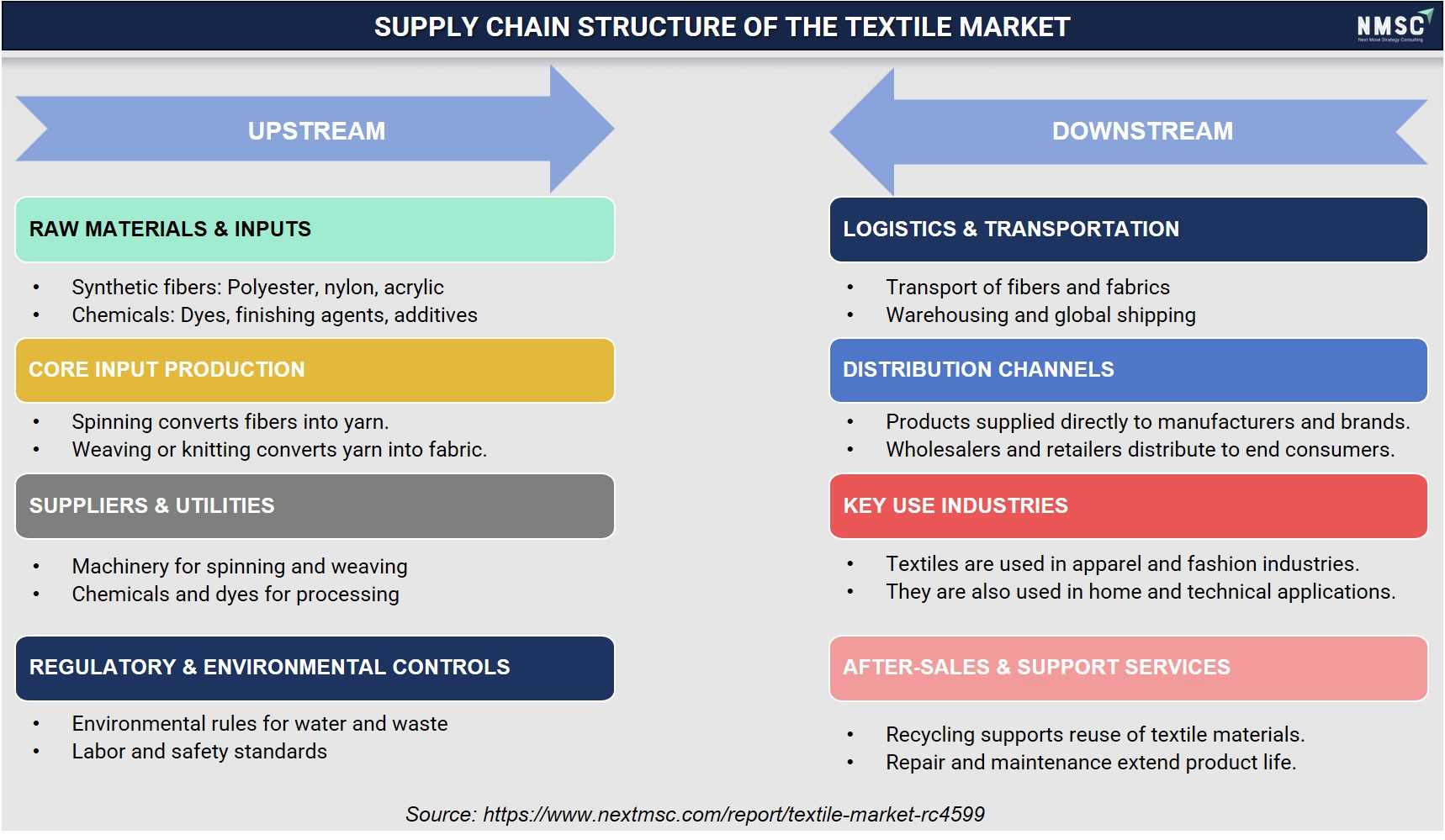
Based on our evaluation of the textile market value chain, we observed that the industry operates through a highly integrated upstream-to-downstream structure, where raw material sourcing, fiber processing, and fabric production align closely with distribution, logistics, and end-use applications. Furthermore, our analysis indicates that strong coordination between manufacturers, suppliers, and distributors enhances production efficiency and market responsiveness. At the same time, regulatory compliance and after-sales recycling systems strengthen sustainability, ensuring long-term value creation and operational continuity across the textile ecosystem.
What Are the Key Market Drivers, Breakthroughs, and Investment Opportunities That Will Shape the Textile Market in the Next Decade?
Growth Catalyst & Risk Assessment Matrix
|
DRIVERS / TRENDS / RESTRAINTS |
(+/–) % IMPACT ON CAGR FORECAST |
GEOGRAPHIC RELEVANCE |
IMPACT TIMELINE |
|
Rising demand for sustainable and circular textiles supported by recycled fibers and eco-friendly processing |
+1.3% |
Europe, North America, China, India |
Medium to long term (3–7 years) |
|
Increasing adoption of functional and performance textiles across apparel, healthcare, and industrial applications |
+1.1% |
North America, Europe, China, Japan |
Medium term (2–5 years) |
|
Advancements in digital manufacturing and smart textile production technologies enhancing efficiency and customization |
+0.9% |
Europe, China, North America |
Medium to long term (3–6 years) |
|
Expansion of Textile-to-Textile recycling and closed-loop production systems improving material efficiency |
+0.8% |
Europe, North America, Japan |
Long term (4–8 years) |
|
Volatility in raw material prices and supply chain complexity affecting cost structures and production stability |
–1.0% |
China, India, USA, Brazil |
Medium term (2–5 years) |
Based on our evaluation of global textile market developments, we found that the industry demonstrates steady evolution, driven by shifting consumer preferences, sustainability imperatives, and advancements in material and manufacturing technologies. Our assessment indicates that emotional and sensory textures gain strong traction, as fabric manufacturers and brands prioritize 3D tactility through matte velvets, raised herringbones, and artisanal weaves to enhance consumer engagement and product differentiation. At the same time, molecular-level circularity transforms sustainability practices, with the integration of Textile-to-Textile recycling technologies enabling the breakdown of blended fibers into original monomers and the production of virgin-quality yarn from complex waste streams. Furthermore, digital-artisanal fusion strengthens innovation across the value chain, as digital jacquard and laser-cutting technologies replicate handcrafted aesthetics at scale while maintaining design uniqueness and accelerating speed-to-market. However, our evaluation also indicates that process standardization and technology integration require continuous alignment across production systems to ensure consistent quality and scalability. At the same time, increasing investments in circular technologies and advanced manufacturing platforms strengthen long-term industry resilience, positioning the market for sustained, innovation-led growth.
Growth Drivers:
How Are Advancements in Digital Manufacturing and Functional Textiles Accelerating Textile Market Expansion?
Based on our analysis of textile production and innovation trends, we observed that advancements in digital manufacturing technologies and functional textiles significantly accelerate market growth. Through our engagements with technology providers and textile manufacturers, we identified that digital jacquard systems, automated processing, and advanced finishing technologies enhance production efficiency, reduce waste, and enable high levels of customisation. In this context, the European Commission reports that 4–9% of textile products are destroyed before use, contributing substantially to carbon emissions and resource inefficiencies across the value chain. Further, functional textiles, including moisture-wicking, antimicrobial, and performance-enhanced fabrics, expand rapidly across apparel, healthcare, and industrial applications. These technologies shorten design-to-market timelines while improving product differentiation and value realization. At the same time, the integration of smart manufacturing systems strengthens scalability and consistency across global production networks. Consequently, technological advancement establishes a strong foundation for sustained growth, enabling textile players to align innovation with evolving consumer and industrial demand.
How Is Rising Demand for Sustainable and Circular Textiles Driving Market Growth?
Based on our evaluation of global textile industry developments, we noticed that the accelerating demand for sustainable and circular textiles drives significant market expansion. Our interactions with fabric manufacturers, global brands, and sustainability certification bodies confirmed that environmental compliance and consumer preference for eco-friendly materials directly influence sourcing and production strategies. This trend is further reinforced by the Government of India (Press Information Bureau), India’s textile sector generated approximately USD 36.1 billion in exports in 2025, with strategic initiatives aimed at scaling this to USD 108.4 billion by 2030, supported by advancements in manufacturing and innovation. Simultaneously, recycled fibres, organic materials, and low-impact processing technologies gain strong adoption across apparel and home textile segments. At the same time, the integration of Textile-to-Textile recycling and closed-loop production systems strengthens material efficiency and reduces dependency on virgin resources. Additionally, sustainability-driven innovation enhances brand positioning, supports regulatory compliance, and improves long-term cost predictability. As a result, sustainability transitions from a compliance requirement to a core growth driver, enabling textile manufacturers and brands to scale responsibly while strengthening competitive differentiation.
Growth Inhibitor:
How Are Volatility in Raw Material Prices and Supply Chain Complexity Affecting Market Stability?
Based on our evaluation of textile supply chains, we assessed that volatility in raw material prices and increasing supply chain complexity influence market stability and operational efficiency. Our interactions with fibre suppliers and textile manufacturers indicate that fluctuations in cotton production, petrochemical-based inputs, and energy costs directly impact input pricing and margin structures. This instability is further highlighted by the USDA's March 2026 outlook projects that while global cotton production will reach 121.9 million bales for the 2025/26 season, production in key markets like India and the United States is projected to decline, contributing to global price sensitivity despite high ending stocks. Additionally, our assessment of sourcing strategies shows that dependence on geographically concentrated supply bases and multi-stage processing networks increases exposure to trade disruptions and logistical constraints. Consequently, cost variability affects planning accuracy, inventory alignment, and production continuity across manufacturers. As a result, these challenges increase operational pressure, limit cost visibility, and constrain margin optimisation across the textile value chain.
Growth Opportunity:
How Is Traceability-as-a-Service Creating New Revenue Opportunities in the Market?
From our evaluation of evolving textile value chains, we observed that traceability-as-a-service is emerging as a commercially driven opportunity rather than solely a compliance requirement. Digital product passports, blockchain-linked tracking systems, and embedded material identifiers enable end-to-end visibility across sourcing and distribution. This momentum is reinforced by the European Commission, the central Digital Product Passport (DPP) registry under the Ecodesign for Sustainable Products Regulation is expected to become operational by around July 2026, establishing the foundational infrastructure for product-level data management. With textiles identified as a priority category under the ESPR working plan, the phased introduction of mandatory Digital Product Passport requirements is expected to drive widespread adoption of traceability systems, digital identity solutions, and lifecycle data platforms across the textile industry. From our interactions with brands and certification bodies, we found that traceability supports premium positioning by validating product authenticity, directly influencing pricing power and consumer trust. At the same time, it enables new revenue streams through data monetization and platform-based solutions. As a result, traceability is evolving into a strategic growth lever, strengthening differentiation and scalable value creation across the textile market.
Price Point Analysis of the Textile Industry
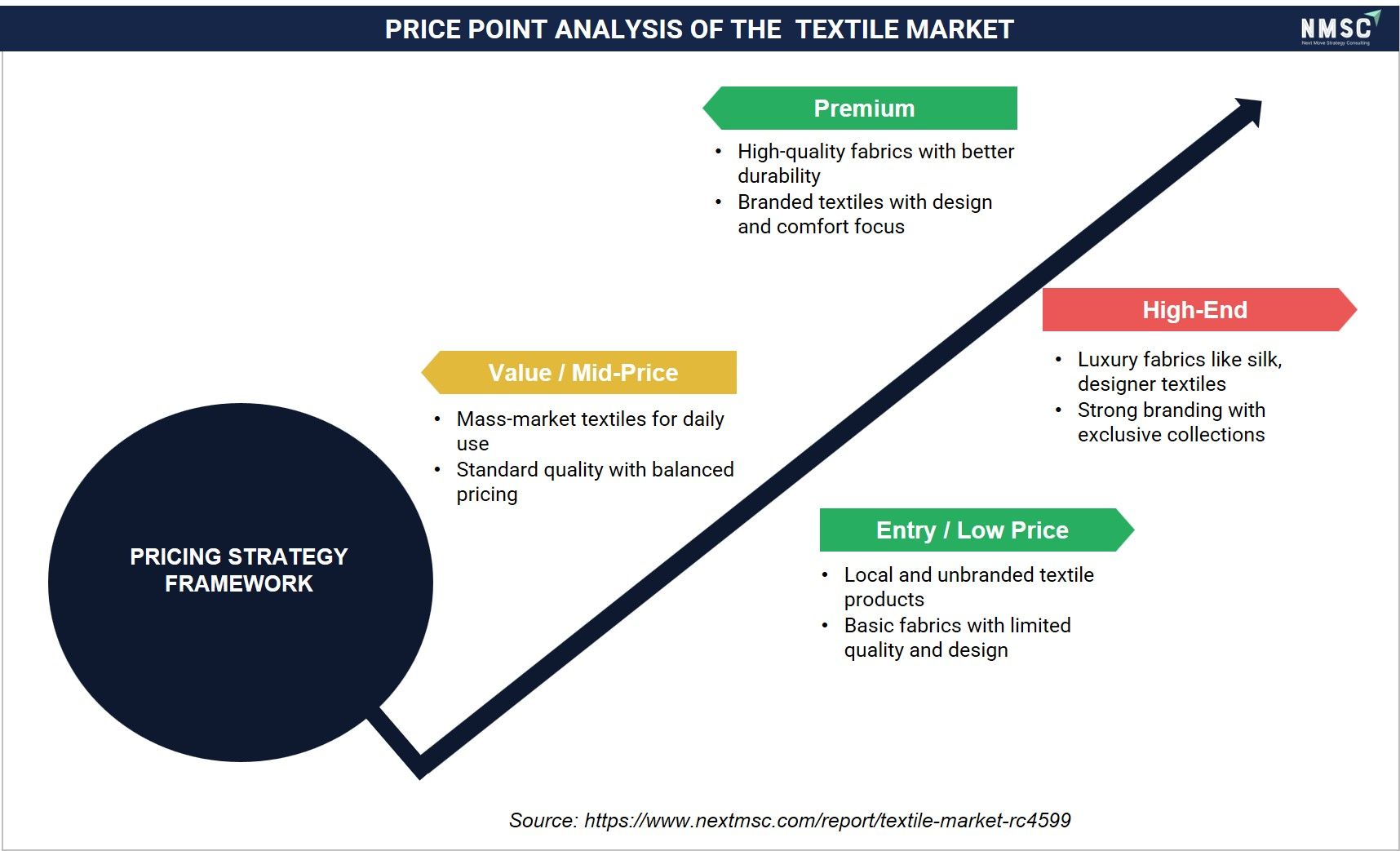
Based on our evaluation of textile pricing dynamics, we noticed that the market follows a structured tiered pricing framework, ranging from entry-level and mid-price segments to premium and high-end offerings. Furthermore, our analysis indicates that value-based pricing dominates mass-market textiles, while premium and luxury segments emphasize quality, durability, and brand differentiation. At the same time, the upward shift toward experiential and high-performance fabrics strengthens premiumization, enabling manufacturers and brands to capture higher margins and reinforce competitive positioning across the textile industry.
How Is the Textile Market Segmented in This Report, And What Are the Key Insights from the Segmentation Analysis?
Market Highlights & Strategic Insights – Textile Market:
|
Segments |
Key Takeaways |
|
Product Form |
Fabric dominated the textile market, driven by strong demand across apparel and home textiles. Woven and knit fabrics led due to versatility, while nonwoven fabrics gained traction in technical applications. Fiber remained foundational with polyester and cotton leading, while high-performance fibers expanded in specialized uses. |
|
Material Type |
Synthetic materials dominated, supported by cost efficiency and large-scale production. Blended materials gained traction for combined performance, while natural fibers maintained steady demand driven by sustainability. Semi-synthetic fibers expanded due to eco-friendly positioning. |
|
Function |
Conventional textiles dominated due to high-volume demand. Functional textiles gained momentum with performance features, while high-performance textiles expanded across industrial and technical applications. |
|
Sales Channel |
Direct B2B dominated, reflecting strong manufacturer–buyer relationships. Distributors and trading houses supported market reach, while digital channels gained traction with increasing online sourcing adoption. |
|
Customer Type |
Textile manufacturers dominated demand, followed by apparel manufacturers. Industrial OEMs gained importance with rising technical textile usage, while brands and intermediaries supported distribution and sourcing. |
|
End Use |
Industrial, Fashion & Apparel and automotive segments gained traction with increasing use of technical textiles, while healthcare expanded steadily with medical textile applications. |
By Product Form Insights
How Does Product Form Influence the Textile Market Demand?
Based on our analysis of textile production and consumption patterns, we observed that the market is segmented into fiber, yarn, fabric, and finished textile goods.
Among these, fabric dominates the market, driven by its central role as the primary input for apparel, home textiles, and industrial applications. Insights gathered from manufacturers indicate that while fibers such as polyester and cotton continue to serve as essential raw materials, and yarn demand remains steady due to the need for blended and synthetic variants, the highest volume demand is concentrated at the fabric stage. This is attributed to large-scale processing, customization capabilities, and direct linkage to end-use industries. Additionally, finished textile goods, including home and technical textiles, are witnessing strong growth as value-added segments. However, the dominance of fabric highlights its critical position in bridging upstream raw materials and downstream applications, making it the most influential segment in terms of volume and market share.

By Material Type Insights
How Do Material Types Shape Demand in the Textile Market?
Based on our assessment of material consumption trends, we evaluated that the market is segmented into natural, synthetic, semi-synthetic, and blended materials.
From our evaluation of production data and sourcing strategies, synthetic materials led the market, driven by large-scale polyester and nylon usage due to cost efficiency, durability, and consistent supply availability. Our analysis indicates that blended materials gained strong traction, particularly in apparel manufacturing, as they combine comfort and performance characteristics. From our discussions with sourcing managers and product developers, natural fibers such as cotton and wool maintained stable demand, supported by increasing consumer preference for sustainable and breathable materials. At the same time, semi-synthetic fibers including viscose and lyocell expanded due to their eco-friendly positioning and improved performance attributes. This evolving material mix reflects a balance between cost efficiency, performance, and sustainability-driven demand across the textile market.

By End-Use Insights
How Do End-Use Applications Drive Demand in the Textile Market?
Based on our evaluation of textile consumption across industries, we observed that the market is segmented into household, automotive, construction, healthcare, agriculture, industrial, and other end-users.
From our analysis of demand patterns, we found that fashion & apparel, industrial and automotive sectors gained significant traction, driven by increasing use of technical textiles in filtration, insulation, and reinforcement applications. Healthcare applications expanded steadily with rising demand for medical textiles, including hygiene and protective products. Meanwhile, construction and agriculture segments demonstrated growing adoption of geotextiles and agro textiles for specialized applications. This diversification across end-use industries strengthens demand resilience and highlights the expanding role of textiles beyond traditional apparel markets.
Regional Outlook:
Geographic Performance Snapshot:
|
Geography |
Key Takeaways |
|
North America |
North America demonstrates strong positioning in the textile market growth, supported by advanced manufacturing capabilities, high demand for premium and functional textiles, and increasing focus on sustainability and traceability. Strong brand presence and innovation in performance fabrics drive adoption across apparel and industrial applications. |
|
Europe |
Europe shows robust growth driven by stringent environmental regulations and strong emphasis on circular textile systems. Increasing adoption of recycled materials, eco-friendly production practices, and demand for high-quality, design-driven textiles accelerate market expansion across fashion and technical segments. |
|
Asia Pacific |
Asia Pacific dominates the market, driven by large-scale manufacturing capacity, cost competitiveness, and strong export orientation. Rapid industrialization, expanding domestic consumption, and government support for textile production strengthen regional leadership across global supply chains. |
|
Latin America |
Latin America demonstrates steady growth supported by increasing retail demand, urbanization, and gradual expansion of local textile manufacturing. Rising consumer spending and improving supply chain infrastructure contribute to consistent market development. |
|
Middle East & Africa |
Middle East & Africa witness emerging growth driven by expanding retail sectors, increasing demand for apparel and home textiles, and rising investments in textile production and trade. Growing urban populations and infrastructure development support gradual market expansion. |
The textile market share is geographically studied across North America, Europe, Asia Pacific, Latin America and Middle East & Africa and each region is further studied across countries.
Textile Market in North America
North America reflects a high-value, innovation-driven textile landscape, where premiumisation, sustainability standards, and advanced manufacturing capabilities shape market expansion. Based on our regional evaluation, we noticed that the market demonstrates strong momentum, as rising demand for functional fabrics, sustainable materials, and digitally enabled production systems continues to strengthen growth. In particular, the United States anchors regional demand through strong brand ecosystems and high consumption of performance and experiential textiles, while Canada contributes through stable growth in technical and industrial textile applications. Furthermore, increasing emphasis on traceability, eco-friendly processing, and circular production frameworks strengthens material innovation and product differentiation. As a result, this evolving ecosystem enhances value realization across the supply chain, positioning North America as a key hub for high-margin, design-led, and sustainability-focused textile development.
Textile Market in the United States
The textile market in the United States continues to advance as a design-led and innovation-centric ecosystem, driven by strong consumer demand for premium, functional, and sustainable textile products. In this context, our assessment indicates that brands increasingly prioritize experiential fabrics, performance-enhanced materials, and rapid design-to-market capabilities to strengthen competitive positioning. Moreover, the integration of digital manufacturing technologies and advanced finishing processes enhances production flexibility and enables high levels of customization. At the same time, increasing focus on traceability and sustainability compliance accelerates adoption of recycled materials and transparent sourcing practices. Consequently, this alignment of innovation, premiumization, and operational agility reinforces market competitiveness and supports sustained value creation across the U.S. textile industry.
Textile Market in Canada
Based on our evaluation of regional textile developments, we assessed that Canada demonstrates steady and structurally aligned growth, supported by increasing demand for technical textiles and high-performance materials across industrial and consumer applications. In addition, our analysis indicates that manufacturers emphasize quality-driven production, advanced material applications, and reliable supply chain integration to meet evolving requirements. Furthermore, the adoption of sustainable practices and compliance with environmental standards strengthens product positioning and export competitiveness. Compared with the United States, production volumes remain moderate, while focus on durability, performance, and long-term product value remains significantly higher. As a result, this approach supports stable demand patterns, enhances product reliability, and enables consistent revenue generation across Canada’s textile landscape.
Textile Market in Europe
Europe represents a regulation-led textile ecosystem, where compliance rigor, circular production mandates, and sustainability standards define market evolution. Our industry analysis highlights that demand remains strong across apparel, home textiles, and technical applications, driven by strict frameworks governing chemical usage, traceability, and sourcing transparency. Notably, regional dynamics remain distinct, with Northern Europe advancing sustainability innovation, Western Europe strengthening premium and luxury positioning, and Southern Europe enhancing flexible manufacturing capabilities. Alongside this, increased integration of recycled materials and low-impact processing technologies improves compliance readiness and product differentiation. This dynamic strengthens Europe’s position as a global benchmark for regulated, high-value textile production, reinforcing long-term competitiveness and brand trust.
Textile Market in the United Kingdom
The textile market in the United Kingdom evolves as a design-led and sustainability-focused landscape, driven by strong demand for premium apparel and ethically sourced materials. In this context, our research indicates that brands actively integrate recycled fabrics, transparent sourcing practices, and digital design capabilities to meet evolving consumer expectations. Moreover, rapid design-to-market cycles and advanced manufacturing adoption strengthen competitiveness across fashion and retail segments. At the same time, regulatory emphasis on sustainability and product traceability reinforces the use of certified materials and responsible production systems. Additionally, increasing focus on experiential textiles enhances product appeal and brand differentiation. Consequently, the UK market strengthens its position as a high-value, innovation-driven ecosystem, supporting consistent growth through premiumization and sustainability alignment.
Textile Market in Germany
Our evaluation of Germany’s textile industry highlights a precision-engineered and industrially aligned market, where performance textiles and technical applications dominate demand. We identified that manufacturers prioritize advanced material science, automation-driven production, and strict quality certifications to enhance operational efficiency and product reliability. Notably, strong alignment with automotive, healthcare, and construction sectors accelerates demand for specialized textile solutions. Parallelly, regulatory compliance and sustainability benchmarks reinforce adoption of durable and high-performance materials. This integration enables Germany to maintain leadership in engineering-grade textiles, delivering consistent value through innovation, system reliability, and long-term industrial applicability.
Textile Market in France
In France, the textile market is shaped by a strong focus on fashion, luxury, and sustainability-driven innovation, creating a distinct premium positioning within the European landscape. Through our market analysis, we observed that brands increasingly adopt eco-friendly materials, recycled fabrics, and traceable sourcing practices to align with evolving consumer preferences. Furthermore, design excellence and product aesthetics remain central to market competitiveness, particularly across high-end apparel and luxury segments. At the same time, regulatory emphasis on environmental compliance supports the transition toward sustainable production systems. Additionally, integration of innovative materials enhances both functionality and design appeal. Consequently, the French market strengthens its global standing through a combination of sustainability, craftsmanship, and premium design leadership.
Textile Market in Italy
From our assessment of Italy’s textile ecosystem, we identified that the market reflects a craftsmanship-driven and export-oriented structure, supported by strong global demand for premium fabrics and luxury apparel. Our evaluation indicates that manufacturers combine traditional textile expertise with modern production technologies to enhance efficiency and scalability. In addition, emphasis on design excellence and material quality strengthens competitive positioning in international markets. Furthermore, sustainability initiatives and advanced processing techniques improve product differentiation and compliance with evolving standards. At the same time, strong integration with fashion and luxury industries supports consistent demand for high-value textiles. As a result, Italy maintains its leadership as a global hub for premium, design-led textile production with strong export competitiveness.
Textile Market in Spain
The textile market in Spain operates as a speed-driven and fashion-responsive ecosystem, shaped by rapid product cycles and strong global retail integration. Our assessment indicates that manufacturers prioritize agile production systems and streamlined supply chains to support fast fashion requirements and international distribution networks. Simultaneously, increasing adoption of sustainable materials aligns production practices with evolving regulatory and consumer expectations. A key shift emerges in the growing emphasis on design responsiveness and shorter turnaround times, enabling brands to maintain competitiveness in high-velocity markets. This approach positions Spain as a highly adaptive textile hub, balancing efficiency, responsiveness, and evolving sustainability standards.
Textile Market in the Nordics
In the Nordic region, including Sweden, Finland, and Norway, the textile market reflects a sustainability-deep and transparency-driven structure, where environmental accountability and traceability define product value. Our regional insights confirm that manufacturers prioritize circular materials, low-impact processing, and ethically sourced fibers to meet stringent environmental expectations. Notably, high consumer awareness strengthens demand for durable and responsibly produced textiles. This is complemented by advanced digital systems enabling end-to-end traceability and supply chain transparency. As a result, the Nordic market sets a global benchmark for sustainable textile ecosystems, reinforcing premium positioning through environmental credibility and long-term material innovation.
Textile Market in Asia-Pacific
Asia-Pacific represents the largest and most dynamic textile market, driven by extensive manufacturing capacity, strong export orientation, and rapidly expanding domestic consumption. Based on our analysis of production trends and industry developments, we noticed that the region demonstrates strong growth momentum, as large-scale textile hubs across China, India, Bangladesh, and Vietnam support cost-efficient and high-volume production. Moreover, rising urbanization, increasing disposable income, and evolving fashion demand accelerate consumption across apparel and home textile segments. We identified distinct regional dynamics, where China leads in scale and integration, India strengthens in diversified production capabilities, and Southeast Asia expands through export competitiveness. At the same time, government support and infrastructure development enhance manufacturing efficiency and global trade positioning. Consequently, Asia-Pacific reinforces its leadership as the backbone of global textile production and supply chain networks.
Textile Market in China
The textile market in China operates as a scale-driven and vertically integrated ecosystem, supported by strong domestic manufacturing capabilities and extensive global export networks. Our primary research indicates that China maintains leadership through cost-efficient production, advanced processing infrastructure, and rapid adoption of digital manufacturing technologies. Furthermore, strong integration across fibre production, fabric processing, and garment manufacturing enhances supply chain efficiency and responsiveness. At the same time, increasing focus on sustainability and material innovation accelerates adoption of recycled fibres and eco-friendly production systems. Additionally, domestic demand continues to expand alongside export growth, strengthening overall market stability. Consequently, China sustains its position as a global textile powerhouse, combining scale, efficiency, and evolving innovation capabilities to drive long-term market expansion.
Textile Market in Japan
Based on our evaluation of Japan’s textile industry, we assessed that the market demonstrates a precision-focused and innovation-driven structure, supported by strong demand for high-performance and functional textiles. Our analysis indicates that manufacturers prioritize advanced material technologies, product quality, and durability to meet stringent consumer and industrial requirements. Furthermore, integration of technical textiles across healthcare, automotive, and industrial applications strengthens demand for specialized fabric solutions. At the same time, emphasis on sustainability and efficient resource utilization supports adoption of eco-friendly production practices. In addition, strong focus on design refinement and product reliability enhances global competitiveness. As a result, Japan reinforces its position as a high-value textile industry, driven by technological innovation, premium quality, and consistent demand for performance-oriented materials.
Textile Market in India
India represents a scale-intensive and diversification-driven textile market, supported by strong domestic consumption and global export integration. Our review of market developments shows that expanding retail demand, rising urbanization, and increasing sourcing diversification strengthen production dynamics. Importantly, large-scale capacity across cotton, synthetic fibres, and garments enhances cost competitiveness and supply chain depth. Alongside this, policy-driven initiatives promoting local manufacturing and sustainability accelerate adoption of advanced production technologies. A parallel trend shows growing investment in technical textiles and value-added segments, improving product diversification. This trajectory positions India as a globally competitive textile hub, combining scale, cost efficiency, and evolving innovation capabilities.
Textile Market in South Korea
South Korea demonstrates a technology-driven and innovation-focused textile market, characterized by strong adoption of advanced materials and high-performance fabrics. From our engagements with manufacturers and technology providers, we observed increasing integration of functional textiles, smart fabrics, and advanced processing techniques across industrial and consumer applications. Moreover, strong alignment between electronics, automotive, and textile industries supports the development of specialized and high-value textile solutions. At the same time, emphasis on product quality, design precision, and rapid innovation cycles strengthens global competitiveness. In addition, growing focus on sustainability and material efficiency enhances adoption of eco-friendly production practices. As a result, South Korea strengthens its position as a high-value, technology-led market with strong innovation capabilities and premium product offerings.
Textile Market in Taiwan
Based on our evaluation of Taiwan’s textile ecosystem, we assessed that the market reflects a technology-integrated and export-oriented structure, supported by strong manufacturing expertise and OEM capabilities. Our analysis indicates that manufacturers focus on high-performance textiles, advanced material applications, and precision-driven production processes to meet global demand. Furthermore, strong integration with electronics and industrial sectors supports innovation in technical textiles and specialized fabric solutions. At the same time, emphasis on system reliability, quality standards, and seamless production integration strengthens competitiveness. In addition, growing adoption of sustainable materials and efficient processing technologies enhances product differentiation. Consequently, Taiwan maintains its position as a high-value textile producer, driven by innovation, reliability, and strong export alignment.
Textile Market in Indonesia
In Indonesia, the textile market demonstrates a developing yet rapidly advancing structure, supported by expanding domestic consumption, growing retail demand, and improving manufacturing capabilities. Through our regional assessment, we observed increasing production activity across apparel and basic textile segments, driven by cost advantages and rising investment in local manufacturing. Moreover, urbanization and evolving consumer preferences strengthen demand for affordable and fast-moving textile products. At the same time, gradual adoption of modern production techniques and supply chain improvements enhances operational efficiency. In addition, growing interest in export markets supports capacity expansion and industry development. As a result, Indonesia emerges as a promising market with increasing competitiveness and expanding production potential.
Textile Market in Australia
The textile market in Australia reflects a demand-driven and quality-focused structure, supported by strong consumption of premium, functional, and sustainable textile products. Based on our evaluation, we observed that manufacturers and suppliers prioritise high-performance materials, durability, and compliance with sustainability standards across apparel and industrial applications. Furthermore, rising focus on technical textiles and specialised fabric solutions strengthens demand across healthcare, mining, and infrastructure-related sectors. At the same time, emphasis on supply chain reliability and product quality enhances purchasing preferences. In addition, integration of sustainable materials and advanced production practices supports long-term market positioning. Consequently, Australia demonstrates a stable and high-value market, driven by premium demand and consistent focus on quality and performance.
Textile Market in Latin America
In Latin America, the textile market reflects a consumption-driven and progressively industrialising structure, supported by expanding retail ecosystems and improving production capabilities. Our analysis highlights that countries such as Brazil anchor regional demand through strong domestic consumption and growing apparel manufacturing networks. Notably, increasing focus on cost-efficient production and regional supply chain development enhances competitiveness across domestic and export markets. Simultaneously, the gradual adoption of modern processing technologies improves operational efficiency and product quality. This progression enables Latin America to strengthen its position as an emerging yet increasingly competitive market, driven by steady consumption growth and expanding manufacturing depth.
Textile Market in the Middle East & Africa
Based on our evaluation of regional textile developments, we assessed that the Middle East and Africa present a diverse and evolving textile landscape, characterised by high-value demand in select markets and emerging growth across developing economies. In the Middle East, strong retail expansion, premium consumption patterns, and increasing demand for luxury and functional textiles support market development. Furthermore, investments in retail infrastructure and trade networks enhance product availability and brand presence. In contrast, Africa demonstrates an emerging textile market, supported by rising urban populations, growing apparel demand, and gradual development of local manufacturing capabilities. At the same time, increasing focus on cost-efficient production and basic textile segments strengthens early-stage industry growth. Consequently, region-specific strategies centered on premium positioning in the Middle East and scalable production in Africa enable sustained expansion across this diverse textile ecosystem.
Competitive Landscape
Competitive Dynamics & M&A Landscape:
|
Key Takeaways |
|
The global textile market is led by vertically integrated players such as Toray Industries, Inc., Teijin Limited, Milliken, HYOSUNG TNC., and Shandong Weiqiao Venture Co., Ltd, as well as regional leaders including Arvind Limited, Vardhman Textiles Limited, Alok Industries Limited, and Welspun. Based on our analysis, these companies maintain strong positioning through integrated operations, large-scale production, and global distribution. At the same time, brands such as Gildan Activewear and Raymond strengthen market presence through product specialisation and brand-led strategies. |
|
Based on our evaluation, we found that competitive differentiation is driven by product innovation, cost efficiency, supply chain integration, and sustainability capabilities. Manufacturers increasingly focus on functional textiles, advanced materials, and digital manufacturing, while sustainable practices such as recycled fibres and eco-friendly processing enhance compliance and brand value. |
|
Recent investments indicate a shift toward sustainable production, value-added textiles, and digital transformation. Based on our assessment, companies focusing on innovation, circular materials, and advanced manufacturing are strengthening long-term competitive positioning and driving future market growth. |
Which Companies Dominate the Textile Industry and How Do They Compete?
Based on our market analysis, we observed that the textile market is led by globally integrated manufacturers such as Toray Industries, Inc., Teijin Limited, Milliken, HYOSUNG TNC., and Shandong Weiqiao Venture Co., Ltd, alongside strong regional players including Arvind Limited, Vardhman Textiles Limited, and Welspun. These companies dominate large-scale production environments where cost efficiency, supply chain integration, and consistent quality remain critical decision factors. From our evaluation, we found that leading players are preferred for operations requiring integrated fibre-to-fabric capabilities and reliable global supply networks. Competition at this level is primarily driven by scale, operational efficiency, and material innovation.
Market Dominated by Textile Giants and Specialists
From our observation, we found that the competitive landscape is further shaped by specialized textile companies such as Gildan Activewear, Raymond, Standard Textile Co., Inc., and Concordia Textiles. Our analysis indicates that these companies gain traction through product specialization, brand positioning, and application-specific textile solutions across apparel, home textiles, and industrial segments. In practice, large integrated manufacturers establish production scale and cost leadership, while specialized players drive differentiation through design, performance fabrics, and targeted end-use applications, together strengthening market competitiveness and diversification.
Innovation and Adaptability Drive Market Success
Innovation remains a key determinant of competitive advantage in the textile market, as observed through advancements in functional textiles, sustainable materials, and digital manufacturing technologies. Market leaders increasingly invest in advanced fibres, performance-enhancing fabrics, and eco-friendly processing techniques to improve product value and operational efficiency. From our assessment, we noticed companies that prioritise circular materials, digital production systems, and design-led innovation are better positioned to scale and adapt to evolving demand. These advancements reflect strong expertise in material science, process optimisation, and integrated manufacturing capabilities, supporting long-term market growth.
Market Players to Opt for Merger & Acquisition Strategies to Expand Their Presence
Based on our primary research, we observed that strategic collaborations, capacity expansions, and technology investments act as key growth levers in the market. Leading players increasingly focus on partnerships across material innovation, sustainable sourcing, and digital manufacturing to enhance product offerings and operational capabilities. Our analysis indicates that these strategies improve supply chain resilience, accelerate innovation cycles, and support expansion into high-value textile segments. As competition intensifies, companies strengthen their positioning through integrated capabilities, advanced production systems, and sustainability-driven strategies, reinforcing long-term competitiveness across the global textile market.
List of Key Textile Companies
-
Toray Industries, Inc.
-
Milliken & Company
-
The Bombay Dyeing and Manufacturing Company Limited
-
Hyosung TNC Corporation
-
Vardhman Textiles Limited
-
Himatsingka Seide Limited
-
Arvind Limited
-
Alok Industries Limited
-
Freudenberg Performance Materials Holding SE & Co. KG
-
Welspun Living Limited
-
Raymond Limited
-
Gildan Activewear Inc.
-
American Textile Company, Inc.
-
Concordia Textiles NV
-
Teijin Limited
-
BSL Limited
-
Sapphire Textile Mills Limited
-
Pearl Global Industries Limited
-
Standard Textile Co., Inc.
-
Shandong Weiqiao Pioneering Group Company Limited
What Are the Latest Key Industry Developments?
-
February 2026 – Freudenberg Performance Materials announced the debut of its new MehlerHeytex brand at Techtextil 2026. This brand represents the full integration of Mehler Texnologies and Heytex as a unified expert in technical coated textiles.
-
December 2025 – Arvind Fashions Ltd completed the acquisition of Flipkart's 31.25% stake in Arvind Youth Brands Pvt Ltd for approximately USD 16.2 million.
-
December 2025 – Gildan Activewear successfully completed the mega-acquisition of HanesBrands Inc. for approximately USD 2.2 billion, effectively doubling Gildan's scale and merging two of the world’s largest vertically integrated apparel platforms.
Expert Insights

As part of our Vision 2030 goals, we want to have 30% of our polyester fabric in apparel fibre-to-fibre recycled by 2030 and our collaboration with RE&UP opens exciting possibilities for integrating virgin-equivalent recycled materials into our products. These materials offer the performance we need while helping us achieve our circularity goals.
- Howard Williams, Director Global Innovation Apparel & Accessories at PUMA
Statement made while discussing PUMA’s Vision 2030 sustainability strategy and its collaboration with RE&UP to accelerate fibre-to-fibre recycled polyester adoption in apparel manufacturing.
Market Interpretation
The statement highlights the increasing commitment of global apparel brands toward circular textile production and the adoption of fibre-to-fibre recycling technologies. By setting measurable recycled material targets and partnering with advanced recycling companies, manufacturers are integrating virgin-equivalent recycled fibres into mainstream apparel without compromising product performance. This reflects the broader market shift toward closed-loop textile systems, sustainability-driven material innovation, and strategic collaborations aimed at reducing dependence on virgin polyester while meeting long-term environmental goals.
What are the Key Factors Influencing Investment Analysis & Opportunities in the Textile Market?
Investment analysis in the textile market is increasingly shaped by a shift toward sustainability-driven innovation, digital manufacturing capabilities, and value-added product development, rather than traditional volume-based production models. Based on our evaluation of recent investments, strategic collaborations, and technology partnerships, we observed that investors favour companies with strong positioning in circular textile systems, advanced material innovation, and scalable digital production platforms. Firms demonstrating capabilities in textile-to-textile recycling, functional fabric development, and design-led differentiation consistently attract higher strategic interest and long-term capital allocation.
We also identified growing investment concentration around advanced recycling technologies, smart manufacturing systems, and traceability solutions, particularly in areas addressing sustainability compliance, supply chain transparency, and premium product positioning. Strategic investments increasingly outweigh purely financial funding, as global brands, manufacturers, and technology providers seek greater control over value chains and faster commercialisation of innovative textile solutions. For investors, the most compelling opportunities emerge in companies that combine material innovation with scalable production capabilities, strong sustainability alignment, and differentiated product offerings, enabling long-term value creation and competitive advantage across the textile ecosystem.
Key Benefits for Stakeholders:
Next Move Strategy Consulting (NMSC) presents a comprehensive analysis of the textile market trends, covering historical developments from 2020 to 2025 and providing forward-looking forecasts through 2035. Our study evaluates the market at global, regional, and country levels, delivering quantitative outlooks alongside qualitative insights into key growth drivers, market restraints, technology trends, and emerging opportunities across major textile applications.
In our observation, the textile industry delivers measurable value to a broad stakeholder base. Investors benefit from value creation driven by premium product positioning, circular business models, and innovation-led differentiation. Textile manufacturers and brands gain efficiency improvements, cost optimization, and product diversification through the adoption of digital manufacturing, functional textiles, and sustainable materials. Technology providers, recyclers, and ecosystem partners benefit from increasing demand for advanced processing technologies, textile-to-textile recycling systems, and traceability solutions. By aligning material innovation with production efficiency and sustainability, the market creates sustained value across the value chain while supporting long-term growth and competitive advantage.
|
Parameters |
Details |
|
Customization Scope |
Free customization (equivalent to up to 80 analyst-working hours) after purchase. Addition or alteration to country, regional & segment scope. |
|
Pricing and Purchase Options |
Avail customized purchase options to meet your exact research needs. |
|
Approach |
In-depth primary and secondary research; proprietary databases; rigorous quality control and validation measures. |
|
Analytical Tools |
Porter's Five Forces, SWOT, value chain, and Harvey ball analysis to assess competitive intensity, stakeholder roles, and relative impact of key factors. |
Key Market Segments
By Product Form
-
Fiber
-
Natural fiber
-
Cotton
-
Wool
-
Silk
-
Jute
-
Flax
-
Hemp
-
Ramie
-
Coir
-
Others
-
-
Manmade fiber
-
Polyester
-
Nylon
-
Acrylic
-
Cellulosic fiber
-
Viscose
-
Modal
-
Lyocell
-
Cupro
-
-
Polyolefin fiber
-
Polypropylene
-
Polyethylene
-
-
High-performance fiber
-
Aramid
-
Carbon
-
UHMWPE
-
PBO
-
PPS
-
-
-
-
Yarn
-
Cotton yarn
-
Blended yarn
-
Synthetic filament yarn
-
POY
-
FDY
-
DTY
-
-
-
Fabric
-
Woven fabric
-
Knit fabric
-
Nonwoven fabric
-
-
Finished Textile Goods
-
Home textiles
-
Bed linen
-
Bath linen
-
Curtains
-
Carpets and rugs
-
Blankets
-
-
Technical textiles
-
Automotive textiles
-
Medical textiles
-
Geotextiles
-
Protective textiles
-
Filtration textiles
-
Industrial textiles
-
Agro textiles
-
-
Other finished textiles
-
By Material Type
-
Natural
-
Synthetic
-
Semi-synthetic
-
Blended
By Function
-
Conventional Textiles
-
Functional Textiles
-
High-performance Textiles
By Sales Channel
-
Direct B2B
-
Distributor
-
Trading house
-
Digital
By Customer Type
- Textile manufacturer
-
Spinners
-
Weavers
-
Knitters
-
Finishers
-
-
Apparel manufacturer
-
Industrial OEM
-
Automotive suppliers
-
Medical product manufacturers
-
Construction material companies
-
Filtration system manufacturers
-
-
Brands and retailers
-
Intermediaries
-
Traders
-
Distributors
-
Export houses
-
By End User
-
Household
-
Automotive
-
Construction
-
Healthcare
-
Agriculture
-
Industrial
-
Fashion & Apparel
-
Sports & Fitness
-
Defense & Military
-
Hospitality
-
Packaging
-
Retail & E-commerce
-
Transportation & Logistics
-
Consumer Electronics
-
Other End Users
Geographical Breakdown
-
North America: U.S., Canada, and Mexico.
-
Europe: UK, Germany, France, Italy, Spain, Sweden, Denmark, Finland, the Netherlands, and the Rest of Europe.
-
Asia Pacific: China, India, Japan, South Korea, Taiwan, Indonesia, Vietnam, Australia, Philippines, Malaysia and the rest of APAC.
-
Middle East & Africa (MEA): Saudi Arabia, UAE, Egypt, Israel, Turkey, Nigeria, South Africa, and the rest of MEA.
-
Latin America: Brazil, Argentina, Chile, Colombia, and the rest of LATAM.
Conclusion & Recommendations
This report provides stakeholders, service providers, investors, and consultants with actionable insights to capitalise on the structural transformation underway in the market. By combining rigorous data-driven analysis with proven strategic frameworks, NMSC’s Textile Market Report serves as a critical decision-support resource for navigating an increasingly dynamic and innovation-driven industry landscape. The market is positioned for steady expansion, supported by rising demand for sustainable and circular materials, increasing adoption of digital manufacturing technologies, and growing preference for functional and experiential fabrics. Key strategic insights highlight the increasing importance of advanced processing technologies, textile-to-textile recycling systems, and digital-artisanal integration, as these capabilities strengthen production efficiency, product differentiation, and long-term value creation. Industry participants that prioritize sustainable sourcing, smart manufacturing systems, and scalable design innovation consistently achieve stronger market positioning and margin optimization.
For executives and investors, capturing value requires focusing on high-growth opportunities such as premium experiential textiles, functional fabric applications, and traceability-driven supply chains, while continuing investments in advanced recycling technologies, digital manufacturing platforms, and integrated value chain capabilities. Expanding presence across high-demand manufacturing hubs and strengthening supply chain resilience unlocks new growth potential. Scalability, product innovation, and sustainability-led differentiation further enhance competitive advantage and accelerate adoption, creating long-term value across the global textile ecosystem.


About the Author
 Saista Faiyaz
— Saista Faiyaz is Research Associate at Next Move Strategy Consulting, where she has covered consumer markets and healthcare technologies for 3 years. Her work includes primary interview review, secondary-source validation, market sizing, and structured analysis of company and industry data. She supports research by comparing evidence across sources, organizing findings into market narratives, and documenting assumptions used in analysis. Her scope includes cross-market benchmarking, and reports.
Saista Faiyaz
— Saista Faiyaz is Research Associate at Next Move Strategy Consulting, where she has covered consumer markets and healthcare technologies for 3 years. Her work includes primary interview review, secondary-source validation, market sizing, and structured analysis of company and industry data. She supports research by comparing evidence across sources, organizing findings into market narratives, and documenting assumptions used in analysis. Her scope includes cross-market benchmarking, and reports.
About the Reviewer
 Supradip Baul
— Supradip Baul is an accomplished business consultant and strategist with over a decade of rich experience in market intelligence, strategy, technology, and business transformation. His work has included rigorous qualitative and quantitative analysis across multiple industries, helping clients shape investment decisions and long-term roadmaps. Earlier in his career, he was associated with Gartner, where he contributed to industry-leading reports and market share analyses. He has worked with leading global companies and holds an MBA with a dual specialization in Marketing and Finance.
Supradip Baul
— Supradip Baul is an accomplished business consultant and strategist with over a decade of rich experience in market intelligence, strategy, technology, and business transformation. His work has included rigorous qualitative and quantitative analysis across multiple industries, helping clients shape investment decisions and long-term roadmaps. Earlier in his career, he was associated with Gartner, where he contributed to industry-leading reports and market share analyses. He has worked with leading global companies and holds an MBA with a dual specialization in Marketing and Finance.
At Next Move Strategy Consulting, we understand that insightful market research is the cornerstone of successful business decisions. That's why we employ a robust and multifaceted approach, combining various methodologies to deliver the most accurate and actionable data for our clients.

Research Landscape
We navigate the world of research with two primary approaches:
Qualitative Approach
Our qualitative research methodologies involve immersive techniques such as in-depth interviews, focus groups, and observational studies. By engaging directly with individuals and stakeholders, we uncover valuable insights that quantitative data alone may overlook.

Quantitative Research
In tandem with qualitative methodologies, NMSC leverages the power of Quantitative Research to provide a robust foundation of numerical insights. Through systematic data collection and analysis, we quantify patterns, preferences, and market trends, offering a comprehensive view of the business landscape.
Our quantitative research approach employs diverse tools, including surveys, experiments, and statistical modelling. These methodologies enable us to gather data from a large and representative sample, ensuring the statistical significance of our findings. By employing structured questionnaires and standardized data collection methods, we guarantee the reliability and validity of the information we present to our clients.
Quantitative research is particularly effective in measuring the prevalence of trends, assessing market size, and gauging the impact of various factors on consumer behavior. The numerical precision attained through this approach equips our clients with actionable insights, facilitating data-driven decision-making and strategy formulation.


Our Specialized Toolbox for Industry-Specific Market Research
We deploy a specialized arsenal of techniques tailored to meet your unique requirements. Here's a glimpse into our comprehensive toolbox:

Information Procurement
The stage entails acquiring market data or relevant information through various sources and methodologies.


Market Research Approach
We utilize both top-down and bottom-up approaches in market research analysis to achieve a comprehensive understanding of the market dynamics, leveraging the broad perspective of industry trends and macroeconomic factors alongside detailed insights from specific segments and individual companies.

Porters Five Forces Analysis
We conduct Porter's Five Forces analysis to evaluate the competitive landscape of an industry, providing us with insights into factors that affect profitability and strategic positioning.

SWOT Analysis

Forecasting
We utilize a forecasting model to predict future consumption by considering parameters like population, economics, regulations, market competition, drivers, constraints, technology, and pricing. We also employ statistical techniques such as multilinear regression, exponential smoothing, moving average, ARIMA, and Monte Carlo simulations for accurate predictions. In econometric forecasting, we analyzed short-term and long-term event impacts, attributing values based on regulatory frameworks, economic factors, and market events.





 Speak to Our Analyst