Home Depot’s AI Rollout as Lowe’s Outlook Signals a Retail Market Split

Home Depot's Nationwide AI Rollout and Lowe's Outlook Reduction Expose a Hardware Retail Market Splitting Along Pro-DIY Lines
In the final two weeks of August 2026, the world's two largest home improvement retailers moved in opposite directions — and the divergence revealed precisely where the USD 1.95 trillion global hardware stores retail market is concentrating its growth. On August 18, The Home Depot, Inc. launched nationwide Express Delivery across all U.S. markets, using its 2,000-plus stores as neighborhood fulfillment hubs to deliver plumbing, electrical, hardware, paint, tools, and project-supply items in three hours or less for a flat fee — no membership required. Nine days later, on August 27, the company expanded its AI-powered Magic Apron assistant to all 2,000-plus U.S. stores, enabling customers to locate products by aisle and bay, upload images, ask questions via voice-to-text, and receive project guidance in multiple languages — all from within the Home Depot mobile app or by scanning in-store QR codes. On August 19, sandwiched between those two announcements, Lowe's Companies, Inc. trimmed its full-year 2026 sales outlook to USD 92 billion — anchoring the bottom of its prior USD 92 billion to USD 94 billion target range — and revised comparable-store sales guidance to flat, down from a prior forecast of flat to 2% growth, citing persistent softness in do-it-yourself spending.
According to Next Move Strategy Consulting's Hardware Stores Retail Market report, the global hardware stores retail market was valued at USD 1.95 trillion in 2025 and is projected to reach USD 3.09 trillion by 2035, growing at a CAGR of 4.55% from 2026 to 2035. That USD 1.02 trillion in incremental revenue will not be distributed evenly across channels or customer segments: NMSC's proprietary research and analysis identifies online sales (10.27% CAGR) and the professional contractor end user as the two fastest-growing vectors, while the DIY residential segment — the one Lowe's specifically flagged as under pressure — is growing at a below-market rate. The August events are not isolated corporate disclosures; they are the clearest real-time confirmation of the structural bifurcation NMSC's model projects through 2035.
For More Information: Download FREE Sample on Hardware Stores Retail Market Report
The Pro-DIY Split: What the August Earnings Cycle Confirmed
The divergence between professional and DIY demand has been building for several quarters, but the August 2026 reporting cycle made it impossible to ignore. Lowe's second-quarter net sales rose to USD 25.96 billion from USD 23.96 billion in the prior-year period — a headline increase that masked the underlying pressure. The company's decision to anchor its full-year guidance at the bottom of its prior range, rather than the midpoint, reflected management's assessment that price-conscious homeowners are deferring major renovation projects — precisely the big-ticket discretionary category most sensitive to elevated mortgage rates.
The Home Depot's first-quarter fiscal 2026 results, reported May 19, 2026, told a more resilient story. The company posted net sales of USD 41.8 billion, up 4.8% year over year, with comparable sales increasing 0.6% overall and 0.4% in the U.S. "Our first quarter results were in line with our expectations. The underlying demand in our business was relatively similar to what we saw throughout fiscal 2025, despite greater consumer uncertainty and housing affordability pressure," said Ted Decker, Chair, President and CEO of The Home Depot, in the company's May 19, 2026 earnings release. The company reaffirmed its full fiscal 2026 guidance of 2.5% to 4.5% total sales growth, a signal that its professional contractor channel — which accounts for approximately 45% of total sales, according to Hardware Retailing — is providing sufficient volume to offset DIY softness.
The National Retail Federation's 2026 Top 100 Retailers list, published July 22, 2026, confirmed the scale gap between the two national leaders and the rest of the category. The Home Depot ranked fifth overall with USD 154.74 billion in 2025 U.S. sales; Lowe's ranked ninth with USD 83.96 billion. Mark Mathews, NRF's Chief Economist and Executive Director of Research, attributed the faster sales growth of cooperative and specialty retailers such as Ace Hardware and True Value to the "owner-proprietor model," which draws in customers who need project-specific advice — a service dimension that large-format stores structurally struggle to replicate at scale.
AI and Fulfillment Infrastructure: The New Competitive Battleground
The August 2026 announcements from The Home Depot represent the most concrete evidence yet that competitive differentiation in hardware retail has shifted from product assortment to fulfillment speed and in-store digital intelligence.
The Express Delivery rollout converts every one of The Home Depot's 2,000-plus U.S. stores into a same-day fulfillment node — a structural advantage that online-only competitors cannot replicate without equivalent physical density. For professional contractors, whose labor costs make a delayed material delivery economically damaging — a stopped job site costs not just the price of missing materials but the full daily labor cost of an idle crew — three-hour delivery is not a convenience feature; it is a supplier-selection criterion.
The Magic Apron expansion addresses a different but equally specific contractor need: the ability to verify product availability, check aisle location, and confirm compatibility without waiting for an associate. "Customers come to The Home Depot for expert guidance, and we know they want their shopping experience to be easy and efficient," said Jordan Broggi, Executive Vice President of Interconnected Retail at The Home Depot, in the company's August 27, 2026 press release. "Magic Apron takes the best of our digital expertise and brings it into the physical store, creating a more connected shopping experience that helps customers find products, get project guidance and make decisions faster."
The European market is following a parallel trajectory. In March 2026, Kingfisher plc and Google Cloud announced a multi-year partnership to deploy Vertex AI across the e-commerce platforms of B&Q, Castorama, and Brico Dépôt — introducing conversational search and AI shopping agents capable of helping customers build project lists and complete purchases. The initiative signals that AI-powered digital customer experience is becoming a baseline competitive requirement across both North American and European home improvement retail, not a differentiator exclusive to the U.S. market.
Distribution Consolidation: The Structural Shift Beneath the Headlines
The AI and fulfillment investments are visible and headline-generating, but NMSC's proprietary research and analysis identifies a deeper structural shift as the primary driver of professional-segment share gains: the acquisition of specialty building material distributors by large-format retailers.
Lowe's Companies, Inc. completed its acquisition of Foundation Building Materials in October 2025, adding more than 370 locations across the United States and Canada and materially expanding its professional assortment, fulfillment capabilities, digital tools, trade credit, and cross-selling opportunities. This followed The Home Depot's approximately USD 18 billion acquisition of SRS Distribution — a transaction that gave the company immediate access to SRS's existing professional contractor accounts rather than requiring it to win those accounts one by one through marketing.
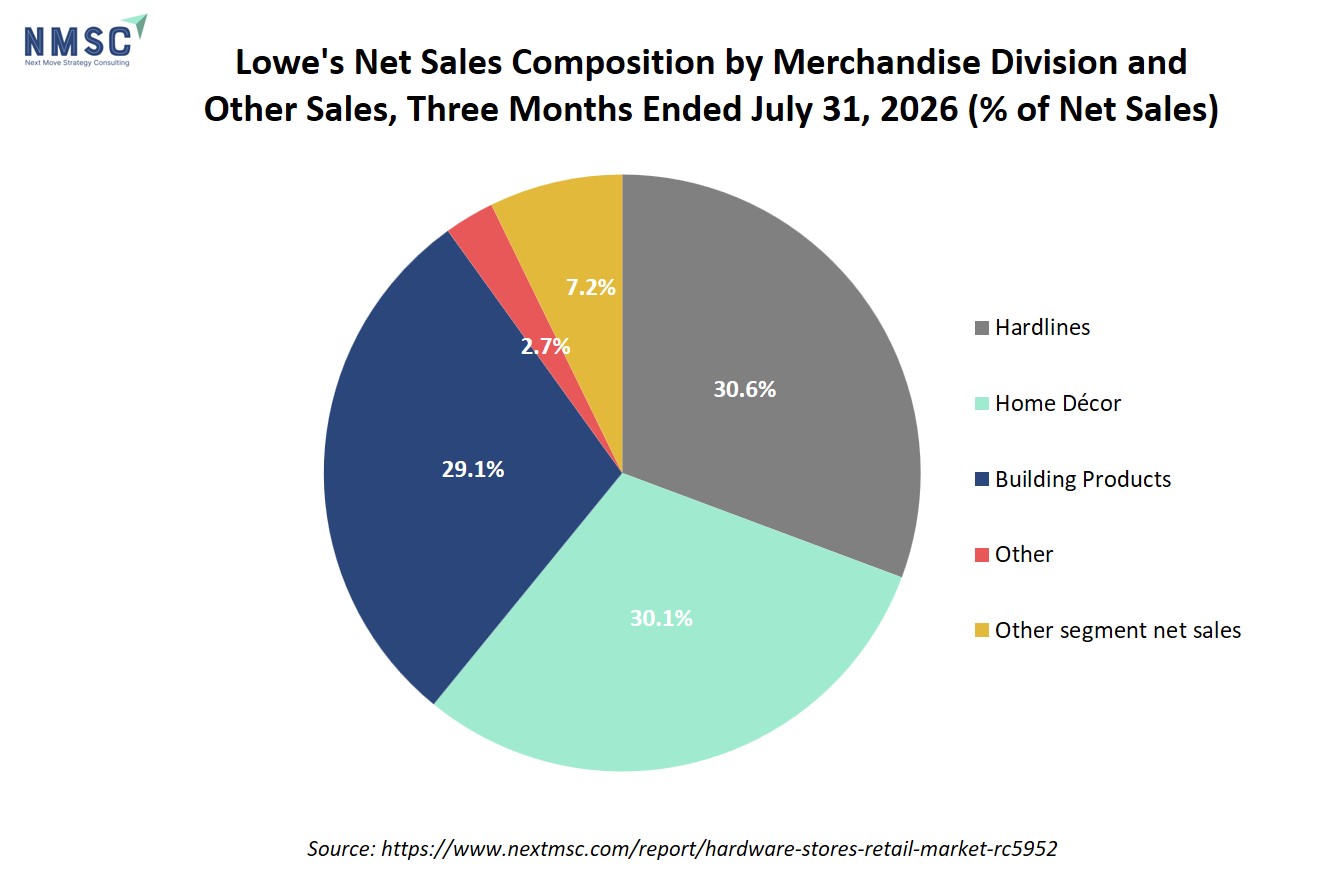
The logic of both transactions is identical: a retailer that acquires a distributor inherits that distributor's contractor relationships overnight. The competitive implication, per NMSC's analysis, is that integration speed — not deal size — will determine which company captures a disproportionate share of the professional contractor segment over the next two years. Whichever retailer converts its acquired distribution network into a seamless ordering, delivery, and credit platform faster will lock in recurring contractor purchase volume that a price-only competitor cannot displace.
Building Materials vs. Storage Products: Building Materials commands approximately 29% of 2025 revenue at USD 0.566 trillion, driven by the non-discretionary nature of lumber, roofing, and drywall purchases — inputs required for virtually every repair or construction job regardless of the broader economic cycle. Storage Products, growing at a 7.18% CAGR, reflects a structural demographic shift: urban housing units are shrinking in average square footage, pushing homeowners toward shelving, garage storage, and closet systems as a necessity rather than a luxury upgrade.
Home Improvement Centers vs. Specialty Stores: Home Improvement Centers hold approximately 46% of the market at USD 0.897 trillion in 2025, because a single large-format store allows both DIY and professional customers to complete a full project list in one visit. Specialty Stores are growing fastest at a 7.95% CAGR, as professional tradespeople in electrical, plumbing, and HVAC increasingly prefer the deeper product expertise and faster in-and-out service of a trade-specific retailer over a generalist superstore.
Online Sales: The 10.27% CAGR for online sales — more than twice the overall market growth rate — is not being driven by DIY consumers browsing home improvement products. It is being driven by professional contractors adopting account-based digital reordering tools that reduce repeat-order friction: purchase history, quoting, spending management, and volume discounts. This is a fundamentally different demand driver than general e-commerce adoption, and it explains why retailers are investing in contractor account management platforms rather than generic online storefronts.
Institutional End Users: Government, education, and healthcare facilities buy on annual maintenance budgets rather than per-project decisions, making institutional accounts more predictable than residential walk-in sales. The institutional segment's 7.18% CAGR reflects the early stages of a procurement channel shift: facility-maintenance budgets that previously routed through direct-to-manufacturer purchasing are increasingly flowing through organized retail.
Regional Outlook: Asia-Pacific Accelerates as North America Matures
|
Region |
2025 Market Size |
2035 Projection |
CAGR (2026–2035) |
Primary Driver |
|
North America |
USD 0.819 Trillion |
USD 1.14 Trillion |
3.09% |
Pro contractor consolidation and omnichannel fulfillment investment |
|
Europe |
USD 0.530 Trillion |
USD 0.74 Trillion |
3.19% |
Established DIY culture and growing digital retail adoption |
|
Asia-Pacific |
USD 0.430 Trillion |
USD 0.87 Trillion |
7.39% |
Rising urbanization and organized retail displacing informal hardware sellers |
|
Middle East & Africa |
USD 0.100 Trillion |
USD 0.19 Trillion |
6.69% |
Government-backed construction programs (Saudi Vision 2030, UAE infrastructure) |
|
Latin America |
USD 0.080 Trillion |
USD 0.15 Trillion |
7.18% |
Expanding middle-class housing investment and retail modernization |
North America remains the largest region in absolute terms at USD 0.819 trillion in 2025, but its 3.09% CAGR trails the global average — a direct consequence of market maturity. The Home Depot and Lowe's already operate near-national store coverage in the U.S., meaning incremental revenue must come from distribution acquisitions, digital account tools, and fulfillment infrastructure rather than new store openings.
Asia-Pacific's 7.39% CAGR — the fastest of any region — reflects a structural transition that North America and Europe completed decades ago: organized retail chains displacing informal, unbranded hardware shops as household incomes rise and urban housing stock expands. India is the fastest-growing individual country at approximately 9.8% CAGR, where organized retail penetration in hardware remains low relative to China, meaning most growth comes from format conversion rather than new construction demand alone. In Australia, Bunnings Group Limited reinforced its dominant position in January 2026 by opening a 40,000-square-metre distribution centre at North Maclean, Queensland — storing full pallets, timber, bulk products, and seasonal inventory to improve stock flow and delivery operations for Queensland DIY and trade customers.
NMSC Strategic Perspective: What the August 2026 Events Signal for the 2026–2035 Forecast
NMSC's proprietary research and analysis identifies three strategic implications from the August 2026 competitive events that are directly relevant to the 2026–2035 market outlook.
First, the DIY softness Lowe's flagged is a cyclical overlay on a structurally growing market, not a structural reversal. Elevated mortgage rates suppress discretionary big-ticket renovation spending — full kitchen remodels, bathroom overhauls — but they do not suppress the repair and maintenance spending that aging housing stock generates regardless of financing conditions. The Home Depot's Q1 FY2026 results, which held up despite "greater consumer uncertainty and housing affordability pressure" per CEO Ted Decker's own characterization, confirm that necessity-driven repair spending is providing a floor beneath the market even as discretionary renovation softens. NMSC's 4.55% CAGR projection through 2035 is built on this distinction: the market's growth engine is professional contractor and repair-driven spending, not discretionary consumer renovation.
Second, the Magic Apron and Express Delivery rollouts are not technology investments — they are contractor retention investments. A professional contractor who can verify product availability, confirm aisle location, and receive materials on a job site within three hours has no operational reason to switch suppliers for a marginal price difference. The switching cost created by these tools is not contractual; it is behavioral. Retailers that build this behavioral lock-in with professional accounts before competitors do will capture a disproportionate share of the online sales channel's 10.27% CAGR, because professional reordering — not DIY browsing — is the primary driver of that growth rate.
Third, the Kingfisher-Google Cloud partnership signals that AI-powered digital experience is becoming a competitive baseline in European hardware retail, not a North American-specific advantage. European retailers that do not deploy comparable conversational search and project-planning tools within the next 24 to 36 months risk ceding digital share to platforms that do — a risk that is particularly acute in the UK and Germany, where trade-account relationships with professional builders are the primary competitive differentiator.
Competitive Landscape: Key Market Players
The global hardware stores retail market is served by 20 companies actively shaping product innovation, capacity expansion, and go-to-market strategy, as identified in NMSC's proprietary research and analysis. These include: The Home Depot, Inc.; Lowe's Companies, Inc.; ADEO Group; Kingfisher plc; Bunnings Group Limited; Ace Hardware Corporation; Menard, Inc.; OBI Group Holding SE & Co. KGaA; BAUHAUS AG; HORNBACH Holding AG & Co. KGaA; Travis Perkins plc; Wickes Group plc; RONA inc.; Home Hardware Stores Limited; CAINZ CORPORATION; DCM Holdings Co., Ltd.; Komeri Co., Ltd.; Konan Shoji Co., Ltd.; Do it Best Corp.; and Groupe BMR Inc.
Key Recent Developments Timeline
|
Date |
Event |
Strategic Significance |
|
August 27, 2026 |
The Home Depot expanded Magic Apron AI assistant to all 2,000+ U.S. stores, adding localized product wayfinding, image uploads, voice-to-text, and multilingual support |
Converts in-store digital guidance from a pilot feature into a national contractor retention tool |
|
August 19, 2026 |
Lowe's trimmed full-year 2026 sales outlook to USD 92 billion and revised comparable-store sales guidance to flat, citing DIY spending softness |
Confirms the pro-DIY bifurcation; Lowe's Q2 net sales still rose to USD 25.96 billion from USD 23.96 billion |
|
August 18, 2026 |
The Home Depot launched nationwide Express Delivery across all U.S. markets, using 2,000+ stores as fulfillment hubs for 3-hour delivery |
Establishes job-site delivery speed as a national competitive standard, not a regional pilot |
|
March 2026 |
Kingfisher plc and Google Cloud announced a multi-year partnership to deploy Vertex AI across B&Q, Castorama, and Brico Dépôt e-commerce platforms |
Extends AI-powered shopping to European home improvement retail at scale |
|
January 2026 |
Bunnings Group Limited opened a 40,000-square-metre distribution centre at North Maclean, Queensland |
Strengthens fulfillment capacity for Queensland DIY and trade customers; reduces third-party storage dependency |
|
October 2025 |
Lowe's completed acquisition of Foundation Building Materials, adding 370+ locations across the U.S. and Canada |
Materially broadens Lowe's professional hardware and building-supply reach overnight |
Bottom Line
The global hardware stores retail market is undergoing a structural reorientation that the August 2026 competitive events have made visible in real time. The Home Depot's simultaneous rollout of nationwide Express Delivery and the Magic Apron AI expansion — combined with Lowe's decision to anchor its full-year 2026 guidance at the bottom of its prior range — confirms that the market's growth is concentrating in the professional contractor channel, not the DIY residential segment. According to NextMSC proprietary research and analysis, the market will grow from USD 1.95 trillion in 2025 to USD 3.09 trillion by 2035 at a 4.55% CAGR, with online sales (10.27% CAGR) and Asia-Pacific (7.39% CAGR) growing at roughly twice the overall market rate. The USD 1.02 trillion in incremental revenue between 2026 and 2035 will be captured disproportionately by retailers that have already built the three structural advantages that define the new competitive standard: owned distribution networks that deliver to job sites, AI-powered digital tools that reduce contractor reorder friction, and institutional account management capabilities that convert government and healthcare facility budgets into recurring revenue streams. Retailers that lack any one of these three capabilities face a narrowing window to acquire or build them before the professional contractor segment consolidates around the incumbents who already have them.
About Next Move Strategy Consulting
Next Move Strategy Consulting is a premier market research and management consulting firm that has been committed to provide strategically analysed well documented latest research reports to its clients. The research industry is flooded with many firms to choose from, what makes NMSC different from the rest is its top-quality research and the obsession of turning data into knowledge by dissecting every bit of it and providing fact-based research recommendation that is supported by information collected from over 500 million websites, paid databases, industry journals and one on one consultations with industry experts across a diverse range of industry sectors. The high-quality customized research reports with actionable insights and excellent end-to-end customer service help our clients to take critical business decisions that enables them to move beyond time and have competitive edge in the industry.
We have been servicing over 1000 customers globally that includes 90% of the Fortune 500 companies over a decade. Our analysts are constantly tracking various high growth markets and identifying hidden opportunities in each sector or the industry. We provide one of the industry's best quality syndicate as well as custom research reports across 10 different industry verticals. We are committed to deliver high quality research solutions in accordance to your business needs. Our industry standard delivery solutions that ranges from the pre consultation to after-sales services, provide an excellent client experience and ensure right strategic decision making for businesses.
For more information, please contact:
Next Move Strategy Consulting
5th Floor 867 Boylston St, STE 500,
Boston, MA 02116, U.S.
E-Mail: [email protected]
Direct: +1-217-650-7991
Website: www.nextmsc.com
About the Author
 Sanyukta Deb
— Sanyukta Deb is Digital Marketing Team Lead at Next Move Strategy Consulting, where she has led content strategy and technical SEO for the firm's B2B market research publications for over 2 years. Her editorial process translates NextMSC's primary and secondary research — spanning technology, industrial, and consumer sectors — into commercial narratives, backed by search-intent, keyword, and competitive analysis. She brings 5 years of overall experience in digital marketing and content strategy.
Sanyukta Deb
— Sanyukta Deb is Digital Marketing Team Lead at Next Move Strategy Consulting, where she has led content strategy and technical SEO for the firm's B2B market research publications for over 2 years. Her editorial process translates NextMSC's primary and secondary research — spanning technology, industrial, and consumer sectors — into commercial narratives, backed by search-intent, keyword, and competitive analysis. She brings 5 years of overall experience in digital marketing and content strategy.
About the Reviewer
 Debashree Dey
— Debashree Dey is Assistant Manager at Next Move Strategy Consulting, where she supports cross-vertical market content and communications across diverse industries for 6 years. Her professional background includes senior content writing, communications, and published manuscript authorship, with experience developing audience-focused business narratives and maintaining clear, consistent messaging. Her role supports research-led content development and editorial quality across NextMSC publications.
Debashree Dey
— Debashree Dey is Assistant Manager at Next Move Strategy Consulting, where she supports cross-vertical market content and communications across diverse industries for 6 years. Her professional background includes senior content writing, communications, and published manuscript authorship, with experience developing audience-focused business narratives and maintaining clear, consistent messaging. Her role supports research-led content development and editorial quality across NextMSC publications.

















Add Comment