Hydrogen-Based AI Semiconductor Signals New Momentum in the Hydrogen Market
Industry Insights from Next Move Strategy Consulting
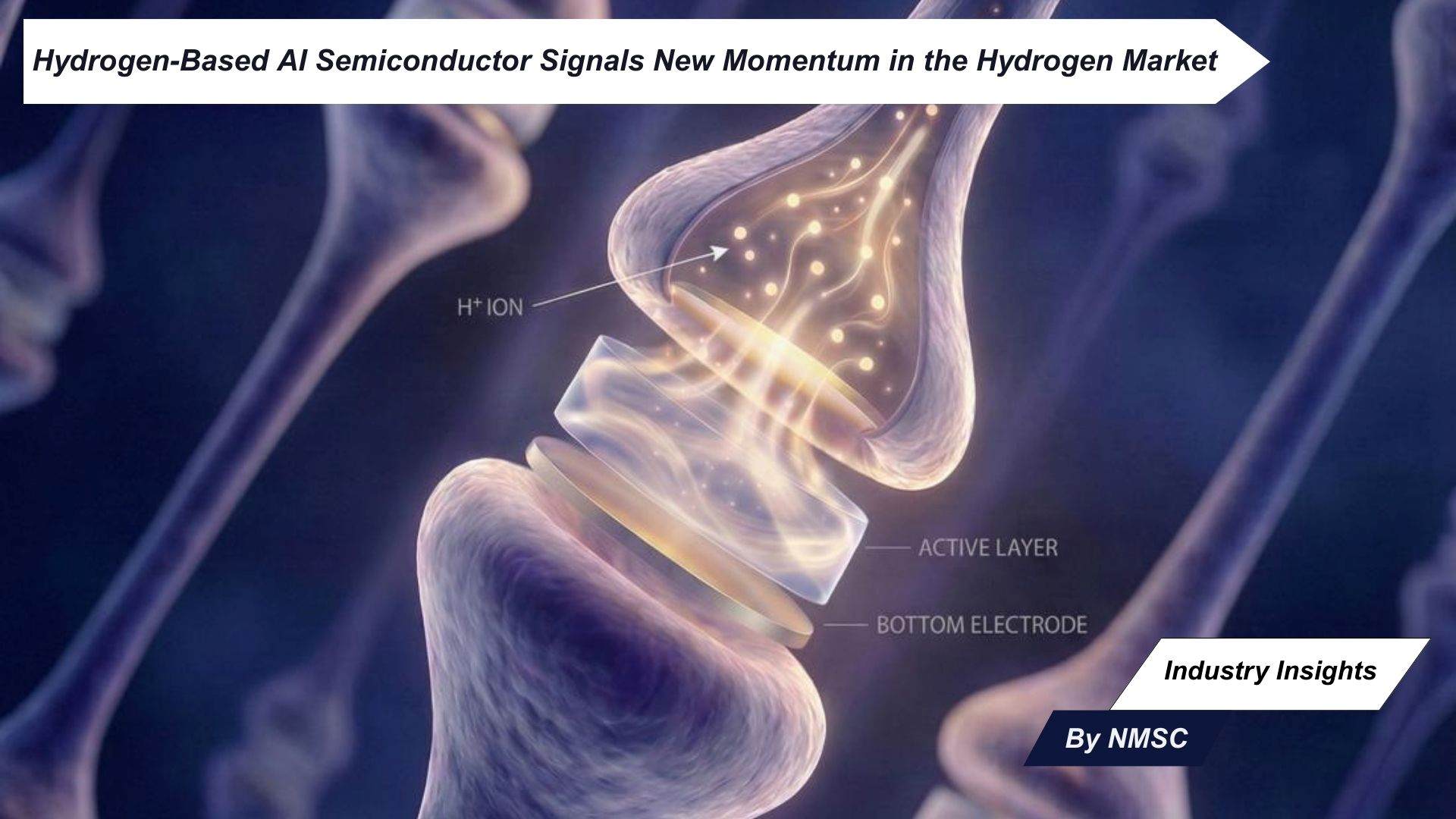
As advanced computing technologies increasingly seek energy-efficient and intelligent architectures, a recent breakthrough from Daegu Gyeongbuk Institute of Science and Technology is drawing attention to the evolving role of hydrogen in next-generation electronics. Researchers at the institute have successfully developed the world’s first artificial intelligence semiconductor capable of remembering and learning through the controlled movement of hydrogen ions, representing a significant technological milestone.
The innovation highlights a new frontier for hydrogen applications beyond energy systems, demonstrating its potential in advanced semiconductor architectures designed for neuromorphic computing.
A New Approach to AI Semiconductor Design
The research team, led by scientists Lee Hyun-joon and Noh Hee-yeon from the institute’s Nanotechnology Research Department, created a two-terminal AI semiconductor device that mimics certain functions of the human brain. By precisely controlling hydrogen ions using electrical signals, the device can both learn and retain information.
This development addresses longstanding challenges faced by conventional AI chips, including instability and high power consumption. Traditional computing architectures often separate data processing and memory functions, which can lead to performance inefficiencies when handling large volumes of data required for artificial intelligence systems.
Neuromorphic semiconductor technologies aim to overcome these limitations by enabling computation and memory operations to occur simultaneously, similar to how neurons function in the human brain.
Hydrogen Migration Enables Brain-Like Learning
The core innovation lies in the precise control of hydrogen migration within stacked semiconductor layers. The research team demonstrated that manipulating hydrogen ions allows the device’s electrical conductivity to change gradually, enabling synapse-like learning and memory functions.
Unlike earlier oxide-based memory semiconductors that relied on oxygen vacancies to operate, the hydrogen-based mechanism introduces a new resistance-switching process. This approach offers improved device stability and uniformity compared with existing technologies.
The AI semiconductor also demonstrated reliable performance during testing, operating stably through more than 10,000 cycles while maintaining its stored memory state even after long periods of storage.
According to the research team, this marks the first instance where hydrogen atoms moving between semiconductor layers have been precisely controlled using electrical signals, opening new possibilities for semiconductor device engineering.
Designed for High-Density and Energy-Efficient AI Chips
The device’s two-terminal vertical structure provides advantages for next-generation chip manufacturing. This architecture supports higher device density and simpler fabrication processes, making it particularly suitable for high-performance AI systems.
By enabling low-power operation and efficient learning capabilities, the hydrogen-based technology could accelerate the development of neuromorphic computing systems designed for advanced artificial intelligence workloads.
Researchers believe the discovery could reshape AI hardware design, offering a pathway toward more efficient, brain-inspired semiconductor platforms.
According to Next Move Strategy Consulting
According to Next Move Strategy Consulting, innovations that expand hydrogen’s role into advanced semiconductor technologies could broaden the scope of the Hydrogen Market beyond traditional energy and industrial applications. Breakthroughs such as hydrogen-based AI semiconductors illustrate how hydrogen-related materials and mechanisms may become increasingly relevant in emerging technology sectors, particularly in next-generation computing architectures that prioritize energy efficiency and high-performance processing.
As research continues to uncover new ways to leverage hydrogen within electronic devices, the intersection of semiconductor innovation and hydrogen-based mechanisms may create new growth opportunities across the global hydrogen ecosystem.
Source: Asia Research News
Prepared by: Next Move Strategy Consulting
About the Author
 Sanyukta Deb
— Sanyukta Deb is Digital Marketing Team Lead at Next Move Strategy Consulting, where she has led content strategy and technical SEO for the firm's B2B market research publications for over 2 years. Her editorial process translates NextMSC's primary and secondary research — spanning technology, industrial, and consumer sectors — into commercial narratives, backed by search-intent, keyword, and competitive analysis. She brings 5 years of overall experience in digital marketing and content strategy.
Sanyukta Deb
— Sanyukta Deb is Digital Marketing Team Lead at Next Move Strategy Consulting, where she has led content strategy and technical SEO for the firm's B2B market research publications for over 2 years. Her editorial process translates NextMSC's primary and secondary research — spanning technology, industrial, and consumer sectors — into commercial narratives, backed by search-intent, keyword, and competitive analysis. She brings 5 years of overall experience in digital marketing and content strategy.
About the Reviewer
 Debashree Dey
— Debashree Dey is Assistant Manager at Next Move Strategy Consulting, where she supports cross-vertical market content and communications across diverse industries for 6 years. Her professional background includes senior content writing, communications, and published manuscript authorship, with experience developing audience-focused business narratives and maintaining clear, consistent messaging. Her role supports research-led content development and editorial quality across NextMSC publications.
Debashree Dey
— Debashree Dey is Assistant Manager at Next Move Strategy Consulting, where she supports cross-vertical market content and communications across diverse industries for 6 years. Her professional background includes senior content writing, communications, and published manuscript authorship, with experience developing audience-focused business narratives and maintaining clear, consistent messaging. Her role supports research-led content development and editorial quality across NextMSC publications.

















Add Comment