Infrastructure Pivot: Mega-Projects, Digital Integration, and the New Construction Market

Lede
Three recent developments—the groundbreaking for Toronto’s massive East Harbour Transit Hub, the commencement of a £20 million integrated health centre in Weybridge, and Amazon’s $12 billion investment in Louisiana data centres—collectively map a Construction Market moving away from broad, generic activity toward high-precision, mission-critical infrastructure. At Next Move Strategy Consulting, our analysts have been tracking these developments as they mirror a fundamental shift in the industry: from volume-driven expansion to complex, performance-based development. This article synthesizes these shifts, offering expert perspectives on the technical, sustainable, and economic pillars currently defining the market.
1. Toronto’s East Harbour Transit Hub: Orchestrating Urban Mobility
Construction has officially begun on the principal station building for the East Harbour Transit Hub, an ambitious infrastructure anchor in Toronto. Designed to serve as a high-capacity interchange for the Lakeshore East, Stouffville, and Ontario lines, the facility is projected to handle 100,000 passenger journeys daily.
From our research perspective, this project is a quintessential example of transit-oriented development (TOD). By significantly reducing pressure on Union Station, the hub is not just building a transport stop; it is creating an economic engine that connects high-density residential areas with commercial opportunity. Our analysis indicates that projects integrating transit with mixed-use development are increasingly favored by municipal stakeholders for their ability to deliver long-term urban efficiency and alleviate infrastructure bottlenecks.
2. Weybridge Health Centre: The Shift to Integrated, Flexible Estates
In the UK, the start of construction on the new £20 million Weybridge health centre marks a pivotal shift in institutional construction. Aligning with the NHS 10-Year Health Plan, this facility abandons the traditional, fragmented approach to clinical space. Instead, it provides a "one-stop shop" that consolidates maternity services, diagnostics, and urgent care under one roof.
Our consulting team notes that the construction approach here emphasizes long-term adaptability. With flexible internal zoning, the facility is designed to evolve alongside changing local population needs and clinical advancements. This project highlights a critical trend we’ve tracked across the healthcare sector: the move toward decentralized, community-integrated infrastructure that prioritizes patient accessibility and operational longevity over monolithic facility footprints.
3. Amazon’s Louisiana Data Centres: Scaling the Digital Backbone
Amazon’s commitment of $12 billion for data centre campuses in Louisiana highlights the staggering scale of current industrial construction. These projects are not merely warehouses; they are sophisticated, mission-critical ecosystems.
Notably, the project integrates advanced sustainability requirements directly into the construction plan. With a $400 million investment in water infrastructure and the use of natural-air cooling technologies, Amazon is responding to the dual pressures of power demand and environmental accountability. This underscores a trend our analysts have highlighted in recent research: hyperscale data centres are now the most aggressive drivers of infrastructure innovation, forcing builders to master complex energy, cooling, and water systems at unprecedented speeds.
4. Next Move Strategy Consulting: Opinion, Impact, and Near-Term Prospects
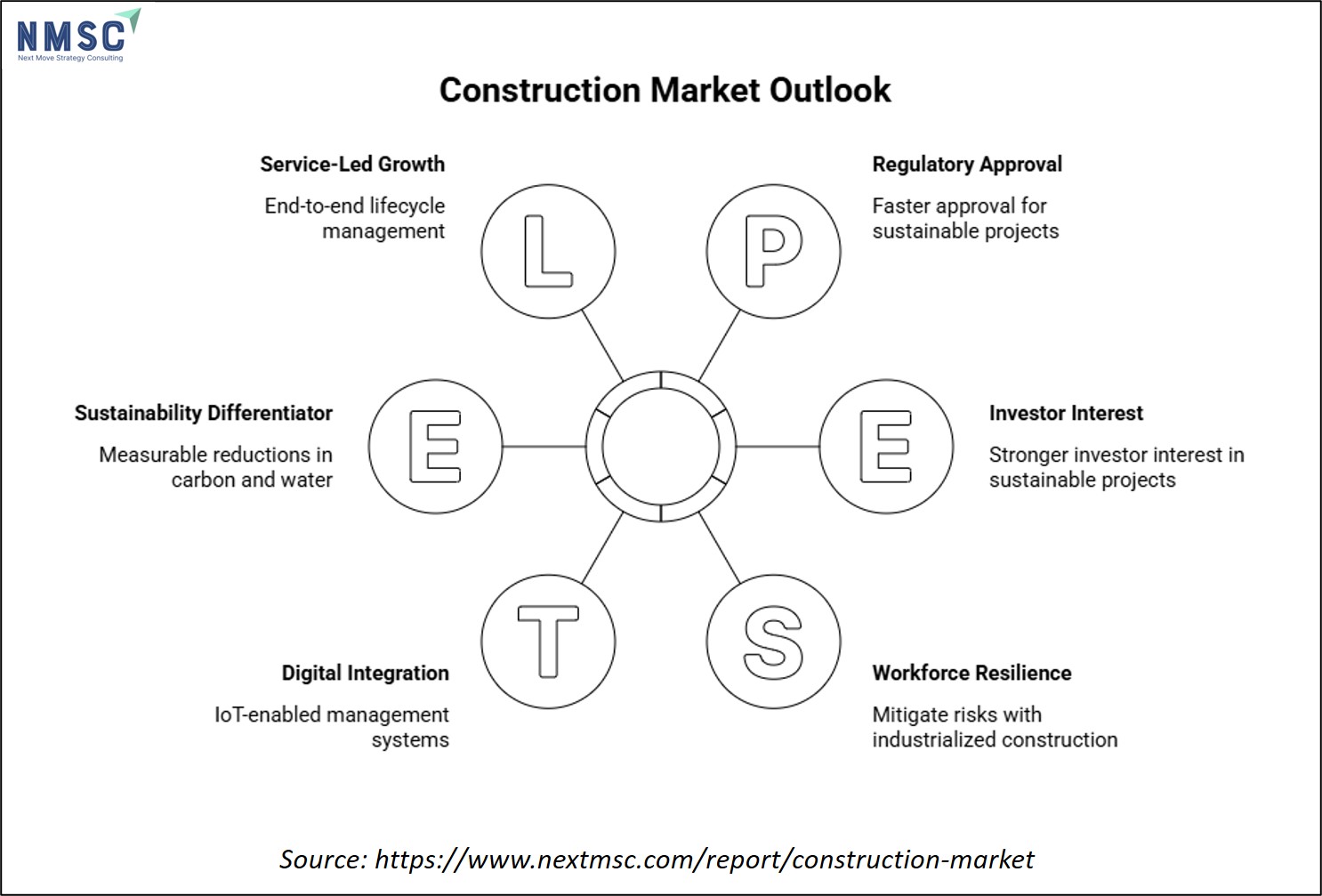
Next Move Strategy Consulting interprets these diverse projects as indicators of a maturing Construction Market, where value is increasingly measured by sustainability, resilience, and digital integration. Based on our decade of experience serving global industry leaders, we offer the following outlook:
-
The Power-Infrastructure Nexus: As data centre demand surges, the bottleneck is increasingly grid capacity. We anticipate that construction firms capable of building and integrating private power/utility solutions will command a higher premium than traditional civil contractors.
-
Operational Intelligence as a Requirement: The era of "build and hand over" is waning. Projects are now expected to include "digital twins" and IoT-enabled management systems from day one to optimize energy consumption and maintenance.
-
Sustainability as a Commercial Differentiator: Environmental performance is no longer a secondary "green" goal; it is a primary project requirement. Developers and contractors that demonstrate measurable reductions in embodied carbon and water usage are seeing faster regulatory approval and stronger investor interest.
-
Service-Led Growth: The value in the construction chain is shifting toward design-build and integrated delivery models. Firms that provide end-to-end lifecycle management—from initial planning to long-term facility monitoring—will secure the highest margins.
-
Workforce Resilience: Given persistent labor shortages, the winners in 2026 will be those who successfully pivot to industrialized construction (modular/prefabrication) to mitigate risks associated with site-based labor.
5. Practical Suggestions for Stakeholders
-
General Contractors: Invest in modular and prefabrication capabilities to reduce reliance on site-based skilled labor.
-
Technology Providers: Focus on integrating AI-driven project management and energy optimization tools directly into building designs, as owners prioritize long-term operational costs.
-
Investors: Prioritize projects that feature "future-proofing" (flexible zoning, multi-purpose use cases) and firms with strong track records in mission-critical infrastructure like data centres or high-capacity transport.
-
Policy Makers: Fast-track the approval of integrated infrastructure hubs (like transit-oriented developments) to capture the economic density they create and help offset softness in traditional commercial real estate.
Conclusion
The convergence of mega-transit, integrated health hubs, and hyperscale data centres signals a transition from volume-driven construction to value-driven infrastructure. The Construction Market is evolving into a more specialized, tech-heavy, and sustainability-conscious industry. Companies that align their innovation roadmaps with these high-growth infrastructure verticals—and that master the complexities of integrated project delivery—will capture the greatest value as the global built environment continues to modernize.
About Next Move Strategy Consulting:
Next Move Strategy Consulting is a premier market research and management consulting firm that has been committed to providing strategically analysed well documented latest research reports to its clients. The research industry is flooded with many firms to choose from, what makes Next Move different from the rest is its top-quality research and the obsession of turning data into knowledge by dissecting every bit of it and providing fact-based research recommendation that is supported by information collected from over 500 million websites, paid databases, industry journals and one on one consultations with industry experts across a diverse range of industry sectors. The high-quality customized research reports with actionable insights and excellent end-to-end customer service help our clients to take critical business decisions that enables them to move beyond time and have competitive edge in the industry.
For more information please contact:
Next Move Strategy Consulting
5th Floor 867
Boylston St, STE 500,
Boston, MA 02116, U.S.
E-Mail: [email protected]
Direct: +1-857-758-5017
Website: www.nextmsc.com
About the Author
 Sanyukta Deb
— Sanyukta Deb is Digital Marketing Team Lead at Next Move Strategy Consulting, where she has led content strategy and technical SEO for the firm's B2B market research publications for over 2 years. Her editorial process translates NextMSC's primary and secondary research — spanning technology, industrial, and consumer sectors — into commercial narratives, backed by search-intent, keyword, and competitive analysis. She brings 5 years of overall experience in digital marketing and content strategy.
Sanyukta Deb
— Sanyukta Deb is Digital Marketing Team Lead at Next Move Strategy Consulting, where she has led content strategy and technical SEO for the firm's B2B market research publications for over 2 years. Her editorial process translates NextMSC's primary and secondary research — spanning technology, industrial, and consumer sectors — into commercial narratives, backed by search-intent, keyword, and competitive analysis. She brings 5 years of overall experience in digital marketing and content strategy.
About the Reviewer
 Debashree Dey
— Debashree Dey is Assistant Manager at Next Move Strategy Consulting, where she supports cross-vertical market content and communications across diverse industries for 6 years. Her professional background includes senior content writing, communications, and published manuscript authorship, with experience developing audience-focused business narratives and maintaining clear, consistent messaging. Her role supports research-led content development and editorial quality across NextMSC publications.
Debashree Dey
— Debashree Dey is Assistant Manager at Next Move Strategy Consulting, where she supports cross-vertical market content and communications across diverse industries for 6 years. Her professional background includes senior content writing, communications, and published manuscript authorship, with experience developing audience-focused business narratives and maintaining clear, consistent messaging. Her role supports research-led content development and editorial quality across NextMSC publications.

















Add Comment