Robot Fleet Management Software Market Global Industry Analysis and Forecast (2026–2035)

The global Robot Fleet Management Software Market size was valued at USD 2.55 billion in 2025 and is estimated at USD 3.84 billion in 2026, forecast to reach USD 15.45 billion by 2035, expanding at a 16.73% CAGR between 2026 and 2035. North America leads with approximately 34% share, while Autonomous Mobile Robots dominate with approximately 70% of market revenue in 2026.

Download Free Sample PDF
Base Year (2025)
$2.55 Billion
Forecast (2035)
$15.45 Billion
CAGR (2026-2035)
16.7%
Top Region
North America

What Is the Robot Fleet Management Software Market Size?

The global Robot Fleet Management Software Market reached USD 2.55 Billion in 2025, is estimated at USD 3.84 Billion in 2026, and is forecast to reach USD 15.45 Billion by 2035, registering a CAGR of 16.73% from 2026 to 2035. North America leads with approximately 34% share, while autonomous mobile robots account for approximately 70% of 2026 revenue.

Our assessment indicates that fleet software spending is concentrating around a few dominant segments, summarised below.

Robot Fleet Management Software Market Global Industry Analysis and Forecast (2026–2035) Revenue Forecast

Values in USD Billion

2025 $2.55 Billion
2025
2026 $3.84 Billion
2026
2027 $4.48 Billion
2027
2028 $5.23 Billion
2028
2029 $6.11 Billion
2029
2030 $7.13 Billion
2030
2031 $8.32 Billion
2031
2032 $9.71 Billion
2032
2033 $11.34 Billion
2033
2034 $13.24 Billion
2034
2035 $15.45 Billion
2035

Key Takeaways

By Robot Type: Autonomous mobile robots held the largest share, expanding from USD 1.80 Billion in 2025 to USD 9.60 Billion by 2035; Other robots is the fastest growing at 25.44% CAGR from 2026–2035.

By Deployment Mode: On premises held the largest share, expanding from USD 1.43 Billion in 2025 to USD 6.10 Billion by 2035; Cloud based is the fastest growing at 20.09% CAGR from 2026–2035.

By End Use Industry: Warehousing and logistics held the largest share, expanding from USD 1.35 Billion in 2025 to USD 7.20 Billion by 2035; Healthcare is the fastest growing at 22.45% CAGR from 2026–2035.

Dominant Region: North America held the largest share, expanding from USD 0.88 Billion in 2025 to USD 5.35 Billion by 2035.

Fastest-Growing Region: Middle East & Africa is the fastest growing at 18.19% CAGR from 2026–2035, rising from USD 0.13 Billion in 2025 to USD 0.90 Billion by 2035.

Dominant Country: The U.S. held the largest share, expanding from USD 0.74 Billion in 2025 to USD 4.45 Billion by 2035.

Fastest-Growing Country: India is the fastest growing at 23.89% CAGR from 2026–2035, rising from USD 0.05 Billion in 2025 to USD 0.55 Billion by 2035.

Market Opportunity: The Robot Fleet Management Software Market presents an absolute investment opportunity of approximately USD 11.61 Billion between 2026 and 2035, signalling that orchestration software is becoming the most valuable control point in mobile automation. Growth is supported by larger fleets, mixed robot types and recurring software licences, which together convert robot installations into long term software revenue streams for vendors.

According to NMSC analysis, orchestration software that can federate several vendor fleet managers is turning into a procurement requirement, because buyers now run robots from different makers under one operations team and expect a single control plane across every site. Vendors that cannot connect to third party robots or enterprise systems risk losing tenders to platforms that can.

What Does the Robot Fleet Management Software Market Encompass?

The Robot Fleet Management Software Market covers platforms that assign missions, control traffic, monitor robot health and analyse performance across fleets of autonomous mobile robots, automated guided vehicles and other robots. Offerings range from vendor native managers, such as OMRON Fleet Operations Workspace and MiR Fleet Enterprise, to neutral orchestration layers that sit above several native systems. This market report treats AMR fleet management software as the core of its scope and excludes robot hardware revenue and generic vehicle telematics.
Regulation and standards shape purchasing decisions. Regulation (EU) 2023/1230 applies from 20 January 2027 and addresses machinery within its scope. ISO 21423:2026, published on 14 October 2026, specifies communication and interoperability requirements for industrial mobile robots, fleet managers, and related enterprise and facility systems. Operators are moving from single-site pilots to multi-site programmes and connecting fleet software through open interfaces such as VDA 5050, supported by MiR and Ati Robotics.

Market Drivers & Dynamics

Interactive Dataset
Rising robot density in warehouses and factories driver +3.10% Global, led by Asia-Pacific and North America 2026–2035
Demand for multivendor interoperability and open standards driver +2.60% Europe and North America 2026–2032
Robot as a Service subscription models driver +1.90% North America and Europe 2026–2035
AI driven orchestration and agentic operations tools driver +1.70% Global 2027–2035
Integration complexity with enterprise and plant systems restraint −1.60% Global 2026–2030
Compliance workload under Regulation (EU) 2023/1230 restraint −1.00% Europe 2027–2031
Change management and upfront cost for smaller operators restraint −0.80% Latin America, Middle East & Africa 2026–2031
Source: Next Move Strategy Consulting

Growth Drivers

What Is the Primary Growth Driver in the Robot Fleet Management Software Market?

Rising robot density is the primary structural driver. The International Federation of Robotics reported that 117,500 professional service robots for transportation and logistics were sold in 2025, up 21% year over year, making this the leading professional service robot application. As fleets expand, operators increasingly need software for dispatch, charging, traffic management and performance monitoring. Larger fleets cannot be managed manually, so operators adopt software for dispatch, charging and traffic control. Our analysis shows that warehouse automation programmes now treat fleet software as core infrastructure rather than an optional add on.

How Is Standardisation Driving the Market Growth?

Common communication standards lower integration cost and widen buying choices. MiR offers a dedicated VDA 5050 adapter, and Ati Robotics supports the interface. Published ISO 21423:2026 provides an additional communication framework for industrial mobile robots, fleet managers and related systems, helping address interoperability challenges in industrial environments. Our findings suggest that standard based interfaces let intralogistics software vendors connect more robot brands per site, which grows deployments across diverse fleets.

Growth Inhibitors

What Is Restraining the Robot Fleet Management Software Market?

Integration complexity is the main restraint. Fleet managers must exchange orders and status with warehouse, enterprise and manufacturing execution systems, and each connection needs testing at every site. Regulation (EU) 2023/1230 applies from 20 January 2027 to machinery within its scope. It can affect fleet software when the software forms part of covered machinery or contributes to its safety functions; obligations for standalone fleet-management platforms depend on their role and integration. We found that smaller operators often delay programmes until integration cost falls, which tempers near term adoption.

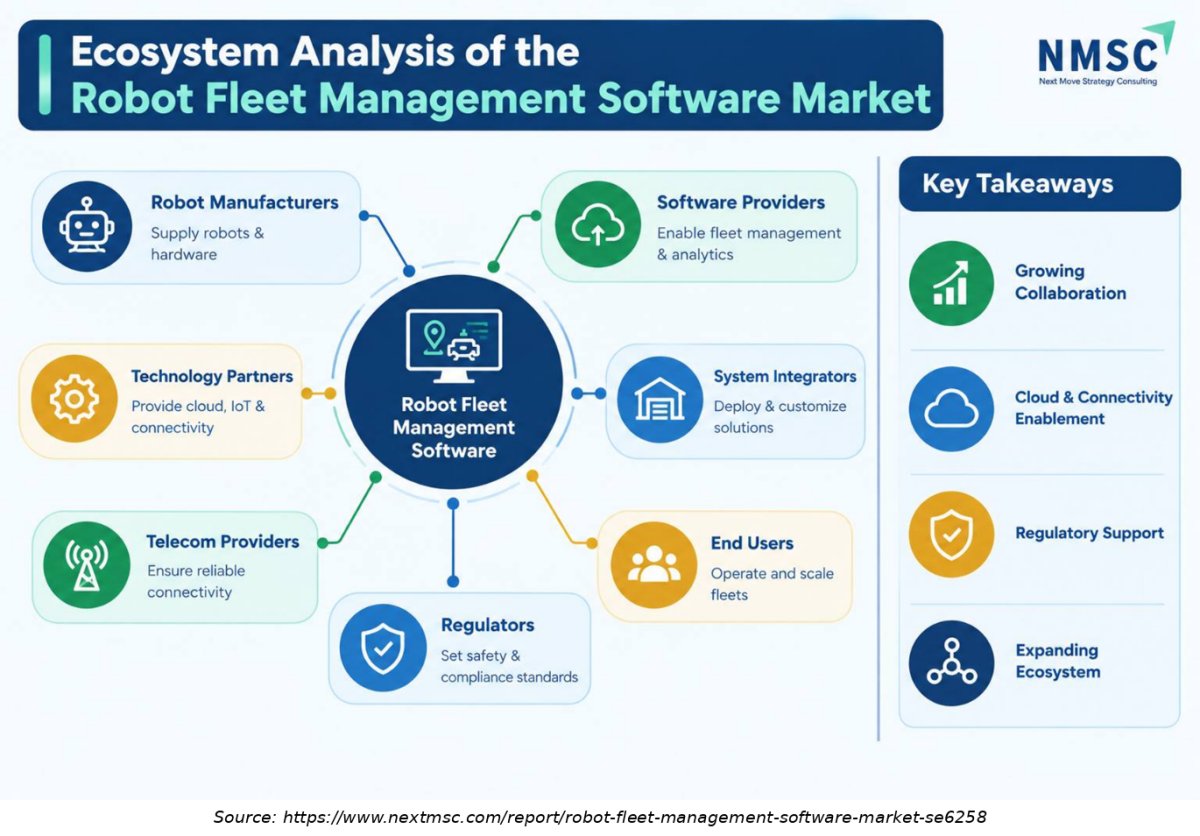
Ecosystem Analysis of the Robot Fleet Management Software Market

The robot fleet management software market ecosystem comprises robot manufacturers, software providers, technology partners, telecom providers, system integrators, end users, and regulators. These stakeholders collaborate to enable fleet coordination, analytics, cloud connectivity, and operational scalability. Increasing automation across industrial and logistics environments is strengthening ecosystem partnerships, while connectivity reliability, interoperability, and regulatory compliance remain important considerations for successful deployment.

Segmentation Analysis

2025 (USD Billion)
2035 (USD Billion)
Autonomous mobile robots 2025: $1.80 Billion | 2035: $9.60 Billion
Autonomous m
Automated guided vehicles 2025: $0.45 Billion | 2035: $1.85 Billion
Automated gu
Other robots 2025: $0.30 Billion | 2035: $4.00 Billion
Other robots
Autonomous mobile robots $1.80 Billion $9.60 Billion 15.14%
Automated guided vehicles $0.45 Billion $1.85 Billion 12.92%
Other robots $0.30 Billion $4.00 Billion 25.44%

Which Robot Type Leads the Robot Fleet Management Software Market?

Autonomous mobile robots dominate with USD 2.70 Billion in 2026, roughly 70% of revenue, because warehouse and factory fleets from Geekplus, Locus Robotics, OTTO, MiR and Omron all rely on dedicated fleet managers. Other robots grow fastest at 25.44% CAGR as humanoids, legged platforms and autonomous mobile manipulator robots join mixed fleets. Automated guided vehicles expand more slowly at 12.92%, since KUKA and others now manage them inside mixed AMR and AGV fleets.

2025 (USD Billion)
2035 (USD Billion)
Autonomous m
Automated gu
Other robots
Cloud based
On premises
Segment Item 2025 (USD Billion) 2035 (USD Billion) CAGR
Autonomous mobile robots $10.0 USD Billion $40.0 USD Billion 25.0%
Automated guided vehicles $17.1 USD Billion $51.1 USD Billion 11.0%
Other robots $24.2 USD Billion $62.2 USD Billion 25.0%
Cloud based $31.3 USD Billion $73.3 USD Billion 11.0%
On premises $38.4 USD Billion $84.4 USD Billion 16.0%

Segment-wise data is locked

Unlock complete segment-wise numbers for By Deployment Mode.

Unlock Full Data
2025 (USD Billion)
2035 (USD Billion)
Autonomous m
Automated gu
Other robots
Cloud based
On premises
Segment Item 2025 (USD Billion) 2035 (USD Billion) CAGR
Autonomous mobile robots $10.0 USD Billion $40.0 USD Billion 27.0%
Automated guided vehicles $17.1 USD Billion $51.1 USD Billion 9.0%
Other robots $24.2 USD Billion $62.2 USD Billion 19.0%
Cloud based $31.3 USD Billion $73.3 USD Billion 17.0%
On premises $38.4 USD Billion $84.4 USD Billion 18.0%

Segment-wise data is locked

Unlock complete segment-wise numbers for By End Use Industry.

Unlock Full Data

Growth Opportunities

Our analysis shows that three whitespace opportunities are positioned to generate disproportionate revenue through 2035.

Can Federated Orchestration Capture Mixed Fleet Budgets?

Operators with robots from several makers need a neutral layer that dispatches across native fleet managers. InOrbit.AI reports an ecosystem of more than 30 robot brands, and Ati Robotics supports reverse interoperability so its robots can run inside third party managers. Vendors that win this layer gain a durable position above hardware, and the other robots and autonomous mobile robot segments benefit most.

Can Healthcare and Retail Become Premium Software Verticals?

Healthcare is the fastest growing end use industry, and retail and hospitality is next at 19.95% CAGR. MiR serves pharma and healthcare customers, while Brain Corporation positions BrainOS for retail fleets. These sites demand strict safety rules, elevator and door integration and remote supervision, so software that bundles such functions can command premium pricing from healthcare and retail buyers.

Does Pre Deployment Simulation Create a New Revenue Stream?

OMRON offers a Fleet Simulator that lets customers test fleet configurations before buying robots. A digital twin of the facility reduces commissioning risk and supports capital approval, so simulation modules can be licensed separately or bundled into subscriptions. Cloud based vendors are best placed to monetise this opportunity because they can run heavy simulations centrally for many sites.

Regional Outlook

2025 (USD Billion)
2035 (USD Billion)
North Americ
Europe
Asia-Pacific
Middle East
Latin Americ
Region 2025 (USD Billion) 2035 (USD Billion) CAGR (%)
North America $10.0 USD Billion $40.0 USD Billion 9.0%
Europe $17.1 USD Billion $51.1 USD Billion 27.0%
Asia-Pacific $24.2 USD Billion $62.2 USD Billion 25.0%
Middle East & Africa $31.3 USD Billion $73.3 USD Billion 23.0%
Latin America $38.4 USD Billion $84.4 USD Billion 12.0%

Regional data is locked

Unlock complete regional numbers for this market.

Unlock Full Data

Competitive Landscape

Our findings suggest that competition is defined by a split between hardware makers that bundle fleet managers and neutral platforms that orchestrate many robot brands. The sections below set out the structure of the field, the main vendor archetypes, the innovation strategies in use and the pattern of deal activity.

Dimension Description
Market Structure Moderately fragmented, with robot makers, industrial automation groups and neutral orchestration specialists competing
Innovation Focus Interoperability, AI assisted operations, simulation and support for humanoid and mixed fleets
M&A Activity Selective, led by industrial automation groups acquiring robot makers and by capital market listings

How Do Companies Compete in the Robot Fleet Management Software Market?

Vendors compete on fleet scale, integration depth and total cost. Geekplus reported more than 72,000 robots delivered to about 950 end customers by the end of 2025, while MiR cites proven operation in more than 1,000 facilities. Pricing is shifting toward subscriptions tied to robot counts, and geographic expansion relies on integrators and regional offices, so vendors with local support and open interfaces win larger multi site programmes.

Which Vendor Archetypes Dominate the Industry?

Three archetypes dominate. Hardware led groups such as Geekplus, Locus Robotics, Rockwell Automation, Teradyne, KUKA and Omron sell fleet managers with their own robots, including mobile collaborative robots in the case of MiR. Neutral orchestrators such as InOrbit.AI differentiate through multivendor reach, and platform operating systems such as BrainOS differentiate through cross workflow software for cleaning and retail fleets.

What Innovation and Differentiation Strategies Are Companies Using?

Differentiation centres on intelligence and openness. Locus Robotics uses LocusONE analytics to tune fleet productivity, OMRON provides fleet simulation and analytics, and Ati Robotics offers reverse interoperability. Vendors also move computation to the robot through edge AI so that traffic decisions continue during network loss, and they package safety, analytics and enterprise connectors as modules that justify recurring licence fees.

How Active Is M&A in the Robot Fleet Management Software Market?

Activity is selective but strategic. Rockwell Automation completed its 2023 acquisition of Clearpath Robotics, the parent of OTTO, and now builds OTTO robots in Milwaukee, while Teradyne has owned MiR since 2018. Geekplus listed on the Hong Kong exchange in July 2025, which gives it capital for acquisitions. Market share data remains unavailable, so we keep rankings qualitative and expect further consolidation among smaller software specialists.

Key Market Players

During our market evaluation, we validated the following companies from official company sources, listed in ranked order of verifiable scale.

Beijing Geekplus Technology Co., Ltd. Locus Robotics Corp. Brain Corporation Rockwell Automation, Inc. Teradyne, Inc. KUKA Aktiengesellschaft OMRON Corporation InOrbit.AI Ati Motors (Ati Robotics)

Latest Developments

We observed that recent announcements concentrate on listings, production capacity, interoperability and orchestration scale.

Date Event
October 2025 Rockwell Automation announced that the first OTTO 600 and OTTO 1200 autonomous mobile robots had rolled off its Milwaukee production line. The milestone expands manufacturing capacity for its autonomous material-handling solutions, supporting industrial customers seeking to automate internal transport, improve workflow efficiency, and optimize factory logistics.
October 2025 Locus Robotics announced that its robots had surpassed 6 billion picks globally, demonstrating the expanding scale of robotic automation in warehouse operations. The company's LocusONE platform coordinates robot fleets and supports operational visibility, workforce productivity, and scalable fulfillment processes for logistics and distribution customers.
October 2025 The International Federation of Robotics (IFR) reported that global sales of professional service robots for transportation and logistics reached 102,900 units in 2024, representing a 14% year-on-year increase. The growth highlights rising adoption of autonomous mobile robots and automated material-handling solutions across warehouses, manufacturing facilities, and logistics operations.

Investment Opportunities

How Are Capital Inflows Shaping the Market?

Capital is flowing to scaled platforms. Geekplus raised public capital through its Hong Kong listing in July 2025 and returned to profitability in its 2025 results, which signals investor appetite for AMR and software businesses with a large installed base. Industrial groups also deploy balance sheet capital, as Rockwell Automation did through Clearpath. Investors favour vendors with recurring software revenue and proven multi site fleets over pure hardware sellers.

Where Is Infrastructure Investment Concentrating?

Infrastructure spending targets production capacity and cloud operations. Rockwell Automation opened a 25,000 square foot OTTO production space in Milwaukee, adding U.S. capacity next to its Canadian plants, while vendors expand cloud platforms that monitor fleets remotely. Our analysis shows that investment in support centres, simulation tools and integrator training will matter as much as robot output, because software value depends on reliable deployment at every site.

What ESG Considerations Matter for Investors?

ESG factors centre on safety, workforce impact and energy use. Regulation (EU) 2023/1230 sets stricter requirements for autonomous mobile machinery from 20 January 2027, so documented compliance becomes a governance signal. Efficient routing and charging management reduce idle time and energy consumption, and robots take over heavy material moves that cause injuries. We found that investors increasingly screen vendors on safety certification and transparent data handling.

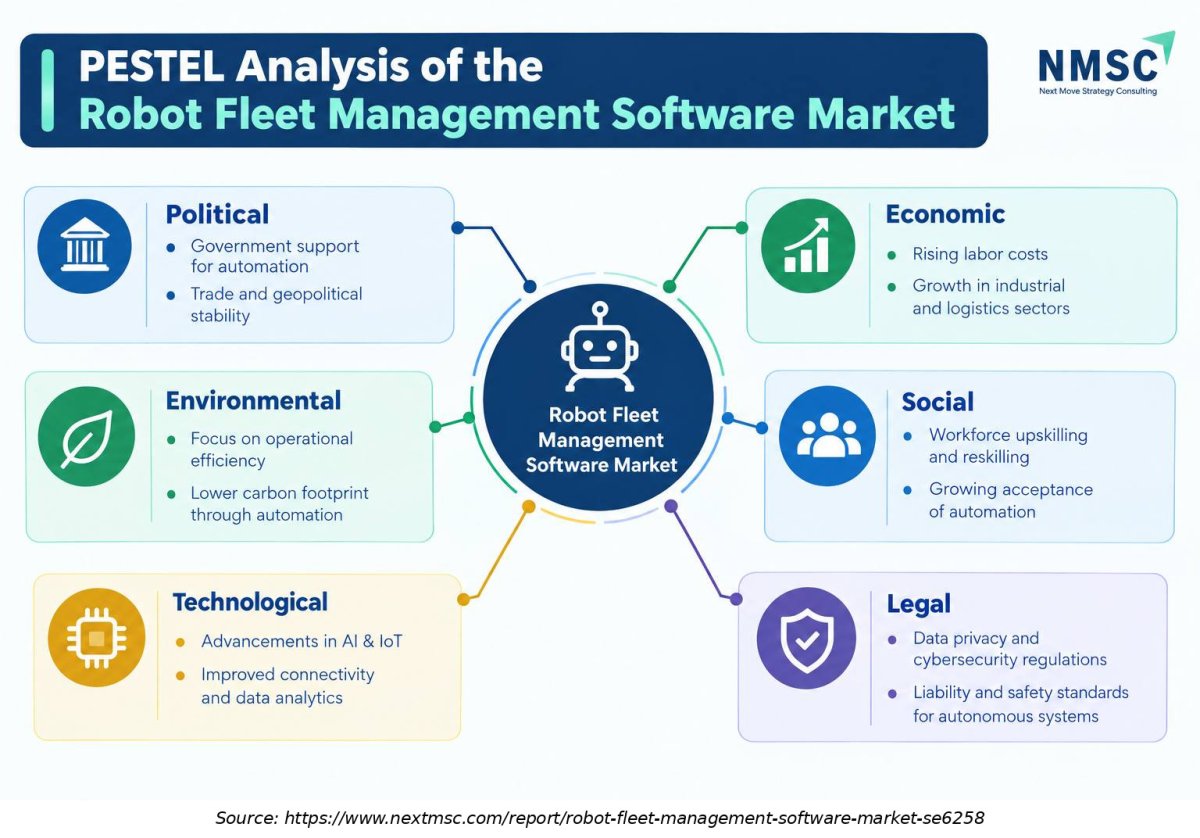
PESTEL Analysis of the Robot Fleet Management Software Market

PESTEL Analysis of the Robot Fleet Management Software Market
The PESTEL analysis highlights the political, economic, social, technological, environmental, and legal factors shaping the robot fleet management software market. Government automation initiatives and industrial growth support adoption, while rising labor costs strengthen the business case for robotics. Advances in AI, IoT, and analytics create further opportunities, although cybersecurity, autonomous-system safety, workforce reskilling, and evolving regulatory requirements influence implementation strategies.

Key Benefits for Stakeholders

How Does the Report Help Enterprise and Industry Leaders?

Enterprise buyers gain a segmented view of deployment choices, from on premises plant systems to cloud platforms, with forecasts to 2035. The analysis shows where multivendor orchestration, simulation and subscription pricing reduce risk, and which regions and industries are adopting fastest. Leaders can use these findings to set vendor selection criteria, plan multi site rollouts and align fleet software with warehouse and plant systems.

How Does the Report Help Investors and Financial Analysts?

Investors receive reconciled sizing from USD 2.55 Billion in 2025 to USD 15.45 Billion by 2035, segment and regional growth rates, and a ranked view of nine validated companies. The report highlights fast growing niches such as healthcare, cloud based deployment and other robots, and explains the drivers and restraints behind each. These insights support valuation work, portfolio screening and the timing of entry into robotics software.

How Does the Report Help Technology Vendors and Product Teams?

Vendors and product teams can benchmark features against competitors, including interoperability, AI assisted operations, simulation and cloud delivery. The report maps standards and regulation that shape product roadmaps, and it identifies segments where demand is outpacing supply. Teams can use the findings to prioritise integrations, decide between open and closed architectures, and design pricing that fits subscription based customers.

Key Market Segments Evaluated

By Robot Type

  • Autonomous mobile robots
  • Automated guided vehicles
  • Other robots

By Deployment Mode

  • Cloud based
  • On premises

By End Use Industry

  • Warehousing and logistics
  • Manufacturing
  • Retail and hospitality
  • Healthcare

By Region

  • North America 
    • U.S.
    • Canada
    • Mexico
  • Europe 
    • UK
    • Germany
    • France
    • Italy
    • Spain
    • Sweden
    • Denmark
    • Finland
    • Netherlands
    • Rest of Europe
  • Asia-Pacific 
    • China
    • India
    • Japan
    • South Korea
    • Taiwan
    • Indonesia
    • Vietnam
    • Australia
    • Philippines
    • Malaysia
    • Rest of APAC
  • Middle East & Africa 
    • Saudi Arabia
    • UAE
    • Egypt
    • Israel
    • Turkey
    • Nigeria
    • South Africa
    • Rest of MEA
  • Latin America 
    • Brazil
    • Argentina
    • Chile
    • Colombia
    • Rest of LATAM

Conclusion & Recommendations

The outlook is strongly positive, with revenue rising from USD 3.84 Billion in 2026 to USD 15.45 Billion in 2035. Growth rests on larger fleets, mixed robot types and recurring software licences rather than one off hardware sales. Our analysis shows that cloud based deployment will overtake on premises systems before the end of the forecast period, and that standards will keep widening the range of robots a single platform can manage.

What Strategic Positioning Recommendations Does NMSC Offer?

NMSC recommends that hardware makers open their fleet managers through VDA 5050 and emerging ISO interfaces, and that neutral platforms deepen enterprise connectors to warehouse and plant systems. Vendors should bundle simulation, analytics and safety modules into subscriptions, and build regional partner networks in Asia-Pacific, the Middle East and Latin America. Buyers should demand multivendor support and clear exit terms in every contract.

What Is the Investment Attractiveness of the Robot Fleet Management Software Market?

Attractiveness is high but selective. Recurring revenue, rising robot density and regulatory pressure favour software leaders, while hardware commoditisation and integration cost compress returns for weaker players. Healthcare, retail and the other robots segment offer faster growth from small bases. We assess that investors should prefer vendors with proven multi site fleets, open interfaces and transparent safety certification over those dependent on a single customer.

What Are the Market Shifts and Key Risks in the Robot Fleet Management Software Market?

Key shifts include federated orchestration, AI assisted operations and humanoid fleets entering mixed environments. Risks include uneven standards adoption and implementation, integration overruns, cybersecurity exposure of connected fleets and compliance cost under Regulation (EU) 2023/1230. Customer concentration and vendor exits can also disrupt support. Buyers and investors should monitor ISO publication timing, vendor financial health and the pace at which enterprises consolidate fleet software across sites.

What Are the Primary Growth Pathways Through 2035?

Growth pathways include expanding multi site subscriptions, adding cloud analytics and simulation modules, entering healthcare and retail with certified solutions, and orchestrating humanoids and mobile manipulators beside carriers. Regional expansion in Asia-Pacific, the Middle East and Africa offers further headroom. We found that vendors combining open standards with deep enterprise integration are best placed to capture these pathways and sustain double digit growth.

FAQs

About the Author

Mihul Sharma

Mihul Sharma

Mihul Sharma is Research Associate at Next Move Strategy Consulting, where he has covered technology, industrial, and healthcare markets for 3 years. His work applies structured business research, market analysis, and secondary-source review to assess market trends, competitive developments, and growth opportunities. He supports report development by fully synthesizing industry data, company information, and market signals into concise findings for strategy and investment-focused research teams.

About the Reviewer

Supradip Baul

Supradip Baul

Supradip Baul is an accomplished business consultant and strategist with over a decade of rich experience in market intelligence, strategy, technology, and business transformation. His work has included rigorous qualitative and quantitative analysis across multiple industries, helping clients shape investment decisions and long-term roadmaps. Earlier in his career, he was associated with Gartner, where he contributed to industry-leading reports and market share analyses. He has worked with leading global companies and holds an MBA with a dual specialization in Marketing and Finance.

Download Free Sample

Nishant Awate

NISHANT AWATE

Business Development Global Sales

Zehnder Group Deutschland GmbH

Our experience working with Next Move Strategy Consulting was positive. The team was responsive, professional, and open to incorporating our specific requirements throughout the project. The India AHU market study was comprehensive and well structured, covering market value and volume forecasts, product and application segments, and key industry trends. The inclusion of both AHU and residential MVHR market insights made the study particularly relevant for our strategic market assessment. Overall, the report provides a solid foundation for evaluating market potential, identifying priority segments, and supporting business-development decisions in India.

Gustaf Hummel Burstrom

GUSTAF HUMMEL BURSTROM

Founder

Revline Tools AB

Joseph and the team at Next Move Strategy Consulting have been excellent to work with, in supplying us with relevant market data and forecasts for our specific category. We had some special requirements and they were able to do a custom package to suit our needs. We would definitely recommend them to any other company needing market data and forecasts

Kishu Kanda

KISHU KANDA

Strategy Analyst

Accenture

We purchased the AI Consumer Market Report from this company. Not only did they customize the report to meet our specific requirements, but they also showed great flexibility in accommodating our budget. The report we received fully met our expectations. Additionally, they provided prompt and thorough responses to both our pre-purchase and follow-up questions. We look forward to working with this company again in the future.

Diana Trejo

DIANA TREJO

Assistant Manager

Sumitomo Corporation de Mexico, S.A. de C.V.

Recently, we purchased a report on the Mexico Data Center Market from Next Move Strategy Consulting. The service has been excellent, with support that is always timely and thoroughly professional. The information provided is interesting, highly useful, and delivered with clarity. I would highly recommend NextMSC for anyone seeking insightful and dependable analysis.

Rishabh Jogani

RISHABH JOGANI

Strategy Analyst

Accenture Japan

We are incredibly impressed with the market report on the real estate market in India provided by Next Move Strategy Consulting. The report was thorough, insightful, and well-structured, offering deep analysis and actionable recommendations. It not only captured the current trends and dynamics but also provided a forward-looking perspective that has been invaluable for our strategic planning. Their team demonstrated exceptional professionalism, attention to detail, and a profound understanding of the industry. The data-driven insights and clarity of presentation exceeded our expectations, making complex market trends easy to understand. We highly recommend Next Move Strategy Consulting to anyone looking for reliable and comprehensive market research services. Their expertise has given us the confidence to navigate the complexities of the Indian real estate market with clarity and foresight.

Custom Market Research Services

We will customize the research for you if the listed report does not fully match your requirements.

Get 30% Free Customization

Select License

This website uses cookies to ensure you get the best experience on our website. Learn more

✖