Market Transformation in Liquid Handling Systems: What Has Changed and What Comes Next
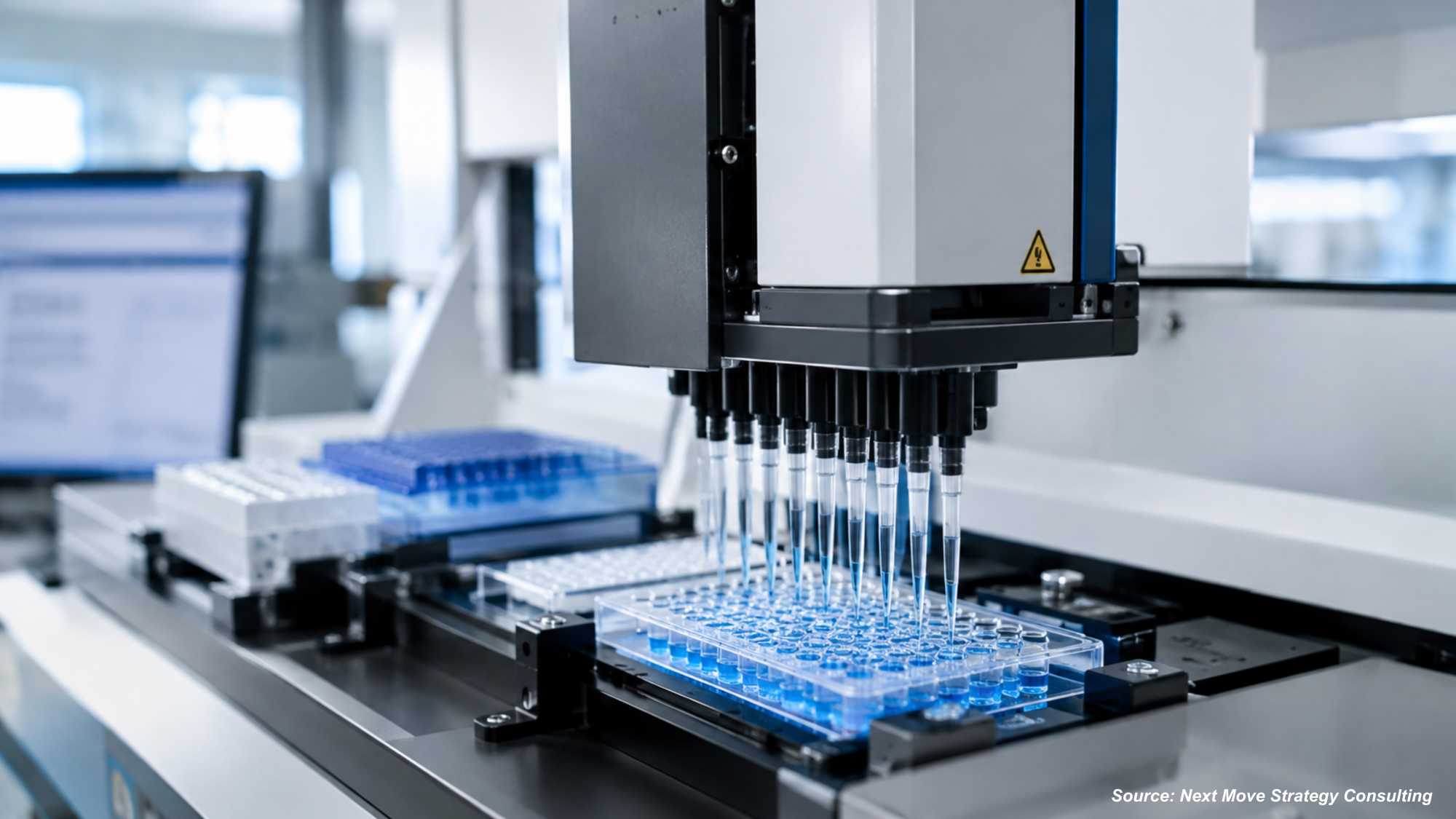
Tecan's Second-Quarter Instrument Recovery, Danaher's Strongest Life Sciences Quarter in Years and Opentrons' Compliance Push Show Lab Automation Moving From Budget Line to Validated Infrastructure
In August 2026, Swiss laboratory automation group Tecan reported that liquid handling instrument revenues recovered in the second quarter after declines in the preceding quarters, lifting sales in its Life Sciences Business 4.6% in local currencies in the second quarter after a 1.3% rise in the first. Group sales for the first half of 2026 reached CHF 427.5 million, up 3.4% in local currencies, with order entry of CHF 444.3 million and a book-to-bill ratio of 1.04, according to Tecan's results announcement of August 11, 2026. The turn matters beyond one company: Danaher and Thermo Fisher Scientific both published second-quarter results in July 2026 that pointed to improving laboratory demand, while academic and government buyers remain the soft spot in the recovery.
According to Next Move Strategy Consulting's Liquid Handling System Market report, the global liquid handling system market was valued at USD 5.21 billion in 2024 and is projected to reach USD 7.77 billion by 2030, growing at a CAGR of 6.9% from 2025 to 2030. NextMSC primary research and analysis places the 2025 market at USD 5.57 billion and identifies government-funded research programs, public investment in diagnostic laboratories and rising accuracy requirements in high-precision bioassays as the structural forces behind that trajectory, with high upfront capital cost as the principal restraint.
For More Information: Download FREE Sample on Liquid Handling System Market Report
The Financial Logic: Biopharma and Diagnostics Carry Demand While Academic Budgets Lag
Danaher reported second-quarter 2026 results on July 21, 2026. Sales in its life sciences unit, which includes Beckman Coulter, rose approximately 6% to USD 1.88 billion from USD 1.78 billion a year earlier, and life science instrument sales improved at a mid-single-digit rate, according to Danaher's Form 10-Q as reported by GenomeWeb. Chief Executive Rainer Blair said the Life Sciences businesses delivered their strongest quarter in several years, but added that academic demand improved only modestly as the quarter progressed and remained below normal levels.
Thermo Fisher Scientific reported second-quarter 2026 revenue of USD 11.99 billion on July 23, 2026, up 10% from USD 10.85 billion a year earlier and including 5% organic growth, according to the company's results release. Two of the sector's largest suppliers therefore agree on direction, although neither disclosure isolates liquid handling as a separate line.
The public-funding backdrop is steadier than it was a year ago but still unsettled. On June 9, 2026, the House Appropriations Committee approved its fiscal 2027 Labor-HHS bill by a 34 to 28 party-line vote, according to the Population Association of America. The bill gives the National Institutes of Health USD 100 million more than its fiscal 2026 level and rejects the administration's proposed cut. The Association of American Medical Colleges reports that the committee preserved limits on multiyear grant funding and used report language to express concern over the pace at which NIH obligates its money. Tecan's own results show where that friction lands: its Academia & Government customer segment declined as expected in the first half of 2026, while the Biopharma and Diagnostics segments continued to grow.
The sequence of Tecan's quarters shows the shape of the recovery. Life Sciences Business sales rose 1.3% in local currencies in the first quarter of 2026 and 4.6% in the second, for 3.1% across the half, and the segment's book-to-bill ratio stayed above 1 as order entry accelerated in the second quarter, according to Tecan's August 11, 2026 announcement.
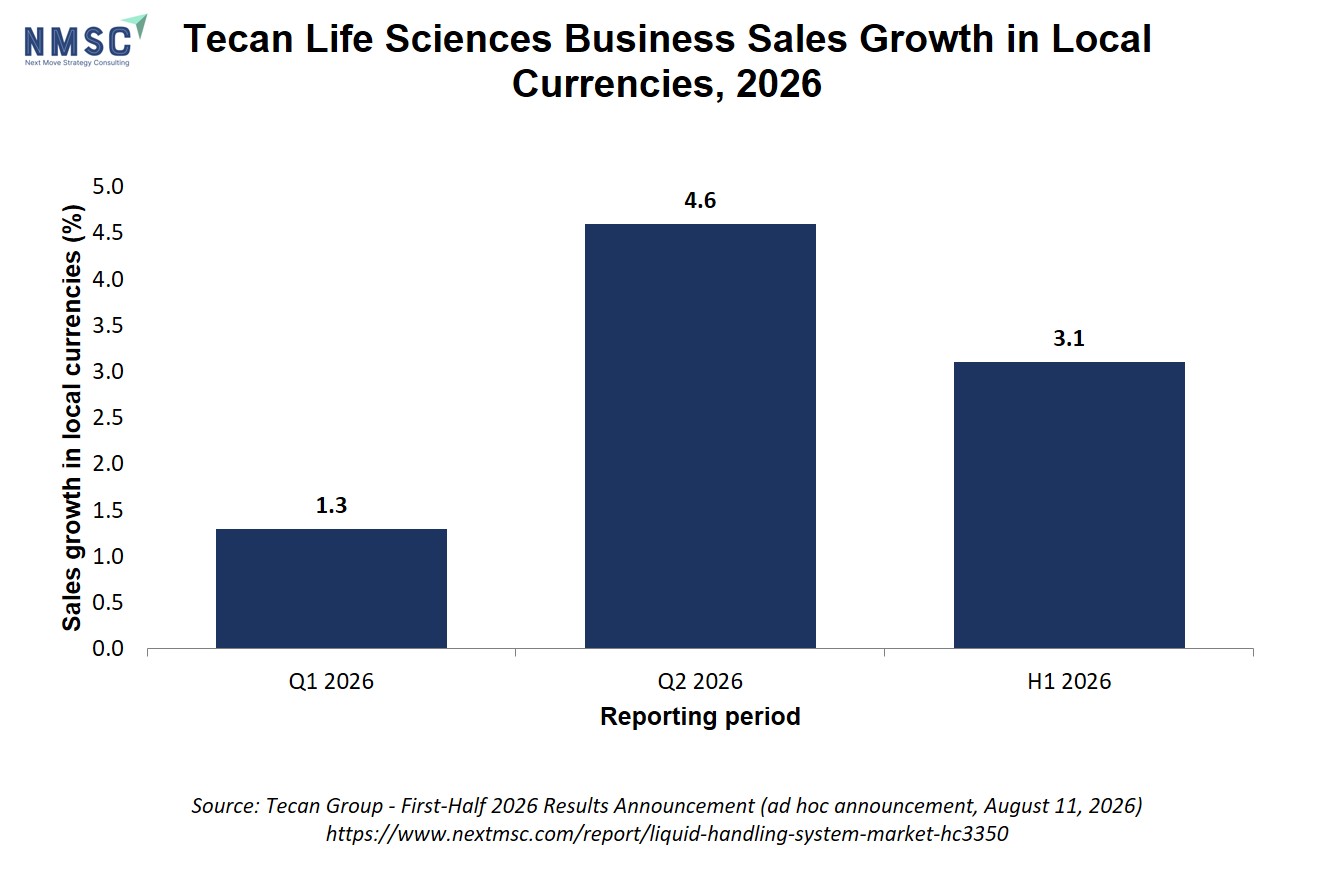
Tecan reported Life Sciences Business sales growth in local currencies of 1.3% in the first quarter of 2026 and 4.6% in the second quarter, for 3.1% across the first half. The company said liquid handling instrument revenues recovered in the second quarter after declines in previous quarters.
Key Industry Developments: Four Dated Moves That Define 2026
Tecan's announcement also set out how it intends to monetize the recovery. Under its Rewired transformation program, launched in March 2026, the company is building an ecosystem to become the automation partner of choice for AI-powered laboratories. A partnership with NVIDIA announced in March was followed in June by the integration of agentic AI capabilities into Tecan's Introspect lab analytics platform, and the two companies are collaborating on further development of physical AI capabilities.
“Market developments are encouraging and remain fully in line with our earlier guidance.”
- Monica Manotas, Chief Executive Officer, Tecan Group, Tecan first-half 2026 results announcement, August 11, 2026.
On May 19, 2026, Opentrons Labworks announced Compliance Ready Software for its Flex platform, adding authentication, role-based access and signed electronic audit trails aligned with 21 CFR Part 11 and ALCOA+ data-integrity expectations. Opentrons, which reports more than 10,000 systems deployed, said the software gives regulated laboratories an audit-ready option at a total cost of ownership about five times lower than GxP liquid-handling systems, with general availability set for August 2026, as reported by The Robot Report.
Larger instrument makers are moving the same way. Beckman Coulter Life Sciences, a Danaher company, announced a strategic partnership with Automata on January 29, 2026 to integrate its liquid handling, genomic and cell analysis technologies with Automata's AI-ready automation platform. At the compact end of the range, Revvity introduced the AssayMate benchtop liquid handler, with liquid level detection and built-in workflow error handling, at SLAS2026 in early February 2026.
Four 2026 Developments at a Glance
|
Date |
Company |
Development |
Detail |
|
January 29, 2026 |
Beckman Coulter Life Sciences |
Strategic partnership with Automata |
Liquid handling, genomic and cell analysis technologies integrated with an AI-ready automation platform |
|
Early February 2026 |
Revvity |
AssayMate benchtop liquid handler introduced at SLAS2026 |
Liquid level detection and built-in workflow error handling |
|
May 19, 2026 |
Opentrons |
Compliance Ready Software for the Flex platform |
21 CFR Part 11-aligned audit trails; general availability August 2026 |
|
August 11, 2026 |
Tecan |
First-half 2026 results |
Life Sciences sales up 3.1% in local currencies; instrument revenues recovered in the second quarter |
Segment Dynamics: Recurring Revenue Is Becoming the Anchor
NextMSC primary research and analysis segments the market by product, application, end user and channel. Products span pipettes, liquid handling workstations, dispensers, microplate reagent dispensers, microplate washers, burettes, accessories, consumables, software and services. Applications run from drug discovery, genomics and clinical diagnostics to proteomics, cell and gene therapy, food, environmental and forensic testing, and academic research. End users range from pharma and biopharma companies and CRO and CDMO organizations to academic and government institutes and clinical laboratories.
Tecan's disclosure shows why separating consumables, software and services from instruments matters. Recurring revenues from services, consumables and reagents rose to 64.4% of Life Sciences Business sales in the first half of 2026 from 62.1% in the prior-year period, even though instrument revenues had declined in earlier quarters before recovering in the second.
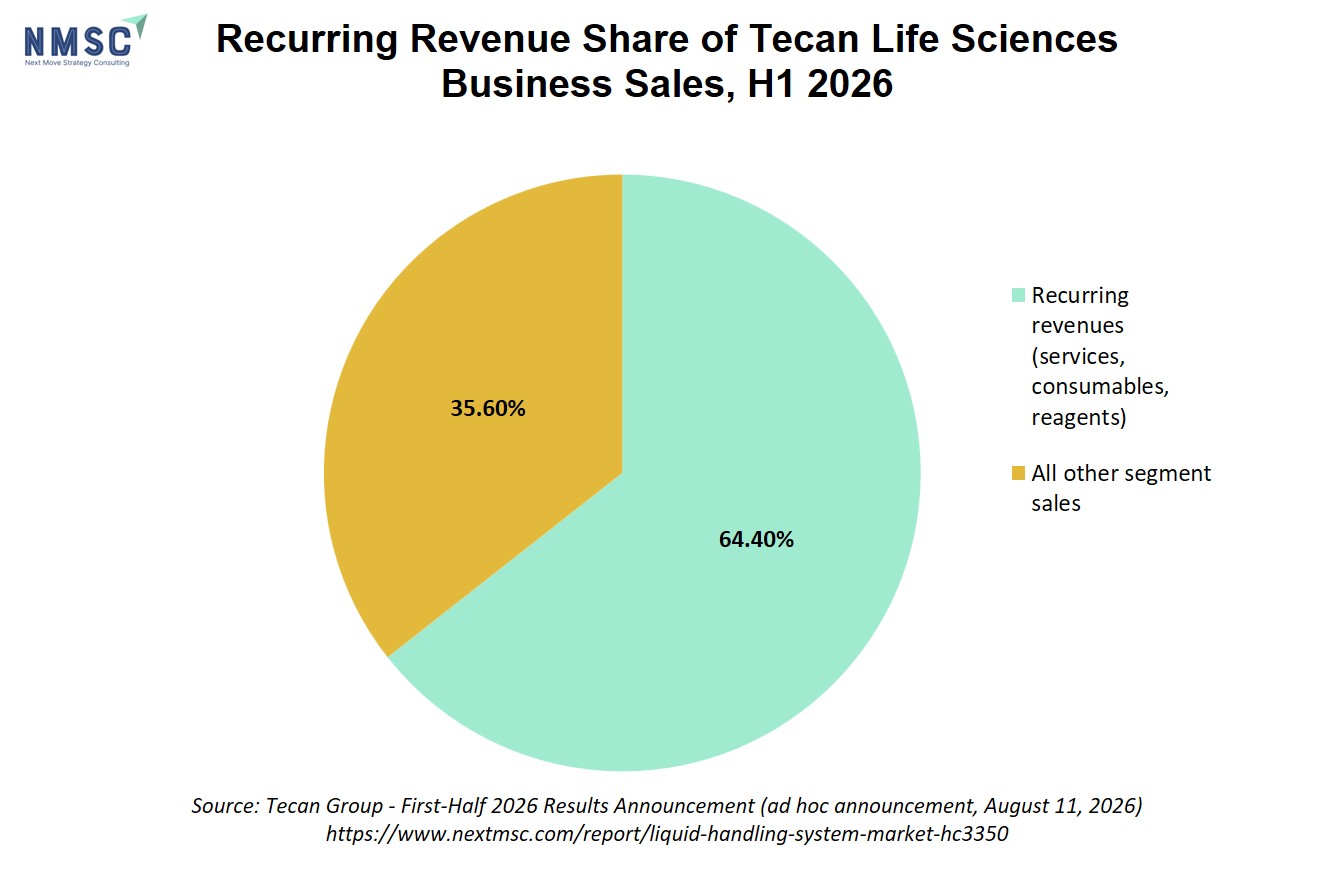
Tecan reported that recurring revenues from services, consumables and reagents accounted for 64.4% of Life Sciences Business sales in the first half of 2026, up from 62.1% in the prior-year period. The remaining 35.6% is calculated as 100% minus the reported recurring share.
NextMSC's trajectory implies an absolute expansion of USD 2.20 billion between 2025 and 2030, a figure derived from the report's 2025 and 2030 values.
Regional Outlook
NextMSC primary research and analysis shows North America holding a significant share of the global market, supported by advanced healthcare infrastructure, high R&D investment and strong adoption of precision medicine, with the United States leading and expected to retain leadership in market size and technological advancement. Cross-border trade costs are a live variable for instrument makers selling into that market: Tecan said tariffs reduced its first-half adjusted EBITDA margin by 50 basis points, expects tariff refunds of around CHF 6 million in the second half related to tariffs paid under the International Emergency Economic Powers Act, and has had pipette tip production lines operating in the United States since the second quarter of 2026.
Europe is growing steadily in NextMSC's analysis, supported by a strong biotechnology base, rising R&D funding and demand for laboratory automation, with Germany, the United Kingdom and France prioritizing high-precision tools for diagnostics and drug development. Regulated European laboratories are a target audience for compliance-ready platforms: Opentrons said its Compliance Ready Software would debut at SLAS Europe 2026.
Asia-Pacific is expanding quickly in NextMSC's analysis, fueled by government-backed genomics programs, a growing biotechnology sector and investment in precision medicine infrastructure in China, India, Japan and South Korea. Suppliers are placing sales coverage accordingly. In May 2026, Tecan established direct operations in India with a dedicated sales and service team in Gurugram, near New Delhi, and in Japan it collaborated with a customer on a biofoundry that integrates robotics, AI, synthetic biology and high-throughput testing.
The Rest of the World, encompassing Latin America, the Middle East and Africa, is at an earlier stage in NextMSC's analysis, with Brazil, South Africa and the United Arab Emirates investing in laboratory modernization and clinical trial capabilities, and expanding life sciences education and diagnostics demand supporting gradual uptake.
Growth Drivers and Restraints
Liquid Handling System Market: Growth Catalyst and Risk Matrix
|
Factor |
Type |
Geography |
2026 evidence |
|
Government-funded research programs expanding automated sample processing |
Driver |
North America, Asia-Pacific |
House committee's fiscal 2027 bill adds USD 100 million for NIH over fiscal 2026 (Population Association of America, June 2026) |
|
Public healthcare investment in diagnostic laboratories |
Driver |
Global, notably low- and middle-income countries |
Biopharma and Diagnostics customer segments kept growing at Tecan (August 2026) |
|
Accuracy and reproducibility needs in high-precision bioassays |
Driver |
Global |
Opentrons' 21 CFR Part 11-aligned audit trails (May 2026); Revvity's workflow error handling (February 2026) |
|
AI-enabled, modular liquid handling platforms |
Opportunity |
Global |
Tecan and NVIDIA partnership (March 2026); Beckman Coulter Life Sciences and Automata partnership (January 2026) |
|
High capital investment for installation, calibration, training and maintenance |
Restraint |
Public hospitals and academic laboratories |
Danaher's chief executive described academic demand as below normal levels (July 2026) |
NMSC Strategic Perspective: Demand Is Rotating From Public Labs to Commercial and Clinical Buyers
NextMSC primary research and analysis reads the 2026 evidence as a change in who is carrying demand. Tecan, Danaher and Thermo Fisher Scientific all reported improving conditions in the second quarter, but the improvement is concentrated in biopharma, biotech and diagnostics buyers: Tecan's academia and government sales declined and Danaher's chief executive put academic demand below normal. NextMSC's report names government-funded research as its first growth driver, so the 6.9% CAGR through 2030 increasingly depends on commercial and clinical laboratories absorbing volume that public laboratories add more slowly.
Second, the capital-cost restraint identified in NextMSC's report is being attacked from two directions. Compact benchtop systems such as Revvity's AssayMate and compliance software such as Opentrons' Compliance Ready Software lower the entry price for smaller and regulated laboratories, while platform makers add orchestration and AI layers to sell automation as a connected system, as the Beckman Coulter Life Sciences and Automata partnership illustrates. NextMSC's analysis indicates that vendors able to document 21 CFR Part 11-aligned records at benchtop prices widen the addressable pool of CRO, CDMO and clinical laboratories that previously had to choose between affordability and validation.
Third, revenue quality is shifting from instrument placement to consumables, services and software. Tecan's recurring share of 64.4% of Life Sciences Business sales is the clearest published datapoint, and NextMSC's product segmentation, which lists consumables, software and services alongside instruments, is built to capture that shift. NextMSC's strategic recommendation for vendors is to price instruments to win installed base and to measure commercial success by the attach rate of tips, reagents, software and service contracts. For investors, instrument orders are the leading indicator and recurring revenue the stabilizer.
Fourth, supply and sales footprints are localizing. Tecan's US pipette tip production and direct operations in India indicate that suppliers are placing capacity and coverage close to demand, at a time when tariffs cost Tecan 50 basis points and currency movements 120 basis points of first-half adjusted EBITDA margin. NextMSC's analysis indicates that regional manufacturing of consumables will be a competitive differentiator through the forecast period, because consumables carry the recurring revenue that stabilizes margins when instrument orders are uneven.
Competitive Landscape
NextMSC primary research and analysis profiles 15 companies in the liquid handling system market and names Thermo Fisher Scientific Inc., Beckman Coulter Life Sciences, Tecan Group AG, Eppendorf SE, Hamilton Company, Agilent Technologies, Inc., Revvity, Inc., Mettler-Toledo International Inc., Sartorius AG, Corning Incorporated, INTEGRA Biosciences AG, Gilson, Inc., SPT Labtech Ltd., Opentrons Labworks, Inc. and Bio-Rad Laboratories, Inc. among the key players. NextMSC's analysis groups them into three clusters: diversified life science tool makers with automation lines, liquid handling specialists, and accessible-automation entrants that compete on price and openness.
Each cluster produced a traceable 2026 move. Thermo Fisher Scientific posted USD 11.99 billion in second-quarter revenue, Danaher's life sciences unit reached USD 1.88 billion, Tecan confirmed full-year 2026 guidance of low single-digit local-currency sales growth and an adjusted EBITDA margin of 15.5% to 16.5%, and Opentrons moved into regulated workflows with its compliance software. The pattern NextMSC tracks is convergence: specialists are adding AI and data layers, large tool makers are adding open orchestration partners, and entrants are adding validation, so competition is shifting from single-instrument performance to workflow ownership.
Bottom Line
Tecan's August 2026 report that liquid handling instrument revenues recovered in the second quarter, together with Danaher's strongest life sciences quarter in several years and Thermo Fisher Scientific's 10% revenue growth, indicates that laboratory automation demand has turned, though unevenly. According to NextMSC primary research and analysis, the global liquid handling system market was valued at USD 5.21 billion in 2024 and is projected to reach USD 7.77 billion by 2030 at a 6.9% CAGR, an increase of USD 2.20 billion between 2025 and 2030. Biopharma, biotech and diagnostics buyers are leading the recovery, while academic and government demand remains below normal and tied to the NIH funding process. Vendors that combine lower-cost benchtop platforms, 21 CFR Part 11-aligned software and AI-ready orchestration, and that grow recurring consumables, service and software revenue, are best positioned to convert the recovery into durable share through 2030.
About Next Move Strategy Consulting
Next Move Strategy Consulting is a premier market research and management consulting firm that has been committed to provide strategically analysed well documented latest research reports to its clients. The research industry is flooded with many firms to choose from, what makes NMSC different from the rest is its top-quality research and the obsession of turning data into knowledge by dissecting every bit of it and providing fact-based research recommendation that is supported by information collected from over 500 million websites, paid databases, industry journals and one on one consultations with industry experts across a diverse range of industry sectors. The high-quality customized research reports with actionable insights and excellent end-to-end customer service help our clients to take critical business decisions that enables them to move beyond time and have competitive edge in the industry.
We have been servicing over 1000 customers globally that includes 90% of the Fortune 500 companies over a decade. Our analysts are constantly tracking various high growth markets and identifying hidden opportunities in each sector or the industry. We provide one of the industry’s best quality syndicate as well as custom research reports across 10 different industry verticals. We are committed to deliver high quality research solutions in accordance to your business needs. Our industry standard delivery solutions that ranges from the pre consultation to after-sales services, provide an excellent client experience and ensure right strategic decision making for businesses.
For more information, please contact:
Next Move Strategy Consulting
5th Floor 867 Boylston St, STE 500,
Boston, MA 02116, U.S.
E-Mail: [email protected]
Direct: +1-217-650-7991
Website: www.nextmsc.com
About the Author
 Sanyukta Deb
— Sanyukta Deb is Digital Marketing Team Lead at Next Move Strategy Consulting, where she has led content strategy and technical SEO for the firm's B2B market research publications for over 2 years. Her editorial process translates NextMSC's primary and secondary research — spanning technology, industrial, and consumer sectors — into commercial narratives, backed by search-intent, keyword, and competitive analysis. She brings 5 years of overall experience in digital marketing and content strategy.
About the Reviewer
 Debashree Dey
— Debashree Dey is Assistant Manager at Next Move Strategy Consulting, where she supports cross-vertical market content and communications across diverse industries for 6 years. Her professional background includes senior content writing, communications, and published manuscript authorship, with experience developing audience-focused business narratives and maintaining clear, consistent messaging. Her role supports research-led content development and editorial quality across NextMSC publications.















Add Comment