Recent Company Moves Put Industry Leaders in the Handheld Surgical Equipment Market in Focus
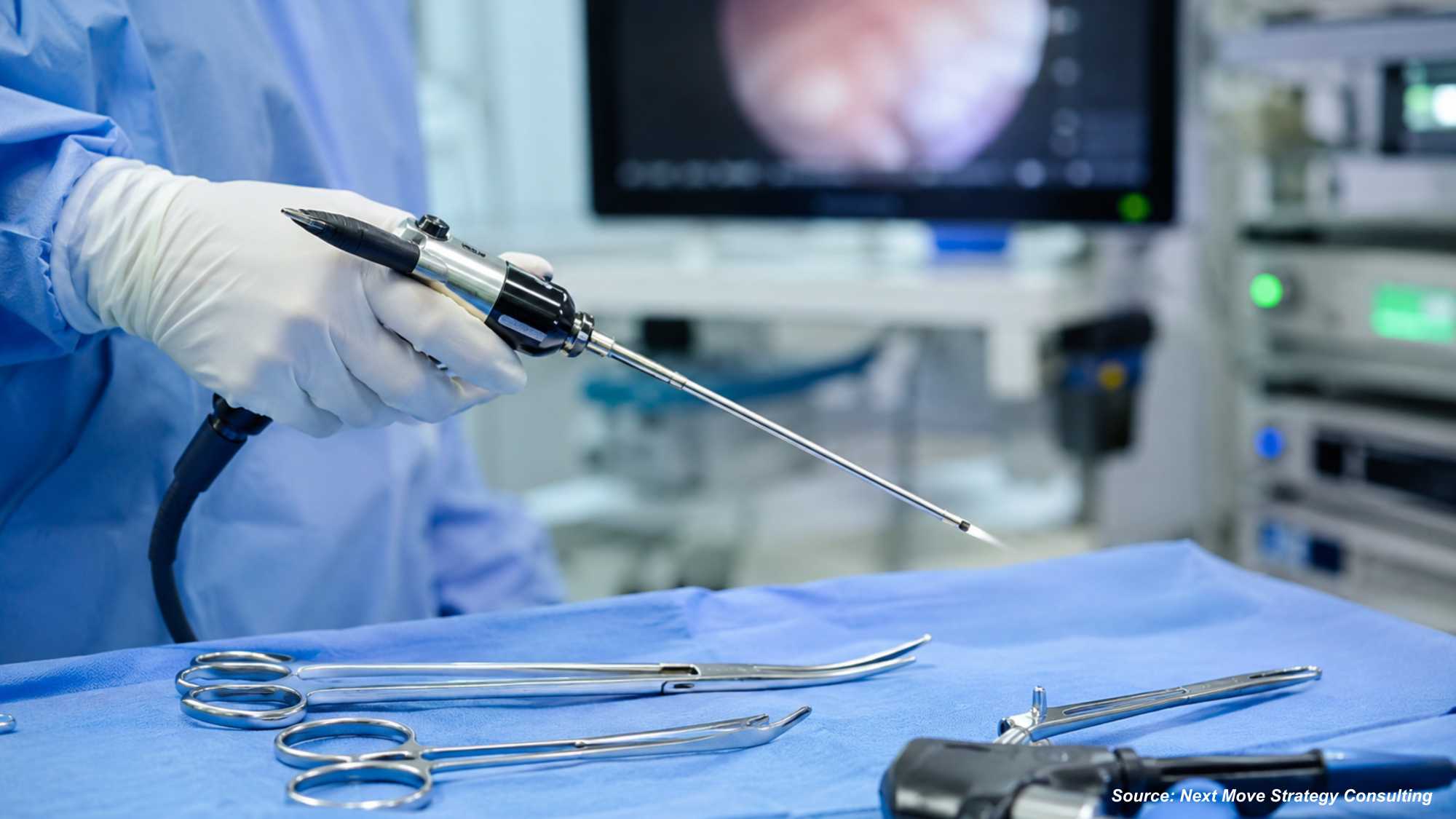
Stryker, Medtronic and Johnson & Johnson Commit to Soft-Tissue Robotics Within 82 Days, Putting the Handheld Instrument Tray Under a New Demand and Trade Lens
On October 12, 2026, Stryker announced a strategic alliance with Cambridge, England-based CMR Surgical, comprising a preferred equity investment of approximately USD 400 million (GBP 300 million), an exclusive option to acquire the remaining equity and an exclusive U.S. sales agency for the Versius surgical robotic portfolio, according to the Stryker and CMR Surgical joint press release dated October 12, 2026. The agreement is the third major commitment to soft-tissue robotic surgery by a leading medical technology company within 82 days. It follows Johnson & Johnson’s July 22, 2026 announcement that the U.S. Food and Drug Administration had granted De Novo authorization for its OTTAVA Robotic Surgical System, and Medtronic’s September 1, 2026 announcement of a strategic partnership with Cornerstone Robotics. The Stryker transaction remains subject to regulatory approvals and customary closing conditions. For the scalpels, forceps, retractors and scissors used in every operating room, the question raised by this capital is how much instrument demand migrates onto robotic platforms and how much stays in surgeons’ hands.
According to Next Move Strategy Consulting’s Handheld Surgical Equipment Market report, the global handheld surgical equipment market was valued at USD 6.25 billion in 2024, is expected to reach USD 6.67 billion in 2025 and is projected to reach USD 9.21 billion by 2030, growing at a CAGR of 6.7% from 2025 to 2030. NextMSC primary research and analysis identifies the rising number of surgical procedures, the burden of chronic disease and an aging population as the principal demand drivers, and tracks robotic forceps, robotic scissors and sensor-enabled scalpels as sub-segments within the report’s type segmentation.
For More Information: Download FREE Sample on Handheld Surgical Equipment Market Report
The Financial Logic: Hospital Spending, Procedure Volumes and Instrument Sales
The demand base is volume-led. The Centers for Medicare & Medicaid Services reported in its National Health Expenditures 2024 Highlights, released in January 2026, that U.S. health care spending rose 7.2% to USD 5.3 trillion in 2024, and that hospital care, which accounts for a 31% share of the total, increased 8.9% to USD 1.6 trillion. The agency attributed the growth of 2023 and 2024 primarily to non-price factors, namely heightened demand for care and shifts in the types of goods and services used. NextMSC primary research and analysis reads that pattern as the foundation for instruments that are consumed, reprocessed or replaced in proportion to the number of procedures performed.
Instrument-heavy franchises at two of the suppliers profiled in the NextMSC report are growing at close to that pace. Stryker reported on July 30, 2026 that second-quarter net sales rose 9.4% to USD 6.6 billion, with MedSurg and Neurotechnology sales of USD 3,625 million, up 9.7%, and its Instruments business line at USD 1,003 million, up 9.3%. Chair and CEO Kevin A. Lobo linked the quarter to the company’s recovery from a cybersecurity incident first reported on March 11, 2026; Stryker’s first-quarter reported net sales had risen only 2.6%, so the second-quarter comparison reflects a rebound as well as underlying demand.
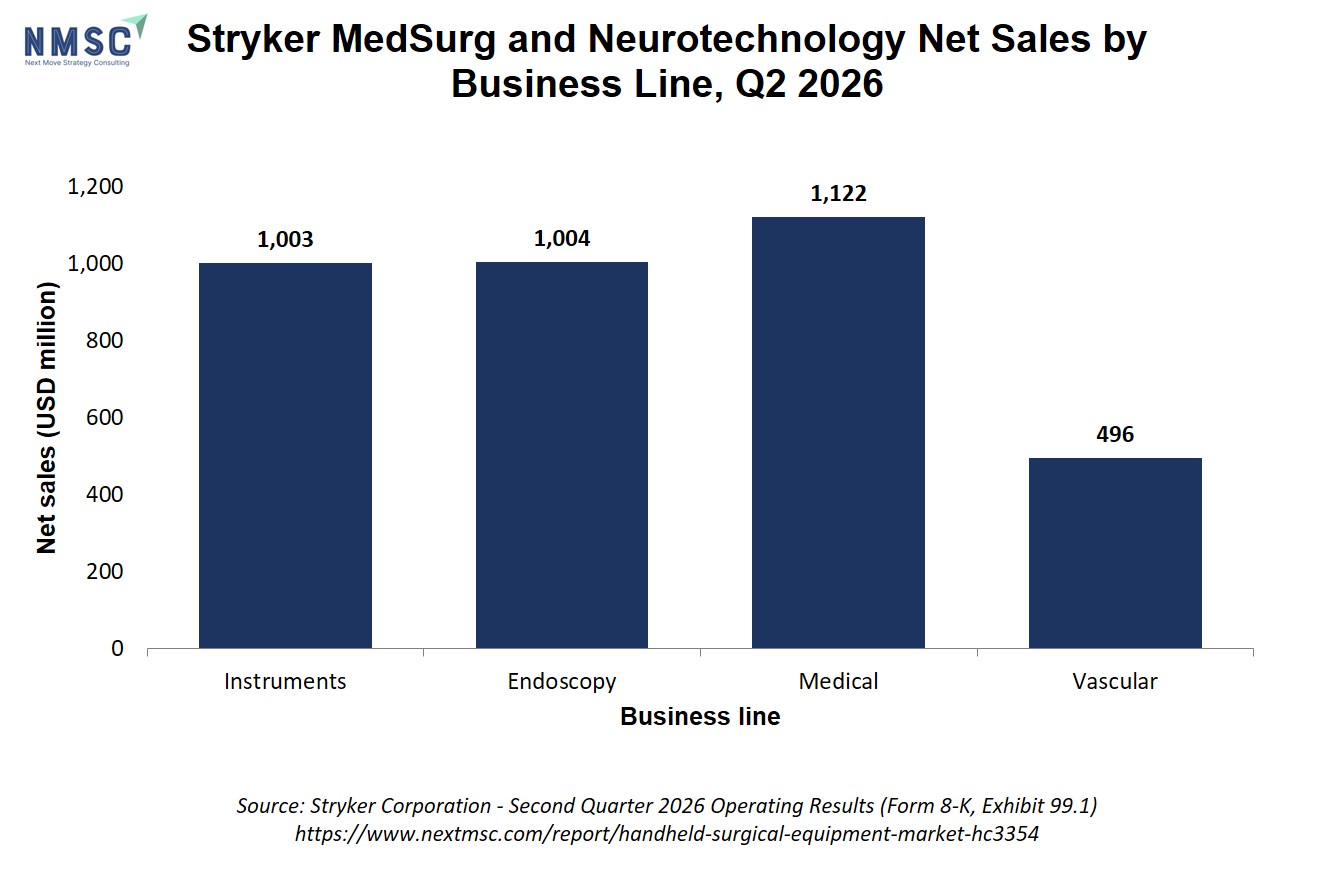
Stryker’s four MedSurg and Neurotechnology business lines totaled USD 3,625 million in the second quarter of 2026: Instruments USD 1,003 million, Endoscopy USD 1,004 million, Medical USD 1,122 million and Vascular USD 496 million.
Medtronic reported on September 1, 2026 that Medical Surgical revenue for its first quarter of fiscal 2027, which ended July 31, 2026, reached USD 2.279 billion, an increase of 10.0% as reported and 10.2% on an organic basis. Surgical & Endoscopy contributed USD 1,740 million, up 8.7% as reported and 9.0% organic. Medtronic also disclosed that fiscal 2027 is a 53-week year with the extra week falling in the first quarter, a calendar effect that the company estimates benefited first-quarter organic growth by approximately USD 570 million across the whole enterprise, so the quarter’s growth rates are not a like-for-like run rate.
Key Industry Developments: Three Robotic Commitments in 82 Days
Johnson & Johnson announced on July 22, 2026 that the FDA had granted De Novo authorization for OTTAVA, which the company describes as the world’s first table-integrated soft tissue robotic system. The authorization covers multiple general surgery procedures in the upper abdomen, including Roux-en-Y gastric bypass, gastrectomy, cholecystectomy, splenectomy, appendectomy and hiatal hernia repair. Johnson & Johnson states that integrating the robotic arms into the operating table occupies 30% to 50% less space than boom- and cart-mounted systems, and that the OTTAVA instrumentation portfolio has been redesigned for robotic surgery.
On September 1, 2026, Medtronic announced a strategic partnership with Cornerstone Robotics that includes an investment in the company and the right to distribute Cornerstone’s Sentire surgical system in select markets outside the United States where it is approved. Medtronic’s Form 10-Q for the quarter ended July 31, 2026 states that it paid approximately USD 700 million in cash for the investment during the second quarter of fiscal 2027.
Stryker’s October 12, 2026 alliance completes the sequence. Under its terms, Stryker becomes the exclusive U.S. sales agent for Versius while CMR Surgical continues to lead portfolio development and commercialization outside the United States. Andy Pierce, Group President, Medsurg and Neurotechnology at Stryker, said in the announcement that the company selected the Versius portfolio to help providers grow robotic-assisted surgery across hospitals and ambulatory surgical centers, and described the field in these terms:
“Soft-tissue robotics is a high-growth adjacency”
- Andy Pierce, Group President, Medsurg and Neurotechnology, Stryker, Stryker and CMR Surgical press release, “Stryker and CMR Surgical announce strategic alliance to advance robotic-assisted surgery”, October 12, 2026.
Soft-Tissue Robotics Commitments by Leading Medical Technology Companies, July to October 2026
|
Company |
Date |
Commitment |
Terms disclosed |
|
Johnson & Johnson |
July 22, 2026 |
FDA De Novo authorization for the OTTAVA Robotic Surgical System |
Multiple upper-abdomen general surgery procedures |
|
Medtronic |
September 1, 2026 |
Strategic partnership with Cornerstone Robotics, including distribution rights for the Sentire system outside the United States |
Approximately USD 700 million paid in cash in fiscal second quarter of 2027 |
|
Stryker |
October 12, 2026 |
Preferred equity investment in CMR Surgical, exclusive U.S. sales agency for Versius and an option to acquire remaining equity |
Approximately USD 400 million (GBP 300 million); subject to regulatory approvals and closing conditions |
Segment Dynamics: Where Robotics Meets the Hand Instrument
NextMSC primary research and analysis segments the handheld surgical equipment market by type (scalpels, forceps, retractors, scissors, dilators and arthroscopic punches), by material (stainless steel, titanium and plastic or polymer), by application, by distribution channel and by end user. Within those segments the report separately tracks disposable, reusable and sensor-enabled scalpels, and robotic forceps and robotic scissors. That structure matters for the current deal flow, because it isolates the instrument categories where robotic platforms and sensors overlap with traditional hand tools.
The end-user dimension carries the same signal. NextMSC’s segmentation includes hospitals, ambulatory surgical centers, specialty clinics, academic and research institutes, emergency care centers and trauma centers. Stryker’s announcement explicitly positions Versius for both hospitals and ambulatory surgical centers, which indicates that robotic programs are being marketed into the outpatient settings that already buy handheld instruments at volume.
Reported Growth in Instrument-Heavy Franchises, Latest Quarter
|
Company and business line |
Period |
Net sales (USD million) |
Reported growth |
Additional disclosure |
|
Stryker, MedSurg and Neurotechnology |
Q2 2026 |
3,625 |
9.7% |
9.2% organic |
|
Stryker, Instruments |
Q2 2026 |
1,003 |
9.3% |
9.0% in constant currency |
|
Stryker, Orthopaedic Instruments (within Ortho Tech) |
Q2 2026 |
523 |
Not published |
USD 501 million in Q2 2025 |
|
Medtronic, Medical Surgical |
Q1 fiscal 2027, ended July 31, 2026 |
2,279 |
10.0% |
10.2% organic; includes extra fiscal week |
|
Medtronic, Surgical & Endoscopy |
Q1 fiscal 2027, ended July 31, 2026 |
1,740 |
8.7% |
9.0% organic; includes extra fiscal week |
Regional Outlook
NextMSC primary research and analysis identifies North America as the leading regional market for handheld surgical equipment, supported by the scale of U.S. health spending that the Centers for Medicare & Medicaid Services put at USD 5.3 trillion in 2024. Asia-Pacific is described in the NextMSC report as a fast-expanding demand center on the strength of chronic disease prevalence and medical tourism; Europe as a steady market shaped by aging populations and minimally invasive procedures; and the Rest of the World as a region of gradual, budget-led adoption.
Company disclosures show the same direction of travel outside the United States. Stryker’s MedSurg and Neurotechnology sales were USD 2,854 million in the United States, up 8.7%, and USD 771 million internationally, up 13.3% as reported and 11.1% in constant currency. Medtronic’s Medical Surgical revenue showed the reverse pattern in its first fiscal quarter, with USD 982 million in the United States, up 11.1%, and USD 1,297 million internationally, up 9.2%. Both partnerships also carry a geographic split: Medtronic’s Cornerstone rights apply outside the United States, while Stryker’s Versius agency is U.S.-only and CMR Surgical retains commercialization elsewhere.
Growth Drivers and Restraints
Handheld Surgical Equipment Market: Growth Catalyst and Risk Assessment Matrix
|
Factor |
Type |
Evidence |
Geography |
|
Procedure volumes and hospital utilization |
Driver |
Hospital care spending rose 8.9% to USD 1.6 trillion in 2024, led by non-price factors |
United States |
|
Chronic disease burden and aging population |
Driver |
Identified as principal demand drivers in NextMSC primary research and analysis |
Global |
|
Robotic and sensor-enabled instruments |
Opportunity |
Robotic forceps, robotic scissors and sensor-enabled scalpels tracked as sub-segments; three robotic commitments between July 22 and October 12, 2026 |
Global |
|
Robotic programs in ambulatory surgical centers |
Opportunity |
Stryker positions Versius for hospitals and ambulatory surgical centers |
United States |
|
Regulatory and sterilization compliance costs |
Restraint |
NextMSC primary research and analysis finds that production and sterilization rules lengthen development time and raise operating cost |
Global |
|
Section 232 trade review of medical consumables |
Restraint |
The review notice names forceps and scalpels among covered medical and surgical instruments |
United States |
The trade restraint deserves separate attention. The U.S. Department of Commerce’s Bureau of Industry and Security initiated a Section 232 national security investigation on September 2, 2025, and published its request for public comments in the Federal Register on September 26, 2025. The notice defines medical consumables to include medical and surgical instruments, with forceps and scalpels given as examples, and asks whether domestic production can meet U.S. demand and how concentrated imports are among a small number of suppliers. At the time of writing, NextMSC has not located a published Commerce determination or presidential proclamation concluding the investigation.
NMSC Strategic Perspective: Robotic Capital Raises the Stakes for the Instrument Tray
NextMSC primary research and analysis does not read the three robotic commitments as a substitution event for handheld instruments. Its reading is that platform capital and instrument demand are being decided by different variables: robot placements follow capital budgets and regulatory authorizations, while hand-instrument consumption follows procedure counts, reprocessing cycles and sterilization rules. The 6.7% CAGR in the NextMSC forecast reflects that second set of variables, together with a gradual mix shift toward the sensor-enabled and robotic instrument categories that the report tracks.
The reported growth rates of 9% to 10% at Stryker and Medtronic should be read with care. Both companies’ business lines are broader than handheld surgical equipment, Medtronic’s quarter includes an extra fiscal week, and Stryker’s quarter follows a cyber-incident disruption in its first quarter. NextMSC primary research and analysis therefore treats them as confirmation that procedure-linked franchises are growing strongly, and not as evidence that the handheld market is tracking above its 6.7% forecast.
The trade review is the variable most specific to this market. Forceps and scalpels are named in the Section 232 notice, and the notice’s criteria on domestic production capacity and import concentration point to the metal-instrument supply chain that NextMSC’s material segmentation covers through stainless steel and titanium. NextMSC treats the pending outcome as a pricing and sourcing variable for the North American segment.
NextMSC is monitoring three indicators: the closing of the Stryker and CMR Surgical transaction, which depends on regulatory approvals; the first U.S. commercial placements of OTTAVA and Versius, particularly in ambulatory surgical centers; and any Commerce determination on medical consumables. Each will indicate whether robotic programs expand the total number of procedures that use handheld instruments or reallocate existing ones.
Competitive Landscape
NextMSC’s report profiles 15 companies, including Zimmer Biomet, B. Braun Melsungen, Becton Dickinson, Medline, Peters Surgical, Medtronic, Abbott, Boston Scientific, Stryker, Smith & Nephew, Johnson & Johnson, Olympus, CONMED, Integra LifeSciences and KLS Martin, and provides market share data for 10 of them. Three of those profiled companies, Johnson & Johnson, Medtronic and Stryker, are the ones that committed capital to soft-tissue robotics between July 22 and October 12, 2026.
Each of those events is traceable to a primary disclosure: Johnson & Johnson’s July 22, 2026 press release on the OTTAVA authorization, Medtronic’s Form 10-Q for the quarter ended July 31, 2026, and the Stryker and CMR Surgical press release of October 12, 2026. The pattern shows large multi-category suppliers extending from instruments into robotic platforms, while the instrument portfolios they already sell, and the regulatory and trade conditions attached to them, remain part of the same procedure economics.
Bottom Line
Stryker’s October 12, 2026 alliance with CMR Surgical, Medtronic’s September 1, 2026 partnership with Cornerstone Robotics and Johnson & Johnson’s July 22, 2026 OTTAVA authorization show that capital is concentrating in soft-tissue robotics. Next Move Strategy Consulting values the global handheld surgical equipment market at USD 6.67 billion in 2025 and projects USD 9.21 billion by 2030 at a CAGR of 6.7%. NextMSC primary research and analysis does not treat the robotic deals as a threat to that trajectory, because instrument demand follows procedure volumes, which the Centers for Medicare & Medicaid Services shows rising, and because robotic and sensor-enabled instruments are already tracked inside the market. The variables to watch are the Stryker transaction’s closing, early placements in ambulatory surgical centers and the outcome of the Section 232 review that names forceps and scalpels.
About Next Move Strategy Consulting
Next Move Strategy Consulting is a premier market research and management consulting firm that has been committed to provide strategically analysed well documented latest research reports to its clients. The research industry is flooded with many firms to choose from, what makes NMSC different from the rest is its top-quality research and the obsession of turning data into knowledge by dissecting every bit of it and providing fact-based research recommendation that is supported by information collected from over 500 million websites, paid databases, industry journals and one on one consultations with industry experts across a diverse range of industry sectors. The high-quality customized research reports with actionable insights and excellent end-to-end customer service help our clients to take critical business decisions that enables them to move beyond time and have competitive edge in the industry.
We have been servicing over 1000 customers globally that includes 90% of the Fortune 500 companies over a decade. Our analysts are constantly tracking various high growth markets and identifying hidden opportunities in each sector or the industry. We provide one of the industry’s best quality syndicate as well as custom research reports across 10 different industry verticals. We are committed to deliver high quality research solutions in accordance to your business needs. Our industry standard delivery solutions that ranges from the pre consultation to after-sales services, provide an excellent client experience and ensure right strategic decision making for businesses.
For more information, please contact:
Next Move Strategy Consulting
5th Floor 867 Boylston St, STE 500,
Boston, MA 02116, U.S.
E-Mail: [email protected]
Direct: +1-217-650-7991
Website: www.nextmsc.com
About the Author
 Sanyukta Deb
— Sanyukta Deb is Digital Marketing Team Lead at Next Move Strategy Consulting, where she has led content strategy and technical SEO for the firm's B2B market research publications for over 2 years. Her editorial process translates NextMSC's primary and secondary research — spanning technology, industrial, and consumer sectors — into commercial narratives, backed by search-intent, keyword, and competitive analysis. She brings 5 years of overall experience in digital marketing and content strategy.
About the Reviewer
 Debashree Dey
— Debashree Dey is Assistant Manager at Next Move Strategy Consulting, where she supports cross-vertical market content and communications across diverse industries for 6 years. Her professional background includes senior content writing, communications, and published manuscript authorship, with experience developing audience-focused business narratives and maintaining clear, consistent messaging. Her role supports research-led content development and editorial quality across NextMSC publications.
















Add Comment