Medical Bed Market Gains as Smart Hospitals Scale
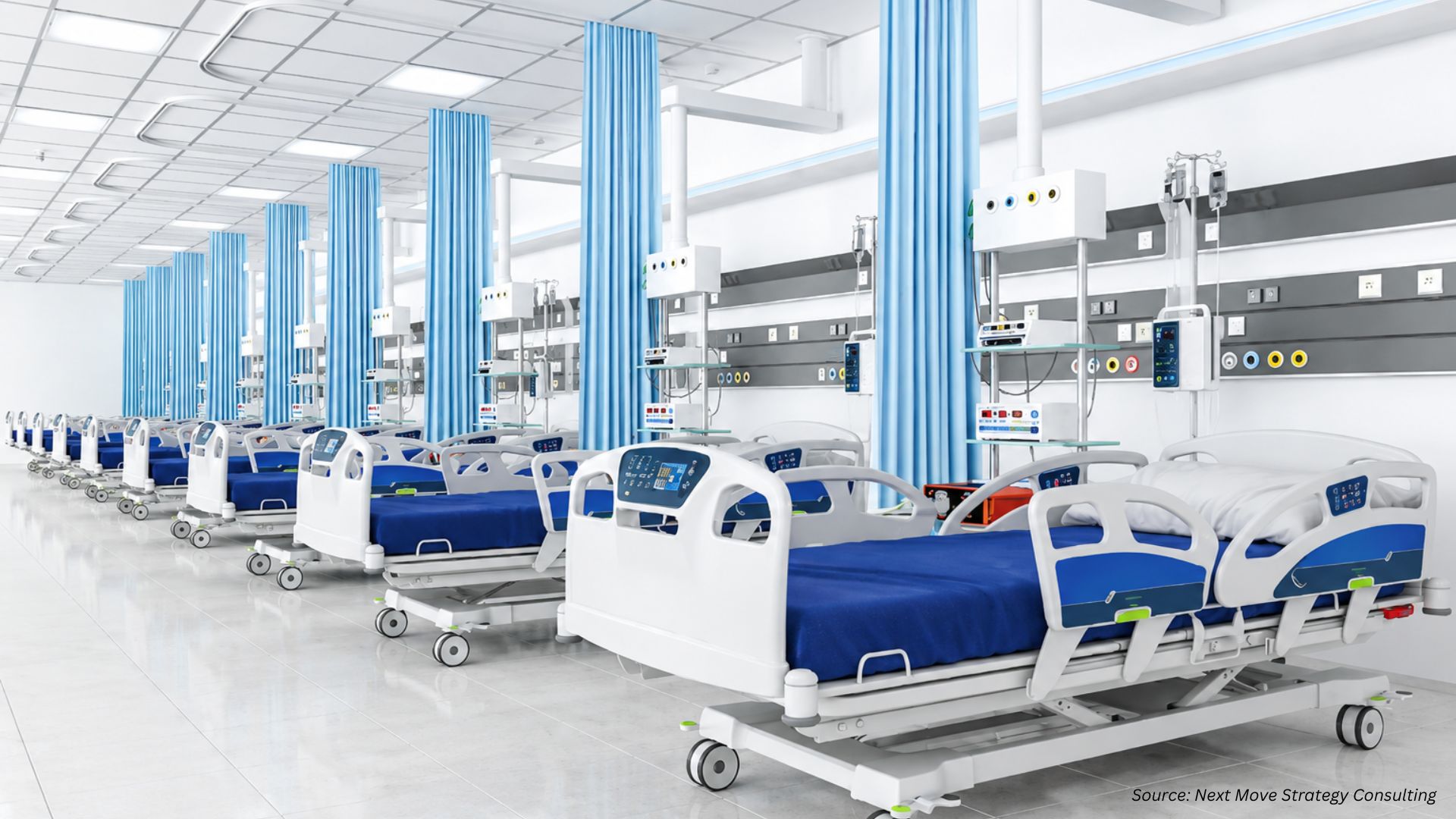
Stryker's SmartHospital Platform Launch Signals Accelerating Digital Convergence Across the Global Medical Bed Market
On March 9, 2026, Stryker (NYSE: SYK) announced the launch of its SmartHospital Platform, a digital foundation designed to connect devices, data, and care teams across the hospital into a single intelligent, adaptive ecosystem, with the rollout timed ahead of the 2026 HIMSS Global Conference & Exhibition. The SmartHospital Platform connects devices and data to support clinical and operational workflows across transport, treatment and recovery, and incorporates ambient sensors, computer vision, and AI to make the care environment more responsive.
The launch—led by Stryker's newly established Smart Care business—underscores a structural shift reshaping hospital capital procurement: the migration of the medical bed from a passive piece of inpatient furniture toward a connected clinical node within broader digital care infrastructure. Stryker positioned the platform as a response to system fragmentation, staff overload, and high patient volumes confronting health systems.
This development carries direct implications for the Medical Bed Market, a sector where connectivity, automation, and patient-monitoring integration are increasingly differentiating premium platforms from commoditized inventory.
For More Information – Download FREE Sample on Medical Bed Market Report
Market Sizing and Forecast Trajectory
According to Next Move Strategy Consulting, the global medical bed market is projected to reach USD 4.56 billion by the end of 2025, advancing to USD 6.00 billion by 2030 at a compound annual growth rate of 5.7% over the 2025–2030 forecast period. The market is driven primarily by the expanding aging population and the rising prevalence of chronic illnesses requiring prolonged care, with increased government investment in healthcare infrastructure further accelerating demand.
The structural demand thesis is anchored in demographic and epidemiological fundamentals. Noncommunicable diseases killed at least 43 million people in 2021, equivalent to 75% of non-pandemic-related deaths globally. This sustained chronic-disease burden translates directly into extended inpatient stays, post-operative recovery requirements, and intensive-care utilization—each a driver of advanced bed demand.
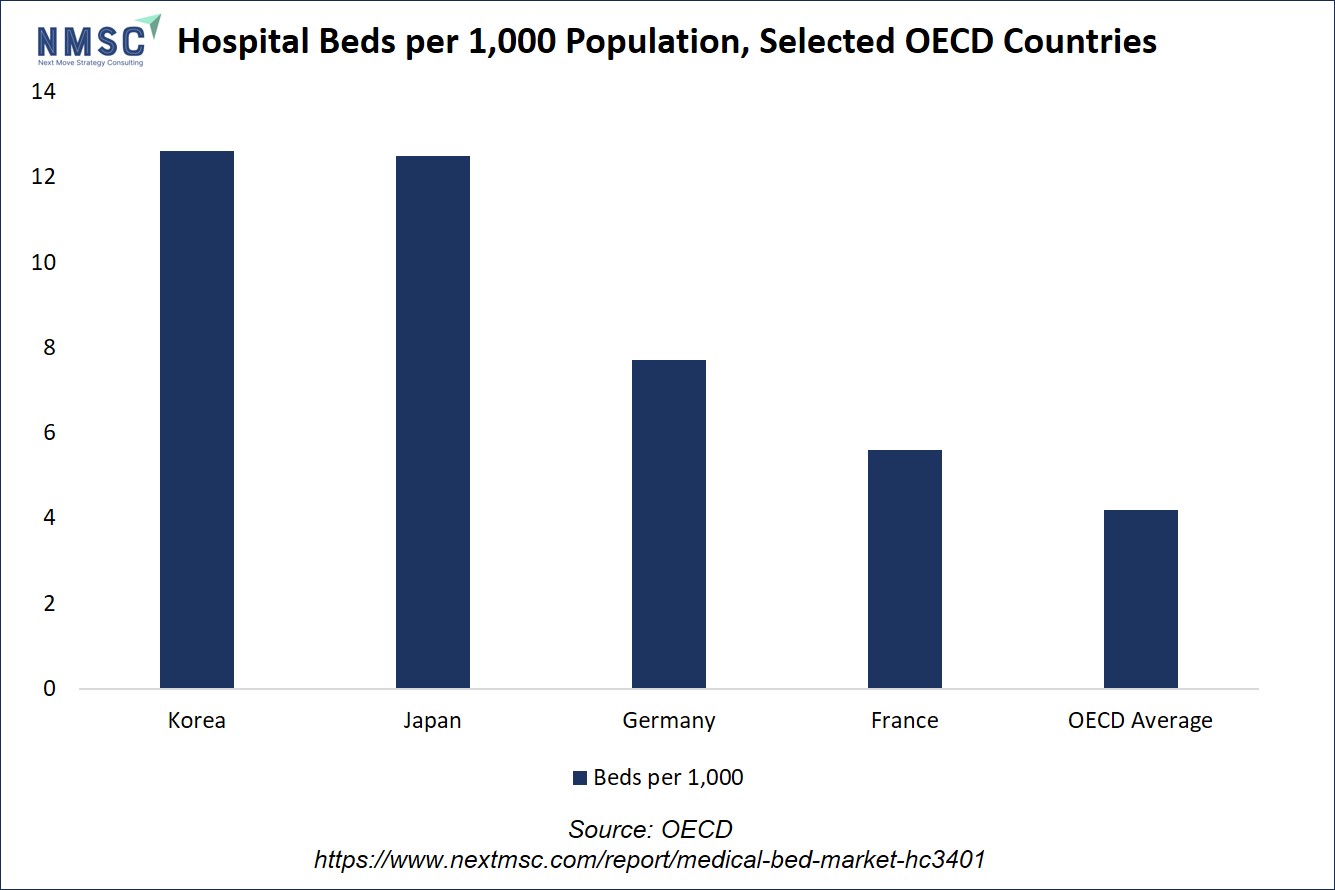
Across OECD countries, there were on average 4.2 hospital beds per 1,000 population in 2023, with rates much higher in Korea at 12.6 beds per 1,000 and Japan at 12.5 per 1,000. The dispersion in bed density across advanced economies signals divergent replacement and modernization cycles, with high-density Asian systems representing substantial recurring upgrade demand.
Capacity, Critical Care, and Modernization Pressure
Intensive-care infrastructure remains a focal point for premium, technology-enabled bed adoption. On average across 31 OECD countries there were 17 ICU beds per 100,000 population in 2023, and most countries have increased ICU capacity compared with the pre-pandemic situation. Notably, the broader trend reflects efficiency-driven rationalization rather than volume expansion. Since 2013, the number of beds per capita has decreased in nearly all OECD countries, due in part to greater use of day care and reductions in the average length of stay.
This dynamic favors higher-value, connected platforms—where revenue migrates from unit volume toward feature density, monitoring integration, and software-enabled workflow capabilities of the kind embedded in Stryker's SmartHospital architecture.
In 2023, the United States allocated 16.7% of GDP to health care, ahead of Germany at 11.8%, Switzerland at 11.7%, France at 11.6%, and Canada at 11.2%. Elevated and rising public-sector health allocations directly underwrite hospital modernization budgets and, by extension, advanced bed procurement.
Regional and Competitive Landscape
According to Next Move Strategy Consulting, North America holds the dominant medical bed market share, supported by well-established healthcare infrastructure, rapid technology adoption, and the strong presence of leading manufacturers including Stryker and Baxter. In Europe, the market is supported by the EU4Health Programme, which allocates approximately USD 5.5 billion to strengthen health systems across the Union through 2027, while Asia-Pacific is expanding rapidly amid an aging population and rising medical tourism.
Recent corporate activity reinforces consolidation and capability-building across the competitive set. In November 2024, LINET Group acquired the French company Domalys, enhancing its portfolio with ergonomic furniture and advanced smart fall-prevention technologies, while in April 2024 GF Health Products acquired the majority of assets from Transfer Master Products to broaden its adjustable-bed offering.
Hospital Bed Density and Occupancy Benchmarks, OECD
|
Indicator |
Value (2023) |
Units |
|
OECD average hospital beds |
4.2 |
Beds per 1,000 population |
|
Korea (highest) |
12.6 |
Beds per 1,000 population |
|
Japan |
12.5 |
Beds per 1,000 population |
|
OECD average ICU beds |
17 |
Beds per 100,000 population |
|
OECD average bed occupancy rate |
72 |
Percent |
Current Health Expenditure as a Share of GDP, Selected Economies (2023)
|
Economy |
Health Expenditure (% of GDP) |
Year |
|
United States |
16.7 |
2023 |
|
Germany |
11.8 |
2023 |
|
Switzerland |
11.7 |
2023 |
|
France |
11.6 |
2023 |
|
Canada |
11.2 |
2023 |
Market Outlook
The convergence of demographic aging, chronic-disease prevalence, and digital-health investment positions the medical bed sector for steady, technology-led expansion. Stryker's SmartHospital Platform exemplifies the strategic pivot among incumbents toward connected, software-enabled clinical ecosystems—a shift that is likely to compress demand for legacy, undifferentiated inventory while expanding premium segment economics. According to Next Move Strategy Consulting, the emergence of smart, connected beds represents a compelling growth opportunity aligned with the industry's transition toward digitalization and patient-centered care.
Bottom Line
The global medical bed market is on a measured but durable growth path, projected by Next Move Strategy Consulting to expand from USD 4.56 billion in 2025 to USD 6.00 billion by 2030 at a 5.7% CAGR. The principal opportunity lies in premiumization: as OECD bed density declines and average length of stay shortens, value is migrating toward connected, monitoring-integrated platforms exemplified by Stryker's SmartHospital launch. Demand fundamentals remain robust, anchored by population aging, a chronic-disease burden responsible for roughly three-quarters of global deaths, and elevated health expenditure across advanced economies. Key risks include stringent regulatory approval cycles, raw-material cost inflation, and capacity rationalization in mature markets. For investors and strategists, the differentiated growth pockets are critical-care, geriatric, and smart-bed segments, alongside Asia-Pacific modernization. Procurement budgets increasingly reward interoperability and software capability—reframing competitive positioning around digital ecosystems rather than unit hardware alone.
About Next Move Strategy Consulting
Next Move Strategy Consulting is a premier market research and management consulting firm that has been committed to provide strategically analysed well documented latest research reports to its clients. The research industry is flooded with many firms to choose from, what makes NMSC different from the rest is its top-quality research and the obsession of turning data into knowledge by dissecting every bit of it and providing fact-based research recommendation that is supported by information collected from over 500 million websites, paid databases, industry journals and one on one consultations with industry experts across a diverse range of industry sectors. The high-quality customized research reports with actionable insights and excellent end-to-end customer service help our clients to take critical business decisions that enables them to move beyond time and have competitive edge in the industry.
We have been servicing over 1000 customers globally that includes 90% of the Fortune 500 companies over a decade. Our analysts are constantly tracking various high growth markets and identifying hidden opportunities in each sector or the industry. We provide one of the industry's best quality syndicate as well as custom research reports across 10 different industry verticals. We are committed to deliver high quality research solutions in accordance to your business needs. Our industry standard delivery solutions that ranges from the pre consultation to after-sales services, provide an excellent client experience and ensure right strategic decision making for businesses.
For more information, please contact:
Next Move Strategy Consulting
5th Floor 867
Boylston St, STE 500,
Boston, MA 02116, U.S.
E-Mail: [email protected]
Direct: +1-217-650-7991
Website: www.nextmsc.com
About the Author
 Sanyukta Deb
— Sanyukta Deb is Digital Marketing Team Lead at Next Move Strategy Consulting, where she has led content strategy and technical SEO for the firm's B2B market research publications for over 2 years. Her editorial process translates NextMSC's primary and secondary research — spanning technology, industrial, and consumer sectors — into commercial narratives, backed by search-intent, keyword, and competitive analysis. She brings 5 years of overall experience in digital marketing and content strategy.
Sanyukta Deb
— Sanyukta Deb is Digital Marketing Team Lead at Next Move Strategy Consulting, where she has led content strategy and technical SEO for the firm's B2B market research publications for over 2 years. Her editorial process translates NextMSC's primary and secondary research — spanning technology, industrial, and consumer sectors — into commercial narratives, backed by search-intent, keyword, and competitive analysis. She brings 5 years of overall experience in digital marketing and content strategy.
About the Reviewer
 Debashree Dey
— Debashree Dey is Assistant Manager at Next Move Strategy Consulting, where she supports cross-vertical market content and communications across diverse industries for 6 years. Her professional background includes senior content writing, communications, and published manuscript authorship, with experience developing audience-focused business narratives and maintaining clear, consistent messaging. Her role supports research-led content development and editorial quality across NextMSC publications.
Debashree Dey
— Debashree Dey is Assistant Manager at Next Move Strategy Consulting, where she supports cross-vertical market content and communications across diverse industries for 6 years. Her professional background includes senior content writing, communications, and published manuscript authorship, with experience developing audience-focused business narratives and maintaining clear, consistent messaging. Her role supports research-led content development and editorial quality across NextMSC publications.

















Add Comment