Nanotechnology Sector Gains on 2026 Medical Advances

Nanotechnology Market Size to Hit USD 3.31 Billion by 2030 as Biomedical RNA and Wireless Implant Breakthroughs Accelerate Clinical Nano Adoption
Two major biomedical research breakthroughs unveiled in early 2026 are reshaping commercial expectations for the global nanotechnology industry after scientists demonstrated both a wireless nano-enabled retinal implant for vision restoration and a programmable RNA nanotechnology platform capable of assembling inside living human cells for future cancer intervention. The back-to-back advancements signal a measurable shift in nanotechnology from laboratory material science toward clinically deployable therapeutic systems, with latest industry estimates indicating the global Nanotechnology Market is projected to reach USD 3.31 billion by 2030, rising from USD 1.15 billion in 2019 at a CAGR of 10.1%.
The first trigger emerged on January 23 when an international team led by Koç University introduced an ultra-thin photovoltaic nano-assembly that safely converts near-infrared light into biological electrical signals for retinal degenerative disorders, potentially opening a new generation of wireless visual prosthetics. The platform replaces bulky wired retinal implants with a fully biocompatible nanoscale stimulation layer, significantly reducing tissue damage risk while improving neural response precision.
The second development came from Rutgers University–Newark, where researchers disclosed a first-of-its-kind RNA nanotechnology capable of self-assembling inside living human cells and being programmed to target multiple malfunctioning genes simultaneously. Scientists confirmed the platform is now being evaluated as a possible therapeutic route to disable cancer stem cells and suppress tumor propagation, metastasis, and relapse. Together, the two announcements represent one of the strongest six-month validation cycles yet for medical nanotechnology’s commercial viability.
According to the latest NMSC proprietary assessment, nanotechnology is entering a translational growth phase in which nanoscale structures are no longer being evaluated only as passive materials, but increasingly as active disease-modifying biomedical systems. This transition is materially expanding investor confidence across nano-enabled therapeutics, neural interfaces, targeted oncology, and regenerative medicine platforms.
Koç University’s retinal innovation is being closely watched because it resolves three of the biggest barriers that have limited retinal prosthesis commercialization for years: excessive implant thickness, visible-light induced tissue stress, and dependence on external electronics. By using zinc oxide nanowire arrays integrated with silver-bismuth-sulfide nanocrystals, researchers were able to produce stable retinal neuron stimulation under low-intensity near-infrared exposure while maintaining cellular safety and long-term structural stability.
Sikha Haritwal, Lead Analyst at Next Move Strategy Consulting, notes that this marks an important inflection point for nano-enabled implantable devices because the market has historically lacked minimally invasive nanosystems that combine wireless operation, low thermal impact, and repeatable biological signal conversion in one architecture. Such convergence directly improves the probability of regulatory and clinical translation.
Meanwhile, Rutgers University’s programmable RNA nanostructure is widening nanotechnology’s relevance beyond hardware-like biomedical implants into intracellular therapeutic engineering. Instead of externally inserting finished RNA molecules, the Rutgers team developed synthetic DNA templates that instruct living cells to generate and fold RNA nano-assemblies internally. These structures can then be customized to interact with several disease-linked genes and proteins at once — a capability that traditional single-target RNA therapeutics have struggled to achieve.
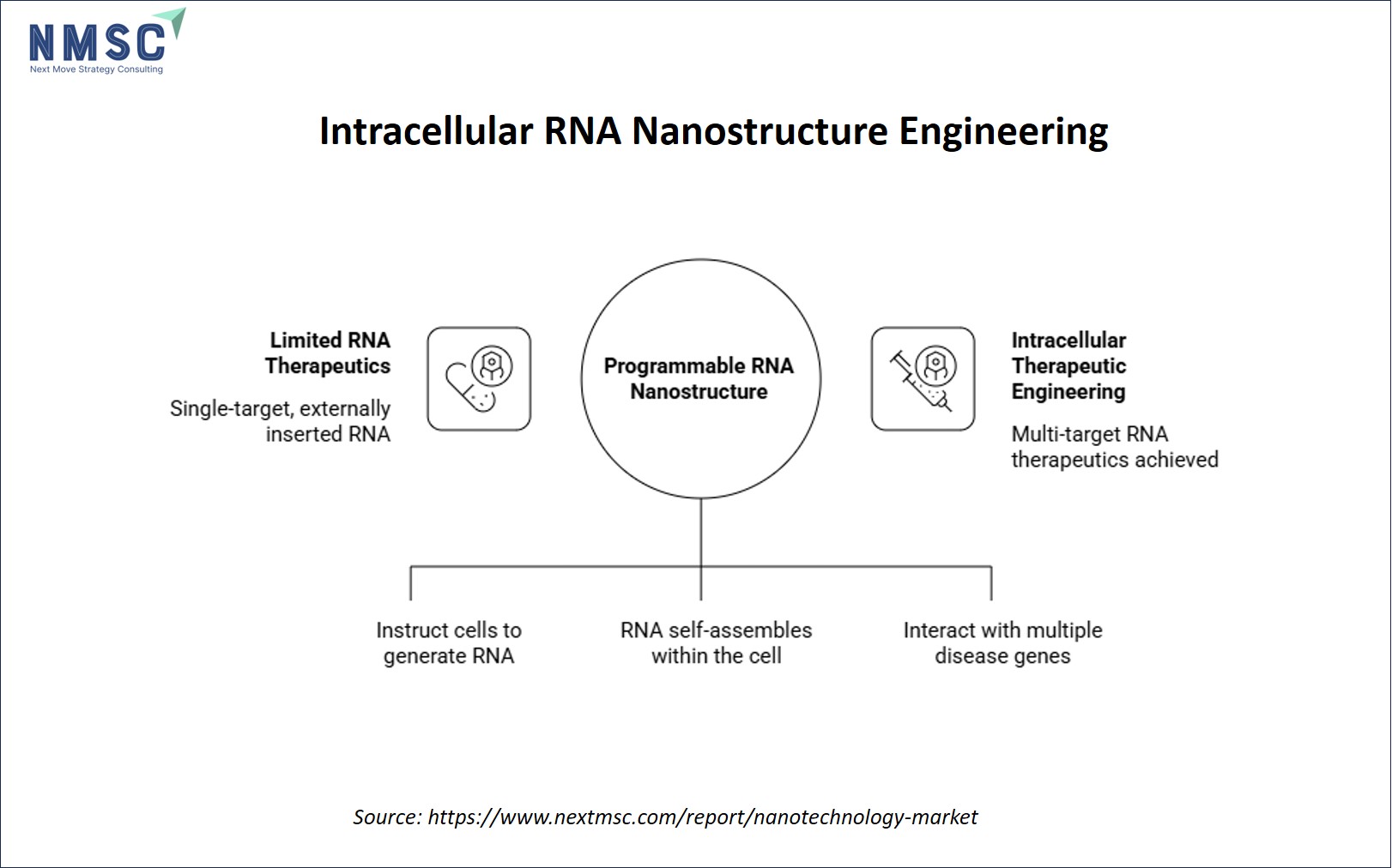
NMSC researchers indicate that this is commercially significant because cancer treatment pipelines are increasingly shifting toward multiplexed gene modulation, where simultaneous control of several oncogenic pathways is required to reduce relapse and therapeutic resistance. Nanotechnology platforms that can operate as programmable intracellular frameworks therefore create a new monetization layer at the intersection of nanomaterials, RNA medicine, and precision oncology.
Nanotechnology Market Quantitative Outlook
|
Metric |
Value |
|
Market Size 2019 |
USD 1.15 Billion |
|
Forecast Market Size 2030 |
USD 3.31 Billion |
|
CAGR (2020–2030) |
10.1% |
|
Current High-Growth Segment |
Biomedical Nanotechnology |
|
Key Commercial Trigger in 2026 |
Clinical Nano Therapeutics & Neural Interfaces |
Recent 2026 Biomedical Nanotechnology Impact Areas
|
Breakthrough |
Institution |
Commercial Relevance |
|
Wireless Near-Infrared Retinal Nano Implant |
Koç University |
Nano-enabled visual prosthetics, neural stimulation devices |
|
Self-Assembling Programmable RNA Nanotechnology |
Rutgers University–Newark |
Cancer therapeutics, gene modulation, intracellular nanomedicine |
According to the latest NMSC dataset, biomedical applications are becoming the fastest strategic value creator inside nanotechnology because they offer clearer licensing pathways, higher intellectual property defensibility, and stronger pharmaceutical partnership opportunities than conventional industrial nanomaterials. Over the last six months, the sector has seen growing concentration of research funding around nanocrystal biosystems, RNA nanoengineering, targeted cellular delivery, and smart biointerfaces — all indicators that the market is shifting toward clinically monetizable niches rather than broad materials experimentation.
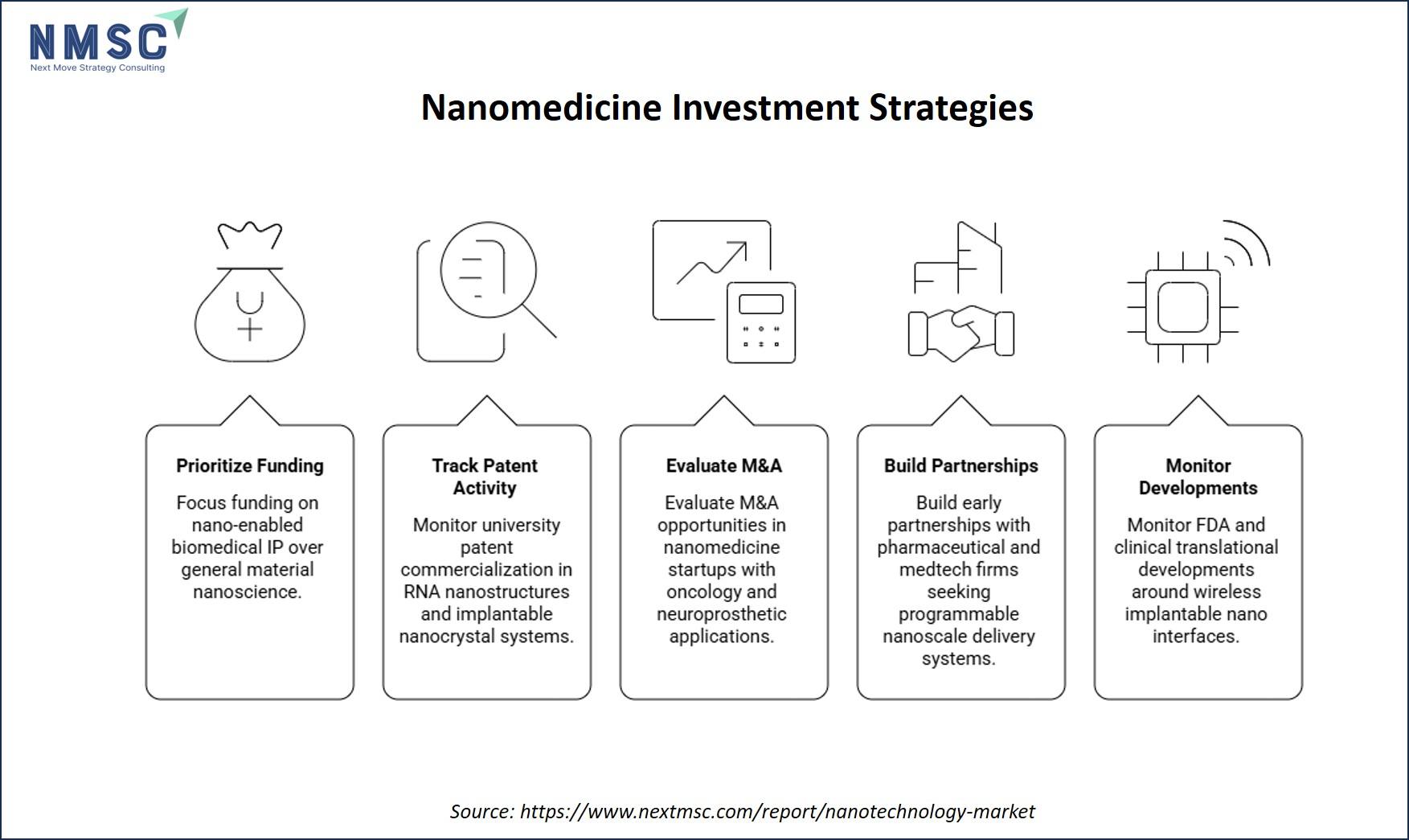
What CEOs and Investors Should Do Next
-
Prioritize funding exposure toward nano-enabled biomedical IP instead of generalized material nanoscience.
-
Track university patent commercialization activity in RNA nanostructures and implantable nanocrystal systems.
-
Evaluate M&A opportunities in nanomedicine startups with oncology and neuroprosthetic applications.
-
Build early partnerships with pharmaceutical and medtech firms seeking programmable nanoscale delivery systems.
-
Monitor FDA and clinical translational developments around wireless implantable nano interfaces.
About Next Move Strategy Consulting:
Next Move Strategy Consulting is a premier market research and management consulting firm that has been committed to provide strategically analysed well documented latest research reports to its clients. The research industry is flooded with many firms to choose from, what makes NMSC different from the rest is its top-quality research and the obsession of turning data into knowledge by dissecting every bit of it and providing fact-based research recommendation that is supported by information collected from over 500 million websites, paid databases, industry journals and one on one consultations with industry experts across a diverse range of industry sectors. The high-quality customized research reports with actionable insights and excellent end-to-end customer service help our clients to take critical business decisions that enables them to move beyond time and have competitive edge in the industry.
We have been servicing over 1000 customers globally that includes 90% of the Fortune 500 companies over a decade. Our analysts are constantly tracking various high growth markets and identifying hidden opportunities in each sector or the industry. We provide one of the industry’s best quality syndicate as well as custom research reports across 10 different industry verticals. We are committed to deliver high quality research solutions in accordance to your business needs. Our industry standard delivery solutions that ranges from the pre consultation to after-sales services, provide an excellent client experience and ensure right strategic decision making for businesses.
For more information, please contact:
Next Move Strategy Consulting
5th Floor 867
Boylston St, STE 500,
Boston, MA 02116, U.S.
E-Mail: [email protected]
Direct: +1-217-650-7991
Website: www.nextmsc.com
About the Author
 Sanyukta Deb
— Sanyukta Deb is Digital Marketing Team Lead at Next Move Strategy Consulting, where she has led content strategy and technical SEO for the firm's B2B market research publications for over 2 years. Her editorial process translates NextMSC's primary and secondary research — spanning technology, industrial, and consumer sectors — into commercial narratives, backed by search-intent, keyword, and competitive analysis. She brings 5 years of overall experience in digital marketing and content strategy.
Sanyukta Deb
— Sanyukta Deb is Digital Marketing Team Lead at Next Move Strategy Consulting, where she has led content strategy and technical SEO for the firm's B2B market research publications for over 2 years. Her editorial process translates NextMSC's primary and secondary research — spanning technology, industrial, and consumer sectors — into commercial narratives, backed by search-intent, keyword, and competitive analysis. She brings 5 years of overall experience in digital marketing and content strategy.
About the Reviewer
 Debashree Dey
— Debashree Dey is Assistant Manager at Next Move Strategy Consulting, where she supports cross-vertical market content and communications across diverse industries for 6 years. Her professional background includes senior content writing, communications, and published manuscript authorship, with experience developing audience-focused business narratives and maintaining clear, consistent messaging. Her role supports research-led content development and editorial quality across NextMSC publications.
Debashree Dey
— Debashree Dey is Assistant Manager at Next Move Strategy Consulting, where she supports cross-vertical market content and communications across diverse industries for 6 years. Her professional background includes senior content writing, communications, and published manuscript authorship, with experience developing audience-focused business narratives and maintaining clear, consistent messaging. Her role supports research-led content development and editorial quality across NextMSC publications.

















Add Comment