Penang's Congestion Cut Shows AI Traffic Management Moving Beyond Pilots
Penang's 10–15% Congestion Cut, Ipoh's 40-Second Signal Waits and Belgrade's Citywide Adaptive Control Show AI Traffic Systems Becoming Standing Municipal Infrastructure
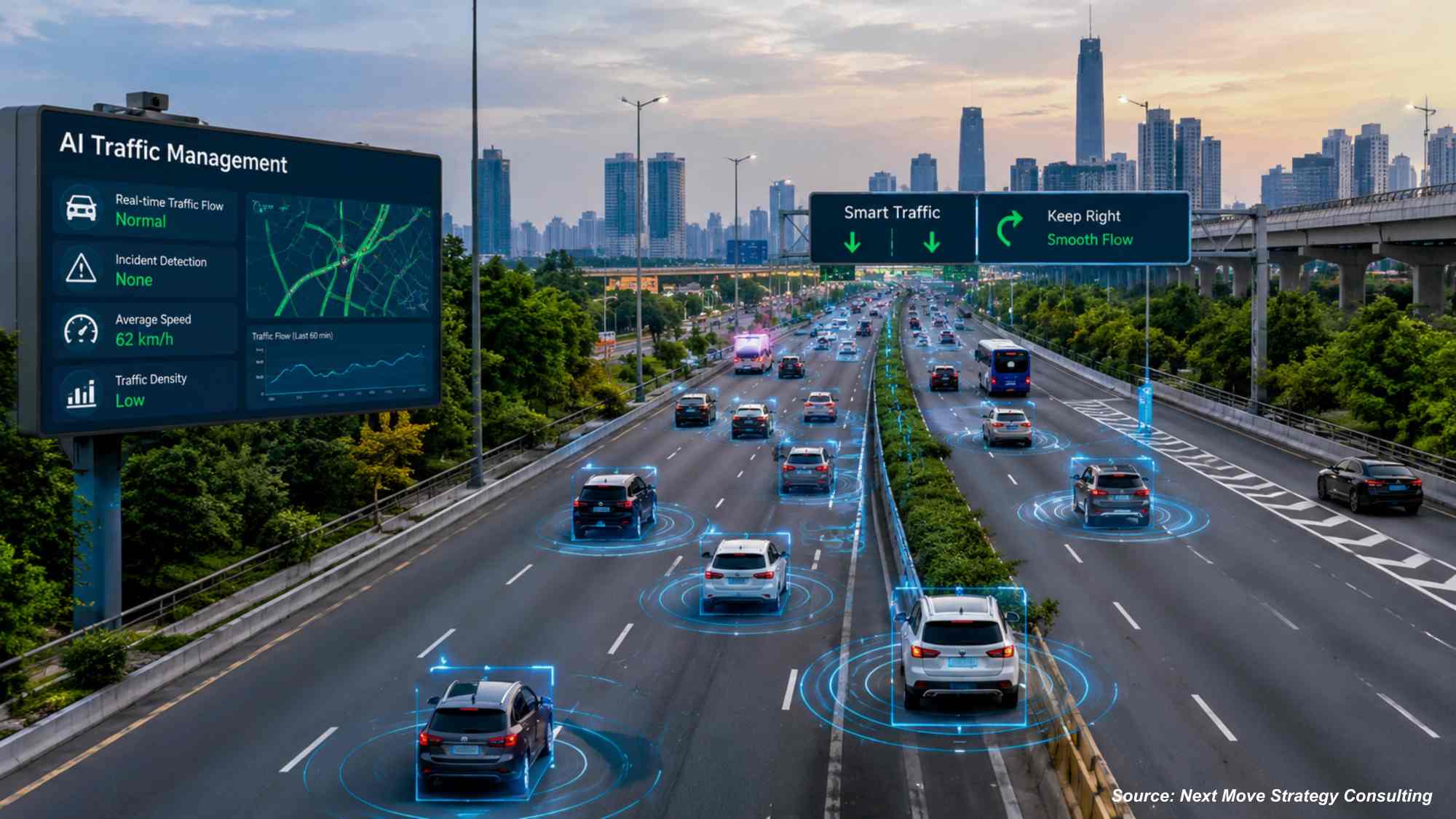
On October 26, 2026, Malaysia's Digital Ministry stated in a written response to a parliamentary question, reported by Bernama, that its AI City Initiative had cut traffic congestion in the Penang Island City Council area by 10 to 15 per cent and reduced waiting times at congested Ipoh junctions from two minutes to 40 seconds through coordinated traffic-light timings. The initiative covers nine local authorities and 28 projects funded through the 5G Enterprise and AI City Grant launched on August 13, 2025, and the ministry said it is moving from individual projects to an integrated ecosystem under a "Build Once, Reuse and Scale" principle, with a shared AI Algorithm Bank and AI Marketplace so that not all 156 local authorities nationwide need to build their own systems. The disclosure turns AI-enabled signal control from a vendor claim into a measured municipal outcome and shows a national buyer designing procurement around reusable models instead of one-off installations.
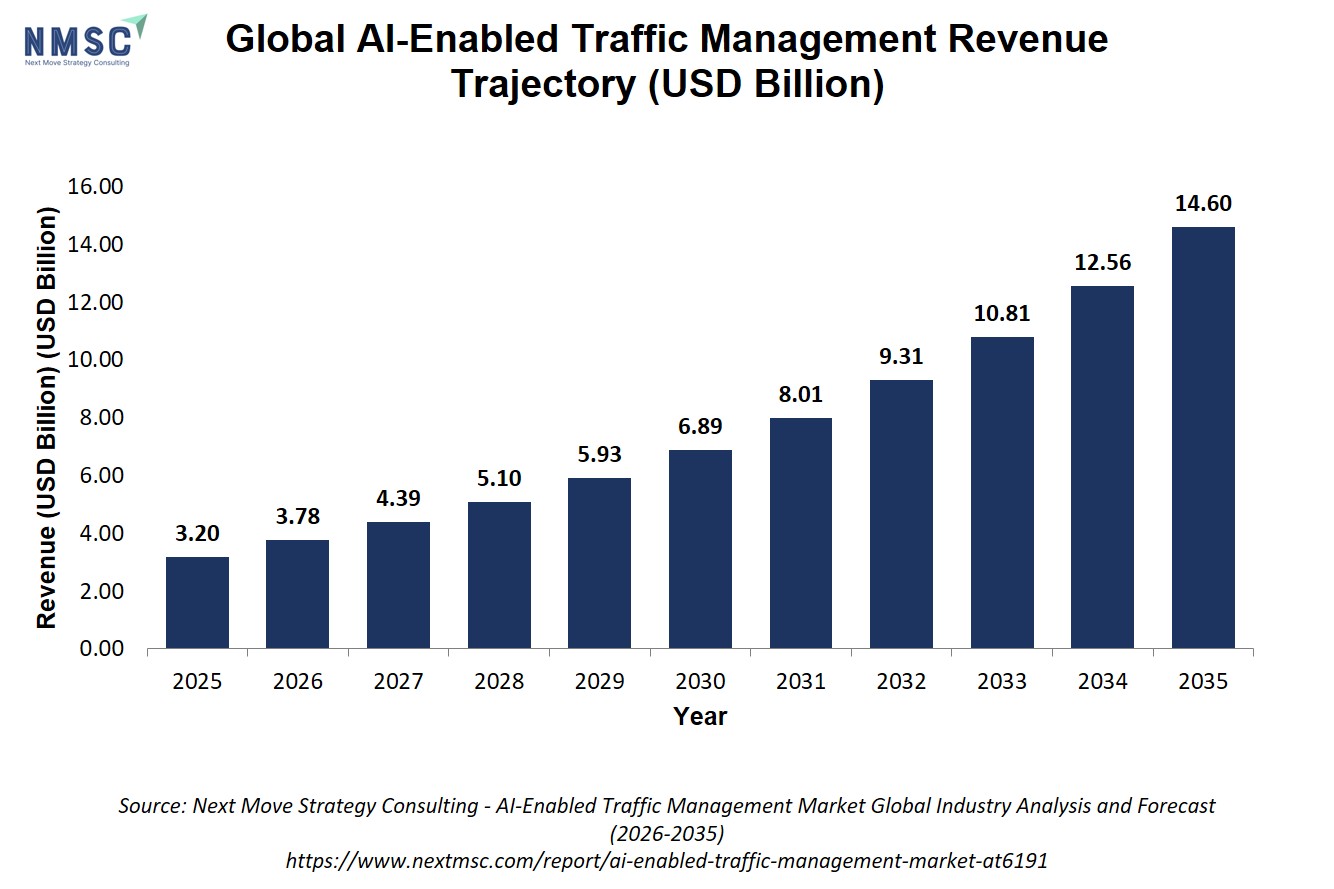
According to Next Move Strategy Consulting's AI-Enabled Traffic Management Market report, the global AI-enabled traffic management market was valued at USD 3.20 billion in 2025 and is projected to reach USD 14.60 billion by 2035, growing at a CAGR of 16.2% from 2026 to 2035. NextMSC primary research and analysis traces this trajectory to the quantified cost of congestion, a large base of fixed-timing signals and falling edge AI detection costs, and finds that software and platforms revenue overtakes hardware revenue in 2027 as agencies purchase operational outcomes rather than cabinets and detectors.
For More Information: Download FREE Sample on AI-Enabled Traffic Management Market Report
The Financial Logic: Congestion Costs, Retiming Backlogs and Federal Seed Funding
INRIX's 2025 Global Traffic Scorecard, released on December 1, 2025, reported that the typical U.S. driver lost 49 hours to congestion in 2025, six hours more than in 2024, at a cost of USD 894 in lost time per driver, with Chicago drivers losing 112 hours at USD 2,063 each. For Germany, the same scorecard recorded 47 hours lost per driver, four hours more than a year earlier, at a national cost of EUR 5.3 billion, while delays in London fell 10 per cent. NextMSC primary research and analysis finds that losses quantified at this level give transport budget holders a measurable benchmark, which is why adaptive signal control and incident detection now compete for funds that once defaulted to added lane capacity.
The maintenance side of the ledger is equally concrete. Miovision stated in its May 20, 2026 product announcement that signal retiming often happens every three to five years, can take months to complete and costs between USD 3,000 and USD 5,000 per intersection, and that its new Signal Optimizer and Controller Manager reduce retiming deployment time by up to 50 per cent. Those are company claims rather than independent audits, but they define the unit economics agencies are weighing: a per-intersection retiming bill that recurs on a multi-year cycle, set against software that can redeploy approved timing plans remotely.
Public funding is seeding corridor-scale adoption. The U.S. Department of Transportation's SMART Grants Program news page recorded in February 2026 that Charleston, South Carolina received USD 1 million to deploy AI-enabled adaptive traffic signals on Calhoun Street, and that Las Vegas received USD 1.4 million to implement automated smart signals around Fremont Street. NextMSC primary research and analysis classes awards of this size as entry points for retrofit programmes rather than network-wide replacement, which is consistent with a market whose near-term revenue sits in detection hardware and per-intersection software bundles.
Key Industry Developments: Deployments Moving AI Traffic Control Into Daily Operations
On September 28, 2026, Yunex Traffic announced that it had completed Belgrade's Adaptive Traffic Control System, a central system that now monitors and manages traffic operations across around 400 intersections. On September 30, 2026, Yunex Traffic and Aimsun were reported to be helping Brno, Czech Republic, build a Traffic Information Center that brings together traffic, parking, public transport and roadway information and supports an AI-enabled traffic digital twin. On October 6, 2026, Yunex Traffic reported that the City of Weiden, Germany, became the first municipality to deploy Yutraffic awareAI 2.0, the next generation of its AI-enabled traffic detection.
The vendor-side shift toward software workflows is visible in Miovision's May 20, 2026 launch, which pairs its Mateo generative AI assistant, made generally available in April 2026, with Signal Optimizer and Controller Manager on the Miovision One platform. The company positions the package as a way to move agencies from reactive, infrequent retiming to proactive optimisation without removing engineers from approval decisions.
“Cities are under pressure to make streets work better for everyone, but traffic teams often have to manage modern mobility problems with outdated solutions.”
— Kurtis McBride, Co-founder and Chief Executive Officer, Miovision, Miovision press release, Miovision Delivers the Future of Proactive Signal Retiming with New AI-Driven, End-to-End Traffic Optimization Solution, May 20, 2026.
Dated Deployments and Announcements Shaping Demand
|
Development |
Date |
Scale and Detail |
|
Malaysia's Digital Ministry, AI City Initiative results |
October 26, 2026 |
Nine local authorities and 28 projects; Penang congestion down 10 to 15 per cent; Ipoh waiting times cut from two minutes to 40 seconds |
|
Yunex Traffic, Belgrade Adaptive Traffic Control System |
September 28, 2026 |
Central system managing traffic operations across around 400 intersections |
|
Yunex Traffic, Yutraffic awareAI 2.0 in Weiden, Germany |
October 6, 2026 |
First municipal deployment of next-generation AI-enabled traffic detection |
|
Miovision, Traffic Optimization with Mateo, Signal Optimizer and Controller Manager |
May 20, 2026 |
Single cloud platform for analysis, optimisation and remote deployment; up to 50 per cent shorter retiming deployment per the company |
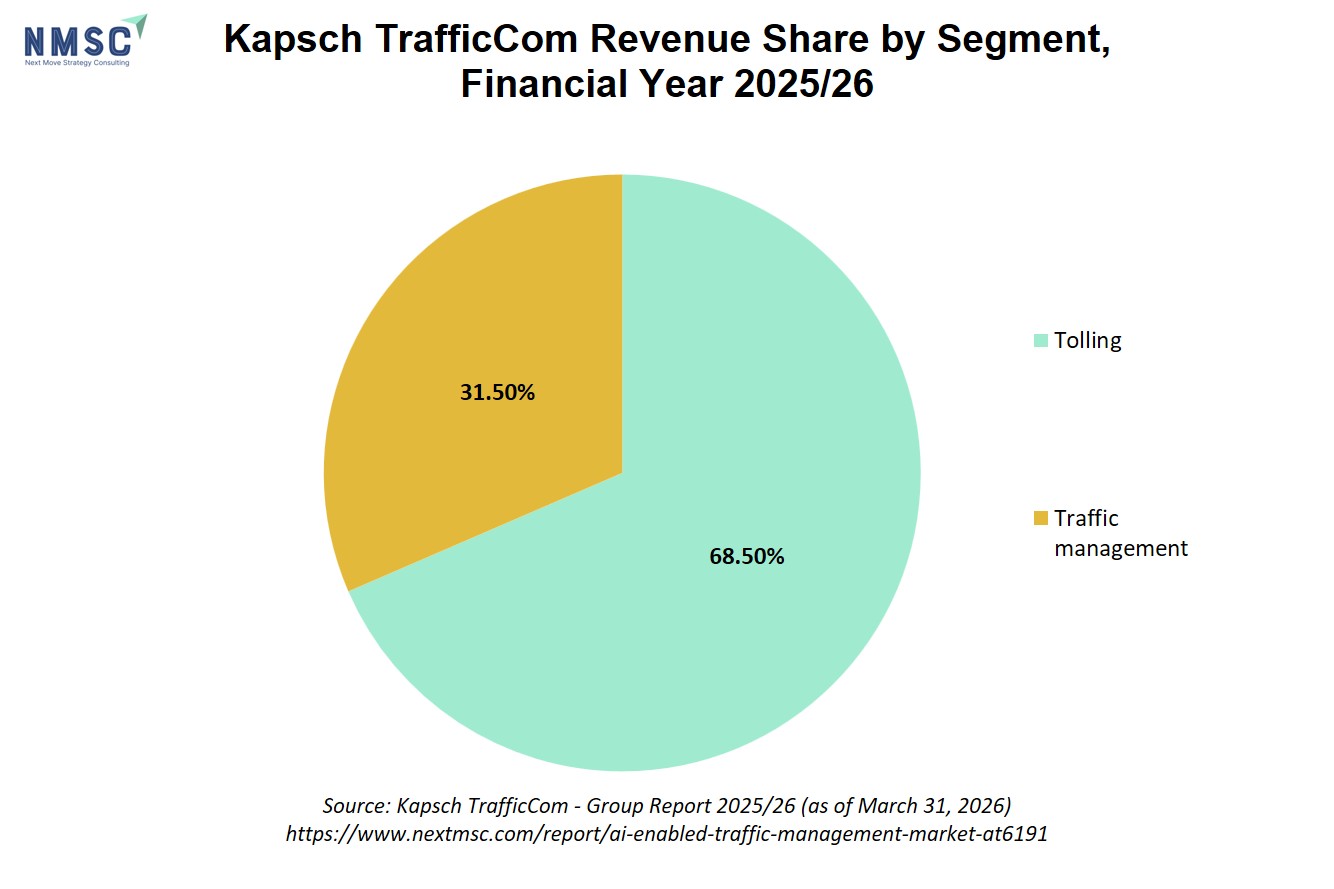
Vendor economics explain why that software shift matters. Kapsch TrafficCom's Group Report 2025/26, published on July 29, 2026, recorded group revenue of EUR 430.6 million, down 18.8 per cent, with the traffic management segment contributing EUR 135.5 million, or 31.5 per cent of revenue, at an EBIT of EUR -2.9 million, while tolling contributed the remaining 68.5 per cent. Kapsch TrafficCom AG's June 17, 2026 results announcement reported an order backlog of EUR 1.3 billion at year-end and said management expects 2026/27 revenue and EBIT to exceed 2025/26 levels. NextMSC primary research and analysis reads the near-flat revenue and negative EBIT of the traffic management segment as evidence that hardware-led project delivery alone does not earn a margin, and that value is migrating toward recurring software and operating contracts.
Segment Dynamics: Hardware Leads Revenue, Software Leads Growth
According to NextMSC primary research and analysis, hardware held the largest share of the AI-enabled traffic management market at about 42% of 2026 revenue, rising from USD 1.40 billion in 2025 to USD 4.90 billion by 2035 at a 13.4% CAGR, because AI cameras, radar and edge controllers must be installed before software can act on their data. Software and platforms are the fastest-growing offering at an 18.0% CAGR, from USD 1.28 billion to USD 6.90 billion, and services expand at 17.6%, from USD 0.52 billion to USD 2.80 billion.
AI-Enabled Traffic Management Market by Offering
|
Offering |
2025 (USD Billion) |
2035 (USD Billion) |
CAGR 2026–2035 |
|
Software and platforms |
1.28 |
6.90 |
18.0% |
|
Hardware |
1.40 |
4.90 |
13.4% |
|
Services |
0.52 |
2.80 |
17.6% |
By application, NextMSC primary research and analysis shows adaptive traffic signal control as the largest segment, expanding from USD 0.95 billion in 2025 to USD 4.10 billion by 2035, while priority and connected vehicle management is the fastest growing at a 21.6% CAGR and predictive analytics follows at 19.8%. Among end users, municipal and city authorities lead at USD 1.90 billion in 2025, rising to USD 8.70 billion by 2035, and law enforcement agencies are the fastest-growing buyer group at a 17.5% CAGR.
Regional Outlook
North America leads with about 31% of 2026 revenue, rising from USD 1.02 billion in 2025 to USD 4.20 billion by 2035 at a 15.0% CAGR, according to NextMSC primary research and analysis, with the United States moving from USD 0.87 billion to USD 3.60 billion at 15.2%. Asia-Pacific is the fastest-growing region at an 18.8% CAGR, increasing from USD 0.92 billion in 2025 to USD 5.20 billion by 2035; within it, China is projected to grow from USD 0.38 billion to USD 2.30 billion at 19.6%, and India from USD 0.06 billion to USD 0.62 billion at 25.5%, the fastest growth among the countries in the report.
Europe is projected to grow from USD 0.84 billion to USD 3.20 billion at a 14.1% CAGR, the Middle East & Africa from USD 0.24 billion to USD 1.16 billion at 16.7%, and Latin America from USD 0.18 billion to USD 0.84 billion at 16.1%. NextMSC primary research and analysis reads Malaysia's October 26, 2026 disclosure as part of the Asia-Pacific growth curve, where city-scale AI programmes are the primary driver. The ministry's proposed National Command Centre integrating AI analytics and digital twin technology, and its shared algorithm bank across 156 local authorities, point to a procurement model in which a national platform, not each council, becomes the contracting counterparty.
Growth Drivers and Restraints
AI-Enabled Traffic Management Market: Growth Driver and Restraint Matrix
|
Factor |
Type |
Impact on CAGR |
Geography |
Timeline |
|
Rising congestion cost and delay |
Driver |
+3.1% |
Global, led by North America and Europe |
2026–2035 |
|
Large base of outdated signal timing |
Driver |
+2.4% |
North America, Europe |
2026–2032 |
|
Falling cost of edge AI detection |
Driver |
+2.2% |
Global, strongest in Asia-Pacific |
2026–2030 |
|
Public policy and ITS frameworks |
Driver |
+1.6% |
Europe, North America |
2026–2033 |
|
Priority and connected vehicle integration |
Driver |
+1.3% |
North America, Europe, Asia-Pacific |
2027–2035 |
|
Tender-based procurement and thin project margins |
Restraint |
−1.9% |
Global |
2026–2029 |
|
Data privacy and cybersecurity duties |
Restraint |
−1.2% |
Europe, North America |
2026–2032 |
|
Legacy controller interoperability gaps |
Restraint |
−0.8% |
Mature urban networks |
2026–2031 |
NMSC Strategic Perspective: Software-Defined Operations Replace Cabinet Purchases
NextMSC primary research and analysis identifies the current period as the point at which AI-enabled traffic management shifts from equipment procurement to operating-outcome procurement. Malaysia's measured Penang and Ipoh results, Yunex Traffic's Belgrade completion and Miovision's remote retiming workflow share one feature: each converts a signal timing plan from a periodic engineering project into a continuously managed service. That mechanism underlies NextMSC's finding that software and platforms revenue overtakes hardware revenue in 2027, even though hardware still holds about 42% of 2026 revenue.
Public procurement is the binding constraint. NextMSC's driver and restraint matrix assigns its largest negative effect on CAGR, −1.9%, to tender-based procurement and thin project margins, and Kapsch TrafficCom's EBIT of EUR -2.9 million on EUR 135.5 million of traffic management revenue in 2025/26 shows how that restraint appears in a vendor's accounts. Vendors that bundle detection, cloud analytics and multi-year operating contracts convert low-margin project revenue into recurring revenue, which is the commercial logic behind the managed-operations demand that NextMSC primary research and analysis identifies among agencies without round-the-clock traffic engineers.
For vendors, NextMSC primary research and analysis recommends pairing detection hardware with cloud software and operating services, since software and platforms grow at 18.0% against 13.4% for hardware, and prioritising priority and connected vehicle management at 21.6% and predictive analytics at 19.8%. For agencies, it recommends staging retrofits corridor by corridor and requiring open interfaces to limit lock-in. For investors, the absolute opportunity of USD 10.82 billion between 2026 and 2035 favours scaled platform assets with recurring software and service revenue, while Asia-Pacific at 18.8% offers the fastest regional expansion.
Competitive Landscape
NextMSC primary research and analysis profiles nine companies in the AI-enabled traffic management market: SWARCO, Mundys, Cubic, Kapsch TrafficCom, Hikvision, Indra, Iteris, Jenoptik and Miovision. It groups suppliers into integrated platform groups such as Kapsch TrafficCom, SWARCO and Yunex Traffic, sensor and analytics specialists such as Cubic, Iteris and Miovision, an enforcement-focused provider in Jenoptik, and large electronics groups such as Hikvision and Indra that bundle traffic with wider public-sector systems. Differentiation rests on standards coverage, detection accuracy, cloud analytics and operating-contract experience.
The dated company events in this cycle are deployment and software announcements: Yunex Traffic's Belgrade, Brno and Weiden announcements between September 28 and October 6, 2026, Miovision's May 20, 2026 optimisation suite, and Kapsch TrafficCom's July 29, 2026 Group Report. NextMSC primary research and analysis finds that buyers prefer vendors that unite detection, cloud analytics and service delivery, which raises entry barriers for point-product suppliers.
Bottom Line
Malaysia's October 26, 2026 disclosure of a 10 to 15 per cent congestion reduction in Penang and Ipoh waiting times cut from two minutes to 40 seconds, together with Yunex Traffic's Belgrade completion and Miovision's remote retiming suite, shows AI traffic control moving from pilot corridors into citywide and national programmes. According to NextMSC primary research and analysis, the global AI-enabled traffic management market will expand from USD 3.20 billion in 2025 to USD 14.60 billion by 2035 at a 16.2% CAGR, adding USD 10.82 billion between 2026 and 2035. Software and platforms, growing at 18.0%, overtake hardware in 2027, while Asia-Pacific, at 18.8%, is the fastest-growing region. Procurement margins remain the constraint: Kapsch TrafficCom's traffic management segment posted an EBIT of EUR -2.9 million on EUR 135.5 million of revenue in 2025/26. Vendors that combine detection, cloud analytics and operating contracts are best placed to convert public budgets into recurring revenue.
About Next Move Strategy Consulting
Next Move Strategy Consulting is a premier market research and management consulting firm that has been committed to provide strategically analysed well documented latest research reports to its clients. The research industry is flooded with many firms to choose from, what makes NMSC different from the rest is its top-quality research and the obsession of turning data into knowledge by dissecting every bit of it and providing fact-based research recommendation that is supported by information collected from over 500 million websites, paid databases, industry journals and one on one consultations with industry experts across a diverse range of industry sectors. The high-quality customized research reports with actionable insights and excellent end-to-end customer service help our clients to take critical business decisions that enables them to move beyond time and have competitive edge in the industry.
We have been servicing over 1000 customers globally that includes 90% of the Fortune 500 companies over a decade. Our analysts are constantly tracking various high growth markets and identifying hidden opportunities in each sector or the industry. We provide one of the industry’s best quality syndicate as well as custom research reports across 10 different industry verticals. We are committed to deliver high quality research solutions in accordance to your business needs. Our industry standard delivery solutions that ranges from the pre consultation to after-sales services, provide an excellent client experience and ensure right strategic decision making for businesses.
For more information, please contact:
Next Move Strategy Consulting
5th Floor 867 Boylston St, STE 500,
Boston, MA 02116, U.S.
E-Mail: [email protected]
Direct: +1-217-650-7991
Website: www.nextmsc.com
About the Author
 Sanyukta Deb
— Sanyukta Deb is Digital Marketing Team Lead at Next Move Strategy Consulting, where she has led content strategy and technical SEO for the firm's B2B market research publications for over 2 years. Her editorial process translates NextMSC's primary and secondary research — spanning technology, industrial, and consumer sectors — into commercial narratives, backed by search-intent, keyword, and competitive analysis. She brings 5 years of overall experience in digital marketing and content strategy.
About the Reviewer
 Debashree Dey
— Debashree Dey is Assistant Manager at Next Move Strategy Consulting, where she supports cross-vertical market content and communications across diverse industries for 6 years. Her professional background includes senior content writing, communications, and published manuscript authorship, with experience developing audience-focused business narratives and maintaining clear, consistent messaging. Her role supports research-led content development and editorial quality across NextMSC publications.















Add Comment