AI-Enabled Traffic Management Market Global Industry Analysis and Forecast (2026–2035)

Revenue climbs from USD 3.20 Billion in 2025 toward USD 14.60 Billion by 2035, a 16.2% CAGR over 2026–2035, as rising congestion costs, ageing signal networks and edge AI detection lift spending, with North America in the lead.

Download Free Sample PDF
Base Year (2025)
$3.20 Billion
Forecast (2035)
$14.60 Billion
CAGR (2026-2035)
16.2%
Top Region
North America

What Is the AI-Enabled Traffic Management Market Size?

The global Market was valued at USD 3.20 Billion in 2025 and is estimated at USD 3.78 Billion in 2026. It is forecast to reach USD 14.60 Billion by 2035, expanding at a 16.2% CAGR from 2026–2035. North America leads with roughly 31% share, while hardware dominates offerings with about 42%.

Our analysis shows that spending is shifting from standalone detectors toward software defined operations across cities and corridors.

AI-Enabled Traffic Management Market Global Industry Analysis and Forecast (2026–2035) Revenue Forecast

Values in USD Billion

2025 $3.20 Billion
2025
2026 $3.78 Billion
2026
2027 $4.39 Billion
2027
2028 $5.10 Billion
2028
2029 $5.93 Billion
2029
2030 $6.89 Billion
2030
2031 $8.01 Billion
2031
2032 $9.31 Billion
2032
2033 $10.81 Billion
2033
2034 $12.56 Billion
2034
2035 $14.60 Billion
2035

Key Takeaways

By Offering: Hardware held the largest share, expanding from USD 1.40 Billion in 2025 to USD 4.90 Billion by 2035; Software and platforms is the fastest growing at 18.0% CAGR from 2026–2035.

By Application: Adaptive traffic signal control held the largest share, expanding from USD 0.95 Billion in 2025 to USD 4.10 Billion by 2035; Priority and connected vehicle management is the fastest growing at 21.6% CAGR from 2026–2035.

By End user: Municipal and city authorities held the largest share, expanding from USD 1.90 Billion in 2025 to USD 8.70 Billion by 2035; Law enforcement agencies are the fastest growing at 17.5% CAGR from 2026–2035.

Dominant Region: North America, rising from USD 1.02 Billion in 2025 to USD 4.20 Billion by 2035.

Fastest-Growing Region: Asia-Pacific at 18.8% CAGR from 2026–2035, reaching USD 5.20 Billion by 2035.

Dominant Country: U.S., rising from USD 0.87 Billion in 2025 to USD 3.60 Billion by 2035.

Fastest-Growing Country: India at 25.5% CAGR from 2026–2035, reaching USD 0.62 Billion by 2035.

The AI-Enabled Traffic Management Market presents an absolute opportunity of approximately USD 10.82 Billion between 2026 and 2035, which signals that agencies upgrading legacy signal networks will anchor vendor revenue.

According to NMSC analysis, software and platforms revenue overtakes hardware revenue in 2027 as agencies purchase operational outcomes rather than cabinets and detectors.

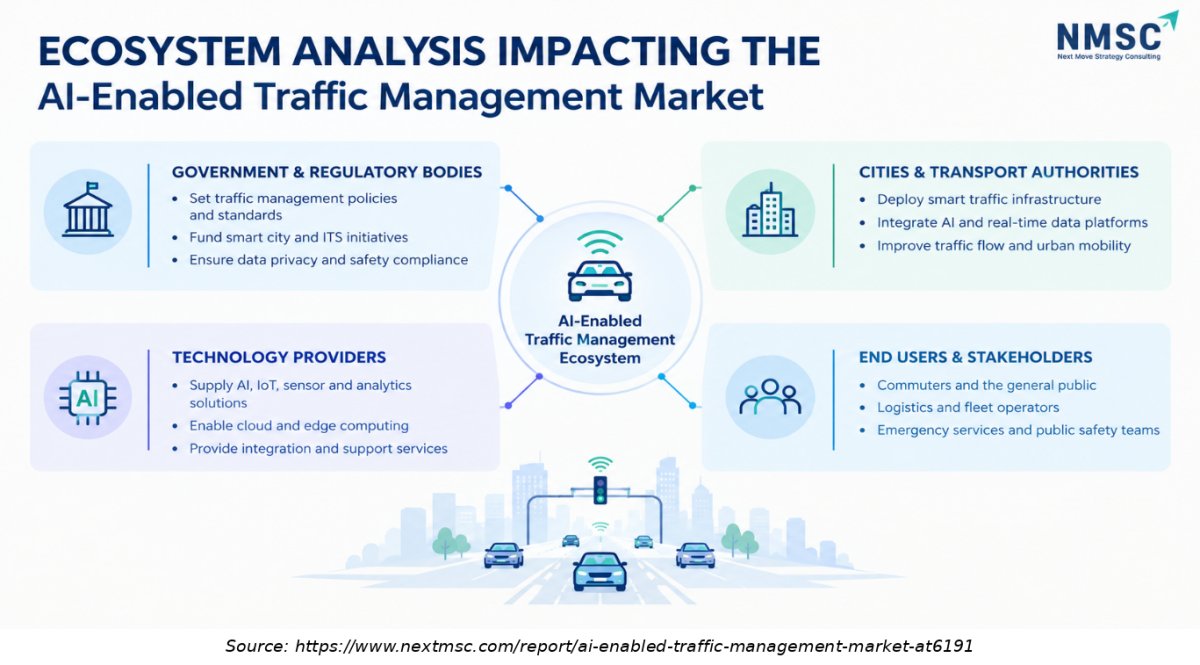
Ecosystem Analysis Impacting the AI-Enabled Traffic Management Market

The infographic illustrates the key stakeholders in the AI-enabled traffic management ecosystem, including government and regulatory bodies, cities and transport authorities, technology providers, and end users. Their collaboration supports smart infrastructure deployment, real-time traffic monitoring, improved traffic flow, and safer urban mobility.

What Does the AI-Enabled Traffic Management Market Encompass?

The Market covers software, hardware and services that apply machine learning, computer vision and optimisation to control signals, detect incidents, manage priority movements and enforce road rules. Tolling back offices, parking systems and drone airspace tools are excluded because they belong to adjacent markets. Conventional traffic management platforms enter the scope only when they embed learning models that adjust timing or predict conditions without manual intervention.

Market Drivers & Dynamics

Interactive Dataset
Rising congestion cost and delay driver +3.1% Global, led by North America and Europe 2026–2035
Large base of outdated signal timing driver +2.4% North America, Europe 2026–2032
Falling cost of edge AI detection driver +2.2% Global, strongest in Asia-Pacific 2026–2030
Public policy and ITS frameworks driver +1.6% Europe, North America 2026–2033
Priority and connected vehicle integration driver +1.3% North America, Europe, Asia-Pacific 2027–2035
Tender based procurement and thin project margins restraint −1.9% Global 2026–2029
Data privacy and cybersecurity duties restraint −1.2% Europe, North America 2026–2032
Legacy controller interoperability gaps restraint −0.8% Mature urban networks 2026–2031
Source: Next Move Strategy Consulting

Growth Drivers

What Is the Primary Growth Driver of the AI-Enabled Traffic Management Market?

Congestion cost is the clearest demand signal. INRIX's 2025 Global Traffic Scorecard reports that the typical U.S. driver lost 49 hours to congestion, up six hours from 2024, which cost USD 894 per driver and at least USD 85.8 Billion nationally. Delays rose in 62% of the 942 urban areas analysed worldwide. Our analysis shows that transport budgets respond to such quantified losses, so adaptive control and incident detection now compete successfully against new lane capacity.

How Is the Ageing Signal Base Driving AI-Enabled Traffic Management Market Growth?

The installed base is large and mostly under optimised. An archived Federal Highway Administration publication reports approximately 330,000 traffic signals in the United States and states that more than 75% could benefit from equipment upgrades or timing adjustments. These figures should be treated as historical benchmarks rather than a current inventory.It also reports that retiming alone can reach benefit cost ratios as high as 40 to 1. Based on research conducted by NMSC, such ratios let agencies justify AI detection as an incremental upgrade, which supports steady demand in the AI-Enabled Traffic Management Market.

Growth Inhibitors

What Is Restraining the AI-Enabled Traffic Management Market Growth?

Project based public procurement keeps vendor margins thin and delays rollouts. Kapsch TrafficCom reported group revenue of EUR 430.6 million and group EBIT of EUR 5.6 million in FY2025/26. Its Traffic Management segment accounted for approximately 31% of group revenue. The segment-specific revenue and EBIT figures should be retained only after verification against the detailed segment reporting in the annual report. Agencies also face privacy and cybersecurity duties around camera data, which widen approval checklists for cyber physical systems security and slow adoption even where benefits are proven.

What Are the Growth Opportunities?

Where Does Legacy Signal Retrofit Create Revenue?

Agencies can raise performance without rebuilding intersections by adding AI detection and cloud optimisation to existing cabinets. With more than 330,000 U.S. signals and over 75% judged improvable, retrofit programmes give vendors a repeatable offer. Detection and software suppliers serving municipal authorities benefit first, because bundles priced per intersection fit annual budgets and let digital twin simulations prove timing gains before deployment.

How Can Managed Operations Services Open New Revenue Pools?

Many agencies lack engineers to run traffic management centres around the clock, which creates demand for outsourced operations. Kapsch won contracts to operate two traffic management centres in New York State, and it secured tunnel management in Sharjah. Service providers and integrators benefit most, because multiyear operating contracts add recurring revenue to project sales and fund continuous model tuning.

Why Are Emerging Corridors Attractive for Expansion?

Fast growing cities in Asia, the Middle East and Latin America are building networks without legacy constraints, so they can specify AI native designs from the outset. Cubic's Gridsmart deployment in Bangkok and its traffic management work in Merida, Mexico show how vendors extend into these corridors. Highway operators and city authorities benefit, and regional integrators gain partnership roles as procurement shifts to performance outcomes.

Segmentation Analysis

2025 (USD Billion)
2035 (USD Billion)
Software and platforms 2025: $1.28 Billion | 2035: $6.90 Billion
Software and
Hardware 2025: $1.40 Billion | 2035: $4.90 Billion
Hardware
Services 2025: $0.52 Billion | 2035: $2.80 Billion
Services
Software and platforms $1.28 Billion $6.90 Billion 18.0%
Hardware $1.40 Billion $4.90 Billion 13.4%
Services $0.52 Billion $2.80 Billion 17.6%

Which Offering Segment Leads the Market?

Hardware held the largest share at roughly 42% of 2026 revenue, supported by AI cameras, radar and edge controllers that agencies must install before software can act. Software and platforms are the fastest growing offering at an 18.0% CAGR from 2026–2035, followed by services at 17.6%. We observed that vendors such as Kapsch with its EcoTrafiX platform and Iteris with Clear Mobility are shifting revenue toward subscriptions, analytics and smart sensors with embedded intelligence.

2025 (USD Billion)
2035 (USD Billion)
Category A
Category B
Category C
Category D
Segment Item 2025 (USD Billion) 2035 (USD Billion) CAGR
Category A $10.0 USD Billion $40.0 USD Billion 18.0%
Category B $17.1 USD Billion $51.1 USD Billion 16.0%
Category C $24.2 USD Billion $62.2 USD Billion 22.0%
Category D $31.3 USD Billion $73.3 USD Billion 12.0%

Segment-wise data is locked

Unlock complete segment-wise numbers for By Application.

Unlock Full Data
2025 (USD Billion)
2035 (USD Billion)
Category A
Category B
Category C
Category D
Segment Item 2025 (USD Billion) 2035 (USD Billion) CAGR
Category A $10.0 USD Billion $40.0 USD Billion 26.0%
Category B $17.1 USD Billion $51.1 USD Billion 16.0%
Category C $24.2 USD Billion $62.2 USD Billion 18.0%
Category D $31.3 USD Billion $73.3 USD Billion 8.0%

Segment-wise data is locked

Unlock complete segment-wise numbers for By End user.

Unlock Full Data

Growth Opportunities

Our findings suggest that three opportunities offer the clearest route to incremental revenue.

Where Does Legacy Signal Retrofit Create Revenue?

Agencies can raise performance without rebuilding intersections by adding AI detection and cloud optimisation to existing cabinets. With more than 330,000 U.S. signals and over 75% judged improvable, retrofit programmes give vendors a repeatable offer. Detection and software suppliers serving municipal authorities benefit first, because bundles priced per intersection fit annual budgets and let digital twin simulations prove timing gains before deployment.

How Can Managed Operations Services Open New Revenue Pools?

Many agencies lack engineers to run traffic management centres around the clock, which creates demand for outsourced operations. Kapsch won contracts to operate two traffic management centres in New York State, and it secured tunnel management in Sharjah. Service providers and integrators benefit most, because multiyear operating contracts add recurring revenue to project sales and fund continuous model tuning.

Why Are Emerging Corridors Attractive for Expansion?

Fast growing cities in Asia, the Middle East and Latin America are building networks without legacy constraints, so they can specify AI native designs from the outset. Cubic's Gridsmart deployment in Bangkok and its traffic management work in Merida, Mexico show how vendors extend into these corridors. Highway operators and city authorities benefit, and regional integrators gain partnership roles as procurement shifts to performance outcomes.

Regional Outlook

2025 (USD Billion)
2035 (USD Billion)
North Americ
Europe
Asia-Pacific
Middle East
Latin Americ
Region 2025 (USD Billion) 2035 (USD Billion) CAGR (%)
North America $10.0 USD Billion $40.0 USD Billion 9.0%
Europe $17.1 USD Billion $51.1 USD Billion 27.0%
Asia-Pacific $24.2 USD Billion $62.2 USD Billion 25.0%
Middle East & Africa $31.3 USD Billion $73.3 USD Billion 23.0%
Latin America $38.4 USD Billion $84.4 USD Billion 12.0%

Regional data is locked

Unlock complete regional numbers for this market.

Unlock Full Data

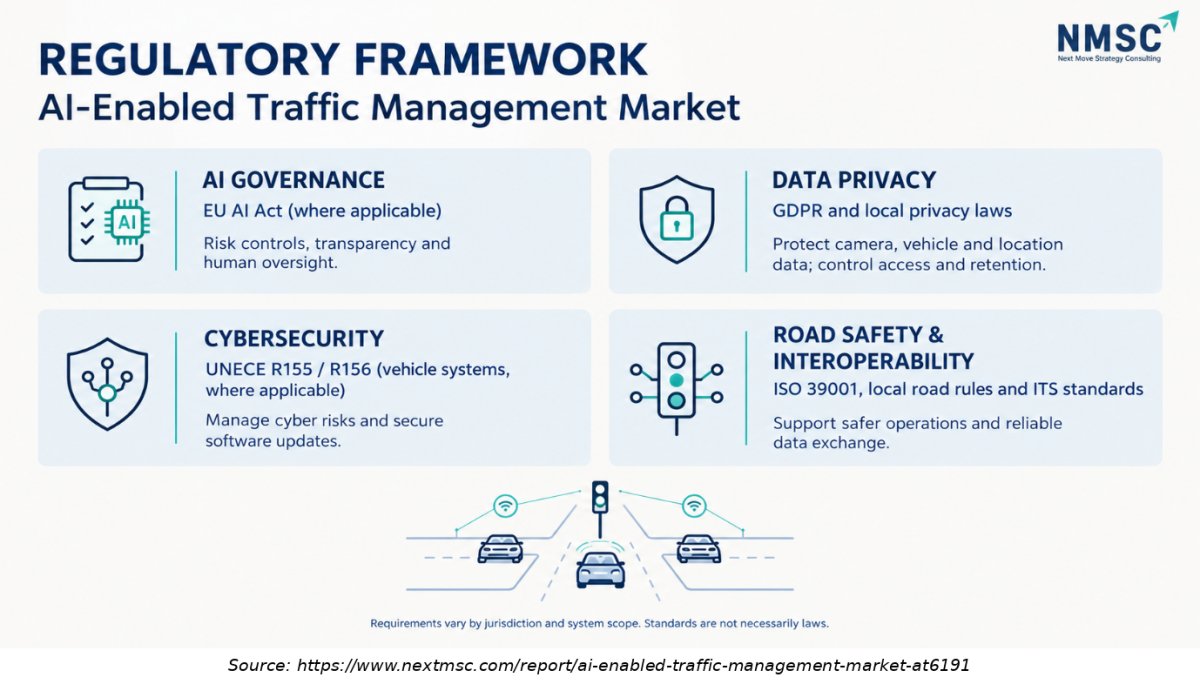
Regulatory Framework Impacting the AI-Enabled Traffic Management Market

The infographic highlights the key regulations and standards shaping AI-enabled traffic management, including AI governance, data privacy, cybersecurity, road safety, and interoperability. These frameworks help ensure secure, reliable, and responsible deployment of intelligent traffic systems.

Competitive Landscape

Based on research conducted by NMSC, the competitive landscape combines European platform groups, North American analytics specialists and large Asian electronics suppliers.

How Do Companies Compete in the AI-Enabled Traffic Management Market?

Competition centres on installed base, standards compliance and delivery capacity. Yunex Traffic claims that its solutions meet major regional traffic standards, while SWARCO reports that intelligent transportation systems account for approximately two-thirds of its group turnover. Attribute the standards statement to Yunex rather than presenting it as an independently verified industry ranking. Cubic and Iteris compete in North America through detection and cloud software, while Hikvision competes on camera scale. Pricing is project based, and service contracts are used to lock in recurring revenue.

Which Company Archetypes Dominate the Market?

Four archetypes stand out. Integrated platform groups include Kapsch, SWARCO and Yunex, while sensor and analytics specialists include Cubic, Iteris and Miovision. Jenoptik leads enforcement focused provision, and large electronics groups such as Hikvision and Indra bundle traffic with wider public sector systems. Differentiation themes include standards coverage, detection accuracy, cloud analytics and operating contract experience.

How Do Leading Vendors Differentiate Through Innovation?

Innovation focuses on turning detection into decisions. Cubic positions AI detection with adaptive control, Miovision promotes a generative AI agent, and Kapsch offers its EcoTrafiX platform that detects incidents automatically and forecasts conditions. Hikvision invested RMB 11.75 billion in research in 2025, which funds large vision models. Our findings suggest that vendors publishing measured delay reductions win trust faster in tenders.

What Does M&A Activity Reveal About Competitive Strategy?

Acquirers are buying capabilities and geography. Atlantia, now Mundys, completed its purchase of Yunex Traffic from Siemens on 30 June 2022. Iteris added ThruGreen Technology on 12 November 2025 for cloud equipment monitoring and V2X applications, and SWARCO agreed to buy Lacroix City-Mobility to expand in France and Spain. During our market evaluation, we noticed that deals favour recurring software and local service capacity over standalone hardware.

Key Market Players

Our assessment indicates that the following verified companies lead the AI-Enabled Traffic Management Market on traffic management scale and AI capability.

SWARCO AG Mundys S.p.A. Cubic Corporation Kapsch TrafficCom AG Hangzhou Hikvision Digital Technology Co., Ltd. Indra Sistemas, S.A. Iteris, Inc. Jenoptik AG Miovision Technologies Incorporated

Latest Developments

We observed that the latest developments point to consolidation, generative AI tooling and continued investment in operations.

Date Event
March 2026 Jenoptik Smart Mobility Solutions announced its acquisition of the intelligent transportation business of FIMA in Lithuania, effective 2 March 2026.
November 2025 Iteris acquired ThruGreen Technology to add cloud equipment monitoring and V2X applications to its Clear Mobility platform.

Expert Insights

Georg Kapsch

CEO of Kapsch Group, including Kapsch TrafficCom | Kapsch Group

"Traffic management is a different story: the user experience will be a different one, because AI helps to improve scenario calculations and predictions."

Analyst Interpretation

The insight highlights the transition from conventional traffic control toward predictive, data-driven traffic management. AI-enabled systems can use real-time traffic information and historical patterns to anticipate congestion, improve signal timing, and support faster operational decisions. These capabilities create opportunities for transportation authorities to improve traffic flow, reduce delays, and enhance the urban travel experience

Investment Opportunities

Where Is Capital Flowing in the AI-Enabled Traffic Management Market?

Strategic transactions illustrate continued consolidation and portfolio expansion in intelligent transportation. Almaviva completed its acquisition of Iteris in November 2024, Atlantia acquired Yunex Traffic in 2022, and Jenoptik expanded its ITS activities through the FIMA acquisition in 2026. These developments indicate strategic interest in mobility technologies but do not, by themselves, quantify sector-wide investment flows. We found that investors favour assets with recurring software revenue, installed bases of controllers and multi-year operating contracts, which improve visibility and support valuations through the forecast period.

How Does Infrastructure Investment Support Demand?

Public budgets remain the main source of demand because roads, signals and control centres are publicly owned. The EU framework for intelligent transport systems calls for interoperable deployment on the trans-European network, and U.S. agencies hold a vast signal base that needs equipment or timing updates. Our findings suggest that retrofit funding will outpace greenfield spending, which favours vendors whose modular software joins intelligent infrastructure and installed controllers.

What ESG Considerations Matter for Investors?

Traffic optimisation may reduce idling and emissions, although the scale of these benefits varies by deployment. INRIX estimated that U.S. drivers lost approximately 4.7 billion hours to congestion in 2025, indicating a substantial congestion burden. Quantified emissions reductions attributable to adaptive control should be supported by separate deployment-specific evidence. Social benefits include safer crossings and faster emergency response, while governance concerns focus on camera data privacy. Investors should favour vendors with transparent data policies and measurable emission savings per deployment.

Key Benefits for Stakeholders

How Does the Report Help Public Agencies and Operators?

Public agencies and operators gain a benchmark for budgeting, with segment forecasts showing where adaptive control, detection and priority management add most value. The regional and country analysis shows adoption pace in comparable cities, and the matrix of drivers and restraints highlights procurement and data risks to plan around. Our analysis shows that agencies can use the forecast to stage retrofit programmes and justify multiyear service contracts.

What Value Does the Report Offer Investors and Financial Analysts?

Investors receive a reconciled view of 2025, 2026 and 2035 revenue across three segmentation axes and five regions, which supports screening of platform, hardware and services exposure. The opportunity of USD 10.82 Billion and the spread of segment growth rates guide allocation decisions. We found that the competitive and development sections help identify consolidation targets and recurring revenue models.

How Do Technology Vendors and Product Teams Benefit?

Vendors and product teams gain evidence on which applications grow fastest, led by priority and connected vehicle management at 21.6% and predictive analytics at 19.8%. Country figures show where to localise offers, while the competitive archetypes clarify partnership choices. Based on research conducted by NMSC, vendors that combine detection accuracy, cloud analytics and service delivery are best placed to capture the faster growing software and services segments.

Key Market Segments Evaluated

By Offering

  • Software and platforms
  • Hardware
  • Services

By Application

  • Adaptive traffic signal control
  • Traffic monitoring and incident detection
  • Enforcement and violation management
  • Predictive analytics and planning
  • Priority and connected vehicle management

By End user

  • Municipal and city authorities
  • Highway and tunnel operators
  • Law enforcement agencies

By Region

  • North America 
    • U.S.
    • Canada
    • Mexico
  • Europe 
    • UK
    • Germany
    • France
    • Italy
    • Spain
    • Sweden
    • Denmark
    • Finland
    • Netherlands
    • Rest of Europe
  • Asia-Pacific 
    • China
    • India
    • Japan
    • South Korea
    • Taiwan
    • Indonesia
    • Vietnam
    • Australia
    • Philippines
    • Malaysia
    • Rest of APAC
  • Middle East & Africa 
    • Saudi Arabia
    • UAE
    • Egypt
    • Israel
    • Turkey
    • Nigeria
    • South Africa
    • Rest of MEA
  • Latin America 
    • Brazil
    • Argentina
    • Chile
    • Colombia
    • Rest of LATAM

Conclusion & Recommendations

The outlook is strongly positive. Revenue rises from USD 3.20 Billion in 2025 to USD 14.60 Billion in 2035, and the growth path is steady, with no unexplained spikes, because demand rests on congestion costs and an ageing signal base. Our assessment indicates that software and services will define value by 2035 as agencies shift from buying equipment to buying outcomes.

What Strategic Positioning Recommendations Does NMSC Offer?

Vendors should pair detection hardware with cloud software and operating services, because software and platforms grow at 18.0% against 13.4% for hardware. Priority and connected vehicle management and predictive analytics deserve early investment given growth above 19%. Agencies should stage retrofits corridor by corridor and require open interfaces, which protects against lock in and supports future AI upgrades.

What Does Investment Attractiveness Look Like for the AI-Enabled Traffic Management Market?

Attractiveness is high but selective. The market adds USD 10.82 Billion of revenue over the forecast period, and Asia-Pacific grows fastest at 18.8%. Thin project margins, shown by Kapsch's traffic management EBIT loss, mean returns depend on recurring software and service revenue rather than hardware tenders. We found that consolidation will continue, which benefits investors holding scaled platform assets.

What Are the Market Shifts and Key Risks in the AI-Enabled Traffic Management Market?

Key shifts include generative AI operations agents, edge detection at small intersections and priority control through connected vehicles. Risks include procurement delays, privacy and cybersecurity duties, and interoperability gaps with legacy controllers. Our analysis shows that vendors able to document measured delay and safety gains, and to comply with frameworks such as Directive (EU) 2023/2661, will manage these risks best.

What Are the Primary Growth Pathways Through 2035?

Growth pathways include retrofit of legacy signals, managed operations contracts and expansion in fast growing Asia-Pacific and Middle East corridors. India, China and Saudi Arabia show the highest country growth rates in this report at 25.5%, 19.6% and 19.6%. Our findings suggest that vendors combining local partnerships with scalable cloud software will convert these pathways into recurring revenue by 2035.

FAQs

Sources & References

1.

INRIX 2025 Global Traffic Scorecard

inrix.com/scorecard
2.

INRIX, Traffic Is Back: Insights from the 2025 Scorecard

inrix.com
3.

INRIX 2025 Global Traffic Scorecard, Germany

inrix.com
4.

INRIX 2025 Global Traffic Scorecard, United Kingdom

inrix.com
5.

U.S. Federal Highway Administration, Arterial Management one pager

ops.fhwa.dot.gov
6.

U.S. Federal Highway Administration, Arterial Management Program

ops-dr.fhwa.dot.gov
7.

European Union, Directive (EU) 2023/2661

eur-lex.europa.eu/eli/dir/2023/2661
8.

European Commission, ITS Directive and Action Plan

transport.ec.europa.eu
9.

Kapsch TrafficCom, Group Report 2025/26

kapsch.net
10.

Kapsch TrafficCom, Q1 2025/26 press release

kapsch.net
11.

Kapsch TrafficCom, 2025/26 publication announcement

kapsch.net
12.

Jenoptik, Annual Report 2025

jenoptik.com
13.

Jenoptik, FIMA ITS business acquisition

jenoptik.us
14.

Indra Group, 2025 results press release

indragroup.com
15.

Iteris, Completes Transaction with Almaviva

iteris.com
16.

Cubic Transportation Systems, Customer Success Stories

cubic.com
17.

ITS America Conference & Expo 2026 press release

itsamericaevents.com
18.

Siemens, New strategic owner for Yunex Traffic

assets.new.siemens.com
19.

Mundys, Atlantia completes acquisition of Yunex Traffic

mundys.com
20.

Mundys, Our history

mundys.com
21.

SWARCO Group, company profile

swarco.com
22.

Lacroix Group, sale of City-Mobility segment to SWARCO

financialfilings.com
23.

Hikvision, 2025 full year and 2026 first quarter results

hikvision.com

About the Author

Mayurima Roy

Mayurima Roy

Mayurima Roy is Research Analyst at Next Move Strategy Consulting, where she has spent 4 years working across the firm's full industry coverage rather than a single fixed vertical. Her work centers on structured research, ongoing trend tracking, competitive assessment, and insight-led content development, translating complex market data into clear, decision-ready narratives that support informed client decision-making across diverse global industries, market sectors, and world regions every day.

About the Reviewer

Supradip Baul

Supradip Baul

Supradip Baul is an accomplished business consultant and strategist with over a decade of rich experience in market intelligence, strategy, technology, and business transformation. His work has included rigorous qualitative and quantitative analysis across multiple industries, helping clients shape investment decisions and long-term roadmaps. Earlier in his career, he was associated with Gartner, where he contributed to industry-leading reports and market share analyses. He has worked with leading global companies and holds an MBA with a dual specialization in Marketing and Finance.

Download Free Sample

Rishabh Jogani

RISHABH JOGANI

Strategy Analyst

Accenture Japan

We are incredibly impressed with the market report on the real estate market in India provided by Next Move Strategy Consulting. The report was thorough, insightful, and well-structured, offering deep analysis and actionable recommendations. It not only captured the current trends and dynamics but also provided a forward-looking perspective that has been invaluable for our strategic planning. Their team demonstrated exceptional professionalism, attention to detail, and a profound understanding of the industry. The data-driven insights and clarity of presentation exceeded our expectations, making complex market trends easy to understand. We highly recommend Next Move Strategy Consulting to anyone looking for reliable and comprehensive market research services. Their expertise has given us the confidence to navigate the complexities of the Indian real estate market with clarity and foresight.

Mohit Agarwal

MOHIT AGARWAL

Chief Manager

DryChem India Pvt. Ltd.

Next Move Strategy Consulting is an amazing team of consultants. We required a market study report for our investors on top priority and the team went above and beyond our expectations to deliver the same with ample supporting data within a short time span enabling us to secure the investments and keep our project timeline maintained. Their professionalism, attention to detail, and timely delivery of actionable recommendations have left a lasting impression on our organization.

Kevin Coker

KEVIN COKER

Founder, CEO and Board Diector

Proxima Clinical Research

I have been using Next MSC reports for product positioning in a new geography for a long time. They have by far the best reports I have found and the price is reasonable too!

Melanie Samko

MELANIE SAMKO

Director of Marketing

TOSOH BIOSCIENCE, INC.

The information provided by NMSC is incredibly valuable, thank you so much for such a excellent work. I really appreciate it. I will make sure to reference all of it, in my summary document.

Ross J Mckenzie

ROSS J MCKENZIE

Business Insight Manager

Staysure Group

“Next MSC have been incredibly helpful in providing detailed & robust information on our market, alongside quantifying growth by different segments. The process to procure was simple and easy, with sample reports and regular contact to ensure we had what we needed. Succinct detail on their sources & methodologies is also greatly received, allowing transparency in this respect helps build trust in the detail you pay for. Joseph in particular was fantastic, and helped ensure efficient provision of the insight pack – thank you NMSC!”.

Custom Market Research Services

We will customize the research for you if the listed report does not fully match your requirements.

Get 30% Free Customization

Select License

This website uses cookies to ensure you get the best experience on our website. Learn more

✖