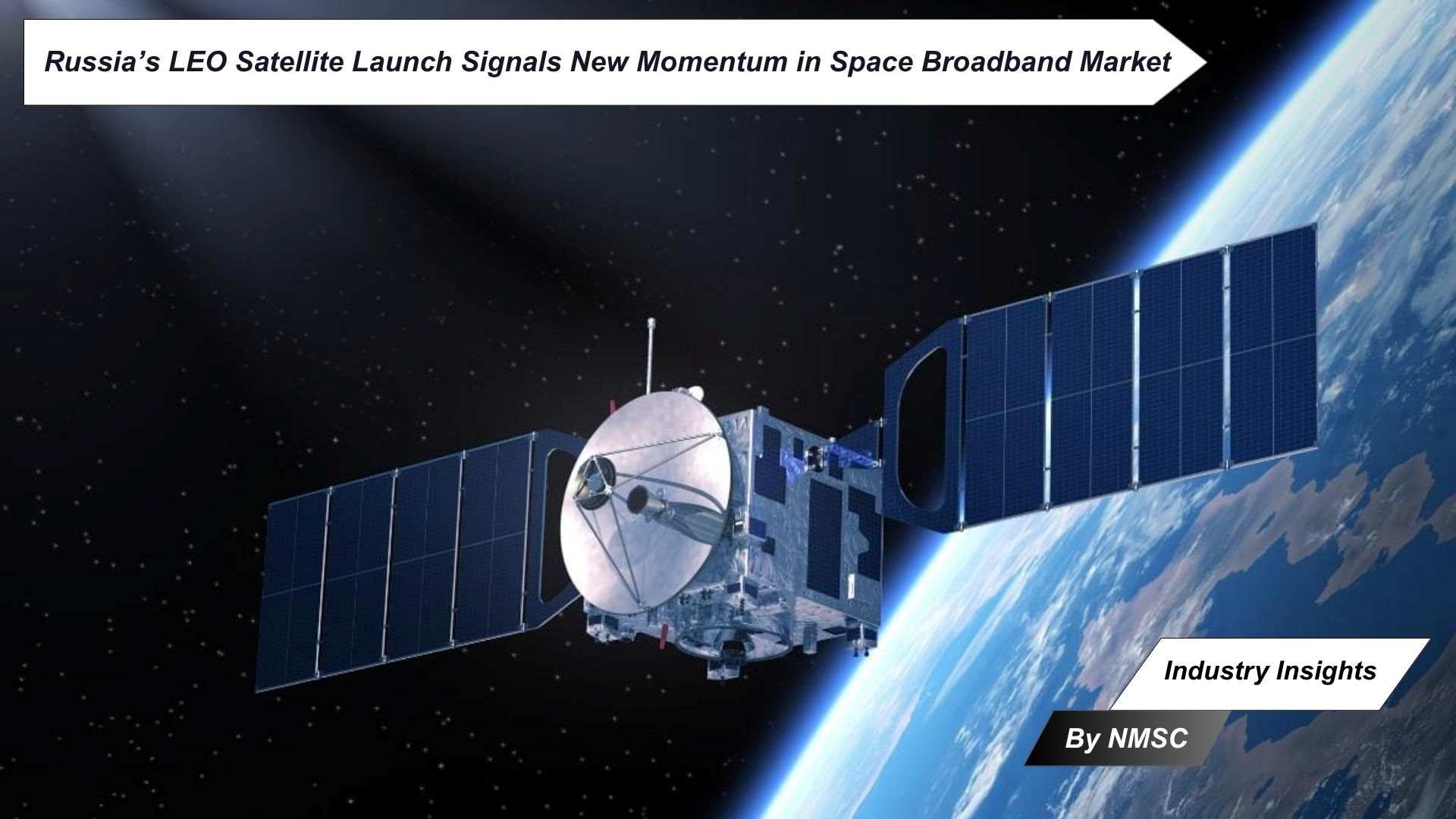
Russia’s LEO Satellite Launch Signals New Momentum in Space Broadband Market
Industry Insights from Next Move Strategy Consulting
As the global Low Earth Orbit (LEO) Satellites Market continues to evolve, Russia’s recent deployment of its first batch of broadband satellites marks a notable step toward expanding competition in space-based connectivity. With increasing reliance on satellite internet to bridge connectivity gaps and support critical communication during disruptions, this development highlights the growing strategic importance of LEO constellations worldwide.
Expanding Ambitions in Satellite Broadband
Russia has successfully launched an initial group of 16 LEO satellites, developed by Bureau 1440, as part of its broader effort to establish a presence in the global satellite broadband market. This move positions the country among emerging contenders aiming to challenge established players such as Starlink and Eutelsat OneWeb.
While the current scale remains relatively small compared to Starlink’s constellation of over 10,000 satellites operating across more than 100 countries, the launch represents the beginning of a larger planned deployment. The initiative reflects Russia’s intent to gradually build a competitive satellite network capable of delivering broadband services on a global scale.
Strengthening Connectivity in Critical Scenarios
LEO satellite systems are gaining traction due to their ability to deliver internet access in remote and underserved regions where traditional infrastructure is limited or unavailable. Beyond expanding digital access, these systems play a crucial role in maintaining communication during natural disasters, when terrestrial networks may be compromised.
In addition to civilian applications, such satellite networks are also being viewed as strategic assets for ensuring communication resilience during times of conflict. This dual-use capability is increasingly influencing how countries approach investments in space-based infrastructure.
Rising Competition in a Rapidly Evolving Market
The entry of new players like Bureau 1440 underscores intensifying competition within the LEO satellite ecosystem. Although Russia’s current deployment may not immediately rival the scale or global reach of existing operators, it signals a long-term commitment to capturing a share of the expanding broadband market.
At the same time, advancements by competitors—such as the development of direct-to-cell satellite services that enable connectivity without the need for ground-based equipment—are further accelerating innovation and redefining user expectations in the sector.
According to Next Move Strategy Consulting
According to Next Move Strategy Consulting, Russia’s initial LEO satellite deployment is expected to contribute to the increasing diversification of the global satellite broadband market. As more nations and companies invest in LEO constellations, the industry is likely to witness heightened competition, faster technological advancements, and broader accessibility of satellite-based internet services.
The growing emphasis on resilient communication infrastructure—particularly for remote connectivity, disaster response, and strategic operations—will continue to drive demand in the LEO satellites market, shaping its trajectory in the coming years.
Building the Future of Global Connectivity
Russia’s entry into the LEO satellite broadband space reflects a broader global shift toward space-driven communication solutions. As deployments scale and technologies evolve, the market is set to play a critical role in delivering reliable, high-speed connectivity across diverse and challenging environments.
With multiple players advancing their capabilities, the LEO satellite ecosystem is steadily moving toward a more competitive and innovation-driven future.
Source: Telecom Talk
Prepared By: Next Move Strategy Consulting
About the Author
 Sanyukta Deb
— Sanyukta Deb is Digital Marketing Team Lead at Next Move Strategy Consulting, where she has led content strategy and technical SEO for the firm's B2B market research publications for over 2 years. Her editorial process translates NextMSC's primary and secondary research — spanning technology, industrial, and consumer sectors — into commercial narratives, backed by search-intent, keyword, and competitive analysis. She brings 5 years of overall experience in digital marketing and content strategy.
Sanyukta Deb
— Sanyukta Deb is Digital Marketing Team Lead at Next Move Strategy Consulting, where she has led content strategy and technical SEO for the firm's B2B market research publications for over 2 years. Her editorial process translates NextMSC's primary and secondary research — spanning technology, industrial, and consumer sectors — into commercial narratives, backed by search-intent, keyword, and competitive analysis. She brings 5 years of overall experience in digital marketing and content strategy.
About the Reviewer
 Debashree Dey
— Debashree Dey is Assistant Manager at Next Move Strategy Consulting, where she supports cross-vertical market content and communications across diverse industries for 6 years. Her professional background includes senior content writing, communications, and published manuscript authorship, with experience developing audience-focused business narratives and maintaining clear, consistent messaging. Her role supports research-led content development and editorial quality across NextMSC publications.
Debashree Dey
— Debashree Dey is Assistant Manager at Next Move Strategy Consulting, where she supports cross-vertical market content and communications across diverse industries for 6 years. Her professional background includes senior content writing, communications, and published manuscript authorship, with experience developing audience-focused business narratives and maintaining clear, consistent messaging. Her role supports research-led content development and editorial quality across NextMSC publications.

















Add Comment